Archivero is in early access — your sources, PDFs and citations in one library.Request early access →
Archivero/guides/
APAMLAHarvardThesis writing
Subscribe
Archivero/guides/Request early access →

Guides

APA styleMLA styleHarvard referencingThesis writing

Compare

APA 6th vs 7thMLA 8th vs 9thHarvard vs APAThesis vs dissertation

Product

FeaturesEarly access

Resources

DocsCheat sheetsNewsletter

Company

ContactStatus ↗
© 2025–2026 Ernesto F. GonzálezGuidesDocsContactPrivacyTerms
Guides/Citations/Harvard Referencing Style

How to Reference a Book in Harvard Style

Harvard referencing formats for books, edited books, e-books, audiobooks, and book chapters — with in-text and reference list examples.

6 min readHarvard

On this page

1 of 19
The Basic FormatBook With One AuthorBook With Multiple AuthorsTwo AuthorsThree AuthorsFour or More AuthorsEdited Book (Editor as Author)Chapter in an Edited BookE-BookE-Book With a DOIE-Book Without Page NumbersE-Book From an Online Library or DatabaseAudiobookTranslated BookBook With No AuthorEdition Other Than the FirstClassic or Reprinted WorkSummary: Book Reference Formats at a GlanceWhat's Next?
All Harvard guides →

Books are one of the most common source types in academic writing — and one of the most straightforward to reference in Harvard style. Whether you're citing a single-author monograph, a chapter from an edited collection, or an e-book you downloaded to your tablet, the basic pattern stays the same. Learn it once, and every variation is just a small adjustment.

Let's start with the simplest case and work through every scenario you're likely to encounter.

The Basic Format

Every book reference follows this general structure:

Author (Year) Title. Edition (if not the first). Place of publication: Publisher.

Here's a complete example:

Walker, M. (2017) Why we sleep: the new science of sleep and dreams. London: Penguin Books.

What to notice:

  • Author's surname first, then initials
  • Year in parentheses
  • Title in italics, sentence case
  • Place of publication followed by a colon, then the publisher name
  • A full stop at the end

Note on place of publication:Some Harvard guides have dropped the place of publication (similar to APA 7th edition). If your institution's guide omits it, leave it out. This guide includes it as it's still the more common convention in UK Harvard guides.

Book With One Author

The baseline case — one person wrote the book, and you're citing the whole thing.

Reference list:

Gladwell, M. (2008) Outliers: the story of success. London: Allen Lane.

In-text citations:

Parenthetical:(Gladwell, 2008, p. 40)

Narrative:Gladwell (2008, p. 40) argues that success is not simply a matter of individual talent.

Include the page number when you're quoting directly or referring to a specific passage. For general paraphrases of an entire argument, the page number is optional but recommended.

Book With Multiple Authors

Two Authors

List both authors. Use "and" to connect them:

Reference list:

Kahneman, D. and Tversky, A. (2000) Choices, values, and frames. Cambridge: Cambridge University Press.

In-text citations:

Parenthetical:(Kahneman and Tversky, 2000)

Narrative:Kahneman and Tversky (2000) demonstrate that…

Note:Some Harvard guides use "&" instead of "and" — e.g., Kahneman, D. & Tversky, A. Check your institution's preference.

Three Authors

List all three authors in the reference list. In text, check whether your institution requires all three names on first use or allows et al. from the start:

Reference list:

Rahman, S., Torres, M. and Kim, J. (2021) Global health policy: challenges and responses. Bristol: Policy Press.

In-text citations:

If listing all on first use:(Rahman, Torres and Kim, 2021) → then (Rahman et al., 2021)

If using et al. from first use:(Rahman et al., 2021)

Four or More Authors

List all authors in the reference list. In the text, use et al. from the first citation:

Reference list:

Nguyen, H., Park, S., Li, W. and Fernandez, C. (2022) Urban sustainability: theory and practice. New York: Routledge.

In-text citations:

(Nguyen et al., 2022)

Nguyen et al. (2022) argue that…

For a comprehensive guide to multi-author citations, see Harvard Citation With Multiple Authors.

Edited Book (Editor as Author)

When you're referencing the book as a whole — rather than a specific chapter — and the book is a collection of works by different contributors, list the editor(s) as the author with "(ed.)" or "(eds.)":

Reference list:

Morris, T. (ed.) (2019) Digital education strategies. Oxford: Oxford University Press.

Patel, R. and Wong, L. (eds.) (2021) Contemporary issues in public health. London: Sage.

In-text citations:

(Morris, 2019)

Morris (2019) presents a collection of perspectives on…

Use (ed.) for one editor and (eds.) for two or more.

Chapter in an Edited Book

When you're citing a specific chapter written by one or more authors within an edited book, the format changes — you need to identify both the chapter and the book:

Author of chapter (Year) 'Chapter title', in Editor (ed.) Book title. Place: Publisher, pp. page range.

Reference list:

Lane, K. (2019) 'Cognitive load in online learning', in Morris, T. (ed.) Digital education strategies. Oxford: Oxford University Press, pp. 112–134.

In-text citations:

(Lane, 2019, p. 118)

Lane (2019, p. 118) argues that cognitive load theory applies directly to…

Notice: the chapter title is in single quotation marks (it's part of a larger work), the book title is in italics, and the page range for the entire chapter is given at the end.

E-Book

If you accessed the book electronically — Kindle, Google Books, an online library platform — the format depends on whether the e-book has a DOI or URL:

E-Book With a DOI

Reference list:

Crawford, K. (2021) Atlas of AI: power, politics, and the planetary costs of artificial intelligence. New Haven: Yale University Press. doi:10.12987/9780300252392.

In-text citations:

(Crawford, 2021, p. 56)

E-Book Without Page Numbers

Many e-books (especially Kindle editions) don't have fixed page numbers. Use chapter numbers, section headings, or location numbers instead:

(Crawford, 2021, ch. 3)

E-Book From an Online Library or Database

Reference list:

Sinek, S. (2014) Leaders eat last: why some teams pull together and others don't. Available at: https://www.overdrive.com/media/1588778 (Accessed: 5 March 2025).

Audiobook

If you listened to an audiobook, include the narrator and the format:

Reference list:

Obama, M. (2018) Becoming. Narrated by Michelle Obama. [Audiobook]. New York: Random House Audio.

In-text citations:

(Obama, 2018)

If you're referencing a specific passage, use a timestamp:

(Obama, 2018, 02:14:30)

Translated Book

Include the translator after the title:

Reference list:

Piketty, T. (2014) Capital in the twenty-first century. Translated by A. Goldhammer. Cambridge, MA: Harvard University Press.

In-text citations:

(Piketty, 2014, p. 237)

Book With No Author

If no author or editor is identified, begin the reference with the title:

Reference list:

The Oxford English dictionary (2023) 12th edn. Oxford: Oxford University Press.

In-text citations:

(The Oxford English dictionary, 2023)

For detailed guidance on no-author sources, see How to Cite a Source With No Author in Harvard.

Edition Other Than the First

If you're referencing a book that isn't the first edition, include the edition number after the title:

Reference list:

Creswell, J.W. (2018) Research design: qualitative, quantitative, and mixed methods approaches. 5th edn. London: Sage.

In-text citations:

(Creswell, 2018, p. 92)

Use "edn." (the standard abbreviation in UK English) or "ed." depending on your institution's preference. Only include the edition if it's not the first — omit it for first editions.

Classic or Reprinted Work

For classic works that have been republished, include both the original publication date and the version you used:

Reference list:

Austen, J. (1813/2003) Pride and prejudice. London: Penguin Classics.

In-text citations:

(Austen, 1813/2003, p. 1)

Some Harvard guides prefer to list only the edition you used, with the original date noted in the text:

Austen's Pride and Prejudice (originally published 1813; 2003 edition) opens with…

Check your institution's preference.

Summary: Book Reference Formats at a Glance

ScenarioReference List Format
One authorSurname, Initial(s). (Year) Title. Place: Publisher.
Two authorsSurname, Initial(s). and Surname, Initial(s). (Year) Title. Place: Publisher.
Three+ authorsSurname, Initial(s)., Surname, Initial(s). and Surname, Initial(s). (Year) Title. Place: Publisher.
Edited bookEditor (ed.) (Year) Title. Place: Publisher.
Book chapterAuthor (Year) 'Chapter title', in Editor (ed.) Title. Place: Publisher, pp. X–Y.
E-book with DOIAuthor (Year) Title. Place: Publisher. doi:xxxxx.
Translated bookAuthor (Year) Title. Translated by Initials. Surname. Place: Publisher.
Edition (not 1st)Author (Year) Title. Xth edn. Place: Publisher.

What's Next?

Now that you know how to reference books, explore these related guides:

  • How to Reference a Journal Article in Harvard Style — the other core academic source type
  • Harvard Citation With Multiple Authors — detailed rules for et al. and multi-author formatting
  • Harvard Reference List — the complete guide to formatting your reference list
All Harvard guides →
← PreviousHow to Reference a Website in Harvard StyleNext →How to Reference a Journal Article in Harvard Style

More on Harvard referencing

The dominant system in British, Australian and international universities. In-text citations, reference lists and the local conventions that vary by department.

View all 26 guides →
12 sections·6 min readHarvardHow to Reference a Journal Article in Harvard Style7 sections·7 min readHarvardHarvard Referencing Example Paper10 sections·8 min readHarvardHow to Use Direct Quotes in Harvard Referencing10 sections·7 min readHarvardHarvard Citation With Multiple Authors

Your sources, PDFs and citations in one library

  • Import a Zotero, Mendeley or EndNote library — or a folder of PDFs
  • Highlight and annotate without leaving the source
  • Cite in any CSL style as you write, with one shared library for your lab
Request early accessSee the product →
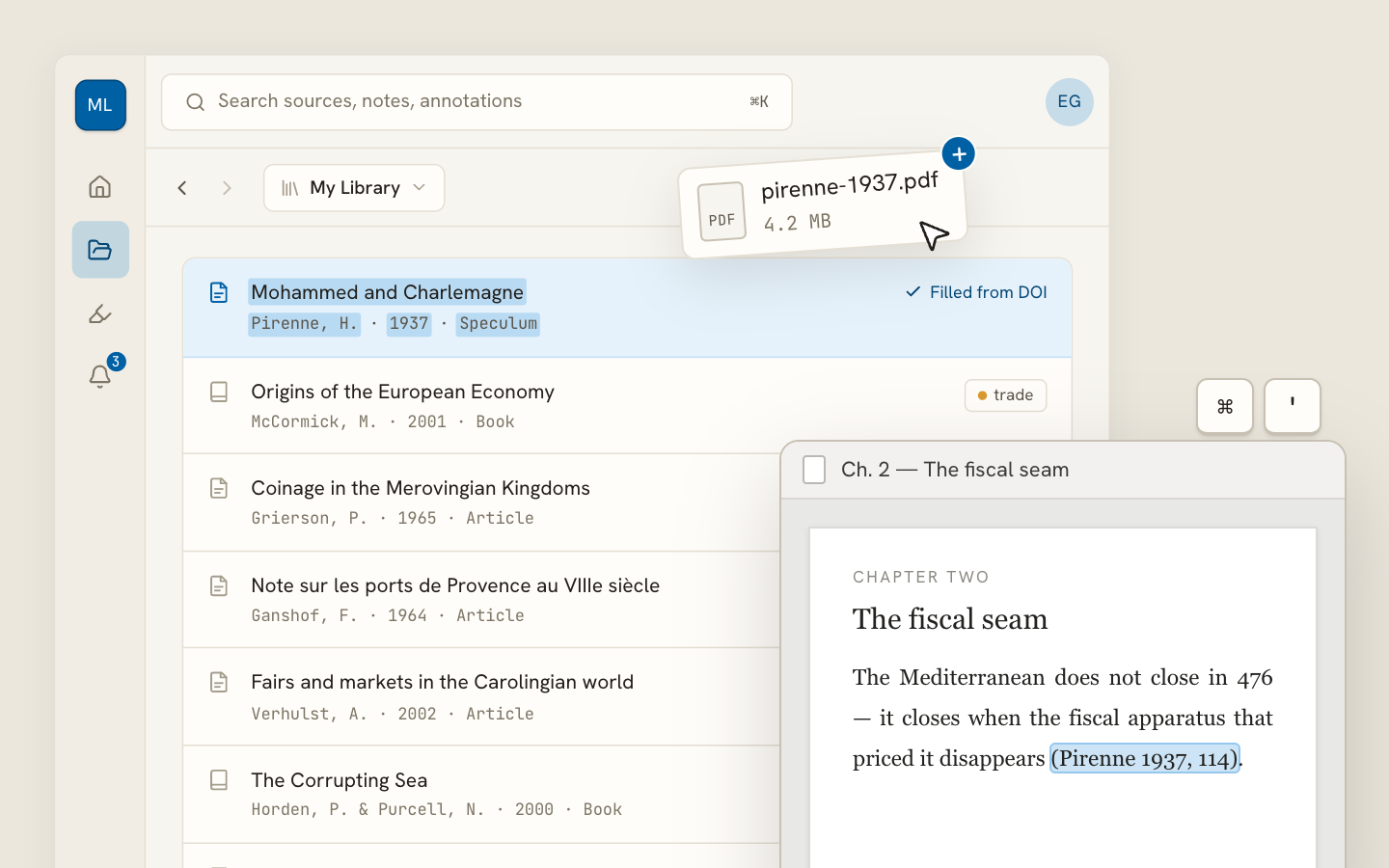
Archivero library view with a source list and an open PDF

Your weekly research workflow, in one email

One tested workflow, three links, no filler — every Tuesday.

Unsubscribe in one click. We never share your address.

Guides/Citations/Harvard Referencing Style

How to Reference a Book in Harvard Style

Harvard referencing formats for books, edited books, e-books, audiobooks, and book chapters — with in-text and reference list examples.

6 min readHarvard

On this page

1 of 19
The Basic FormatBook With One AuthorBook With Multiple AuthorsTwo AuthorsThree AuthorsFour or More AuthorsEdited Book (Editor as Author)Chapter in an Edited BookE-BookE-Book With a DOIE-Book Without Page NumbersE-Book From an Online Library or DatabaseAudiobookTranslated BookBook With No AuthorEdition Other Than the FirstClassic or Reprinted WorkSummary: Book Reference Formats at a GlanceWhat's Next?
All Harvard guides →

Books are one of the most common source types in academic writing — and one of the most straightforward to reference in Harvard style. Whether you're citing a single-author monograph, a chapter from an edited collection, or an e-book you downloaded to your tablet, the basic pattern stays the same. Learn it once, and every variation is just a small adjustment.

Let's start with the simplest case and work through every scenario you're likely to encounter.

The Basic Format

Every book reference follows this general structure:

Author (Year) Title. Edition (if not the first). Place of publication: Publisher.

Here's a complete example:

Walker, M. (2017) Why we sleep: the new science of sleep and dreams. London: Penguin Books.

What to notice:

  • Author's surname first, then initials
  • Year in parentheses
  • Title in italics, sentence case
  • Place of publication followed by a colon, then the publisher name
  • A full stop at the end

Note on place of publication:Some Harvard guides have dropped the place of publication (similar to APA 7th edition). If your institution's guide omits it, leave it out. This guide includes it as it's still the more common convention in UK Harvard guides.

Book With One Author

The baseline case — one person wrote the book, and you're citing the whole thing.

Reference list:

Gladwell, M. (2008) Outliers: the story of success. London: Allen Lane.

In-text citations:

Parenthetical:(Gladwell, 2008, p. 40)

Narrative:Gladwell (2008, p. 40) argues that success is not simply a matter of individual talent.

Include the page number when you're quoting directly or referring to a specific passage. For general paraphrases of an entire argument, the page number is optional but recommended.

Book With Multiple Authors

Two Authors

List both authors. Use "and" to connect them:

Reference list:

Kahneman, D. and Tversky, A. (2000) Choices, values, and frames. Cambridge: Cambridge University Press.

In-text citations:

Parenthetical:(Kahneman and Tversky, 2000)

Narrative:Kahneman and Tversky (2000) demonstrate that…

Note:Some Harvard guides use "&" instead of "and" — e.g., Kahneman, D. & Tversky, A. Check your institution's preference.

Three Authors

List all three authors in the reference list. In text, check whether your institution requires all three names on first use or allows et al. from the start:

Reference list:

Rahman, S., Torres, M. and Kim, J. (2021) Global health policy: challenges and responses. Bristol: Policy Press.

In-text citations:

If listing all on first use:(Rahman, Torres and Kim, 2021) → then (Rahman et al., 2021)

If using et al. from first use:(Rahman et al., 2021)

Four or More Authors

List all authors in the reference list. In the text, use et al. from the first citation:

Reference list:

Nguyen, H., Park, S., Li, W. and Fernandez, C. (2022) Urban sustainability: theory and practice. New York: Routledge.

In-text citations:

(Nguyen et al., 2022)

Nguyen et al. (2022) argue that…

For a comprehensive guide to multi-author citations, see Harvard Citation With Multiple Authors.

Edited Book (Editor as Author)

When you're referencing the book as a whole — rather than a specific chapter — and the book is a collection of works by different contributors, list the editor(s) as the author with "(ed.)" or "(eds.)":

Reference list:

Morris, T. (ed.) (2019) Digital education strategies. Oxford: Oxford University Press.

Patel, R. and Wong, L. (eds.) (2021) Contemporary issues in public health. London: Sage.

In-text citations:

(Morris, 2019)

Morris (2019) presents a collection of perspectives on…

Use (ed.) for one editor and (eds.) for two or more.

Chapter in an Edited Book

When you're citing a specific chapter written by one or more authors within an edited book, the format changes — you need to identify both the chapter and the book:

Author of chapter (Year) 'Chapter title', in Editor (ed.) Book title. Place: Publisher, pp. page range.

Reference list:

Lane, K. (2019) 'Cognitive load in online learning', in Morris, T. (ed.) Digital education strategies. Oxford: Oxford University Press, pp. 112–134.

In-text citations:

(Lane, 2019, p. 118)

Lane (2019, p. 118) argues that cognitive load theory applies directly to…

Notice: the chapter title is in single quotation marks (it's part of a larger work), the book title is in italics, and the page range for the entire chapter is given at the end.

E-Book

If you accessed the book electronically — Kindle, Google Books, an online library platform — the format depends on whether the e-book has a DOI or URL:

E-Book With a DOI

Reference list:

Crawford, K. (2021) Atlas of AI: power, politics, and the planetary costs of artificial intelligence. New Haven: Yale University Press. doi:10.12987/9780300252392.

In-text citations:

(Crawford, 2021, p. 56)

E-Book Without Page Numbers

Many e-books (especially Kindle editions) don't have fixed page numbers. Use chapter numbers, section headings, or location numbers instead:

(Crawford, 2021, ch. 3)

E-Book From an Online Library or Database

Reference list:

Sinek, S. (2014) Leaders eat last: why some teams pull together and others don't. Available at: https://www.overdrive.com/media/1588778 (Accessed: 5 March 2025).

Audiobook

If you listened to an audiobook, include the narrator and the format:

Reference list:

Obama, M. (2018) Becoming. Narrated by Michelle Obama. [Audiobook]. New York: Random House Audio.

In-text citations:

(Obama, 2018)

If you're referencing a specific passage, use a timestamp:

(Obama, 2018, 02:14:30)

Translated Book

Include the translator after the title:

Reference list:

Piketty, T. (2014) Capital in the twenty-first century. Translated by A. Goldhammer. Cambridge, MA: Harvard University Press.

In-text citations:

(Piketty, 2014, p. 237)

Book With No Author

If no author or editor is identified, begin the reference with the title:

Reference list:

The Oxford English dictionary (2023) 12th edn. Oxford: Oxford University Press.

In-text citations:

(The Oxford English dictionary, 2023)

For detailed guidance on no-author sources, see How to Cite a Source With No Author in Harvard.

Edition Other Than the First

If you're referencing a book that isn't the first edition, include the edition number after the title:

Reference list:

Creswell, J.W. (2018) Research design: qualitative, quantitative, and mixed methods approaches. 5th edn. London: Sage.

In-text citations:

(Creswell, 2018, p. 92)

Use "edn." (the standard abbreviation in UK English) or "ed." depending on your institution's preference. Only include the edition if it's not the first — omit it for first editions.

Classic or Reprinted Work

For classic works that have been republished, include both the original publication date and the version you used:

Reference list:

Austen, J. (1813/2003) Pride and prejudice. London: Penguin Classics.

In-text citations:

(Austen, 1813/2003, p. 1)

Some Harvard guides prefer to list only the edition you used, with the original date noted in the text:

Austen's Pride and Prejudice (originally published 1813; 2003 edition) opens with…

Check your institution's preference.

Summary: Book Reference Formats at a Glance

ScenarioReference List Format
One authorSurname, Initial(s). (Year) Title. Place: Publisher.
Two authorsSurname, Initial(s). and Surname, Initial(s). (Year) Title. Place: Publisher.
Three+ authorsSurname, Initial(s)., Surname, Initial(s). and Surname, Initial(s). (Year) Title. Place: Publisher.
Edited bookEditor (ed.) (Year) Title. Place: Publisher.
Book chapterAuthor (Year) 'Chapter title', in Editor (ed.) Title. Place: Publisher, pp. X–Y.
E-book with DOIAuthor (Year) Title. Place: Publisher. doi:xxxxx.
Translated bookAuthor (Year) Title. Translated by Initials. Surname. Place: Publisher.
Edition (not 1st)Author (Year) Title. Xth edn. Place: Publisher.

What's Next?

Now that you know how to reference books, explore these related guides:

  • How to Reference a Journal Article in Harvard Style — the other core academic source type
  • Harvard Citation With Multiple Authors — detailed rules for et al. and multi-author formatting
  • Harvard Reference List — the complete guide to formatting your reference list
All Harvard guides →
← PreviousHow to Reference a Website in Harvard StyleNext →How to Reference a Journal Article in Harvard Style

More on Harvard referencing

The dominant system in British, Australian and international universities. In-text citations, reference lists and the local conventions that vary by department.

View all 26 guides →
12 sections·6 min readHarvardHow to Reference a Journal Article in Harvard Style7 sections·7 min readHarvardHarvard Referencing Example Paper10 sections·8 min readHarvardHow to Use Direct Quotes in Harvard Referencing10 sections·7 min readHarvardHarvard Citation With Multiple Authors

Your sources, PDFs and citations in one library

  • Import a Zotero, Mendeley or EndNote library — or a folder of PDFs
  • Highlight and annotate without leaving the source
  • Cite in any CSL style as you write, with one shared library for your lab
Request early accessSee the product →
Archivero library view with a source list and an open PDF

Your weekly research workflow, in one email

One tested workflow, three links, no filler — every Tuesday.

Unsubscribe in one click. We never share your address.