Archivero is in early access — your sources, PDFs and citations in one library.Request early access →
Archivero/guides/
APAMLAHarvardThesis writing
Subscribe
Archivero/guides/Request early access →

Guides

APA styleMLA styleHarvard referencingThesis writing

Compare

APA 6th vs 7thMLA 8th vs 9thHarvard vs APAThesis vs dissertation

Product

FeaturesEarly access

Resources

DocsCheat sheetsNewsletter

Company

ContactStatus ↗
© 2025–2026 Ernesto F. GonzálezGuidesDocsContactPrivacyTerms
Guides/Citations/APA Citation Style

APA 6th vs. 7th Edition — What Changed

A detailed comparison of every major change between APA 6th edition and 7th edition, so you know exactly what to update.

8 min readAPA

On this page

1 of 21
Why a New Edition?Title Page ChangesFont FlexibilityAuthor Listing ChangesReference List: Up to 20 AuthorsIn-Text Citations: Simplified et al. RuleDOI Format Change"Retrieved from" RemovalBias-Free Language ExpansionIn-Text Citation ChangesShortened Quotations From Sources Without Page NumbersSame Author, Same YearNew Source TypesSide-by-Side Reference ExamplesJournal ArticleBookWebsiteMultiple Authors (8+ authors)Other Notable ChangesQuick Summary of What ChangedWhat's Next
All APA guides →

The 7th edition of the APA Publication Manual arrived in October 2019, and it brought some welcome changes. If you learned APA formatting under the 6th edition — or if you're updating an older paper — this page covers every significant difference so you know exactly what to change.

The short version: the 7th edition is simpler and more flexible. Many of the fussier rules were relaxed, and new guidance was added for modern source types that didn't exist when the 6th edition was published in 2009.

Why a New Edition?

The 6th edition was published in 2009. Since then, the landscape of academic writing and publishing has changed dramatically:

  • Digital sources became the norm rather than the exception
  • Social media emerged as a citable source
  • AI-generated content didn't exist yet
  • Bias-free language guidelines needed significant expansion
  • Student papers needed distinct formatting rules from professional manuscripts

The 7th edition addressed all of these gaps while also simplifying rules that had caused chronic confusion among writers.

Title Page Changes

This is one of the most visible changes. The 7th edition introduced two distinct title page formats — one for students, one for professionals.

Element6th Edition7th Edition (Student)7th Edition (Professional)
Running head6th EditionRequired, with "Running head:" label on title page7th Edition (Student)Not required7th Edition (Professional)Required, no "Running head:" label
Course info6th EditionNot specified7th Edition (Student)Required (course name, instructor, due date)7th Edition (Professional)Not included
Author note6th EditionOptional7th Edition (Student)Not included7th Edition (Professional)Required
Bold title6th EditionNot specified7th Edition (Student)Yes7th Edition (Professional)Yes

The biggest change: Students no longer need a running head. The old format required every paper — even a 5-page essay — to include "Running head: SHORTENED TITLE" in the header. The 7th edition eliminated this for student papers entirely.

For full details, see APA Title Page Format.

Font Flexibility

The 6th edition essentially required Times New Roman 12 pt — it was the only font mentioned in the manual.

The 7th edition expanded this to several options:

FontSize
Times New Roman12 pt
Calibri11 pt
Arial11 pt
Lucida Sans Unicode10 pt
Georgia11 pt

You can use any of these — just be consistent throughout your paper. This was a welcome change for anyone who found 12-point Times New Roman cramped or hard to read on screen.

Author Listing Changes

Reference List: Up to 20 Authors

Rule6th Edition7th Edition
Max authors before ellipsis6th Edition7 (list first 6 … last)7th Edition20 (list first 19 … last)

In the 6th edition, if a source had more than 7 authors, you listed the first six, added an ellipsis, and then the last author. The 7th edition expanded this to 20 — you now spell out up to 20 author names before using the ellipsis.

6th edition format (8+ authors):

Garcia, M. L., Lee, J., Park, S., Nakamura, K., Torres, R., Chen, W., … Zimmerman, T. (2022).

7th edition format (21+ authors):

Garcia, M. L., Lee, J., Park, S., Nakamura, K., Torres, R., Chen, W., Rivera, K., Osei, A., Kim, D., Thompson, L., Patel, R., Johnson, M., Davis, C., Brown, A., Wilson, E., Taylor, J., Anderson, S., Thomas, N., Jackson, P., … Zimmerman, T. (2022).

In-Text Citations: Simplified et al. Rule

Rule6th Edition7th Edition
3–5 authors, first citation6th EditionList all authors7th Editionet al. from the first citation
3–5 authors, subsequent6th Editionet al.7th Editionet al.
6+ authors6th Editionet al. from first7th Editionet al. from first

The 6th edition made you list all authors (up to five) the first time you cited a work, then switch to et al. The 7th edition collapsed this into one simple rule: three or more authors = et al. every time, including the first citation.

This is one of the changes that saves the most time. For the full guide, see APA Citation With Multiple Authors.

DOI Format Change

The DOI format was standardized in the 7th edition. Instead of multiple acceptable formats, there's now one:

FormatEdition
doi:10.1037/dev00011486th edition (acceptable)
DOI: 10.1037/dev00011486th edition (acceptable)
http://dx.doi.org/10.1037/dev00011486th edition (acceptable)
https://doi.org/10.1037/dev00011487th edition (required)

The 7th edition requires DOIs to be formatted as full HTTPS URLs using the https://doi.org/ prefix. This makes them clickable links, which is better for digital reading.

6th edition:

Garcia, M. L. (2022). Title of article. Journal Name, 57(3), 412–425. doi:10.1037/dev0001148

7th edition:

Garcia, M. L. (2022). Title of article. Journal Name, 57(3), 412–425. https://doi.org/10.1037/dev0001148

"Retrieved from" Removal

The 6th edition required "Retrieved from" before URLs for most online sources:

6th edition:Retrieved from https://www.example.com/article

The 7th edition dropped this for most sources. Now, you simply place the URL at the end:

7th edition:https://www.example.com/article

When you still use a retrieval date: Only for sources whose content is designed to change over time and has no archived version — like Wikipedia articles, social media profiles, and live data dashboards. In those cases, format it as:

Retrieved February 15, 2026, from https://en.wikipedia.org/wiki/Example

For more details, see How to Cite a Website in APA Format.

Bias-Free Language Expansion

The 7th edition significantly expanded its guidance on inclusive, bias-free language. Key additions include:

Topic6th Edition7th Edition
Singular "they"6th EditionNot addressed7th EditionEndorsed for referring to people whose gender is unknown or who use "they/them" pronouns
Racial/ethnic terms6th EditionBrief guidance7th EditionExpanded — capitalize racial and ethnic group names (Black, White, Indigenous)
Age terms6th EditionBrief guidance7th EditionExpanded — use specific terms like "older adults" rather than "elderly"
Disability language6th EditionMentioned7th EditionExpanded — preference for person-first ("person with a disability") with acknowledgment that some communities prefer identity-first ("autistic person")
Gender language6th EditionBinary framing7th EditionExpanded to include nonbinary and gender-diverse identities

This isn't a formatting rule per se, but it affects how you write. The 7th edition makes clear that bias-free language isn't just a style preference — it's a requirement for APA-compliant writing.

In-Text Citation Changes

Beyond the et al. simplification, a few other in-text citation rules changed:

Shortened Quotations From Sources Without Page Numbers

Both editions require locators for direct quotes. The 7th edition provides clearer guidance on what to use when there are no page numbers:

(Martinez, 2024, para. 4)

(Khan Academy, 2022, 4:32)

(Chen, 2021, "Results" section, para. 2)

Same Author, Same Year

The rule for disambiguating works by the same author published in the same year didn't change — you still use lowercase letters (2022a, 2022b) — but the 7th edition clarified that the letters are assigned based on the alphabetical order of the titles.

New Source Types

The 6th edition was published before many modern content types became common in academic work. The 7th edition added specific guidance for:

  • Social media posts (Twitter/X, Instagram, Facebook, Reddit)
  • YouTube videos and other streaming content
  • Podcast episodes
  • Apps and software
  • TED Talks
  • AI-generated content (added via a 2023 update to the 7th edition's website)

For each of these, APA now specifies author format, date format, title conventions, and description brackets (like [Video], [Tweet], [Audio podcast episode]).

Side-by-Side Reference Examples
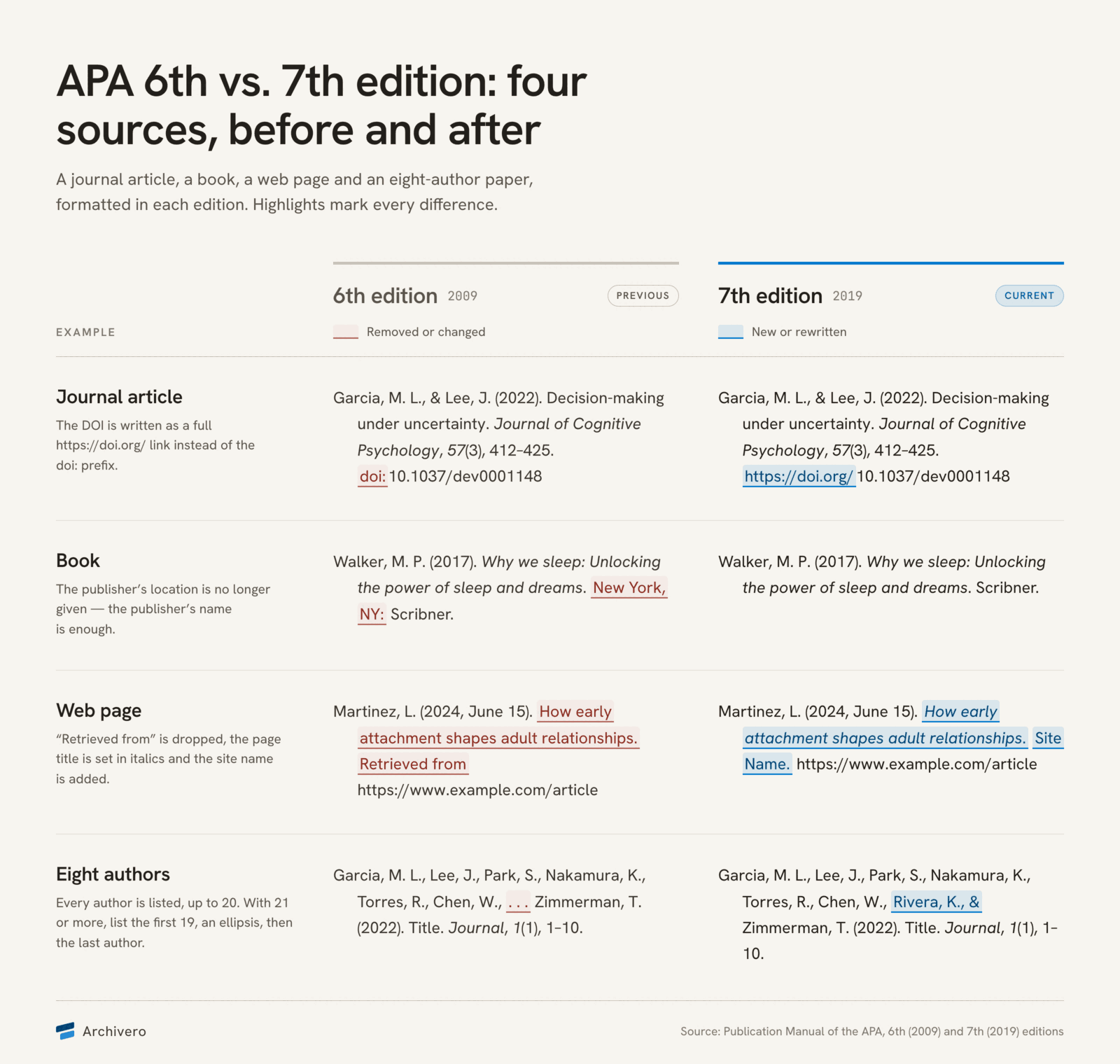
The same four sources — a journal article, a book, a web page and an eight-author paper — set in APA 6th edition on the left and 7th edition on the right, with every difference highlighted.

Here's how the same sources look under each edition:

Journal Article

6th edition:

Garcia, M. L., & Lee, J. (2022). Decision-making under uncertainty. Journal of Cognitive Psychology, 57(3), 412–425. doi:10.1037/dev0001148

7th edition:

Garcia, M. L., & Lee, J. (2022). Decision-making under uncertainty. Journal of Cognitive Psychology, 57(3), 412–425. https://doi.org/10.1037/dev0001148

Change: DOI format updated to HTTPS URL.

Book

6th edition:

Walker, M. P. (2017). Why we sleep: Unlocking the power of sleep and dreams. New York, NY: Scribner.

7th edition:

Walker, M. P. (2017). Why we sleep: Unlocking the power of sleep and dreams. Scribner.

Change: Publisher location (city, state) is no longer included. Just the publisher name.

Website

6th edition:

Martinez, L. (2024, June 15). How early attachment shapes adult relationships. Retrieved from https://www.example.com/article

7th edition:

Martinez, L. (2024, June 15). How early attachment shapes adult relationships. Site Name. https://www.example.com/article

Changes: "Retrieved from" removed. Web page title is now italicized. Site name added as a separate element.

Multiple Authors (8+ authors)

6th edition (list first 6 … last):

Garcia, M. L., Lee, J., Park, S., Nakamura, K., Torres, R., Chen, W., … Zimmerman, T. (2022). Title. Journal, 1(1), 1–10.

7th edition (list all up to 20):

Garcia, M. L., Lee, J., Park, S., Nakamura, K., Torres, R., Chen, W., Rivera, K., & Zimmerman, T. (2022). Title. Journal, 1(1), 1–10.

Change: All 8 authors are now listed (since it's under 21).

Other Notable Changes

A few more differences worth knowing:

Change6th Edition7th Edition
Publisher location6th EditionRequired (City, State: Publisher)7th EditionRemoved — just the publisher name
"Running head:" label6th EditionRequired on title page7th EditionRemoved
Heading Level 3 format6th EditionIndented, bold, ending with a period7th EditionFlush left, bold, not ending with a period
Tables and figures6th EditionDifferent formats for table notes and figure captions7th EditionUnified format — both now use number, title, body, and notes
Appendix labels6th EditionAppendix A, B, C7th EditionSame, but each appendix starts on a new page (clarified)

Quick Summary of What Changed

If you just need the highlights:

  1. Two title page formats — student (no running head) and professional
  2. More fonts allowed — not just Times New Roman anymore
  3. et al. from the first citation for 3+ authors (no more listing all authors first)
  4. Up to 20 authors in the reference list (was 7)
  5. DOIs as HTTPS links — https://doi.org/…
  6. No more "Retrieved from" for most sources
  7. No more publisher location — drop the city and state
  8. Bias-free language guidelines significantly expanded
  9. New source types — social media, videos, podcasts, AI
  10. Singular "they" endorsed

What's Next

Now that you understand the differences, explore these guides for specific 7th-edition formatting topics:

  • APA General Format — the complete guide to page layout and paper structure
  • APA Citation With Multiple Authors — the simplified et al. rule in detail
  • APA Reference List — how to format your reference entries under the 7th edition

If you're updating a paper from the 6th to the 7th edition, Archivero formats everything according to the latest APA 7th edition rules automatically — DOI format, author listings, title case, and all.
All APA guides →
← PreviousAPA Annotated BibliographyNext →Common APA Format Mistakes (and How to Fix Them)

More on APA style

The standard in psychology, education and the social sciences. The author–date system, reference-list formatting and what the 7th edition changed.

View all 34 guides →
6 sections·8 min readAPACommon APA Format Mistakes (and How to Fix Them)8 sections·5 min readAPAHow to Cite a Chart or Graph in APA Format7 sections·5 min readAPAHow to Cite a Drawing or Illustration in APA Format11 sections·5 min readAPAHow to Format Figures in APA

Your sources, PDFs and citations in one library

  • Import a Zotero, Mendeley or EndNote library — or a folder of PDFs
  • Highlight and annotate without leaving the source
  • Cite in any CSL style as you write, with one shared library for your lab
Request early accessSee the product →
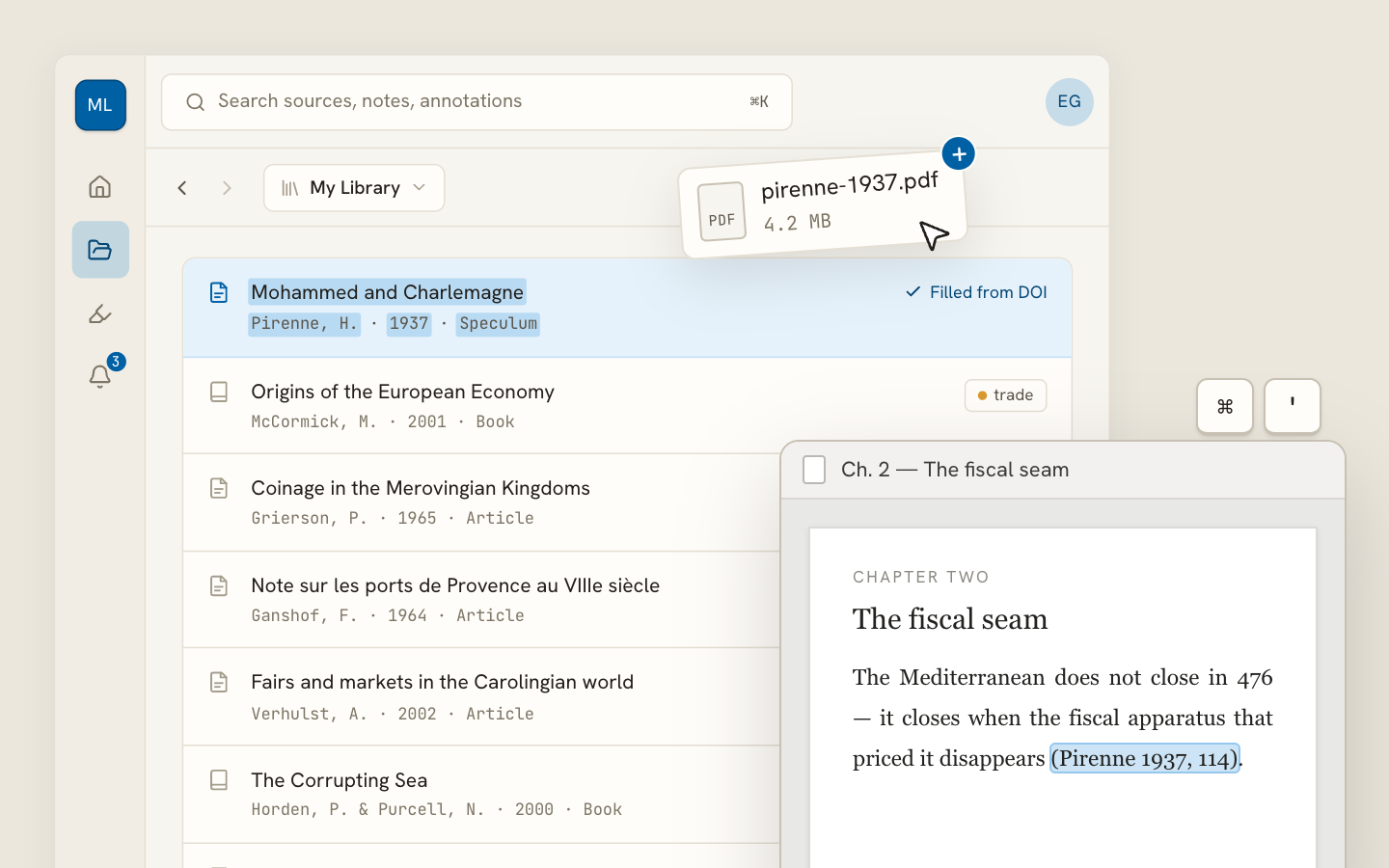
Archivero library view with a source list and an open PDF

Your weekly research workflow, in one email

One tested workflow, three links, no filler — every Tuesday.

Unsubscribe in one click. We never share your address.

Guides/Citations/APA Citation Style

APA 6th vs. 7th Edition — What Changed

A detailed comparison of every major change between APA 6th edition and 7th edition, so you know exactly what to update.

8 min readAPA

On this page

1 of 21
Why a New Edition?Title Page ChangesFont FlexibilityAuthor Listing ChangesReference List: Up to 20 AuthorsIn-Text Citations: Simplified et al. RuleDOI Format Change"Retrieved from" RemovalBias-Free Language ExpansionIn-Text Citation ChangesShortened Quotations From Sources Without Page NumbersSame Author, Same YearNew Source TypesSide-by-Side Reference ExamplesJournal ArticleBookWebsiteMultiple Authors (8+ authors)Other Notable ChangesQuick Summary of What ChangedWhat's Next
All APA guides →

The 7th edition of the APA Publication Manual arrived in October 2019, and it brought some welcome changes. If you learned APA formatting under the 6th edition — or if you're updating an older paper — this page covers every significant difference so you know exactly what to change.

The short version: the 7th edition is simpler and more flexible. Many of the fussier rules were relaxed, and new guidance was added for modern source types that didn't exist when the 6th edition was published in 2009.

Why a New Edition?

The 6th edition was published in 2009. Since then, the landscape of academic writing and publishing has changed dramatically:

  • Digital sources became the norm rather than the exception
  • Social media emerged as a citable source
  • AI-generated content didn't exist yet
  • Bias-free language guidelines needed significant expansion
  • Student papers needed distinct formatting rules from professional manuscripts

The 7th edition addressed all of these gaps while also simplifying rules that had caused chronic confusion among writers.

Title Page Changes

This is one of the most visible changes. The 7th edition introduced two distinct title page formats — one for students, one for professionals.

Element6th Edition7th Edition (Student)7th Edition (Professional)
Running head6th EditionRequired, with "Running head:" label on title page7th Edition (Student)Not required7th Edition (Professional)Required, no "Running head:" label
Course info6th EditionNot specified7th Edition (Student)Required (course name, instructor, due date)7th Edition (Professional)Not included
Author note6th EditionOptional7th Edition (Student)Not included7th Edition (Professional)Required
Bold title6th EditionNot specified7th Edition (Student)Yes7th Edition (Professional)Yes

The biggest change: Students no longer need a running head. The old format required every paper — even a 5-page essay — to include "Running head: SHORTENED TITLE" in the header. The 7th edition eliminated this for student papers entirely.

For full details, see APA Title Page Format.

Font Flexibility

The 6th edition essentially required Times New Roman 12 pt — it was the only font mentioned in the manual.

The 7th edition expanded this to several options:

FontSize
Times New Roman12 pt
Calibri11 pt
Arial11 pt
Lucida Sans Unicode10 pt
Georgia11 pt

You can use any of these — just be consistent throughout your paper. This was a welcome change for anyone who found 12-point Times New Roman cramped or hard to read on screen.

Author Listing Changes

Reference List: Up to 20 Authors

Rule6th Edition7th Edition
Max authors before ellipsis6th Edition7 (list first 6 … last)7th Edition20 (list first 19 … last)

In the 6th edition, if a source had more than 7 authors, you listed the first six, added an ellipsis, and then the last author. The 7th edition expanded this to 20 — you now spell out up to 20 author names before using the ellipsis.

6th edition format (8+ authors):

Garcia, M. L., Lee, J., Park, S., Nakamura, K., Torres, R., Chen, W., … Zimmerman, T. (2022).

7th edition format (21+ authors):

Garcia, M. L., Lee, J., Park, S., Nakamura, K., Torres, R., Chen, W., Rivera, K., Osei, A., Kim, D., Thompson, L., Patel, R., Johnson, M., Davis, C., Brown, A., Wilson, E., Taylor, J., Anderson, S., Thomas, N., Jackson, P., … Zimmerman, T. (2022).

In-Text Citations: Simplified et al. Rule

Rule6th Edition7th Edition
3–5 authors, first citation6th EditionList all authors7th Editionet al. from the first citation
3–5 authors, subsequent6th Editionet al.7th Editionet al.
6+ authors6th Editionet al. from first7th Editionet al. from first

The 6th edition made you list all authors (up to five) the first time you cited a work, then switch to et al. The 7th edition collapsed this into one simple rule: three or more authors = et al. every time, including the first citation.

This is one of the changes that saves the most time. For the full guide, see APA Citation With Multiple Authors.

DOI Format Change

The DOI format was standardized in the 7th edition. Instead of multiple acceptable formats, there's now one:

FormatEdition
doi:10.1037/dev00011486th edition (acceptable)
DOI: 10.1037/dev00011486th edition (acceptable)
http://dx.doi.org/10.1037/dev00011486th edition (acceptable)
https://doi.org/10.1037/dev00011487th edition (required)

The 7th edition requires DOIs to be formatted as full HTTPS URLs using the https://doi.org/ prefix. This makes them clickable links, which is better for digital reading.

6th edition:

Garcia, M. L. (2022). Title of article. Journal Name, 57(3), 412–425. doi:10.1037/dev0001148

7th edition:

Garcia, M. L. (2022). Title of article. Journal Name, 57(3), 412–425. https://doi.org/10.1037/dev0001148

"Retrieved from" Removal

The 6th edition required "Retrieved from" before URLs for most online sources:

6th edition:Retrieved from https://www.example.com/article

The 7th edition dropped this for most sources. Now, you simply place the URL at the end:

7th edition:https://www.example.com/article

When you still use a retrieval date: Only for sources whose content is designed to change over time and has no archived version — like Wikipedia articles, social media profiles, and live data dashboards. In those cases, format it as:

Retrieved February 15, 2026, from https://en.wikipedia.org/wiki/Example

For more details, see How to Cite a Website in APA Format.

Bias-Free Language Expansion

The 7th edition significantly expanded its guidance on inclusive, bias-free language. Key additions include:

Topic6th Edition7th Edition
Singular "they"6th EditionNot addressed7th EditionEndorsed for referring to people whose gender is unknown or who use "they/them" pronouns
Racial/ethnic terms6th EditionBrief guidance7th EditionExpanded — capitalize racial and ethnic group names (Black, White, Indigenous)
Age terms6th EditionBrief guidance7th EditionExpanded — use specific terms like "older adults" rather than "elderly"
Disability language6th EditionMentioned7th EditionExpanded — preference for person-first ("person with a disability") with acknowledgment that some communities prefer identity-first ("autistic person")
Gender language6th EditionBinary framing7th EditionExpanded to include nonbinary and gender-diverse identities

This isn't a formatting rule per se, but it affects how you write. The 7th edition makes clear that bias-free language isn't just a style preference — it's a requirement for APA-compliant writing.

In-Text Citation Changes

Beyond the et al. simplification, a few other in-text citation rules changed:

Shortened Quotations From Sources Without Page Numbers

Both editions require locators for direct quotes. The 7th edition provides clearer guidance on what to use when there are no page numbers:

(Martinez, 2024, para. 4)

(Khan Academy, 2022, 4:32)

(Chen, 2021, "Results" section, para. 2)

Same Author, Same Year

The rule for disambiguating works by the same author published in the same year didn't change — you still use lowercase letters (2022a, 2022b) — but the 7th edition clarified that the letters are assigned based on the alphabetical order of the titles.

New Source Types

The 6th edition was published before many modern content types became common in academic work. The 7th edition added specific guidance for:

  • Social media posts (Twitter/X, Instagram, Facebook, Reddit)
  • YouTube videos and other streaming content
  • Podcast episodes
  • Apps and software
  • TED Talks
  • AI-generated content (added via a 2023 update to the 7th edition's website)

For each of these, APA now specifies author format, date format, title conventions, and description brackets (like [Video], [Tweet], [Audio podcast episode]).

Side-by-Side Reference Examples

The same four sources — a journal article, a book, a web page and an eight-author paper — set in APA 6th edition on the left and 7th edition on the right, with every difference highlighted.

Here's how the same sources look under each edition:

Journal Article

6th edition:

Garcia, M. L., & Lee, J. (2022). Decision-making under uncertainty. Journal of Cognitive Psychology, 57(3), 412–425. doi:10.1037/dev0001148

7th edition:

Garcia, M. L., & Lee, J. (2022). Decision-making under uncertainty. Journal of Cognitive Psychology, 57(3), 412–425. https://doi.org/10.1037/dev0001148

Change: DOI format updated to HTTPS URL.

Book

6th edition:

Walker, M. P. (2017). Why we sleep: Unlocking the power of sleep and dreams. New York, NY: Scribner.

7th edition:

Walker, M. P. (2017). Why we sleep: Unlocking the power of sleep and dreams. Scribner.

Change: Publisher location (city, state) is no longer included. Just the publisher name.

Website

6th edition:

Martinez, L. (2024, June 15). How early attachment shapes adult relationships. Retrieved from https://www.example.com/article

7th edition:

Martinez, L. (2024, June 15). How early attachment shapes adult relationships. Site Name. https://www.example.com/article

Changes: "Retrieved from" removed. Web page title is now italicized. Site name added as a separate element.

Multiple Authors (8+ authors)

6th edition (list first 6 … last):

Garcia, M. L., Lee, J., Park, S., Nakamura, K., Torres, R., Chen, W., … Zimmerman, T. (2022). Title. Journal, 1(1), 1–10.

7th edition (list all up to 20):

Garcia, M. L., Lee, J., Park, S., Nakamura, K., Torres, R., Chen, W., Rivera, K., & Zimmerman, T. (2022). Title. Journal, 1(1), 1–10.

Change: All 8 authors are now listed (since it's under 21).

Other Notable Changes

A few more differences worth knowing:

Change6th Edition7th Edition
Publisher location6th EditionRequired (City, State: Publisher)7th EditionRemoved — just the publisher name
"Running head:" label6th EditionRequired on title page7th EditionRemoved
Heading Level 3 format6th EditionIndented, bold, ending with a period7th EditionFlush left, bold, not ending with a period
Tables and figures6th EditionDifferent formats for table notes and figure captions7th EditionUnified format — both now use number, title, body, and notes
Appendix labels6th EditionAppendix A, B, C7th EditionSame, but each appendix starts on a new page (clarified)

Quick Summary of What Changed

If you just need the highlights:

  1. Two title page formats — student (no running head) and professional
  2. More fonts allowed — not just Times New Roman anymore
  3. et al. from the first citation for 3+ authors (no more listing all authors first)
  4. Up to 20 authors in the reference list (was 7)
  5. DOIs as HTTPS links — https://doi.org/…
  6. No more "Retrieved from" for most sources
  7. No more publisher location — drop the city and state
  8. Bias-free language guidelines significantly expanded
  9. New source types — social media, videos, podcasts, AI
  10. Singular "they" endorsed

What's Next

Now that you understand the differences, explore these guides for specific 7th-edition formatting topics:

  • APA General Format — the complete guide to page layout and paper structure
  • APA Citation With Multiple Authors — the simplified et al. rule in detail
  • APA Reference List — how to format your reference entries under the 7th edition

If you're updating a paper from the 6th to the 7th edition, Archivero formats everything according to the latest APA 7th edition rules automatically — DOI format, author listings, title case, and all.

All APA guides →
← PreviousAPA Annotated BibliographyNext →Common APA Format Mistakes (and How to Fix Them)

More on APA style

The standard in psychology, education and the social sciences. The author–date system, reference-list formatting and what the 7th edition changed.

View all 34 guides →
6 sections·8 min readAPACommon APA Format Mistakes (and How to Fix Them)8 sections·5 min readAPAHow to Cite a Chart or Graph in APA Format7 sections·5 min readAPAHow to Cite a Drawing or Illustration in APA Format11 sections·5 min readAPAHow to Format Figures in APA

Your sources, PDFs and citations in one library

  • Import a Zotero, Mendeley or EndNote library — or a folder of PDFs
  • Highlight and annotate without leaving the source
  • Cite in any CSL style as you write, with one shared library for your lab
Request early accessSee the product →
Archivero library view with a source list and an open PDF

Your weekly research workflow, in one email

One tested workflow, three links, no filler — every Tuesday.

Unsubscribe in one click. We never share your address.