Archivero is in early access — your sources, PDFs and citations in one library.Request early access →
Archivero/guides/
APAMLAHarvardThesis writing
Subscribe
Archivero/guides/Request early access →

Guides

APA styleMLA styleHarvard referencingThesis writing

Compare

APA 6th vs 7thMLA 8th vs 9thHarvard vs APAThesis vs dissertation

Product

FeaturesEarly access

Resources

DocsCheat sheetsNewsletter

Company

ContactStatus ↗
© 2025–2026 Ernesto F. GonzálezGuidesDocsContactPrivacyTerms
Guides/Citations/APA Citation Style

APA Reference List

How to build, format, and organize the reference list at the end of an APA 7th edition paper.

8 min readAPA

On this page

1 of 19
Ground RulesThe Four Building Blocks1. Author2. Date3. Title4. SourceDOIs and URLsCommon Reference ExamplesJournal ArticleBookEdited Book ChapterWebsite PageConference PaperDissertation or ThesisSocial Media PostWhen Information Is MissingAlphabetizing: The Tricky CasesFinal ChecklistNext Steps
All APA guides →

The reference list is where everything comes together. Every source you cited in your paper gets a full entry here — the author, date, title, and where to find the work — so your readers can track down anything that caught their interest.

Think of it as a contract with your reader: "Here's exactly where I got this information, and here's how you can verify it yourself."

Ground Rules

Before getting into the details of individual entries, here are the formatting rules that apply to the reference list as a whole:

  1. Start on a new page. Center the word References in bold at the top — don't resize it, bold it, or make it all caps beyond what APA's heading Level 1 requires.
  2. Double-space every entry, with no extra space between entries.
  3. Use a hanging indent — the first line of each entry sits flush against the left margin, and every subsequent line is indented 0.5 inches (1.27 cm). This is the opposite of a regular paragraph indent, and it's what makes reference lists visually scannable.
  4. Alphabetize entries by the first author's last name. If there's no author, alphabetize by the first meaningful word of the title (skip "A," "An," and "The").
  5. Only list sources you actually cited. The reference list is not a bibliography of everything you read — it's a one-to-one match with your in-text citations.

The Four Building Blocks

Every reference entry — whether it's a journal article, a book, or a TikTok video — is built from the same four elements, always in the same order:

Author. (Date). Title. Source.

Let's break each one down.

1. Author

The person or organization responsible for the work.

ScenarioHow to FormatExample
One authorHow to FormatLast name, First initial(s).ExampleGarcia, M. L.
Two authorsHow to FormatConnect with &ExampleGarcia, M. L., & Lee, J.
Three to twenty authorsHow to FormatList all, with & before the lastExampleGarcia, M. L., Lee, J., & Park, S.
Twenty-one or moreHow to FormatFirst 19, then … then the last authorExampleGarcia, M. L., Lee, J., … Zimmerman, T.
Group/organizationHow to FormatFull nameExampleWorld Health Organization.
No authorHow to FormatMove the title into the author positionExample—

Quick note on et al.:You never use "et al." in the reference list. That's only for in-text citations. In the reference list, you spell out every author's name (up to 20).

2. Date

When the work was published.

ScenarioHow to FormatExample
Standard (most works)How to FormatYear in parentheses, followed by a periodExample(2023).
Exact date (magazine, newspaper, blog)How to FormatYear, Month DayExample(2023, September 14).
No date availableHow to FormatUse n.d.Example(n.d.).

3. Title

The name of the work.

This is where many people trip up, because APA treats different types of works differently:

  • Articles, chapters, and web pages — Use sentence case (capitalize only the first word, proper nouns, and the first word after a colon). No italics, no quotation marks.
  • Books, reports, dissertations, and films — Use sentence case and italicize the title.
  • Edition or volume info follows the title in parentheses, not italicized: (2nd ed.) or (Vol. 3).

What's sentence case?It means you capitalize the title as if it were a regular sentence: only the first word and any proper nouns. So a journal article title would be: Spaced retrieval practice in higher education: A meta-analysis — not Spaced Retrieval Practice in Higher Education: A Meta-Analysis.

4. Source

This tells the reader where to find the work. The format depends on the source type:

  • Journal article: Journal Title in Title Case and Italics, volume(issue), page range. DOI
  • Book: Publisher Name. DOI (if available)
  • Edited book chapter: In E. Editor (Ed.), Book title (pp. xx–xx). Publisher. DOI
  • Website: Site Name. URL

DOIs and URLs

This is one of the areas where the 7th edition simplified things significantly:

  • Always include a DOI when one is available — even for works you accessed in print. Format it as a full URL: https://doi.org/10.1037/amp0000255
  • Don't put a period after a DOI or URL. It could be mistaken as part of the link, and a reader who clicks a broken DOI link will not thank you.
  • For online sources without a DOI, provide the direct URL.
  • "Retrieved from" is gone for most sources. Just place the URL at the end. The one exception is content that changes over time (like a wiki article), where you include the retrieval date: Retrieved January 5, 2025, from https://…

Common Reference Examples

Here are the most common source types you'll encounter, with a properly formatted example for each. Use these as templates when building your own reference list.

Journal Article

Garcia, M. L., & Lee, J. (2021). Spaced retrieval practice in higher education: A meta-analysis. Journal of Educational Psychology, 113(4), 718–735. https://doi.org/10.1037/edu0000612

What to notice: Authors in last-name-first format, article title in sentence case (not italicized), journal name in title case and italicized, volume number italicized, issue number in parentheses (not italicized), page range, DOI as a full URL with no period after it.

For a complete guide covering DOIs, online-only articles, article numbers, advance online publications, and more, see How to Cite a Journal Article in APA Format.

Book

Walker, M. (2017). Why we sleep: Unlocking the power of sleep and dreams. Scribner.

What to notice: Book title is italicized and in sentence case. Publisher name follows — no city or state is needed (that was a 6th edition rule).

For a complete guide covering edited books, book chapters, e-books, translated books, and more, see How to Cite a Book in APA Format.

Edited Book Chapter

Sweller, J. (2011). Cognitive load theory. In J. P. Mestre & B. H. Ross (Eds.), The psychology of learning and motivation (Vol. 55, pp. 37–76). Academic Press. https://doi.org/10.1016/B978-0-12-387691-1.00002-8

What to notice: The chapter title is not italicized. The book title is italicized. The editors' names appear in first-initial-last-name order (not inverted), preceded by "In".

Website Page

World Health Organization. (2024, March 1). Mental health: Strengthening our response. https://www.who.int/news-room/fact-sheets/detail/mental-health-strengthening-our-response

What to notice: Group author written out in full. The title is italicized because it's a standalone web page. If the author and site name are the same, omit the site name to avoid repetition.

For a complete guide covering no-author websites, blog posts, Wikipedia, retrieval dates, and more, see How to Cite a Website in APA Format.

Conference Paper

Park, S., & Chen, Y. (2023, August 10–13). Adaptive learning algorithms for diverse classrooms [Paper presentation]. Annual Meeting of the American Psychological Association, Washington, DC, United States.

What to notice: The date range of the conference is included. The contribution type is noted in square brackets.

Dissertation or Thesis

Rodriguez, A. L. (2022). Bilingual language development in early childhood: A longitudinal study [Doctoral dissertation, University of Texas at Austin]. ProQuest Dissertations & Theses Global.

What to notice: The type of dissertation and the institution go in square brackets. The database or archive name follows.

Social Media Post

National Geographic [@NatGeo]. (2024, February 12). The deepest cave in the world just got deeper [Instagram photograph]. Instagram. https://www.instagram.com/p/example

What to notice: The account handle goes in square brackets after the name. The content type is also in square brackets. The platform name serves as the source.

When Information Is Missing

Real-world sources aren't always perfect. Here's what to do when a required element is missing — APA has a clear fallback for each situation:

Missing ElementWhat to DoExample
AuthorWhat to DoMove the title into the author positionExampleClimate change and public health. (2022). …
DateWhat to DoUse (n.d.)ExampleGarcia, M. L. (n.d.). …
TitleWhat to DoProvide a description in square bracketsExampleGarcia, M. L. (2023). [Untitled blog post]. …
DOI or URLWhat to DoSimply omit it — no placeholder needed for print-only sourcesExample—

Alphabetizing: The Tricky Cases

Most of the time, alphabetizing is straightforward. But a few situations trip people up:

  • Mc vs. Mac — Alphabetize them literally, letter by letter. "McDonald" comes before "MacNeil" because "Mc" precedes "Mac" when compared character by character.
  • Numbers in titles — Treat the number as if it were spelled out. A work titled "4th wave feminism" files under F (fourth).
  • Same first author, different works — Single-author entries come before multi-author entries. So Garcia (2021) appears before Garcia & Lee (2021). Among multi-author entries sharing the first author, sort by the second author's last name, then the third, and so on.
  • Same author, same year — Append lowercase letters (a, b, c…) after the year: Garcia (2021a), Garcia (2021b). Assign the letters based on the alphabetical order of the titles.

Final Checklist

Before submitting your paper, walk through this list to catch the most common reference list errors:

  • Every in-text citation has a corresponding reference list entry
  • Every reference list entry has at least one in-text citation
  • Entries are alphabetized by first author's last name (or by title if there's no author)
  • Hanging indent is applied to all entries
  • DOIs are present wherever available and formatted as https://doi.org/…
  • No period follows a DOI or URL
  • Journal titles and volume numbers are italicized
  • Book and report titles are italicized and in sentence case
  • Article and chapter titles are in sentence case but not italicized
  • "Et al." does not appear anywhere in the reference list (spell out all author names)

Next Steps

Now that you know how to build a reference list, explore guides for specific source types:

  • How to Cite a Book in APA Format — books, edited books, e-books, and book chapters
  • How to Cite a Journal Article in APA Format — articles with DOIs, print-only articles, and online-only journals
  • How to Cite a Website in APA Format — web pages, blog posts, and organizational sources
  • How to Cite a Video in APA Format — YouTube videos, TED Talks, films, and other audiovisual media
  • How to Cite Social Media in APA Format — tweets, Instagram posts, Facebook posts, and more
  • How to Cite ChatGPT & AI-Generated Content in APA — citing output from ChatGPT, Claude, Copilot, and other AI tools
  • APA Annotated Bibliography — when your assignment requires annotations with each reference

Writing a thesis? See our Literature Review guide for how to synthesize sources and build the chapter that relies most heavily on your reference list.

Remember: nobody memorizes everything. Even experienced researchers look things up. The point is knowing what to look up and where to find it — and now you have a guide you can come back to anytime.
All APA guides →
← PreviousNarrative vs. Parenthetical Citations in APANext →How to Cite a Book in APA Format

More on APA style

The standard in psychology, education and the social sciences. The author–date system, reference-list formatting and what the 7th edition changed.

View all 34 guides →
13 sections·7 min readAPAHow to Cite a Book in APA Format12 sections·8 min readAPAHow to Cite a Journal Article in APA Format12 sections·7 min readAPAHow to Cite a Website in APA Format11 sections·7 min readAPAHow to Cite a Video in APA Format

Your sources, PDFs and citations in one library

  • Import a Zotero, Mendeley or EndNote library — or a folder of PDFs
  • Highlight and annotate without leaving the source
  • Cite in any CSL style as you write, with one shared library for your lab
Request early accessSee the product →
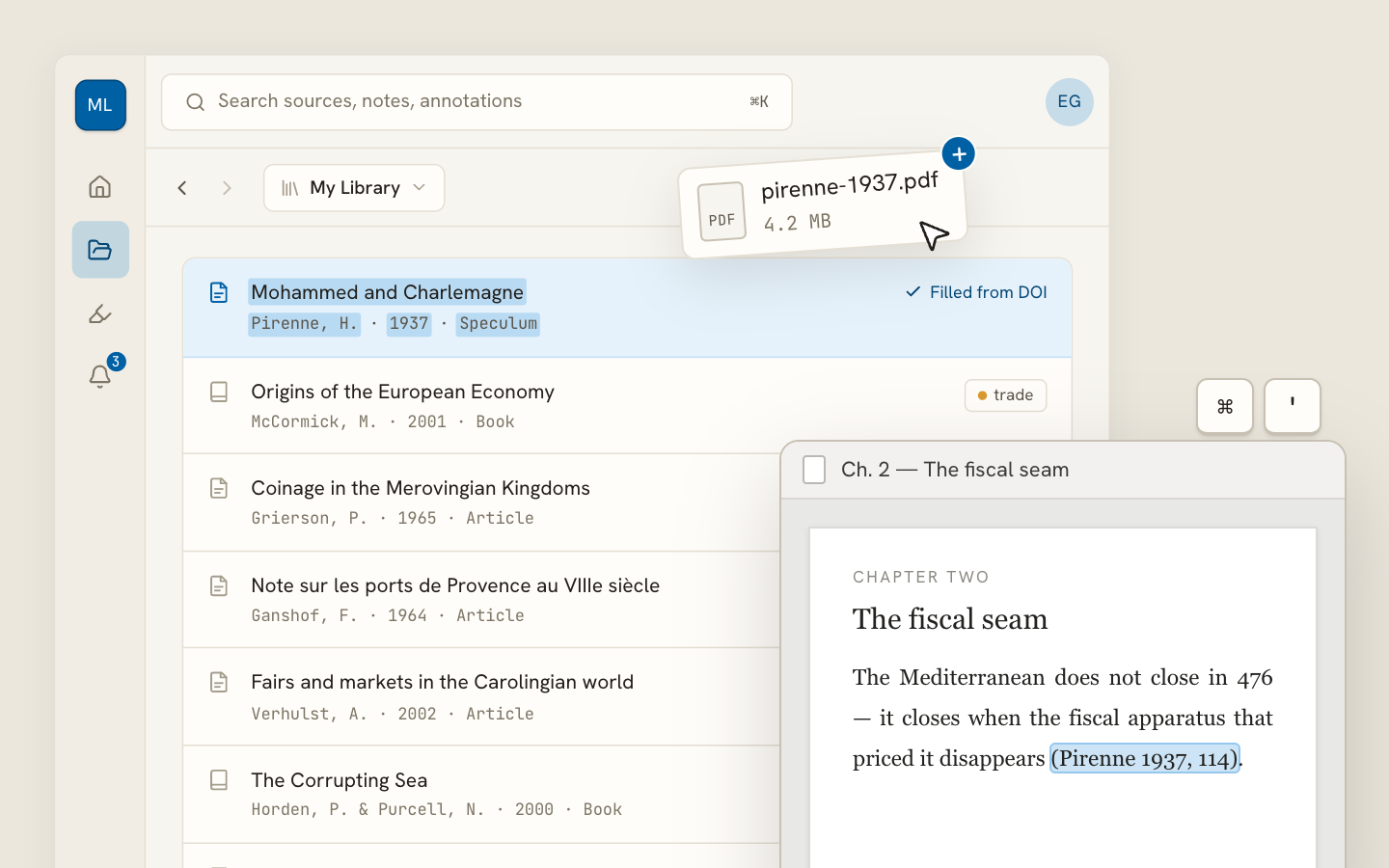
Archivero library view with a source list and an open PDF

Your weekly research workflow, in one email

One tested workflow, three links, no filler — every Tuesday.

Unsubscribe in one click. We never share your address.

Guides/Citations/APA Citation Style

APA Reference List

How to build, format, and organize the reference list at the end of an APA 7th edition paper.

8 min readAPA

On this page

1 of 19
Ground RulesThe Four Building Blocks1. Author2. Date3. Title4. SourceDOIs and URLsCommon Reference ExamplesJournal ArticleBookEdited Book ChapterWebsite PageConference PaperDissertation or ThesisSocial Media PostWhen Information Is MissingAlphabetizing: The Tricky CasesFinal ChecklistNext Steps
All APA guides →

The reference list is where everything comes together. Every source you cited in your paper gets a full entry here — the author, date, title, and where to find the work — so your readers can track down anything that caught their interest.

Think of it as a contract with your reader: "Here's exactly where I got this information, and here's how you can verify it yourself."

Ground Rules

Before getting into the details of individual entries, here are the formatting rules that apply to the reference list as a whole:

  1. Start on a new page. Center the word References in bold at the top — don't resize it, bold it, or make it all caps beyond what APA's heading Level 1 requires.
  2. Double-space every entry, with no extra space between entries.
  3. Use a hanging indent — the first line of each entry sits flush against the left margin, and every subsequent line is indented 0.5 inches (1.27 cm). This is the opposite of a regular paragraph indent, and it's what makes reference lists visually scannable.
  4. Alphabetize entries by the first author's last name. If there's no author, alphabetize by the first meaningful word of the title (skip "A," "An," and "The").
  5. Only list sources you actually cited. The reference list is not a bibliography of everything you read — it's a one-to-one match with your in-text citations.

The Four Building Blocks

Every reference entry — whether it's a journal article, a book, or a TikTok video — is built from the same four elements, always in the same order:

Author. (Date). Title. Source.

Let's break each one down.

1. Author

The person or organization responsible for the work.

ScenarioHow to FormatExample
One authorHow to FormatLast name, First initial(s).ExampleGarcia, M. L.
Two authorsHow to FormatConnect with &ExampleGarcia, M. L., & Lee, J.
Three to twenty authorsHow to FormatList all, with & before the lastExampleGarcia, M. L., Lee, J., & Park, S.
Twenty-one or moreHow to FormatFirst 19, then … then the last authorExampleGarcia, M. L., Lee, J., … Zimmerman, T.
Group/organizationHow to FormatFull nameExampleWorld Health Organization.
No authorHow to FormatMove the title into the author positionExample—

Quick note on et al.:You never use "et al." in the reference list. That's only for in-text citations. In the reference list, you spell out every author's name (up to 20).

2. Date

When the work was published.

ScenarioHow to FormatExample
Standard (most works)How to FormatYear in parentheses, followed by a periodExample(2023).
Exact date (magazine, newspaper, blog)How to FormatYear, Month DayExample(2023, September 14).
No date availableHow to FormatUse n.d.Example(n.d.).

3. Title

The name of the work.

This is where many people trip up, because APA treats different types of works differently:

  • Articles, chapters, and web pages — Use sentence case (capitalize only the first word, proper nouns, and the first word after a colon). No italics, no quotation marks.
  • Books, reports, dissertations, and films — Use sentence case and italicize the title.
  • Edition or volume info follows the title in parentheses, not italicized: (2nd ed.) or (Vol. 3).

What's sentence case?It means you capitalize the title as if it were a regular sentence: only the first word and any proper nouns. So a journal article title would be: Spaced retrieval practice in higher education: A meta-analysis — not Spaced Retrieval Practice in Higher Education: A Meta-Analysis.

4. Source

This tells the reader where to find the work. The format depends on the source type:

  • Journal article: Journal Title in Title Case and Italics, volume(issue), page range. DOI
  • Book: Publisher Name. DOI (if available)
  • Edited book chapter: In E. Editor (Ed.), Book title (pp. xx–xx). Publisher. DOI
  • Website: Site Name. URL

DOIs and URLs

This is one of the areas where the 7th edition simplified things significantly:

  • Always include a DOI when one is available — even for works you accessed in print. Format it as a full URL: https://doi.org/10.1037/amp0000255
  • Don't put a period after a DOI or URL. It could be mistaken as part of the link, and a reader who clicks a broken DOI link will not thank you.
  • For online sources without a DOI, provide the direct URL.
  • "Retrieved from" is gone for most sources. Just place the URL at the end. The one exception is content that changes over time (like a wiki article), where you include the retrieval date: Retrieved January 5, 2025, from https://…

Common Reference Examples

Here are the most common source types you'll encounter, with a properly formatted example for each. Use these as templates when building your own reference list.

Journal Article

Garcia, M. L., & Lee, J. (2021). Spaced retrieval practice in higher education: A meta-analysis. Journal of Educational Psychology, 113(4), 718–735. https://doi.org/10.1037/edu0000612

What to notice: Authors in last-name-first format, article title in sentence case (not italicized), journal name in title case and italicized, volume number italicized, issue number in parentheses (not italicized), page range, DOI as a full URL with no period after it.

For a complete guide covering DOIs, online-only articles, article numbers, advance online publications, and more, see How to Cite a Journal Article in APA Format.

Book

Walker, M. (2017). Why we sleep: Unlocking the power of sleep and dreams. Scribner.

What to notice: Book title is italicized and in sentence case. Publisher name follows — no city or state is needed (that was a 6th edition rule).

For a complete guide covering edited books, book chapters, e-books, translated books, and more, see How to Cite a Book in APA Format.

Edited Book Chapter

Sweller, J. (2011). Cognitive load theory. In J. P. Mestre & B. H. Ross (Eds.), The psychology of learning and motivation (Vol. 55, pp. 37–76). Academic Press. https://doi.org/10.1016/B978-0-12-387691-1.00002-8

What to notice: The chapter title is not italicized. The book title is italicized. The editors' names appear in first-initial-last-name order (not inverted), preceded by "In".

Website Page

World Health Organization. (2024, March 1). Mental health: Strengthening our response. https://www.who.int/news-room/fact-sheets/detail/mental-health-strengthening-our-response

What to notice: Group author written out in full. The title is italicized because it's a standalone web page. If the author and site name are the same, omit the site name to avoid repetition.

For a complete guide covering no-author websites, blog posts, Wikipedia, retrieval dates, and more, see How to Cite a Website in APA Format.

Conference Paper

Park, S., & Chen, Y. (2023, August 10–13). Adaptive learning algorithms for diverse classrooms [Paper presentation]. Annual Meeting of the American Psychological Association, Washington, DC, United States.

What to notice: The date range of the conference is included. The contribution type is noted in square brackets.

Dissertation or Thesis

Rodriguez, A. L. (2022). Bilingual language development in early childhood: A longitudinal study [Doctoral dissertation, University of Texas at Austin]. ProQuest Dissertations & Theses Global.

What to notice: The type of dissertation and the institution go in square brackets. The database or archive name follows.

Social Media Post

National Geographic [@NatGeo]. (2024, February 12). The deepest cave in the world just got deeper [Instagram photograph]. Instagram. https://www.instagram.com/p/example

What to notice: The account handle goes in square brackets after the name. The content type is also in square brackets. The platform name serves as the source.

When Information Is Missing

Real-world sources aren't always perfect. Here's what to do when a required element is missing — APA has a clear fallback for each situation:

Missing ElementWhat to DoExample
AuthorWhat to DoMove the title into the author positionExampleClimate change and public health. (2022). …
DateWhat to DoUse (n.d.)ExampleGarcia, M. L. (n.d.). …
TitleWhat to DoProvide a description in square bracketsExampleGarcia, M. L. (2023). [Untitled blog post]. …
DOI or URLWhat to DoSimply omit it — no placeholder needed for print-only sourcesExample—

Alphabetizing: The Tricky Cases

Most of the time, alphabetizing is straightforward. But a few situations trip people up:

  • Mc vs. Mac — Alphabetize them literally, letter by letter. "McDonald" comes before "MacNeil" because "Mc" precedes "Mac" when compared character by character.
  • Numbers in titles — Treat the number as if it were spelled out. A work titled "4th wave feminism" files under F (fourth).
  • Same first author, different works — Single-author entries come before multi-author entries. So Garcia (2021) appears before Garcia & Lee (2021). Among multi-author entries sharing the first author, sort by the second author's last name, then the third, and so on.
  • Same author, same year — Append lowercase letters (a, b, c…) after the year: Garcia (2021a), Garcia (2021b). Assign the letters based on the alphabetical order of the titles.

Final Checklist

Before submitting your paper, walk through this list to catch the most common reference list errors:

  • Every in-text citation has a corresponding reference list entry
  • Every reference list entry has at least one in-text citation
  • Entries are alphabetized by first author's last name (or by title if there's no author)
  • Hanging indent is applied to all entries
  • DOIs are present wherever available and formatted as https://doi.org/…
  • No period follows a DOI or URL
  • Journal titles and volume numbers are italicized
  • Book and report titles are italicized and in sentence case
  • Article and chapter titles are in sentence case but not italicized
  • "Et al." does not appear anywhere in the reference list (spell out all author names)

Next Steps

Now that you know how to build a reference list, explore guides for specific source types:

  • How to Cite a Book in APA Format — books, edited books, e-books, and book chapters
  • How to Cite a Journal Article in APA Format — articles with DOIs, print-only articles, and online-only journals
  • How to Cite a Website in APA Format — web pages, blog posts, and organizational sources
  • How to Cite a Video in APA Format — YouTube videos, TED Talks, films, and other audiovisual media
  • How to Cite Social Media in APA Format — tweets, Instagram posts, Facebook posts, and more
  • How to Cite ChatGPT & AI-Generated Content in APA — citing output from ChatGPT, Claude, Copilot, and other AI tools
  • APA Annotated Bibliography — when your assignment requires annotations with each reference

Writing a thesis? See our Literature Review guide for how to synthesize sources and build the chapter that relies most heavily on your reference list.

Remember: nobody memorizes everything. Even experienced researchers look things up. The point is knowing what to look up and where to find it — and now you have a guide you can come back to anytime.

All APA guides →
← PreviousNarrative vs. Parenthetical Citations in APANext →How to Cite a Book in APA Format

More on APA style

The standard in psychology, education and the social sciences. The author–date system, reference-list formatting and what the 7th edition changed.

View all 34 guides →
13 sections·7 min readAPAHow to Cite a Book in APA Format12 sections·8 min readAPAHow to Cite a Journal Article in APA Format12 sections·7 min readAPAHow to Cite a Website in APA Format11 sections·7 min readAPAHow to Cite a Video in APA Format

Your sources, PDFs and citations in one library

  • Import a Zotero, Mendeley or EndNote library — or a folder of PDFs
  • Highlight and annotate without leaving the source
  • Cite in any CSL style as you write, with one shared library for your lab
Request early accessSee the product →
Archivero library view with a source list and an open PDF

Your weekly research workflow, in one email

One tested workflow, three links, no filler — every Tuesday.

Unsubscribe in one click. We never share your address.