Archivero is in early access — your sources, PDFs and citations in one library.Request early access →
Archivero/guides/
APAMLAHarvardThesis writing
Subscribe
Archivero/guides/Request early access →

Guides

APA styleMLA styleHarvard referencingThesis writing

Compare

APA 6th vs 7thMLA 8th vs 9thHarvard vs APAThesis vs dissertation

Product

FeaturesEarly access

Resources

DocsCheat sheetsNewsletter

Company

ContactStatus ↗
© 2025–2026 Ernesto F. GonzálezGuidesDocsContactPrivacyTerms
Guides/Citations/APA Citation Style

Narrative vs. Parenthetical Citations in APA

When to use narrative (author as subject) vs. parenthetical (author in parentheses) APA citations, with examples showing how each affects your writing.

6 min readAPA

On this page

1 of 17
What's the Difference?Parenthetical CitationsFormatExamplesPunctuation RulesMultiple Sources in One CitationNarrative CitationsFormatExamplesWhere to Place the YearRepeating the Year in the Same ParagraphWhen to Use WhichUse Parenthetical When…Use Narrative When…The Best Writing Uses BothCommon MistakesWhat's Next
All APA guides →

Every APA in-text citation does the same job — it tells readers who said something and when. But you have two ways to deliver that information: you can weave the author's name into your sentence (narrative) or tuck it into parentheses at the end (parenthetical).

The choice isn't random. Each format creates a different emphasis and rhythm in your writing. Understanding when to use which — and how to mix them — makes your papers read like polished academic writing instead of a citation checklist.

What's the Difference?

The difference is about where the author's name appears in your sentence:

TypeStructureExample
ParentheticalStructureAuthor and year are both inside parenthesesExampleSleep deprivation impairs memory consolidation (Walker, 2017).
NarrativeStructureAuthor is part of the sentence; year is in parenthesesExampleWalker (2017) found that sleep deprivation impairs memory consolidation.

Both citations point the reader to the same reference list entry. Both are equally valid in APA style. The difference is purely about writing style and emphasis.

Parenthetical Citations

In a parenthetical citation, the author's name and year appear together in parentheses, usually at the end of the sentence or clause that contains the cited information.

Format

(Author, Year)

Examples

One author:

Sleep deprivation impairs memory consolidation and emotional regulation (Walker, 2017).

Two authors:

Bilingual children show cognitive advantages in executive function tasks (Bialystok & Martin, 2004).

Note the ampersand (&) between two author names inside parentheses.

Three or more authors:

Early intervention programs show lasting effects on academic achievement (Heckman et al., 2010).

Group author:

Approximately 20% of U.S. adults experience a mental illness each year (National Institute of Mental Health, 2023).

Punctuation Rules

The period goes after the closing parenthesis, not before it:

✓ Research supports this conclusion (Walker, 2017).

✗ Research supports this conclusion. (Walker, 2017)

For block quotes (40+ words), the rule flips — the period goes before the parenthetical citation:

    Sleep is the single most effective thing we can do to reset our brain and body health each day. It is the Swiss Army knife of health. (Walker, 2017, p. 7)

Multiple Sources in One Citation

When citing multiple sources in the same parentheses, list them in alphabetical order and separate them with semicolons:

Several studies support this finding (Bialystok & Martin, 2004; Heckman et al., 2010; Walker, 2017).

Narrative Citations

In a narrative citation, you use the author's name as part of your sentence — it becomes a grammatical element, not a parenthetical aside. Only the year stays in parentheses.

Format

Author (Year) verb…

Examples

One author:

Walker (2017) found that even moderate sleep deprivation significantly impairs memory retention.

Two authors:

Bialystok and Martin (2004) demonstrated that bilingual children outperformed monolinguals on executive function tasks.

Note: In narrative citations, use "and" between two author names (not the ampersand). The ampersand (&) is only for parenthetical citations.

Three or more authors:

Heckman et al. (2010) tracked participants for over 30 years to measure the lasting impact of early intervention.

Group author:

The National Institute of Mental Health (2023) reports that anxiety disorders are the most common mental health condition in the United States.

Where to Place the Year

The year goes in parentheses immediately after the author's name, regardless of where in the sentence the author appears:

✓ Walker (2017) argued that chronic sleep loss is a public health crisis.

✓ In a landmark study, Walker (2017) argued that chronic sleep loss is a public health crisis.

✗ Walker argued that chronic sleep loss is a public health crisis (2017).

Don't separate the author from the year. They should be adjacent.

Repeating the Year in the Same Paragraph

If you cite the same source multiple times in the same paragraph using narrative citations, you can omit the year after the first mention — as long as the source can't be confused with another:

Walker (2017) examined the cognitive effects of sleep deprivation across multiple domains. Walker found that even one night of poor sleep reduced attention span by approximately 40%. Walker concluded that sleep education should be a public health priority.

The year only appears with the first narrative citation in the paragraph. Subsequent uses within the same paragraph can drop it.

When to Use Which

Both formats are correct, so the choice comes down to writing strategy. Here are guidelines:

Use Parenthetical When…

  • The idea matters more than who said it. You want readers focused on the content, not the researcher.
  • You're summarizing a broad finding. When the takeaway is the point, not the attribution.
  • You're citing multiple sources for one claim. Listing several sources in one set of parentheses is cleaner than naming them all.
  • You're writing dense paragraphs with many citations. Parenthetical citations keep the sentence structure clean.

Research consistently links sleep quality to cognitive performance (Lim & Dinges, 2010; Pilcher & Huffcutt, 1996; Walker, 2017).

Use Narrative When…

  • The author matters. You want to highlight who made the finding — their credibility, perspective, or specific contribution.
  • You're discussing a specific study in detail. When you're about to describe a study's methods or results, it helps to name the researcher(s) first.
  • You're comparing or contrasting researchers' positions. Naming them makes the comparison explicit.
  • You're using an author as a signal phrase. "According to…" or "As X (Year) argued…" adds variety to your prose.

Walker (2017) argued that sleep deprivation is a public health crisis, while Grandner (2019) emphasized the role of sleep timing over sleep duration.

The Best Writing Uses Both

Strong academic writing doesn't rely exclusively on one format. Alternating between narrative and parenthetical citations prevents your writing from becoming monotonous.

Before (all parenthetical — reads like a list):

Sleep deprivation affects memory (Walker, 2017). It also impairs emotional regulation (Goldstein & Walker, 2014). Chronic sleep loss is associated with increased anxiety symptoms (Ben Simon et al., 2020). These effects are compounded by irregular sleep schedules (Phillips et al., 2017).

After (mixed — reads like a paragraph):

Walker (2017) demonstrated that sleep deprivation significantly impairs memory consolidation. Subsequent research found that the effects extend beyond cognition — chronic sleep loss is associated with heightened anxiety symptoms and reduced emotional regulation (Ben Simon et al., 2020; Goldstein & Walker, 2014). Phillips et al. (2017) noted that these effects are compounded when students maintain irregular sleep schedules, suggesting that consistency matters as much as duration.

The second version uses the same four sources but reads more naturally. The narrative citations introduce key studies, while the parenthetical citation handles supporting evidence without cluttering the sentence.

Common Mistakes

These are the citation-format errors we see most often:

  1. Using "&" in narrative citations. Use "and" in running text: "Bialystok and Martin (2004)." The ampersand (&) is only for parenthetical citations: "(Bialystok & Martin, 2004)."

  2. Separating the author from the year in narrative citations. The year must immediately follow the author's name: "Walker (2017) found…" — not "Walker found… (2017)."

  3. Putting the period before the parenthetical citation. The period goes after the closing parenthesis: "…consolidation (Walker, 2017)." — not "…consolidation. (Walker, 2017)"

  4. Never using narrative citations. If every citation in your paper is parenthetical, your writing will feel mechanical. Mix in narrative citations to improve flow.

  5. Using "According to (Walker, 2017)…" If you're using a signal phrase like "According to," you're writing a narrative citation — pull the author out of the parentheses: "According to Walker (2017)…"

  6. Repeating the year unnecessarily. Within the same paragraph, you can drop the year after the first narrative citation to the same source. Including it every time is technically not wrong, but it clutters your writing.

What's Next

Now that you understand narrative and parenthetical citations, explore these related topics:

  • How to Paraphrase in APA — in-text citation rules when you put ideas in your own words
  • How to Quote in APA Format — adding page numbers and formatting block quotes
  • APA In-Text Citations — the complete guide to in-text citation formatting

Archivero formats your citations correctly in both narrative and parenthetical styles — so you can focus on choosing the format that makes your writing stronger, not on remembering whether to use "and" or "&."
All APA guides →
← PreviousHow to Cite a Secondary Source in APANext →APA Reference List

More on APA style

The standard in psychology, education and the social sciences. The author–date system, reference-list formatting and what the 7th edition changed.

View all 34 guides →
8 sections·8 min readAPAAPA Reference List13 sections·7 min readAPAHow to Cite a Book in APA Format12 sections·8 min readAPAHow to Cite a Journal Article in APA Format12 sections·7 min readAPAHow to Cite a Website in APA Format

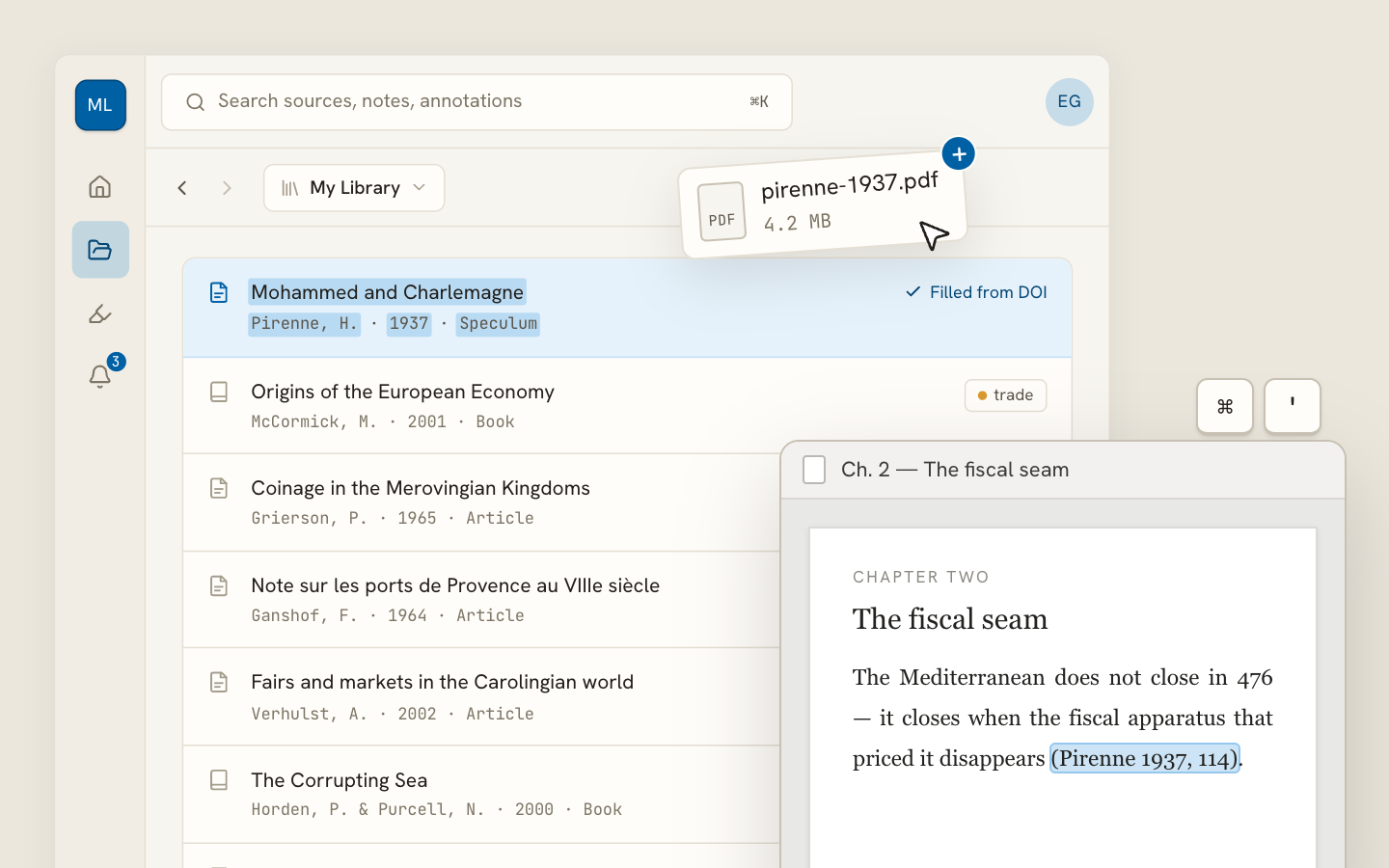
Your sources, PDFs and citations in one library

  • Import a Zotero, Mendeley or EndNote library — or a folder of PDFs
  • Highlight and annotate without leaving the source
  • Cite in any CSL style as you write, with one shared library for your lab
Request early accessSee the product →
Archivero library view with a source list and an open PDF

Your weekly research workflow, in one email

One tested workflow, three links, no filler — every Tuesday.

Unsubscribe in one click. We never share your address.

Guides/Citations/APA Citation Style

Narrative vs. Parenthetical Citations in APA

When to use narrative (author as subject) vs. parenthetical (author in parentheses) APA citations, with examples showing how each affects your writing.

6 min readAPA

On this page

1 of 17
What's the Difference?Parenthetical CitationsFormatExamplesPunctuation RulesMultiple Sources in One CitationNarrative CitationsFormatExamplesWhere to Place the YearRepeating the Year in the Same ParagraphWhen to Use WhichUse Parenthetical When…Use Narrative When…The Best Writing Uses BothCommon MistakesWhat's Next
All APA guides →

Every APA in-text citation does the same job — it tells readers who said something and when. But you have two ways to deliver that information: you can weave the author's name into your sentence (narrative) or tuck it into parentheses at the end (parenthetical).

The choice isn't random. Each format creates a different emphasis and rhythm in your writing. Understanding when to use which — and how to mix them — makes your papers read like polished academic writing instead of a citation checklist.

What's the Difference?

The difference is about where the author's name appears in your sentence:

TypeStructureExample
ParentheticalStructureAuthor and year are both inside parenthesesExampleSleep deprivation impairs memory consolidation (Walker, 2017).
NarrativeStructureAuthor is part of the sentence; year is in parenthesesExampleWalker (2017) found that sleep deprivation impairs memory consolidation.

Both citations point the reader to the same reference list entry. Both are equally valid in APA style. The difference is purely about writing style and emphasis.

Parenthetical Citations

In a parenthetical citation, the author's name and year appear together in parentheses, usually at the end of the sentence or clause that contains the cited information.

Format

(Author, Year)

Examples

One author:

Sleep deprivation impairs memory consolidation and emotional regulation (Walker, 2017).

Two authors:

Bilingual children show cognitive advantages in executive function tasks (Bialystok & Martin, 2004).

Note the ampersand (&) between two author names inside parentheses.

Three or more authors:

Early intervention programs show lasting effects on academic achievement (Heckman et al., 2010).

Group author:

Approximately 20% of U.S. adults experience a mental illness each year (National Institute of Mental Health, 2023).

Punctuation Rules

The period goes after the closing parenthesis, not before it:

✓ Research supports this conclusion (Walker, 2017).

✗ Research supports this conclusion. (Walker, 2017)

For block quotes (40+ words), the rule flips — the period goes before the parenthetical citation:

    Sleep is the single most effective thing we can do to reset our brain and body health each day. It is the Swiss Army knife of health. (Walker, 2017, p. 7)

Multiple Sources in One Citation

When citing multiple sources in the same parentheses, list them in alphabetical order and separate them with semicolons:

Several studies support this finding (Bialystok & Martin, 2004; Heckman et al., 2010; Walker, 2017).

Narrative Citations

In a narrative citation, you use the author's name as part of your sentence — it becomes a grammatical element, not a parenthetical aside. Only the year stays in parentheses.

Format

Author (Year) verb…

Examples

One author:

Walker (2017) found that even moderate sleep deprivation significantly impairs memory retention.

Two authors:

Bialystok and Martin (2004) demonstrated that bilingual children outperformed monolinguals on executive function tasks.

Note: In narrative citations, use "and" between two author names (not the ampersand). The ampersand (&) is only for parenthetical citations.

Three or more authors:

Heckman et al. (2010) tracked participants for over 30 years to measure the lasting impact of early intervention.

Group author:

The National Institute of Mental Health (2023) reports that anxiety disorders are the most common mental health condition in the United States.

Where to Place the Year

The year goes in parentheses immediately after the author's name, regardless of where in the sentence the author appears:

✓ Walker (2017) argued that chronic sleep loss is a public health crisis.

✓ In a landmark study, Walker (2017) argued that chronic sleep loss is a public health crisis.

✗ Walker argued that chronic sleep loss is a public health crisis (2017).

Don't separate the author from the year. They should be adjacent.

Repeating the Year in the Same Paragraph

If you cite the same source multiple times in the same paragraph using narrative citations, you can omit the year after the first mention — as long as the source can't be confused with another:

Walker (2017) examined the cognitive effects of sleep deprivation across multiple domains. Walker found that even one night of poor sleep reduced attention span by approximately 40%. Walker concluded that sleep education should be a public health priority.

The year only appears with the first narrative citation in the paragraph. Subsequent uses within the same paragraph can drop it.

When to Use Which

Both formats are correct, so the choice comes down to writing strategy. Here are guidelines:

Use Parenthetical When…

  • The idea matters more than who said it. You want readers focused on the content, not the researcher.
  • You're summarizing a broad finding. When the takeaway is the point, not the attribution.
  • You're citing multiple sources for one claim. Listing several sources in one set of parentheses is cleaner than naming them all.
  • You're writing dense paragraphs with many citations. Parenthetical citations keep the sentence structure clean.

Research consistently links sleep quality to cognitive performance (Lim & Dinges, 2010; Pilcher & Huffcutt, 1996; Walker, 2017).

Use Narrative When…

  • The author matters. You want to highlight who made the finding — their credibility, perspective, or specific contribution.
  • You're discussing a specific study in detail. When you're about to describe a study's methods or results, it helps to name the researcher(s) first.
  • You're comparing or contrasting researchers' positions. Naming them makes the comparison explicit.
  • You're using an author as a signal phrase. "According to…" or "As X (Year) argued…" adds variety to your prose.

Walker (2017) argued that sleep deprivation is a public health crisis, while Grandner (2019) emphasized the role of sleep timing over sleep duration.

The Best Writing Uses Both

Strong academic writing doesn't rely exclusively on one format. Alternating between narrative and parenthetical citations prevents your writing from becoming monotonous.

Before (all parenthetical — reads like a list):

Sleep deprivation affects memory (Walker, 2017). It also impairs emotional regulation (Goldstein & Walker, 2014). Chronic sleep loss is associated with increased anxiety symptoms (Ben Simon et al., 2020). These effects are compounded by irregular sleep schedules (Phillips et al., 2017).

After (mixed — reads like a paragraph):

Walker (2017) demonstrated that sleep deprivation significantly impairs memory consolidation. Subsequent research found that the effects extend beyond cognition — chronic sleep loss is associated with heightened anxiety symptoms and reduced emotional regulation (Ben Simon et al., 2020; Goldstein & Walker, 2014). Phillips et al. (2017) noted that these effects are compounded when students maintain irregular sleep schedules, suggesting that consistency matters as much as duration.

The second version uses the same four sources but reads more naturally. The narrative citations introduce key studies, while the parenthetical citation handles supporting evidence without cluttering the sentence.

Common Mistakes

These are the citation-format errors we see most often:

  1. Using "&" in narrative citations. Use "and" in running text: "Bialystok and Martin (2004)." The ampersand (&) is only for parenthetical citations: "(Bialystok & Martin, 2004)."

  2. Separating the author from the year in narrative citations. The year must immediately follow the author's name: "Walker (2017) found…" — not "Walker found… (2017)."

  3. Putting the period before the parenthetical citation. The period goes after the closing parenthesis: "…consolidation (Walker, 2017)." — not "…consolidation. (Walker, 2017)"

  4. Never using narrative citations. If every citation in your paper is parenthetical, your writing will feel mechanical. Mix in narrative citations to improve flow.

  5. Using "According to (Walker, 2017)…" If you're using a signal phrase like "According to," you're writing a narrative citation — pull the author out of the parentheses: "According to Walker (2017)…"

  6. Repeating the year unnecessarily. Within the same paragraph, you can drop the year after the first narrative citation to the same source. Including it every time is technically not wrong, but it clutters your writing.

What's Next

Now that you understand narrative and parenthetical citations, explore these related topics:

  • How to Paraphrase in APA — in-text citation rules when you put ideas in your own words
  • How to Quote in APA Format — adding page numbers and formatting block quotes
  • APA In-Text Citations — the complete guide to in-text citation formatting

Archivero formats your citations correctly in both narrative and parenthetical styles — so you can focus on choosing the format that makes your writing stronger, not on remembering whether to use "and" or "&."

All APA guides →
← PreviousHow to Cite a Secondary Source in APANext →APA Reference List

More on APA style

The standard in psychology, education and the social sciences. The author–date system, reference-list formatting and what the 7th edition changed.

View all 34 guides →
8 sections·8 min readAPAAPA Reference List13 sections·7 min readAPAHow to Cite a Book in APA Format12 sections·8 min readAPAHow to Cite a Journal Article in APA Format12 sections·7 min readAPAHow to Cite a Website in APA Format

Your sources, PDFs and citations in one library

  • Import a Zotero, Mendeley or EndNote library — or a folder of PDFs
  • Highlight and annotate without leaving the source
  • Cite in any CSL style as you write, with one shared library for your lab
Request early accessSee the product →
Archivero library view with a source list and an open PDF

Your weekly research workflow, in one email

One tested workflow, three links, no filler — every Tuesday.

Unsubscribe in one click. We never share your address.