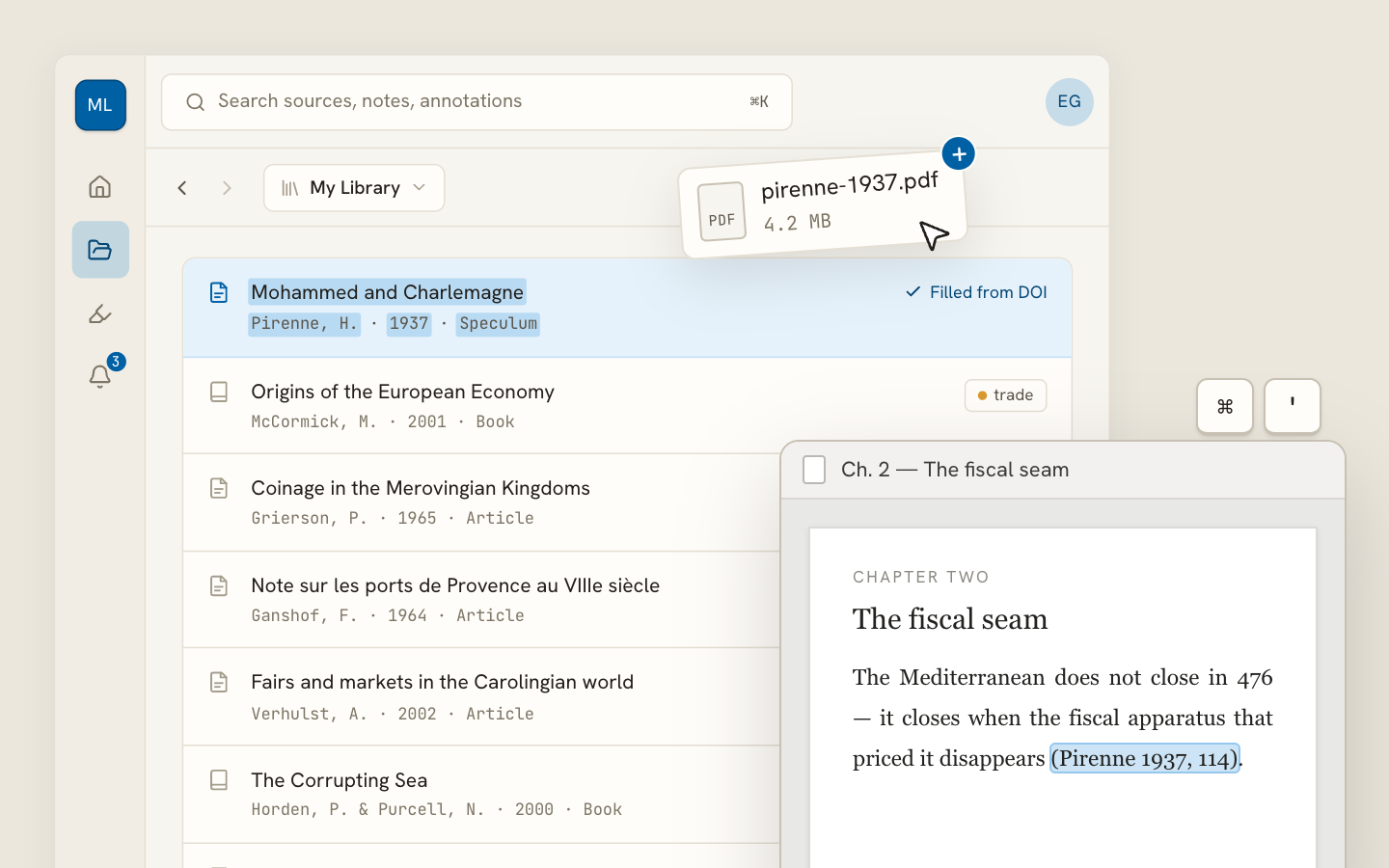
In-text citations are the backbone of academic integrity. Every time you paraphrase, summarize, or directly quote someone else's work, you need to tell the reader exactly where that information came from — right there in the sentence, not just in the reference list at the end.
APA uses the author-date system: you mention the author's last name and the year the work was published. That's the basic building block. Everything else on this page is just variations on that simple idea.
The Two Ways to Cite
You have two options for weaving a citation into your writing. Both are equally correct — the choice depends on what reads more naturally in context.
Parenthetical Citations
The author and year go inside parentheses, usually at the end of the sentence, before the period:
Cognitive load theory has been widely applied in instructional design research (Sweller, 1988).
This format keeps the focus on the idea rather than the person. It's great when you're presenting a fact or finding and the source is supporting evidence.
Narrative Citations
Here, the author's name becomes part of your sentence, and only the year goes in parentheses:
Sweller (1988) introduced the framework that would become cognitive load theory.
This format works well when you want to highlight who did the research — for example, when you're tracing the history of an idea or comparing researchers' positions.
Writing tip:Try to mix both formats throughout your paper. A paragraph full of nothing but parenthetical citations at the end of every sentence can feel monotonous. Narrative citations add variety and make your writing feel more conversational.
How Many Authors? Here's What to Do
The number of authors on a source determines how you format the citation. Here's the complete breakdown:
One Author
Simply use the author's last name and the year:
(Garcia, 2021)
Garcia (2021) found that…
Two Authors
Include both names every time you cite the work. Use & (ampersand) in parenthetical citations and "and" when writing the names into the sentence:
Parenthetical:(Garcia & Lee, 2021)
Narrative:Garcia and Lee (2021) discovered that…
Three or More Authors
This is where the 7th edition made things much simpler. Regardless of how many authors a work has — three, seven, or twenty — just use the first author's last name followed by "et al." every single time:
(Garcia et al., 2021)
Garcia et al. (2021) argued that…
If you learned under the 6th edition, you might remember having to list all authors on the first mention for groups of three to five. That rule is gone. It's always "et al." from the first citation onward.
Direct Quotations
When you use someone else's exact words, you need three things: author, year, and a page number (or another locator like a paragraph number). This extra specificity helps the reader find the precise passage.
Short Quotations (Under 40 Words)
Weave the quote into your paragraph and wrap it in double quotation marks:
The researchers noted that "retrieval practice produced significantly better long-term retention than restudy" (Roediger & Karpicke, 2006, p. 249).
You can also lead with a narrative citation and place the page number after the quote:
Roediger and Karpicke (2006) noted that "retrieval practice produced significantly better long-term retention than restudy" (p. 249).
Long Quotations (40 Words or More)
Longer quotes get special treatment — they become a block quote:
- Start the quote on a new line
- Indent the entire block 0.5 inches from the left margin
- Don't use quotation marks (the indentation already signals that it's a quote)
- Place the parenthetical citation after the period at the end
Roediger and Karpicke (2006) summarized their findings:
Retrieval practice produced significantly better long-term retention than repeated studying. This finding held across different types of material, different retention intervals, and different testing formats. The implication is that students should be encouraged to test themselves repeatedly rather than simply rereading their notes. (p. 249)
What If There Are No Page Numbers?
Not every source comes with convenient page numbers. Use whatever locator helps the reader find the passage:
| Source Type | What to Use | Example |
|---|---|---|
| Web page | Paragraph number or section heading | (para. 4) or ("Methods" section) |
| Video or audio | Timestamp | (01:23:45) |
| Slide deck | Slide number | (Slide 12) |
| Religious or classical text | Standard divisions | (Chapter 3, Verse 16) |
| E-book without fixed pages | Section heading or chapter | (Chapter 4, "Findings" section) |
Paraphrasing
When you restate an author's ideas in your own words, include the author and year. Page numbers are optional for paraphrases, but APA encourages you to include them when the source is long and the page number would help the reader find the relevant passage:
Recent studies suggest that spaced repetition leads to stronger memory consolidation than massed practice (Cepeda et al., 2006).
Cepeda et al. (2006) demonstrated that distributing study sessions over time — rather than cramming — significantly improves long-term retention.
Important:Paraphrasing doesn't mean swapping out a few synonyms. You need to genuinely restate the idea in your own words and sentence structure. If your paraphrase is too close to the original, it's considered patchwriting — and it can be flagged as a form of plagiarism even with a citation.
Citing Multiple Works at Once
Sometimes a single claim is supported by several sources. When this happens, list them alphabetically by first author inside a single set of parentheses, separated by semicolons:
Several studies have linked sleep deprivation to reduced cognitive performance (Alhola & Polo-Kantola, 2007; Lim & Dinges, 2010; Walker, 2017).
This signals that you've done thorough research and that the claim is well-supported across the literature.
Same Author, Same Year
When your reference list includes two or more works by the same author published in the same year, add lowercase letters after the year to tell them apart:
(Johnson, 2019a, 2019b)
The letters are assigned based on the alphabetical order of the works' titles in your reference list. So if Johnson published "Anxiety in adolescents" and "Burnout in healthcare workers" both in 2019, the anxiety paper would be 2019a and the burnout paper would be 2019b.
Secondary Sources (Citing Something You Found in Another Source)
Sometimes you'll encounter a study cited in a textbook or article, but you can't track down the original. This is called a secondary source. Use it sparingly — always try to find the original first — but when you must:
Bandura's social learning theory (as cited in Zimmerman, 2000) emphasizes the role of observational learning.
An important detail: only the source you actually read goes in the reference list. In this example, you'd list Zimmerman (2000), not Bandura's original work.
Edge Cases
No Author
When a work has no identified author, use the first few words of the title in place of the author name. Italicize it if it's a standalone work (book, report, webpage), or use quotation marks if it's part of a larger work (article, chapter):
(Climate Change and Public Health, 2022)
("New Policies for Remote Learning," 2023)
No Date
When no publication date is available, use n.d. (short for "no date"):
(National Institutes of Health, n.d.)
Personal Communications
Emails, interviews, private messages, phone calls, and other sources that the reader can't actually look up are cited in text only — they do not appear in the reference list:
J. Smith (personal communication, March 10, 2024) confirmed the project timeline.
Since there's no way for a reader to verify a personal communication, APA doesn't include them in the reference list. It makes sense — a reference should point the reader to something they can find.
Common Mistakes to Watch For
Here's a quick list of the most frequent in-text citation errors (and how to avoid them):
| Mistake | How to Fix It |
|---|---|
| Forgetting the year in a narrative citation | Always include it: Smith (2020), not just Smith |
| Using "et al." for two authors | "Et al." is only for three or more authors. Two authors → always name both |
| Putting the period before the parenthetical citation | The period goes after the closing parenthesis: …results (Smith, 2020). |
| Citing a source in text but forgetting the reference list entry | Every in-text citation needs a matching reference — and vice versa |
| Adding "p." for a paraphrase when you don't have the page | Page numbers are encouraged but optional for paraphrases. Don't invent one |
Next Steps
Now that you know how to cite sources in the body of your paper, dive deeper into specific in-text citation topics:
- How to Quote in APA Format — formatting rules for short quotes, block quotes, and page number locators
- How to Paraphrase in APA — rules and examples for putting ideas in your own words
- APA Citation With Multiple Authors — the et al. rule and every multi-author scenario
- How to Cite a Source With No Author in APA — what to do when there's no identifiable author
When you're ready to build the back of your paper, head to Reference List to learn how to format the full details of every work you cited.