Archivero is in early access — your sources, PDFs and citations in one library.Request early access →
Archivero/guides/
APAMLAHarvardThesis writing
Subscribe
Archivero/guides/Request early access →

Guides

APA styleMLA styleHarvard referencingThesis writing

Compare

APA 6th vs 7thMLA 8th vs 9thHarvard vs APAThesis vs dissertation

Product

FeaturesEarly access

Resources

DocsCheat sheetsNewsletter

Company

ContactStatus ↗
© 2025–2026 Ernesto F. GonzálezGuidesDocsContactPrivacyTerms
Guides/Citations/APA Citation Style

How to Paraphrase in APA

Rules and examples for paraphrasing sources properly in APA 7th edition, including when to add page numbers.

7 min readAPA

On this page

1 of 17
What Counts as Paraphrasing vs. Quoting vs. SummarizingCitation Format for ParaphrasesParenthetical FormatNarrative FormatGood Paraphrase vs. PatchwritingOriginal TextPatchwriting (Too Close — Avoid This)Good Paraphrase (In Your Own Words)How to Tell if You're PatchwritingWhen to Include Page NumbersMultiple Paraphrases From the Same SourceSame Source, Same ParagraphMixing Sources in a ParagraphCiting Multiple Sources for the Same PointCommon Paraphrasing MistakesQuick-Reference TableWhat's Next
All APA guides →

Paraphrasing is the most common way to incorporate sources into an academic paper — far more common than direct quoting. When you paraphrase, you take someone else's idea and restate it entirely in your own words and sentence structure, while still crediting the original source.

It sounds simple. In practice, it's one of the trickiest skills in academic writing. Too close to the original and you're patchwriting (which counts as plagiarism). Too far from the meaning and you're misrepresenting the source. Getting it right takes deliberate practice — and understanding exactly what APA expects.

What Counts as Paraphrasing vs. Quoting vs. Summarizing

These three techniques are related, but they serve different purposes:

TechniqueWhat You're DoingLength Relative to OriginalCitation Required?
ParaphrasingWhat You're DoingRestating a specific idea in your own wordsLength Relative to OriginalAbout the sameCitation Required?Yes
QuotingWhat You're DoingUsing the author's exact wordingLength Relative to OriginalExactly the sameCitation Required?Yes (with page number)
SummarizingWhat You're DoingCondensing a broad section or entire work into a few sentencesLength Relative to OriginalMuch shorterCitation Required?Yes

Paraphrasing is for specific ideas, findings, or arguments. You're working with a particular passage — maybe a sentence or a short paragraph — and putting it into your own language.

Summarizing is broader. You might condense an entire study into a single sentence. Think of a summary as the helicopter view, and a paraphrase as the close-up.

Quoting is for when the exact words matter. For formatting rules on direct quotes, see How to Quote in APA Format.

Citation Format for Paraphrases

When you paraphrase, you need the author and the year — that's the minimum. Page numbers are encouraged but not required.

Parenthetical Format

Research suggests that sleep deprivation significantly impairs the brain's ability to manage emotional reactions (Walker, 2017).

Narrative Format

Walker (2017) found that insufficient sleep weakens the neural systems responsible for regulating emotion.

Both formats are correct. Choose whichever reads more naturally in context, and vary between them throughout your paper to keep the writing from getting repetitive.

Good Paraphrase vs. Patchwriting

This is where most students run into trouble. Patchwriting — swapping out a few words or rearranging the sentence while keeping the original structure — is the most common form of unintentional plagiarism.

Here's what the spectrum looks like:

Original Text

"Executive function skills allow individuals to plan complex actions, hold information in working memory, and inhibit inappropriate responses in favor of goal-directed behavior" (Diamond, 2013, p. 150).

Patchwriting (Too Close — Avoid This)

❌ Executive function skills enable people to plan complex activities, maintain information in working memory, and suppress inappropriate behaviors in favor of goal-oriented actions (Diamond, 2013).

This is not a good paraphrase. The sentence structure is identical — the writer just replaced a few words with synonyms. Even with a citation, this is too close to the original and many instructors would flag it as plagiarism.

Good Paraphrase (In Your Own Words)

✅ According to Diamond (2013), executive function acts as the brain's control system — it's what allows us to make plans, hold information in mind long enough to use it, and resist impulses that would take us off track.

This version communicates the same idea but with a completely different sentence structure, voice, and word choice. The writer clearly understood the concept and re-expressed it.

How to Tell if You're Patchwriting

A useful test: cover the original text and write the paraphrase from memory. If you can explain the idea without looking at the source, you understand it well enough to paraphrase it properly. If you keep peeking at the original to get the wording right, you're probably patchwriting.

Another test: Compare your sentence structure to the original. If the skeleton of your sentence — subject, verb, object, clause order — mirrors the original, restructure it.

When to Include Page Numbers

APA's rule on page numbers for paraphrases is often misunderstood:

  • Direct quotes: Page numbers are required. Always.
  • Paraphrases: Page numbers are encouraged but not required.

APA recommends including page numbers for paraphrases because it helps readers locate the specific information in the source — especially for long works like books. But you won't lose points for omitting them (unless your instructor has a stricter policy).

When you should include them:

  • The source is a book or lengthy report and the reader would have trouble finding the passage
  • You're paraphrasing a very specific claim, statistic, or data point
  • Your instructor requires page numbers for all citations

When you can skip them:

  • The source is a short article where the information is easy to find
  • You're paraphrasing a general theme that spans the entire source
  • The source doesn't have page numbers (like many web pages)

Format:

Walker (2017, p. 194) found that sleep deprivation weakens emotional regulation.

Sleep deprivation weakens emotional regulation (Walker, 2017, p. 194).

Use "p." for a single page and "pp." for a page range: (Walker, 2017, pp. 194–196).

Multiple Paraphrases From the Same Source

When you paraphrase the same source multiple times in a single paragraph, you don't need to repeat the full citation every time — but you do need enough citation information for the reader to know which ideas come from where.

Same Source, Same Paragraph

If an entire paragraph draws from a single source, cite it at the beginning of the paragraph and make the attribution clear:

Walker (2017) describes several consequences of chronic sleep deprivation. The prefrontal cortex becomes less effective at regulating emotional responses, leading to increased reactivity. Memory consolidation — the process of moving information from short-term to long-term storage — is also disrupted. Perhaps most concerning, sleep-deprived individuals often don't realize the extent of their impairment.

The first sentence establishes the source. The remaining sentences clearly continue from the same source because they follow logically and no new source is introduced.

Mixing Sources in a Paragraph

When a paragraph draws from multiple sources, each idea needs its own citation:

Sleep deprivation impairs the prefrontal cortex's ability to regulate emotion (Walker, 2017). This finding is consistent with earlier research on stress hormones and emotional processing (Goldstein & Walker, 2014). More recent studies have extended these results to adolescent populations, where the effects appear even more pronounced (Crowley et al., 2023).

Citing Multiple Sources for the Same Point

When several sources support the same idea, list them all in one set of parentheses, separated by semicolons, in alphabetical order:

Research consistently shows that sleep deprivation impairs cognitive function (Alhola & Polo-Kantola, 2007; Lim & Dinges, 2010; Walker, 2017).

Common Paraphrasing Mistakes

These are the errors we see most often:

  1. Patchwriting. Swapping out synonyms while keeping the original sentence structure. This is the #1 paraphrasing mistake. See the examples above for how to avoid it.

  2. Forgetting the citation. Even though you're using your own words, the idea belongs to someone else. Every paraphrase needs a citation.

  3. Changing the meaning. In the effort to use different words, you accidentally distort what the author actually said. Always double-check that your paraphrase preserves the original meaning.

  4. Over-citing. Repeating the same citation at the end of every single sentence in a paragraph that draws from one source. One clear attribution at the beginning is usually enough.

  5. Adding interpretation without signaling it. If you're adding your own analysis or opinion to a paraphrased idea, make that clear: "Walker (2017) argues X, which suggests Y" — where X is the paraphrase and Y is your contribution.

  6. Using air quotes. Putting distinctive phrases in quotation marks while paraphrasing ("the brain's control system") means you're quoting — and now you need a page number. If you want to use the author's exact phrase, either commit to a proper direct quote or find different words.

Quick-Reference Table

ScenarioWhat to IncludeExample
Basic paraphraseWhat to IncludeAuthor + yearExample(Walker, 2017)
Paraphrase with page numberWhat to IncludeAuthor + year + pageExample(Walker, 2017, p. 194)
Narrative paraphraseWhat to IncludeAuthor (year)ExampleWalker (2017) found that…
Multiple sources, same pointWhat to IncludeAll sources, semicolons, alphabeticalExample(Alhola & Polo-Kantola, 2007; Walker, 2017)
Same source, whole paragraphWhat to IncludeCite at the beginningExampleWalker (2017) describes…

What's Next

Now that you know how to paraphrase properly, explore these related topics:

  • How to Quote in APA Format — when and how to use direct quotes instead of paraphrasing
  • Narrative vs. Parenthetical Citations in APA — choosing between citation styles for your paraphrases
  • APA In-Text Citations — the complete guide to citing sources in the body of your paper

Archivero tracks your sources and generates properly formatted in-text citations automatically — so you can focus on writing strong paraphrases instead of worrying about formatting.
All APA guides →
← PreviousAPA Citation With Multiple AuthorsNext →How to Cite a Source With No Author in APA

More on APA style

The standard in psychology, education and the social sciences. The author–date system, reference-list formatting and what the 7th edition changed.

View all 34 guides →
8 sections·6 min readAPAHow to Cite a Source With No Author in APA8 sections·7 min readAPAHow to Cite a Secondary Source in APA6 sections·6 min readAPANarrative vs. Parenthetical Citations in APA8 sections·8 min readAPAAPA Reference List

Your sources, PDFs and citations in one library

  • Import a Zotero, Mendeley or EndNote library — or a folder of PDFs
  • Highlight and annotate without leaving the source
  • Cite in any CSL style as you write, with one shared library for your lab
Request early accessSee the product →
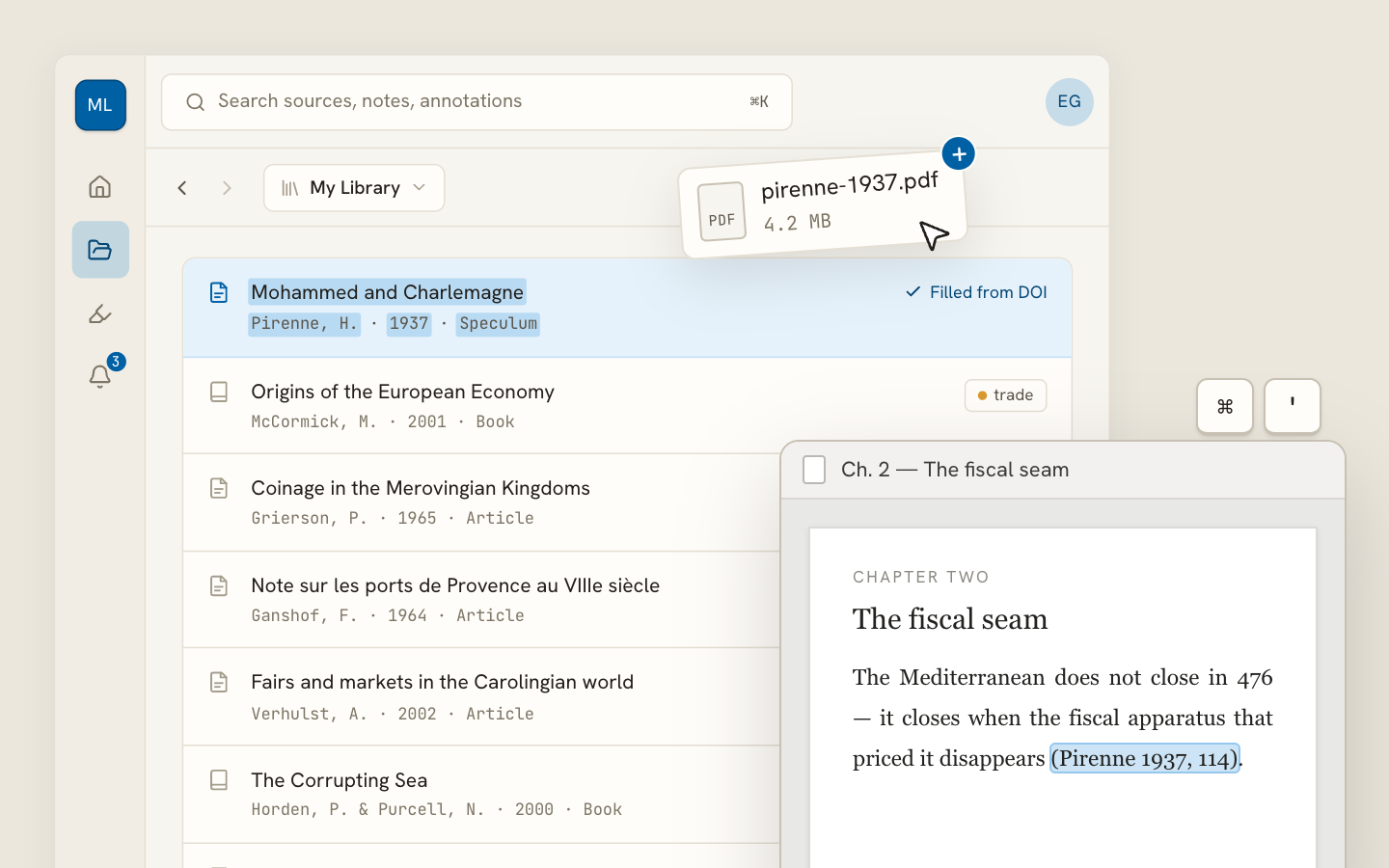
Archivero library view with a source list and an open PDF

Your weekly research workflow, in one email

One tested workflow, three links, no filler — every Tuesday.

Unsubscribe in one click. We never share your address.

Guides/Citations/APA Citation Style

How to Paraphrase in APA

Rules and examples for paraphrasing sources properly in APA 7th edition, including when to add page numbers.

7 min readAPA

On this page

1 of 17
What Counts as Paraphrasing vs. Quoting vs. SummarizingCitation Format for ParaphrasesParenthetical FormatNarrative FormatGood Paraphrase vs. PatchwritingOriginal TextPatchwriting (Too Close — Avoid This)Good Paraphrase (In Your Own Words)How to Tell if You're PatchwritingWhen to Include Page NumbersMultiple Paraphrases From the Same SourceSame Source, Same ParagraphMixing Sources in a ParagraphCiting Multiple Sources for the Same PointCommon Paraphrasing MistakesQuick-Reference TableWhat's Next
All APA guides →

Paraphrasing is the most common way to incorporate sources into an academic paper — far more common than direct quoting. When you paraphrase, you take someone else's idea and restate it entirely in your own words and sentence structure, while still crediting the original source.

It sounds simple. In practice, it's one of the trickiest skills in academic writing. Too close to the original and you're patchwriting (which counts as plagiarism). Too far from the meaning and you're misrepresenting the source. Getting it right takes deliberate practice — and understanding exactly what APA expects.

What Counts as Paraphrasing vs. Quoting vs. Summarizing

These three techniques are related, but they serve different purposes:

TechniqueWhat You're DoingLength Relative to OriginalCitation Required?
ParaphrasingWhat You're DoingRestating a specific idea in your own wordsLength Relative to OriginalAbout the sameCitation Required?Yes
QuotingWhat You're DoingUsing the author's exact wordingLength Relative to OriginalExactly the sameCitation Required?Yes (with page number)
SummarizingWhat You're DoingCondensing a broad section or entire work into a few sentencesLength Relative to OriginalMuch shorterCitation Required?Yes

Paraphrasing is for specific ideas, findings, or arguments. You're working with a particular passage — maybe a sentence or a short paragraph — and putting it into your own language.

Summarizing is broader. You might condense an entire study into a single sentence. Think of a summary as the helicopter view, and a paraphrase as the close-up.

Quoting is for when the exact words matter. For formatting rules on direct quotes, see How to Quote in APA Format.

Citation Format for Paraphrases

When you paraphrase, you need the author and the year — that's the minimum. Page numbers are encouraged but not required.

Parenthetical Format

Research suggests that sleep deprivation significantly impairs the brain's ability to manage emotional reactions (Walker, 2017).

Narrative Format

Walker (2017) found that insufficient sleep weakens the neural systems responsible for regulating emotion.

Both formats are correct. Choose whichever reads more naturally in context, and vary between them throughout your paper to keep the writing from getting repetitive.

Good Paraphrase vs. Patchwriting

This is where most students run into trouble. Patchwriting — swapping out a few words or rearranging the sentence while keeping the original structure — is the most common form of unintentional plagiarism.

Here's what the spectrum looks like:

Original Text

"Executive function skills allow individuals to plan complex actions, hold information in working memory, and inhibit inappropriate responses in favor of goal-directed behavior" (Diamond, 2013, p. 150).

Patchwriting (Too Close — Avoid This)

❌ Executive function skills enable people to plan complex activities, maintain information in working memory, and suppress inappropriate behaviors in favor of goal-oriented actions (Diamond, 2013).

This is not a good paraphrase. The sentence structure is identical — the writer just replaced a few words with synonyms. Even with a citation, this is too close to the original and many instructors would flag it as plagiarism.

Good Paraphrase (In Your Own Words)

✅ According to Diamond (2013), executive function acts as the brain's control system — it's what allows us to make plans, hold information in mind long enough to use it, and resist impulses that would take us off track.

This version communicates the same idea but with a completely different sentence structure, voice, and word choice. The writer clearly understood the concept and re-expressed it.

How to Tell if You're Patchwriting

A useful test: cover the original text and write the paraphrase from memory. If you can explain the idea without looking at the source, you understand it well enough to paraphrase it properly. If you keep peeking at the original to get the wording right, you're probably patchwriting.

Another test: Compare your sentence structure to the original. If the skeleton of your sentence — subject, verb, object, clause order — mirrors the original, restructure it.

When to Include Page Numbers

APA's rule on page numbers for paraphrases is often misunderstood:

  • Direct quotes: Page numbers are required. Always.
  • Paraphrases: Page numbers are encouraged but not required.

APA recommends including page numbers for paraphrases because it helps readers locate the specific information in the source — especially for long works like books. But you won't lose points for omitting them (unless your instructor has a stricter policy).

When you should include them:

  • The source is a book or lengthy report and the reader would have trouble finding the passage
  • You're paraphrasing a very specific claim, statistic, or data point
  • Your instructor requires page numbers for all citations

When you can skip them:

  • The source is a short article where the information is easy to find
  • You're paraphrasing a general theme that spans the entire source
  • The source doesn't have page numbers (like many web pages)

Format:

Walker (2017, p. 194) found that sleep deprivation weakens emotional regulation.

Sleep deprivation weakens emotional regulation (Walker, 2017, p. 194).

Use "p." for a single page and "pp." for a page range: (Walker, 2017, pp. 194–196).

Multiple Paraphrases From the Same Source

When you paraphrase the same source multiple times in a single paragraph, you don't need to repeat the full citation every time — but you do need enough citation information for the reader to know which ideas come from where.

Same Source, Same Paragraph

If an entire paragraph draws from a single source, cite it at the beginning of the paragraph and make the attribution clear:

Walker (2017) describes several consequences of chronic sleep deprivation. The prefrontal cortex becomes less effective at regulating emotional responses, leading to increased reactivity. Memory consolidation — the process of moving information from short-term to long-term storage — is also disrupted. Perhaps most concerning, sleep-deprived individuals often don't realize the extent of their impairment.

The first sentence establishes the source. The remaining sentences clearly continue from the same source because they follow logically and no new source is introduced.

Mixing Sources in a Paragraph

When a paragraph draws from multiple sources, each idea needs its own citation:

Sleep deprivation impairs the prefrontal cortex's ability to regulate emotion (Walker, 2017). This finding is consistent with earlier research on stress hormones and emotional processing (Goldstein & Walker, 2014). More recent studies have extended these results to adolescent populations, where the effects appear even more pronounced (Crowley et al., 2023).

Citing Multiple Sources for the Same Point

When several sources support the same idea, list them all in one set of parentheses, separated by semicolons, in alphabetical order:

Research consistently shows that sleep deprivation impairs cognitive function (Alhola & Polo-Kantola, 2007; Lim & Dinges, 2010; Walker, 2017).

Common Paraphrasing Mistakes

These are the errors we see most often:

  1. Patchwriting. Swapping out synonyms while keeping the original sentence structure. This is the #1 paraphrasing mistake. See the examples above for how to avoid it.

  2. Forgetting the citation. Even though you're using your own words, the idea belongs to someone else. Every paraphrase needs a citation.

  3. Changing the meaning. In the effort to use different words, you accidentally distort what the author actually said. Always double-check that your paraphrase preserves the original meaning.

  4. Over-citing. Repeating the same citation at the end of every single sentence in a paragraph that draws from one source. One clear attribution at the beginning is usually enough.

  5. Adding interpretation without signaling it. If you're adding your own analysis or opinion to a paraphrased idea, make that clear: "Walker (2017) argues X, which suggests Y" — where X is the paraphrase and Y is your contribution.

  6. Using air quotes. Putting distinctive phrases in quotation marks while paraphrasing ("the brain's control system") means you're quoting — and now you need a page number. If you want to use the author's exact phrase, either commit to a proper direct quote or find different words.

Quick-Reference Table

ScenarioWhat to IncludeExample
Basic paraphraseWhat to IncludeAuthor + yearExample(Walker, 2017)
Paraphrase with page numberWhat to IncludeAuthor + year + pageExample(Walker, 2017, p. 194)
Narrative paraphraseWhat to IncludeAuthor (year)ExampleWalker (2017) found that…
Multiple sources, same pointWhat to IncludeAll sources, semicolons, alphabeticalExample(Alhola & Polo-Kantola, 2007; Walker, 2017)
Same source, whole paragraphWhat to IncludeCite at the beginningExampleWalker (2017) describes…

What's Next

Now that you know how to paraphrase properly, explore these related topics:

  • How to Quote in APA Format — when and how to use direct quotes instead of paraphrasing
  • Narrative vs. Parenthetical Citations in APA — choosing between citation styles for your paraphrases
  • APA In-Text Citations — the complete guide to citing sources in the body of your paper

Archivero tracks your sources and generates properly formatted in-text citations automatically — so you can focus on writing strong paraphrases instead of worrying about formatting.

All APA guides →
← PreviousAPA Citation With Multiple AuthorsNext →How to Cite a Source With No Author in APA

More on APA style

The standard in psychology, education and the social sciences. The author–date system, reference-list formatting and what the 7th edition changed.

View all 34 guides →
8 sections·6 min readAPAHow to Cite a Source With No Author in APA8 sections·7 min readAPAHow to Cite a Secondary Source in APA6 sections·6 min readAPANarrative vs. Parenthetical Citations in APA8 sections·8 min readAPAAPA Reference List

Your sources, PDFs and citations in one library

  • Import a Zotero, Mendeley or EndNote library — or a folder of PDFs
  • Highlight and annotate without leaving the source
  • Cite in any CSL style as you write, with one shared library for your lab
Request early accessSee the product →
Archivero library view with a source list and an open PDF

Your weekly research workflow, in one email

One tested workflow, three links, no filler — every Tuesday.

Unsubscribe in one click. We never share your address.