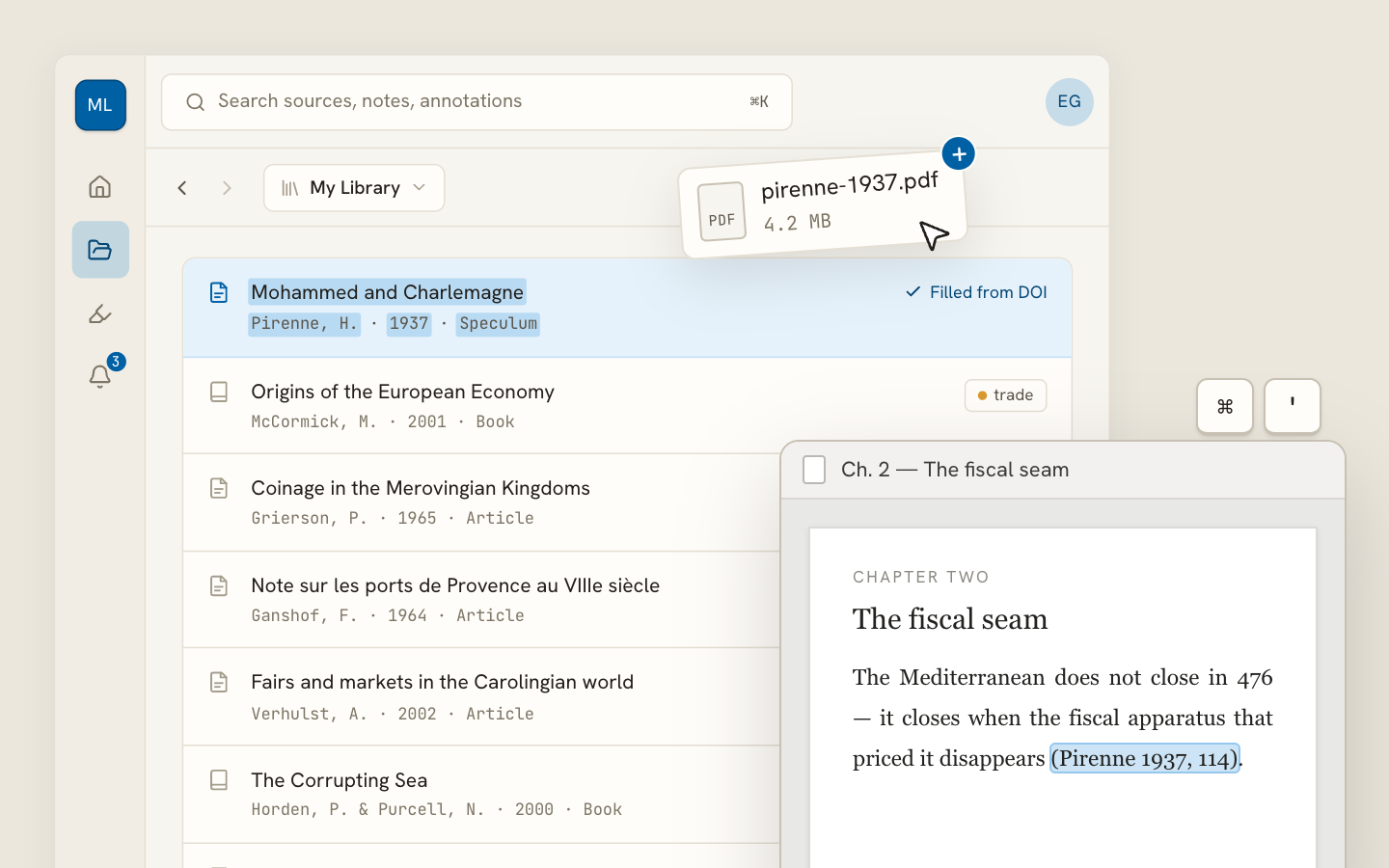
Sometimes a source says something so precisely — so perfectly — that paraphrasing it would water it down. That's when you reach for a direct quote. But in APA, you can't just drop quotation marks around some text and call it a day. There are specific rules for how to format short quotes, when to use block quotes, and what locator information to include.
Let's walk through every quoting scenario you're likely to encounter.
When to Use a Direct Quote vs. Paraphrasing
Before diving into formatting, a quick reality check: most of your paper should be paraphrased, not quoted. Direct quotes are powerful precisely because they're used sparingly. Reserve them for situations where:
- The exact wording matters (definitions, key phrases, landmark arguments)
- You plan to analyze the language itself
- Paraphrasing would distort the original meaning
- The original is so well-written that your version would be weaker
If none of those apply, paraphrase instead. For a full guide, see How to Paraphrase in APA.
Short Quotations (Under 40 Words)
When your quote is fewer than 40 words, integrate it directly into your text using double quotation marks. Include the author, year, and a page number (or other locator).
Parenthetical Format
Researchers have noted that "sleep deprivation impairs the prefrontal cortex's ability to regulate emotional responses, leading to heightened reactivity to negative stimuli" (Walker, 2017, p. 194).
Narrative Format
Walker (2017) argued that "sleep deprivation impairs the prefrontal cortex's ability to regulate emotional responses, leading to heightened reactivity to negative stimuli" (p. 194).
Key formatting details:
- The period goes after the parenthetical citation, not inside the quotation marks. This is different from how you'd normally punctuate quoted text in everyday writing.
- In a narrative citation, the year follows the author's name and the page number goes in parentheses at the end of the quote.
- Always include a page number (or alternative locator) for direct quotes. This is required, not optional.
Quotation Within a Quotation
If the text you're quoting already contains a quotation, use single quotation marks for the internal quote:
According to the report, "participants described the experience as 'overwhelming but ultimately rewarding' when reflecting on the first week" (Torres & Kim, 2023, p. 47).
In the original source, "overwhelming but ultimately rewarding" was in double quotes. When you nest it inside your own quote, it switches to single quotes.
Block Quotations (40 or More Words)
When your quote is 40 words or longer, format it as a freestanding block of text — no quotation marks, indented from the left margin.
Here's what a block quote looks like in context:
Garcia and Patel (2022) described the intervention's impact on student engagement:
The structured peer-mentoring program produced measurable shifts in classroom participation within the first four weeks. Students who had previously been classified as "disengaged" by their instructors showed a 40% increase in voluntary contributions during discussion sessions. Perhaps more notably, mentors reported that the process of explaining concepts to their peers deepened their own understanding of the material. (p. 312)
Key formatting details:
- No quotation marks. The indentation itself signals that this is a direct quote.
- Start the block quote on a new line, indented 0.5 inches (1.27 cm) from the left margin — the same distance as a paragraph indent.
- Double-space the block quote, just like the rest of your paper.
- If the quote contains multiple paragraphs, indent the first line of each subsequent paragraph an additional 0.5 inches.
- The parenthetical citation goes after the final period, not before it. This is the opposite of short quotes — notice the period comes before the citation in block quotes.
Introducing a Block Quote
Always introduce a block quote with a signal phrase or sentence. Don't just plop it into your paper without context. Good introductions include:
- Claim + colon: "The researchers described a notable shift in engagement:"
- Narrative citation + verb: "Garcia and Patel (2022) explained that:"
- Context sentence: "The results were particularly striking for previously disengaged students:"
Avoid introducing a block quote with a sentence that trails off grammatically. The text before the colon should be a complete clause.
Adding or Omitting Words
Sometimes you need to tweak a quote slightly to make it fit grammatically into your sentence, or to cut out irrelevant parts. APA has strict rules for this.
Adding Words — Use Square Brackets
If you need to insert a word or change a letter to make the quote work in your sentence, enclose the addition in square brackets [ ]:
Original: "The results suggest that this approach is effective."
Modified: Walker (2017) found that "[the] results suggest that [cognitive behavioral] approach is effective" (p. 89).
Use brackets to:
- Change a pronoun for clarity: "They" → "[The participants]"
- Adjust verb tense: "are" → "[were]"
- Add context: "this method" → "[the sleep restriction] method"
Omitting Words — Use Ellipses
If you need to cut out part of a quote that isn't relevant to your point, use an ellipsis (…) — three spaced periods:
"Cognitive behavioral therapy has demonstrated significant efficacy … across multiple populations and clinical settings" (Hofmann et al., 2012, p. 430).
Rules for ellipses:
- Use three dots with spaces between them.
- Don't use ellipses at the beginning or end of a quote — only in the middle.
- Don't use ellipses to change the meaning of the original. The remaining text should still accurately represent the author's point.
Emphasis — Use Italics Sparingly
If you want to emphasize a word or phrase in the quote that wasn't emphasized in the original, italicize it and add a note in brackets:
"The effect was observed across all age groups, but was particularly pronounced [emphasis added] in adolescents" (Rivera, 2021, p. 215).
If the original already had italics, note that too: "[emphasis in original]."
Page Numbers and Alternative Locators
For direct quotes, APA requires a locator — something that tells the reader exactly where in the source the quoted text appears.
Standard Page Numbers
The most common locator. Use "p." for a single page and "pp." for a range:
(Walker, 2017, p. 194)
(Walker, 2017, pp. 194–196)
Sources Without Page Numbers
Many sources — websites, e-books without fixed pages, videos — don't have traditional page numbers. Use the best available alternative:
| Source Type | Locator Format | Example |
|---|---|---|
| Web page with headings | Paragraph number or heading | (Martinez, 2024, para. 4) |
| E-book with numbered sections | Section heading | (Lee, 2023, Chapter 3) |
| Video or audio | Timestamp | (Khan Academy, 2022, 4:32) |
| PowerPoint/slides | Slide number | (Torres, 2023, Slide 12) |
| Numbered paragraph | Paragraph number | (WHO, 2024, para. 8) |
| Work with heading but no page or paragraph numbers | Shortened heading + paragraph count | (Chen, 2021, "Results" section, para. 2) |
If the heading is too long for the locator, shorten it in quotation marks:
(Chen, 2021, "Cognitive Outcomes" section, para. 2)
Quoting From Secondary Sources
If you're reading Source A and it quotes Source B, and you want to use that quote from Source B, you have a special situation. Ideally, you should track down the original source. But if you can't:
James (1890) argued that "the stream of thought is sensibly continuous" (as cited in Solms, 2021, p. 74).
Your reference list would include Solms (2021) — the source you actually read — not James (1890).
For more on this, see How to Cite a Secondary Source in APA.
Common Quoting Mistakes
These are the errors we see most often with direct quotes:
- Putting the period inside the quotation marks. In APA, the period goes after the parenthetical citation: …stimuli" (Walker, 2017, p. 194). Not inside the quotes.
- Forgetting the page number. Every direct quote needs a locator. No exceptions — even for paraphrases, APA "encourages" page numbers, but for quotes they're mandatory.
- Using block quote format for short quotes. If it's under 40 words, keep it inline with quotation marks. Block format is only for 40+ words.
- Using quotation marks on block quotes. If it's 40+ words and indented, the quotation marks are redundant — drop them.
- Starting a block quote without an introduction. Always lead into a block quote with a signal phrase or contextual sentence.
- Using ellipses at the start of a quote. You don't need to signal that there was text before your quote started. Just begin where you want to begin.
- Changing the meaning with brackets or ellipses. Modifications to a quote must not alter the author's intended meaning. If you'd need to rewrite half the sentence to make it fit, paraphrase instead.
Quick-Reference Table
| Scenario | Format | Example |
|---|---|---|
| Short quote (< 40 words) | Double quotes, inline | "quote text" (Author, Year, p. #). |
| Block quote (≥ 40 words) | Indented 0.5", no quotes | Indented text. (p. #) |
| Quote within a quote | Single quotes inside double | "She said 'example' to the group" |
| Added words | Square brackets | "[The participants] agreed" |
| Omitted words | Ellipsis | "results … were significant" |
| Added emphasis | Italics + note | "key finding [emphasis added]" |
| No page number | Alternative locator | (Author, Year, para. 4) |
| Secondary source | "as cited in" | (as cited in Author, Year, p. #) |
What's Next
Now that you know how to handle direct quotes, explore these related topics:
- How to Paraphrase in APA — when and how to put ideas in your own words
- Narrative vs. Parenthetical Citations in APA — choosing between citation styles
- APA In-Text Citations — the complete guide to citing sources in the body of your paper
Archivero automatically tracks your sources and generates properly formatted in-text citations — so you can focus on integrating quotes effectively instead of double-checking punctuation placement.