Archivero is in early access — your sources, PDFs and citations in one library.Request early access →
Archivero/guides/
APAMLAHarvardThesis writing
Subscribe
Archivero/guides/Request early access →

Guides

APA styleMLA styleHarvard referencingThesis writing

Compare

APA 6th vs 7thMLA 8th vs 9thHarvard vs APAThesis vs dissertation

Product

FeaturesEarly access

Resources

DocsCheat sheetsNewsletter

Company

ContactStatus ↗
© 2025–2026 Ernesto F. GonzálezGuidesDocsContactPrivacyTerms
Guides/Citations/APA Citation Style

APA Citation With Multiple Authors

How to cite sources with 2, 3, or more authors in APA 7th edition, including the et al. rule.

7 min readAPA

On this page

1 of 12
One Author — The BaselineTwo AuthorsThree or More Authors — The et al. RuleWhat Changed From the 6th EditionGroup and Organizational AuthorsGroup Author With a Well-Known AbbreviationGroup Author Without an AbbreviationAmbiguous "et al." — When Two Citations Look the SameTwenty-One or More AuthorsQuick-Reference TableCommon MistakesWhat's Next
All APA guides →

Most academic sources have more than one author. A psychology study might list three researchers. A textbook might have a dozen contributors. And a large-scale meta-analysis could name twenty or more.

The good news is that APA 7th edition simplified the multi-author rules significantly. If you learned the old system (where you listed every author the first time and used "et al." after that), you can forget it. The new rules are cleaner — let's walk through them.

One Author — The Baseline

Before tackling multiple authors, let's anchor on the simplest case:

Reference list:

Garcia, M. L. (2022). Decision-making under uncertainty: A cognitive approach. Oxford University Press.

In-text citations:

Parenthetical:(Garcia, 2022)

Narrative:Garcia (2022) argued that…

One name, one year. That's the foundation everything else builds on.

Two Authors

When a work has two authors, include both names every time you cite it — in every single citation, first and subsequent.

Reference list:

Patel, R., & Nakamura, K. (2021). Bilingual advantages in executive function: A longitudinal study. Developmental Psychology, 57(3), 412–425. https://doi.org/10.1037/dev0001148

In-text citations:

Parenthetical:(Patel & Nakamura, 2021)

Narrative:Patel and Nakamura (2021) found that…

Notice the difference:

  • In parenthetical citations and in the reference list, use the ampersand (&).
  • In narrative citations (where the names are part of your sentence), write out "and."

This is one of the most common small errors in student papers. Think of it this way: if the names are inside parentheses, use &. If they're outside parentheses, use "and."

Three or More Authors — The et al. Rule

This is where APA 7th edition made the biggest change. The rule is now beautifully simple:

For works with three or more authors, use the first author's last name followed by "et al." in every citation — including the very first one.

That's it. No more listing all authors the first time. No more switching between formats depending on whether it's the first or subsequent citation. Just "et al." from the start.

Reference list (list all authors up to 20):

Henrich, J., Heine, S. J., & Norenzayan, A. (2010). The weirdest people in the world? Behavioral and Brain Sciences, 33(2–3), 61–83. https://doi.org/10.1017/S0140525X0999152X

In-text citations (every time):

Parenthetical:(Henrich et al., 2010)

Narrative:Henrich et al. (2010) argued that…

Key details about et al.:

  • "et al." is short for et alia (Latin for "and others").
  • The "et" has no period after it. The "al." does have a period — because it's an abbreviation.
  • It's not italicized in the text.
  • In a narrative citation, the sentence verb agrees with the full author group: "Henrich et al. (2010) found that…" — not "Henrich et al. finds."

What Changed From the 6th Edition

If your instructor learned APA under the 6th edition — or if you're updating a paper from an older format — here's what's different:

Rule6th Edition7th Edition
3–5 authors, first citation6th EditionList all authors7th EditionUse et al. from the first citation
3–5 authors, subsequent citations6th EditionUse et al.7th EditionUse et al.
6+ authors6th EditionUse et al. from first citation7th EditionUse et al. from first citation
Reference list, max authors before "…"6th Edition77th Edition20

In plain English: The 6th edition had different rules for 3–5 authors vs. 6+ authors. The 7th edition collapsed those into a single rule: three or more = et al. every time. It also expanded the reference list limit from 7 authors to 20 before you start using the ellipsis.

For a complete comparison of all edition changes, see APA 6th vs. 7th Edition — What Changed.

Group and Organizational Authors

When an organization is the author (rather than individual people), the group name replaces the author's last name in the citation.

Group Author With a Well-Known Abbreviation

If the organization has a familiar abbreviation, spell it out the first time and abbreviate it after that:

First citation (parenthetical):(American Psychological Association [APA], 2020)

Subsequent citations:(APA, 2020)

First citation (narrative):The American Psychological Association (APA, 2020) recommends…

Subsequent citations:APA (2020) recommends…

Group Author Without an Abbreviation

If the organization doesn't have a standard abbreviation (or the abbreviation wouldn't be recognized by your readers), spell out the full name every time:

Every citation:(National Sleep Foundation, 2024)

Narrative:The National Sleep Foundation (2024) reports that…

Don't abbreviate unless it helps. Abbreviations like WHO, CDC, NASA, and APA are universally recognized. But "University of Colorado Denver" abbreviated to "UCD" would confuse more than it helps — just write it out each time.

Reference list (both cases):

American Psychological Association. (2020). Publication manual of the American Psychological Association (7th ed.). American Psychological Association.

In the reference list, always use the full name — never the abbreviation.

Ambiguous "et al." — When Two Citations Look the Same

Here's a tricky situation. Suppose you're citing two different papers that, when shortened to "first author et al.," look identical:

  • Paper A: Torres, Kim, & Osei (2022)
  • Paper B: Torres, Nakamura, & Chen (2022)

Both would shorten to (Torres et al., 2022). Your reader wouldn't know which paper you mean.

The fix: Include as many author names as needed to distinguish the two citations, then add "et al.":

(Torres, Kim, et al., 2022) — referring to Paper A

(Torres, Nakamura, et al., 2022) — referring to Paper B

In the reference list, both entries are listed fully as usual — no ambiguity there.

This rule only kicks in when two or more references would produce identical shortened citations. If there's no ambiguity, use the standard "first author et al." format.

Twenty-One or More Authors

Most student papers won't encounter this, but it comes up in large-scale scientific research. If a work has 21 or more authors:

Reference list: List the first 19 authors, then insert an ellipsis (…), then the last author:

Kaptchuk, T. J., Miller, F. G., Irwin, S., Reardon, C., Park, C., Nedeljkovic, M., Jütte, R., Sismondo, S., Mitseas, A., Fernandez, M. A., Moerman, D. E., Meissner, K., Gold, J. I., Colloca, L., Barsky, A. J., Benedetti, F., Enck, P., Klinger, R., Vase, L., … Whitehead, W. E. (2023). Toward a placebo science: A multicenter study. Pain, 164(2), 301–315.

In-text citations: Same as always — first author + et al.:

(Kaptchuk et al., 2023)

Quick-Reference Table

Number of AuthorsIn-Text Citation (Every Time)Reference List
1In-Text Citation (Every Time)(Garcia, 2022)Reference ListGarcia, M. L. (2022).
2In-Text Citation (Every Time)(Patel & Nakamura, 2021)Reference ListPatel, R., & Nakamura, K. (2021).
3–20In-Text Citation (Every Time)(Henrich et al., 2010)Reference ListList all authors
21+In-Text Citation (Every Time)(Kaptchuk et al., 2023)Reference ListFirst 19 … last author
Group (known abbreviation)In-Text Citation (Every Time)First: (APA, 2020); then: (APA, 2020)Reference ListFull name
Group (no abbreviation)In-Text Citation (Every Time)(National Sleep Foundation, 2024)Reference ListFull name
Ambiguous et al.In-Text Citation (Every Time)(Torres, Kim, et al., 2022)Reference ListList all authors

Common Mistakes

These are the multi-author errors we see most often:

  1. Using "and" instead of "&" in parenthetical citations. Inside parentheses, it's always &. "And" is for narrative citations only.
  2. Listing all authors the first time (6th edition habit). In APA 7th, use et al. from the very first citation when there are three or more authors.
  3. Using et al. in the reference list. Never. The reference list always spells out every author's name (up to 20).
  4. Putting a period after "et." "et" is a complete Latin word, not an abbreviation. No period: et al. — not et. al.
  5. Forgetting to introduce the abbreviation for group authors. Spell out the full name on first use (with the abbreviation in brackets) before switching to the abbreviation.
  6. Abbreviating obscure group names. Only abbreviate if the abbreviation is well-known. If your reader wouldn't recognize it, spell it out every time.

What's Next

Now that you know how to handle multiple authors, explore these related topics:

  • How to Cite a Source With No Author in APA — what to do when there's no author at all
  • APA In-Text Citations — the complete guide to in-text citation formatting
  • APA Reference List — how to format your reference entries

Archivero handles multi-author citations automatically — it knows when to use et al., when to spell out "and," and when two references need disambiguation. Just save your sources and let Archivero do the formatting.
All APA guides →
← PreviousHow to Quote in APA FormatNext →How to Paraphrase in APA

More on APA style

The standard in psychology, education and the social sciences. The author–date system, reference-list formatting and what the 7th edition changed.

View all 34 guides →
8 sections·7 min readAPAHow to Paraphrase in APA8 sections·6 min readAPAHow to Cite a Source With No Author in APA8 sections·7 min readAPAHow to Cite a Secondary Source in APA6 sections·6 min readAPANarrative vs. Parenthetical Citations in APA

Your sources, PDFs and citations in one library

  • Import a Zotero, Mendeley or EndNote library — or a folder of PDFs
  • Highlight and annotate without leaving the source
  • Cite in any CSL style as you write, with one shared library for your lab
Request early accessSee the product →
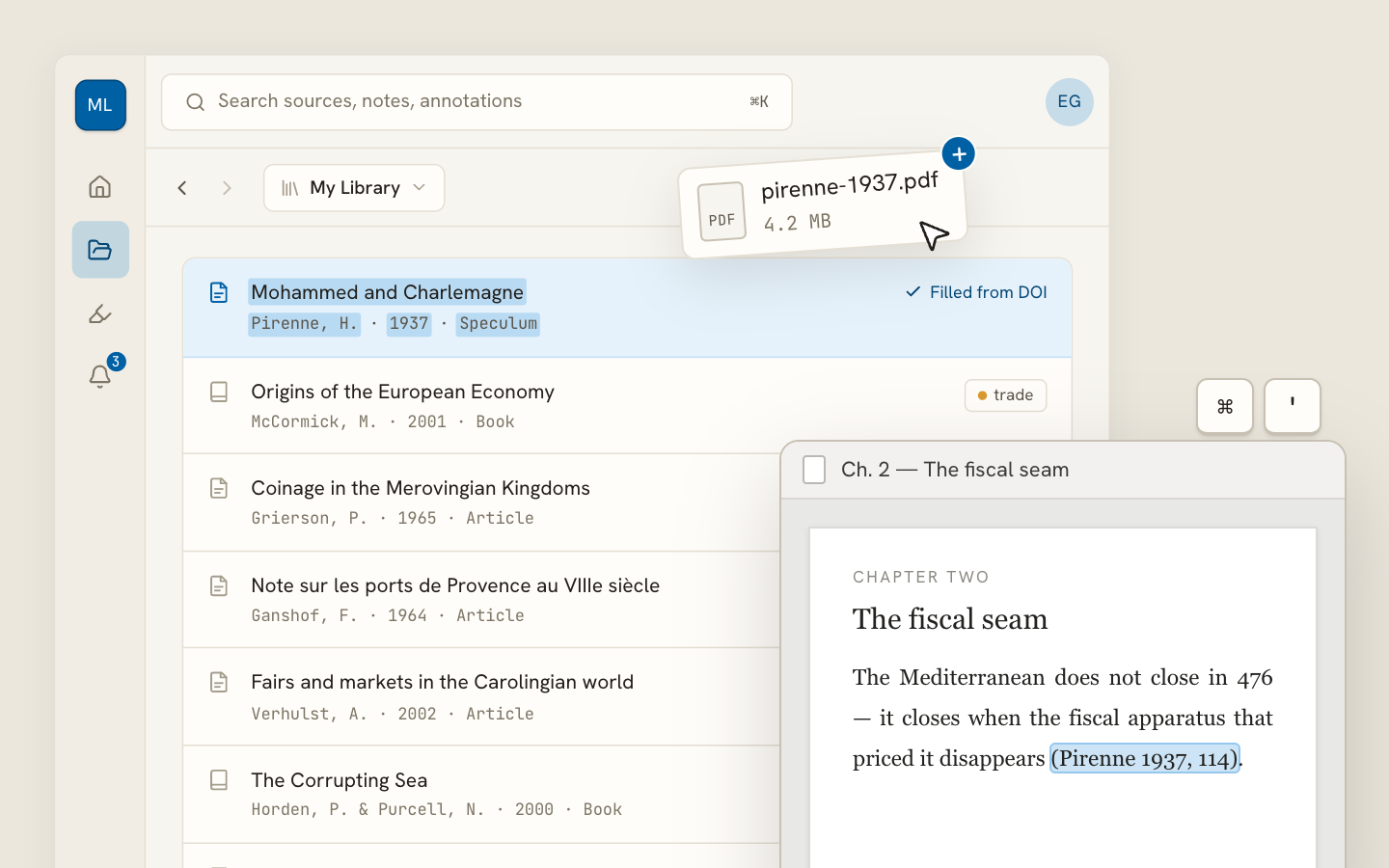
Archivero library view with a source list and an open PDF

Your weekly research workflow, in one email

One tested workflow, three links, no filler — every Tuesday.

Unsubscribe in one click. We never share your address.

Guides/Citations/APA Citation Style

APA Citation With Multiple Authors

How to cite sources with 2, 3, or more authors in APA 7th edition, including the et al. rule.

7 min readAPA

On this page

1 of 12
One Author — The BaselineTwo AuthorsThree or More Authors — The et al. RuleWhat Changed From the 6th EditionGroup and Organizational AuthorsGroup Author With a Well-Known AbbreviationGroup Author Without an AbbreviationAmbiguous "et al." — When Two Citations Look the SameTwenty-One or More AuthorsQuick-Reference TableCommon MistakesWhat's Next
All APA guides →

Most academic sources have more than one author. A psychology study might list three researchers. A textbook might have a dozen contributors. And a large-scale meta-analysis could name twenty or more.

The good news is that APA 7th edition simplified the multi-author rules significantly. If you learned the old system (where you listed every author the first time and used "et al." after that), you can forget it. The new rules are cleaner — let's walk through them.

One Author — The Baseline

Before tackling multiple authors, let's anchor on the simplest case:

Reference list:

Garcia, M. L. (2022). Decision-making under uncertainty: A cognitive approach. Oxford University Press.

In-text citations:

Parenthetical:(Garcia, 2022)

Narrative:Garcia (2022) argued that…

One name, one year. That's the foundation everything else builds on.

Two Authors

When a work has two authors, include both names every time you cite it — in every single citation, first and subsequent.

Reference list:

Patel, R., & Nakamura, K. (2021). Bilingual advantages in executive function: A longitudinal study. Developmental Psychology, 57(3), 412–425. https://doi.org/10.1037/dev0001148

In-text citations:

Parenthetical:(Patel & Nakamura, 2021)

Narrative:Patel and Nakamura (2021) found that…

Notice the difference:

  • In parenthetical citations and in the reference list, use the ampersand (&).
  • In narrative citations (where the names are part of your sentence), write out "and."

This is one of the most common small errors in student papers. Think of it this way: if the names are inside parentheses, use &. If they're outside parentheses, use "and."

Three or More Authors — The et al. Rule

This is where APA 7th edition made the biggest change. The rule is now beautifully simple:

For works with three or more authors, use the first author's last name followed by "et al." in every citation — including the very first one.

That's it. No more listing all authors the first time. No more switching between formats depending on whether it's the first or subsequent citation. Just "et al." from the start.

Reference list (list all authors up to 20):

Henrich, J., Heine, S. J., & Norenzayan, A. (2010). The weirdest people in the world? Behavioral and Brain Sciences, 33(2–3), 61–83. https://doi.org/10.1017/S0140525X0999152X

In-text citations (every time):

Parenthetical:(Henrich et al., 2010)

Narrative:Henrich et al. (2010) argued that…

Key details about et al.:

  • "et al." is short for et alia (Latin for "and others").
  • The "et" has no period after it. The "al." does have a period — because it's an abbreviation.
  • It's not italicized in the text.
  • In a narrative citation, the sentence verb agrees with the full author group: "Henrich et al. (2010) found that…" — not "Henrich et al. finds."

What Changed From the 6th Edition

If your instructor learned APA under the 6th edition — or if you're updating a paper from an older format — here's what's different:

Rule6th Edition7th Edition
3–5 authors, first citation6th EditionList all authors7th EditionUse et al. from the first citation
3–5 authors, subsequent citations6th EditionUse et al.7th EditionUse et al.
6+ authors6th EditionUse et al. from first citation7th EditionUse et al. from first citation
Reference list, max authors before "…"6th Edition77th Edition20

In plain English: The 6th edition had different rules for 3–5 authors vs. 6+ authors. The 7th edition collapsed those into a single rule: three or more = et al. every time. It also expanded the reference list limit from 7 authors to 20 before you start using the ellipsis.

For a complete comparison of all edition changes, see APA 6th vs. 7th Edition — What Changed.

Group and Organizational Authors

When an organization is the author (rather than individual people), the group name replaces the author's last name in the citation.

Group Author With a Well-Known Abbreviation

If the organization has a familiar abbreviation, spell it out the first time and abbreviate it after that:

First citation (parenthetical):(American Psychological Association [APA], 2020)

Subsequent citations:(APA, 2020)

First citation (narrative):The American Psychological Association (APA, 2020) recommends…

Subsequent citations:APA (2020) recommends…

Group Author Without an Abbreviation

If the organization doesn't have a standard abbreviation (or the abbreviation wouldn't be recognized by your readers), spell out the full name every time:

Every citation:(National Sleep Foundation, 2024)

Narrative:The National Sleep Foundation (2024) reports that…

Don't abbreviate unless it helps. Abbreviations like WHO, CDC, NASA, and APA are universally recognized. But "University of Colorado Denver" abbreviated to "UCD" would confuse more than it helps — just write it out each time.

Reference list (both cases):

American Psychological Association. (2020). Publication manual of the American Psychological Association (7th ed.). American Psychological Association.

In the reference list, always use the full name — never the abbreviation.

Ambiguous "et al." — When Two Citations Look the Same

Here's a tricky situation. Suppose you're citing two different papers that, when shortened to "first author et al.," look identical:

  • Paper A: Torres, Kim, & Osei (2022)
  • Paper B: Torres, Nakamura, & Chen (2022)

Both would shorten to (Torres et al., 2022). Your reader wouldn't know which paper you mean.

The fix: Include as many author names as needed to distinguish the two citations, then add "et al.":

(Torres, Kim, et al., 2022) — referring to Paper A

(Torres, Nakamura, et al., 2022) — referring to Paper B

In the reference list, both entries are listed fully as usual — no ambiguity there.

This rule only kicks in when two or more references would produce identical shortened citations. If there's no ambiguity, use the standard "first author et al." format.

Twenty-One or More Authors

Most student papers won't encounter this, but it comes up in large-scale scientific research. If a work has 21 or more authors:

Reference list: List the first 19 authors, then insert an ellipsis (…), then the last author:

Kaptchuk, T. J., Miller, F. G., Irwin, S., Reardon, C., Park, C., Nedeljkovic, M., Jütte, R., Sismondo, S., Mitseas, A., Fernandez, M. A., Moerman, D. E., Meissner, K., Gold, J. I., Colloca, L., Barsky, A. J., Benedetti, F., Enck, P., Klinger, R., Vase, L., … Whitehead, W. E. (2023). Toward a placebo science: A multicenter study. Pain, 164(2), 301–315.

In-text citations: Same as always — first author + et al.:

(Kaptchuk et al., 2023)

Quick-Reference Table

Number of AuthorsIn-Text Citation (Every Time)Reference List
1In-Text Citation (Every Time)(Garcia, 2022)Reference ListGarcia, M. L. (2022).
2In-Text Citation (Every Time)(Patel & Nakamura, 2021)Reference ListPatel, R., & Nakamura, K. (2021).
3–20In-Text Citation (Every Time)(Henrich et al., 2010)Reference ListList all authors
21+In-Text Citation (Every Time)(Kaptchuk et al., 2023)Reference ListFirst 19 … last author
Group (known abbreviation)In-Text Citation (Every Time)First: (APA, 2020); then: (APA, 2020)Reference ListFull name
Group (no abbreviation)In-Text Citation (Every Time)(National Sleep Foundation, 2024)Reference ListFull name
Ambiguous et al.In-Text Citation (Every Time)(Torres, Kim, et al., 2022)Reference ListList all authors

Common Mistakes

These are the multi-author errors we see most often:

  1. Using "and" instead of "&" in parenthetical citations. Inside parentheses, it's always &. "And" is for narrative citations only.
  2. Listing all authors the first time (6th edition habit). In APA 7th, use et al. from the very first citation when there are three or more authors.
  3. Using et al. in the reference list. Never. The reference list always spells out every author's name (up to 20).
  4. Putting a period after "et." "et" is a complete Latin word, not an abbreviation. No period: et al. — not et. al.
  5. Forgetting to introduce the abbreviation for group authors. Spell out the full name on first use (with the abbreviation in brackets) before switching to the abbreviation.
  6. Abbreviating obscure group names. Only abbreviate if the abbreviation is well-known. If your reader wouldn't recognize it, spell it out every time.

What's Next

Now that you know how to handle multiple authors, explore these related topics:

  • How to Cite a Source With No Author in APA — what to do when there's no author at all
  • APA In-Text Citations — the complete guide to in-text citation formatting
  • APA Reference List — how to format your reference entries

Archivero handles multi-author citations automatically — it knows when to use et al., when to spell out "and," and when two references need disambiguation. Just save your sources and let Archivero do the formatting.

All APA guides →
← PreviousHow to Quote in APA FormatNext →How to Paraphrase in APA

More on APA style

The standard in psychology, education and the social sciences. The author–date system, reference-list formatting and what the 7th edition changed.

View all 34 guides →
8 sections·7 min readAPAHow to Paraphrase in APA8 sections·6 min readAPAHow to Cite a Source With No Author in APA8 sections·7 min readAPAHow to Cite a Secondary Source in APA6 sections·6 min readAPANarrative vs. Parenthetical Citations in APA

Your sources, PDFs and citations in one library

  • Import a Zotero, Mendeley or EndNote library — or a folder of PDFs
  • Highlight and annotate without leaving the source
  • Cite in any CSL style as you write, with one shared library for your lab
Request early accessSee the product →
Archivero library view with a source list and an open PDF

Your weekly research workflow, in one email

One tested workflow, three links, no filler — every Tuesday.

Unsubscribe in one click. We never share your address.