The terms thesis and dissertation are often used interchangeably, but they refer to different types of academic work depending on the degree level and the country. In the United States, a thesis is typically a master's-level research project, while a dissertation is a doctoral-level work that makes an original contribution to the field. In the United Kingdom and much of Europe, the terminology is reversed — "thesis" refers to the doctoral document and "dissertation" to the undergraduate or master's work.
Quick Comparison Table
| Thesis (US) | Dissertation (US) | |
|---|---|---|
| Degree level | Master's | Doctoral (PhD, EdD, etc.) |
| Purpose | Demonstrate mastery of existing research | Make an original contribution to knowledge |
| Originality | Applies, synthesizes, or extends existing work | Must produce new knowledge, theory, or findings |
| Length | 60–100 pages | 150–300+ pages |
| Research scope | Narrower — often one study or analysis | Broader — may include multiple studies or extensive data |
| Committee | 2–3 members | 4–5 members, often including an external examiner |
| Defense | Shorter, sometimes optional | Longer, formal, always required |
| Timeline | 1–2 years | 3–7 years |
| Typical chapter count | 4–5 chapters | 5–7 chapters |
What Is a Thesis?
In the US academic context, a thesis is a substantial research paper completed as a capstone requirement for a master's degree. It demonstrates that the student can:
- Identify a research question within their field
- Conduct a thorough literature review
- Apply appropriate research methods
- Analyze findings and draw conclusions
- Write at a scholarly level
A thesis shows mastery — the student understands the existing research landscape and can contribute to it in a focused, methodologically sound way. However, a thesis does not typically require the student to produce entirely new knowledge. Applying an existing framework to a new context, replicating a study with a different population, or synthesizing literature in a novel way all count as valid thesis work.
Master's theses typically follow a 5-chapter structure: Introduction, Literature Review, Methodology, Results, and Conclusion.
Not all master's programs require a thesis. Some offer alternatives such as a capstone project, comprehensive exams, or a portfolio. The thesis option is most common in research-oriented master's programs and in programs that serve as stepping stones to doctoral study.
What Is a Dissertation?
A dissertation is the defining scholarly work of a doctoral degree (PhD, EdD, DBA, and similar). It is the most substantial academic document most scholars ever produce, and it must make an original contribution to knowledge in the field.
"Original contribution" means the dissertation must produce something new — new data, a new theoretical framework, a new interpretation of existing evidence, or a new solution to a practical problem. The expectation is that the dissertation adds to the body of knowledge in ways that didn't exist before the student's research.
A dissertation typically requires:
- Independent research — the student designs and executes a study with committee guidance but without the hand-holding of a course structure
- Comprehensive literature review — a thorough, often exhaustive survey of the relevant scholarship
- Rigorous methodology — methods that can withstand scrutiny from experts in the field
- Publishable findings — many programs expect that parts of the dissertation can be published as journal articles
Dissertations typically follow a 5–7 chapter structure, though some programs use a "three-paper" model in which the dissertation consists of three related but standalone journal-length papers, unified by an introduction and conclusion.
Key Differences
Degree Level
The most fundamental difference: a thesis is for a master's degree, a dissertation is for a doctoral degree. This distinction drives all the others — doctoral programs demand more depth, more independence, and more originality because they are training students to become independent researchers and scholars.
Purpose and Scope
A master's thesis demonstrates that the student can engage with existing scholarship. A doctoral dissertation demonstrates that the student can advance it.
| Thesis | Dissertation | |
|---|---|---|
| Goal | Show mastery of a subject | Contribute new knowledge |
| Research scope | Narrower, often one study | Broader, often multiple phases |
| Independence | Guided closely by advisor | Greater independence expected |
A thesis might ask: "How does the Community of Inquiry framework apply to asynchronous courses at this university?" A dissertation on the same topic might ask: "How should the Community of Inquiry framework be revised to account for the unique engagement patterns observed in asynchronous courses?" — proposing a theoretical extension rather than an application.
Original Research vs. Existing Research
A thesis can work within established frameworks, replicate studies, or apply existing theories to new contexts. A dissertation must push beyond what is known. This is the criterion that most clearly separates the two.
Examples of original research that would be appropriate for each:
Thesis-level originality:
- Applying a well-studied model to an unstudied population
- Replicating a key study with updated data or a different context
- Comparing two existing approaches in a new setting
Dissertation-level originality:
- Proposing a new theoretical model based on original data
- Developing and validating a new measurement instrument
- Producing findings that challenge or extend an established theory
- Creating a new methodology for studying a known problem
Length
Length varies significantly by discipline, but the general pattern holds:
| Type | Typical Page Range |
|---|---|
| Master's thesis (humanities) | 60–100 pages |
| Master's thesis (STEM) | 40–80 pages |
| Doctoral dissertation (humanities) | 200–400 pages |
| Doctoral dissertation (STEM) | 100–200 pages |
| Doctoral dissertation (social sciences) | 150–300 pages |
These are rough ranges. Your institution and discipline set the actual expectations. Some STEM dissertations are shorter because they rely on equations and data rather than prose; some humanities dissertations are longer because the analysis is text-based.
Committee and Defense
Both theses and dissertations require committee oversight and a defense, but the expectations differ in scale and rigor.
Thesis committee:
- Typically 2–3 members from the student's department
- The chair is usually the student's advisor
- The defense may be 30–60 minutes, and some programs make it optional or replace it with a final portfolio review
Dissertation committee:
- Typically 4–5 members, including at least one external member from outside the department or university
- The defense is a formal event — usually 60–120 minutes — involving a presentation followed by questioning from the committee
- The committee may require revisions before granting final approval
For more on preparing for the defense, see Thesis Defense.
Regional Differences (US vs. UK vs. Europe)
The terminology varies by country, which creates confusion for students reading international sources.
| Country / Region | "Thesis" refers to… | "Dissertation" refers to… |
|---|---|---|
| United States | Master's-level research paper | Doctoral-level research (PhD) |
| United Kingdom | Doctoral-level research (PhD) | Undergraduate or master's-level paper |
| Europe (general) | Often used for doctoral work | Less common; varies by institution |
| Australia | Doctoral-level research | Undergraduate or master's-level paper |
In the UK, a student "writes a dissertation" for their undergraduate or master's degree and "submits a thesis" for their PhD — the exact reverse of US terminology.
This guide follows US conventions (thesis = master's, dissertation = doctoral) unless otherwise specified. When reading academic resources from other countries, pay attention to which definition the author is using.
Which Term Should You Use?
Follow the conventions of your institution and country. If you're enrolled in a master's program in the United States, your document is a thesis. If you're in a PhD program in the United States, it's a dissertation. If you're in the UK, reverse those terms.
When in doubt:
- Check your program's handbook or catalog — it will specify the required document and what it's called
- Look at recent graduates' work from your department — the title pages will show the correct term
- Ask your advisor — they've guided dozens of students through the same process
The content and structure of both documents are more similar than different. Both require a literature review, a methodology, a results section, and a defense. The scope, depth, and originality differ — but the fundamental skills are the same.
Next Steps
Whether you're writing a thesis or a dissertation, these guides help you through each stage:
- Thesis Structure — the standard chapter-by-chapter layout for both theses and dissertations
- Research Question — how to develop the central question your project investigates
- Thesis Proposal — how to pitch your planned research for committee approval
- Thesis Defense — how to prepare for and navigate the oral defense
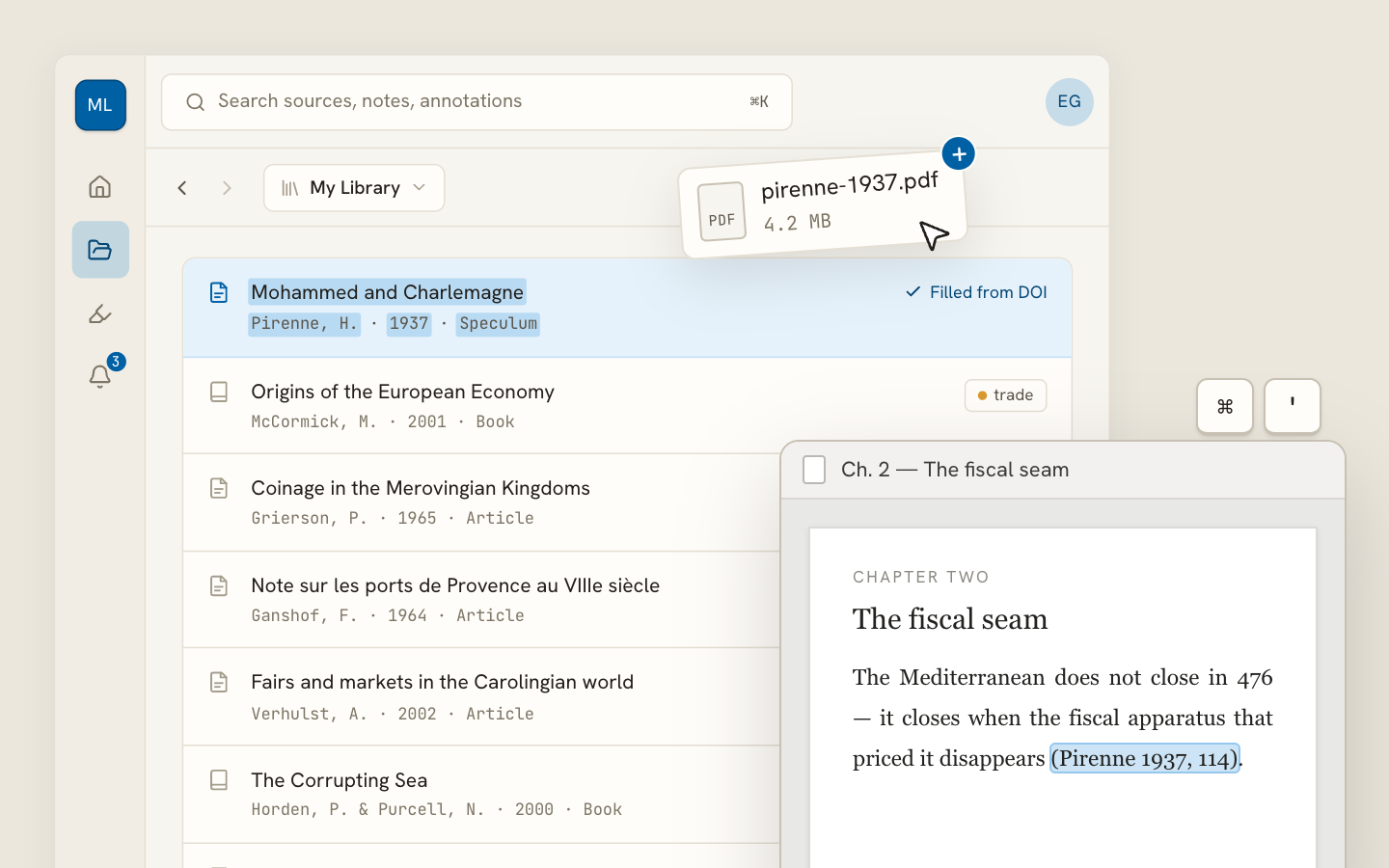
Archivero helps you manage the research process — whether it's a master's thesis or a doctoral dissertation — by keeping your sources, annotations, and notes organized in one place, so you can focus on the scholarship rather than the logistics.