Archivero is in early access — your sources, PDFs and citations in one library.Request early access →
Archivero/guides/
APAMLAHarvardThesis writing
Subscribe
Archivero/guides/Request early access →

Guides

APA styleMLA styleHarvard referencingThesis writing

Compare

APA 6th vs 7thMLA 8th vs 9thHarvard vs APAThesis vs dissertation

Product

FeaturesEarly access

Resources

DocsCheat sheetsNewsletter

Company

ContactStatus ↗
© 2025–2026 Ernesto F. GonzálezGuidesDocsContactPrivacyTerms
Guides/How to Write a Thesis

Research Question

How to write a research question for a thesis or dissertation — characteristics of a good question, types, examples by discipline, and common pitfalls.

9 min readThesis writing

Key Takeaways

  • A research question defines what your thesis investigates — it is the single question your entire study is designed to answer.
  • A thesis statement states your argument or claim; a research question states what you're investigating — the question comes first and the thesis statement answers it.
  • Strong research questions are focused (narrow enough to study), researchable (answerable with available methods and data), complex (not yes/no), and relevant (connected to a gap in the literature).
  • The four main types are descriptive (what is happening?), comparative (how do X and Y differ?), causal/explanatory (why does X happen?), and evaluative (how effective is X?).
  • Develop a research question by starting broad, doing preliminary reading, narrowing to a specific angle, and refining through iteration.
  • A thesis typically has one primary research question and 1–3 sub-questions that break the main question into manageable parts.
  • Avoid questions that are too broad, too narrow, too simple, or unanswerable with your available resources.

On this page

1 of 28
Key TakeawaysWhat Is a Research Question?Research Question vs. Thesis StatementCharacteristics of a Strong Research QuestionFocusedResearchableComplex (Not Yes/No)RelevantTypes of Research QuestionsDescriptiveComparativeCausal / ExplanatoryEvaluativeHow to Develop a Research QuestionStep 1: Choose a Broad TopicStep 2: Do Preliminary ReadingStep 3: Narrow to a Specific AngleStep 4: Formulate and RefineSub-QuestionsExamples by DisciplineEducationPsychologyPublic HealthComputer ScienceLiteratureBusiness / ManagementCommon MistakesNext Steps
All Thesis writing guides →

A research question is the central question a thesis or dissertation sets out to answer — it defines the scope of the study, guides the methodology, and shapes the entire structure of the paper. A strong research question is focused, researchable, complex (not answerable with a simple yes or no), and directly connected to a gap identified in the existing literature.

What Is a Research Question?

A research question is a clearly formulated question that identifies exactly what your thesis or dissertation will investigate. It sits at the heart of the research process — everything else flows from it:

  • The literature review establishes the context and gap that makes your question worth asking
  • The methodology describes how you'll answer it
  • The results present what you found
  • The conclusion answers it directly

Without a clear research question, a thesis lacks direction. Readers should be able to point to your research question and understand, in a single sentence, what your study is about and what kind of answer it seeks.

Research questions typically appear in the Introduction chapter (Chapter 1), after the problem statement and before the description of the study's scope. Some programs also require them in the thesis proposal.

Research Question vs. Thesis Statement

These two concepts are closely related but serve different functions.

Research QuestionThesis Statement
FormResearch QuestionA questionThesis StatementA declarative statement
When it's writtenResearch QuestionBefore the research beginsThesis StatementAfter research and analysis
FunctionResearch QuestionDefines what you're investigatingThesis StatementStates what you've concluded
Found inResearch QuestionIntroduction, proposalThesis StatementIntroduction (essays), sometimes Conclusion (theses)
ExampleResearch Question"How does remote work affect employee productivity in the tech industry?"Thesis Statement"Remote work increases employee productivity in the tech industry by reducing commute-related fatigue and enabling flexible scheduling."

The research question opens the investigation. The thesis statement — or, in a thesis/dissertation, the findings — closes it.

For essays and shorter papers, the thesis statement is the primary structural element. For theses and dissertations, the research question plays that role, and the "answer" emerges through the full study rather than being stated in a single sentence up front.

For more on thesis statements, see What Is a Thesis Statement?.

Characteristics of a Strong Research Question

Focused

A strong research question is narrow enough that it can be answered within the scope of your thesis. If the question requires an entire book — or an entire career — to answer, it's too broad.

  • Too broad: "How does social media affect society?"
  • Focused: "How does Instagram use affect body image satisfaction among female college students aged 18–22?"

Narrowing involves specifying the population, the variables, the context, and the timeframe.

Researchable

The question must be answerable using available research methods, data sources, and resources. A question might be intellectually fascinating but practically unanswerable if the data doesn't exist, the population is inaccessible, or the ethics are prohibitive.

  • Not researchable (with typical resources): "What do all employees worldwide think about remote work?"
  • Researchable: "How do software engineers at mid-size US companies perceive the impact of remote work on their productivity?"

Consider whether you can realistically collect the data you'd need — within your timeline, budget, and institutional constraints.

Complex (Not Yes/No)

Research questions should require analysis, interpretation, or explanation — not a simple factual lookup or a binary yes/no answer.

  • Too simple: "Do students use social media?" (Yes — research complete.)
  • Complex: "How do first-year university students perceive the influence of social media on their academic motivation?"

Questions starting with "how," "why," "to what extent," or "in what ways" naturally produce complex answers. Questions starting with "do" or "is" often produce yes/no answers — though they can work in quantitative studies if paired with measurable variables (e.g., "Is there a significant difference between…").

Relevant

The question should address a genuine gap in the existing literature. The literature review establishes what's been studied; the research question targets what hasn't.

  • No clear relevance: "What color are university library walls?" (No scholarly gap to fill.)
  • Relevant: "How does library spatial design influence undergraduate students' self-reported concentration and study duration?"

A relevant research question connects to existing theory, addresses a practical problem, or extends prior research into a new context.

Types of Research Questions

Descriptive

Descriptive questions ask what is happening — they seek to identify, describe, or document a phenomenon.

"What strategies do high school teachers in rural districts use to integrate technology into their classrooms?"

Descriptive questions are common in exploratory and qualitative research. They map a territory rather than testing a hypothesis.

Comparative

Comparative questions ask how two or more groups, variables, or phenomena differ.

"How do the study habits of first-generation college students compare to those of continuing-generation students?"

These questions often lead to quantitative designs with comparison groups, though qualitative comparative studies exist as well.

Causal / Explanatory

Causal questions ask why something happens or what causes a particular outcome.

"What is the effect of mindfulness-based interventions on test anxiety among undergraduate students?"

Causal questions require designs that can isolate cause and effect — experiments, quasi-experiments, or (with appropriate caveats) longitudinal studies.

Evaluative

Evaluative questions ask how effective, useful, or successful something is.

"How effective is peer tutoring in improving math achievement among middle school students with learning disabilities?"

Evaluative questions are common in applied research, program evaluation, and policy analysis.

How to Develop a Research Question

Step 1: Choose a Broad Topic

Start with a general area of interest. At this stage, you're not trying to be precise — you're identifying the territory.

Broad topic:"Online learning and student engagement"

Step 2: Do Preliminary Reading

Read survey articles, literature reviews, and recent studies in your area. Pay attention to:

  • What has already been studied extensively
  • What gaps or limitations previous researchers have noted
  • What contexts or populations remain underexplored

Preliminary reading transforms a vague interest into an informed focus. The gaps you find in the literature become the raw material for your research question.

Step 3: Narrow to a Specific Angle

Apply constraints — a specific population, context, variable, or time frame — to move from a broad topic to a researchable question.

Broad:"Online learning and student engagement" Narrower: "Asynchronous online courses and student engagement" Specific: "How does asynchronous course design affect self-reported engagement among first-generation college students at public universities?"

Each narrowing step makes the question more focused, more researchable, and more answerable within the scope of a thesis.

Step 4: Formulate and Refine

Write the question out in full. Then test it against the four criteria:

  1. Focused? — Can I answer this within the scope of my thesis?
  2. Researchable? — Can I collect the necessary data?
  3. Complex? — Does it require analysis, not just a yes/no answer?
  4. Relevant? — Does it address a gap in the literature?

Refine iteratively. Most researchers revise their research question multiple times as they deepen their understanding of the literature and clarify their methodology.

Sub-Questions

Most theses include one primary research question and 1–3 sub-questions that break the main question into specific, manageable components.

Primary:How does asynchronous course design affect self-reported engagement among first-generation college students?

Sub-question 1:Which specific course design features (e.g., discussion forums, recorded lectures, asynchronous group projects) are most strongly associated with student engagement?

Sub-question 2:How do first-generation students describe their experience of engagement in asynchronous courses compared to synchronous ones?

Sub-question 3:What role does instructor feedback timing play in first-generation students' perceptions of engagement?

Sub-questions serve several purposes:

  • They operationalize the primary question by specifying what you'll actually measure or explore
  • They often map to different sections of the Results chapter
  • In mixed-methods studies, different sub-questions may correspond to different methods (e.g., one quantitative, one qualitative)

Examples by Discipline

Education

"To what extent does culturally responsive teaching in elementary science classrooms affect student achievement and science self-efficacy among Black and Latino students?"

Psychology

"How do attachment styles predict relationship satisfaction and conflict resolution strategies among cohabiting couples aged 25–35?"

Public Health

"What barriers do undocumented immigrants in urban areas face in accessing preventive healthcare services, and how do these barriers vary by gender and age?"

Computer Science

"How does the integration of explainable AI (XAI) techniques affect end-user trust in automated medical diagnostic systems?"

Literature

"In what ways does Toni Morrison's use of non-linear narrative structure in Beloved challenge conventional representations of historical trauma in American fiction?"

Business / Management

"How do mid-level managers in multinational corporations perceive the effectiveness of virtual team-building activities in maintaining team cohesion during fully remote work?"

Common Mistakes

  1. Too broad. "How does technology affect education?" could fill a library. Narrow the population, the technology, the educational outcome, and the context.

  2. Too narrow. "Does using Kahoot quizzes in my Tuesday 10am Biology 101 section improve quiz scores?" is so specific it has no broader relevance. Find the balance between specificity and generalizability.

  3. Answerable with a simple fact. "What percentage of college students use social media?" is a lookup, not a research question. A thesis-level question requires analysis and interpretation.

  4. Leading or biased. "Why is social media harmful to teenagers?" assumes the conclusion. Reframe as "How do teenagers perceive the impact of social media on their well-being?" to allow the data to speak.

  5. Unanswerable with available methods. "What will education look like in 2050?" is speculative, not researchable. Stick to questions that your methodology can address with available data.

  6. No connection to the literature. A research question that emerges from personal curiosity alone, without grounding in existing scholarship, won't produce a defensible thesis. The literature review must establish why your question matters.

  7. Multiple questions disguised as one. "How does social media affect academic performance and mental health among college students?" is really two questions. Split them into a primary question and sub-questions, or choose one focus.

Next Steps

Once your research question is defined, build the rest of your thesis around it:

  • How to Write a Thesis Statement — craft the statement that answers your research question
  • Thesis Structure — see how the research question fits into the broader thesis framework
  • Thesis Introduction — where your research question is formally presented
  • Literature Review — how to identify the gap that justifies your question
  • Methodology — designing the approach that will answer your question
  • Thesis Proposal — how to present your question and planned methodology for approval

Archivero helps you develop and refine your research question by keeping your sources, annotations, and literature review organized — so you can identify the gaps that lead to a strong, original question.
All Thesis writing guides →
← PreviousExpository Thesis StatementNext →Thesis Structure

More on Thesis writing

From crafting a thesis statement to structuring chapters, writing the proposal and preparing for the defence.

View all 19 guides →
12 sections·9 min readThesis writingThesis Structure7 sections·8 min readThesis writingThesis Introduction8 sections·9 min readThesis writingLiterature Review8 sections·9 min readThesis writingThesis Methodology

Your sources, PDFs and citations in one library

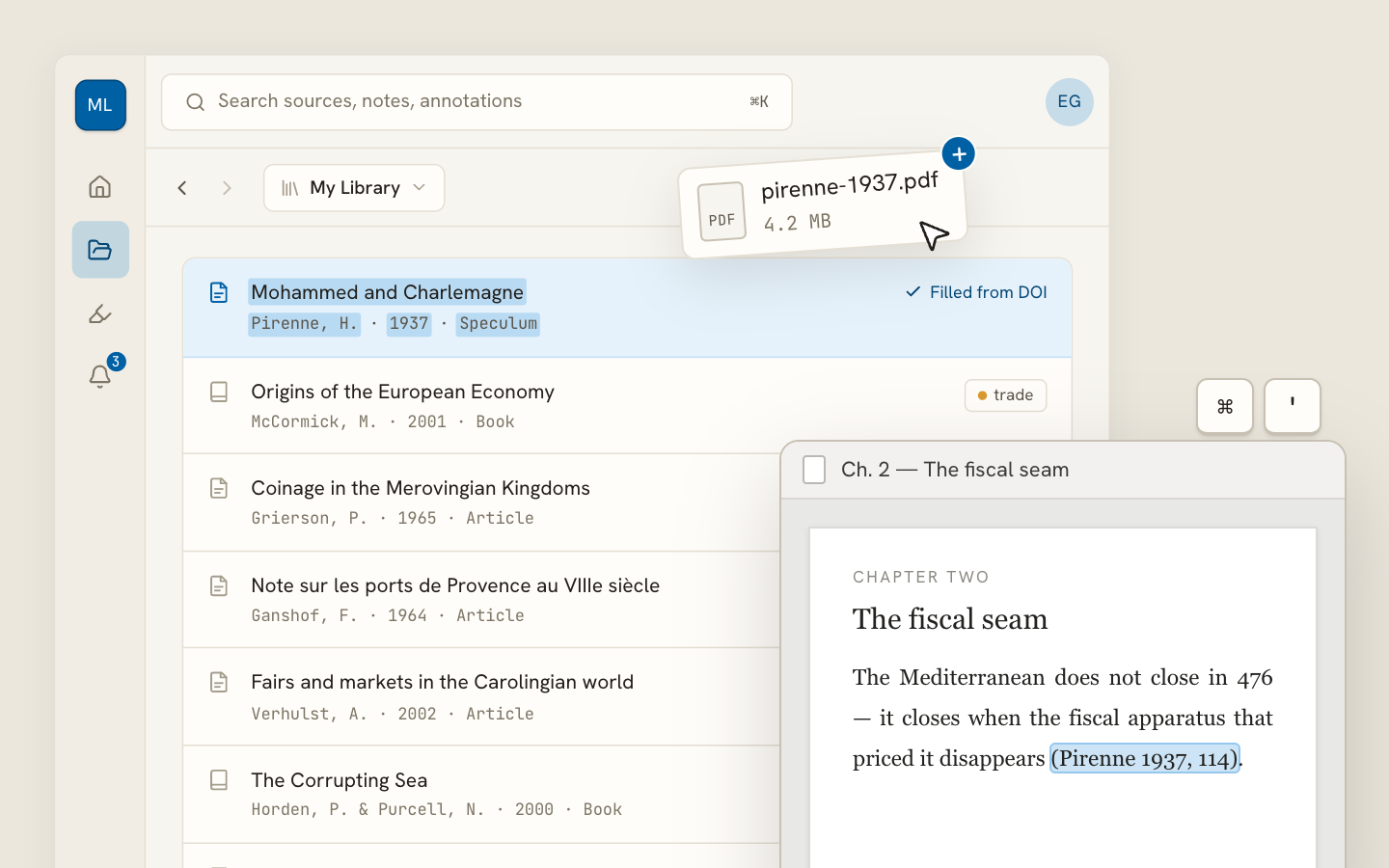
  • Import a Zotero, Mendeley or EndNote library — or a folder of PDFs
  • Highlight and annotate without leaving the source
  • Cite in any CSL style as you write, with one shared library for your lab
Request early accessSee the product →
Archivero library view with a source list and an open PDF

Your weekly research workflow, in one email

One tested workflow, three links, no filler — every Tuesday.

Unsubscribe in one click. We never share your address.

Guides/How to Write a Thesis

Research Question

How to write a research question for a thesis or dissertation — characteristics of a good question, types, examples by discipline, and common pitfalls.

9 min readThesis writing

Key Takeaways

  • A research question defines what your thesis investigates — it is the single question your entire study is designed to answer.
  • A thesis statement states your argument or claim; a research question states what you're investigating — the question comes first and the thesis statement answers it.
  • Strong research questions are focused (narrow enough to study), researchable (answerable with available methods and data), complex (not yes/no), and relevant (connected to a gap in the literature).
  • The four main types are descriptive (what is happening?), comparative (how do X and Y differ?), causal/explanatory (why does X happen?), and evaluative (how effective is X?).
  • Develop a research question by starting broad, doing preliminary reading, narrowing to a specific angle, and refining through iteration.
  • A thesis typically has one primary research question and 1–3 sub-questions that break the main question into manageable parts.
  • Avoid questions that are too broad, too narrow, too simple, or unanswerable with your available resources.

On this page

1 of 28
Key TakeawaysWhat Is a Research Question?Research Question vs. Thesis StatementCharacteristics of a Strong Research QuestionFocusedResearchableComplex (Not Yes/No)RelevantTypes of Research QuestionsDescriptiveComparativeCausal / ExplanatoryEvaluativeHow to Develop a Research QuestionStep 1: Choose a Broad TopicStep 2: Do Preliminary ReadingStep 3: Narrow to a Specific AngleStep 4: Formulate and RefineSub-QuestionsExamples by DisciplineEducationPsychologyPublic HealthComputer ScienceLiteratureBusiness / ManagementCommon MistakesNext Steps
All Thesis writing guides →

A research question is the central question a thesis or dissertation sets out to answer — it defines the scope of the study, guides the methodology, and shapes the entire structure of the paper. A strong research question is focused, researchable, complex (not answerable with a simple yes or no), and directly connected to a gap identified in the existing literature.

What Is a Research Question?

A research question is a clearly formulated question that identifies exactly what your thesis or dissertation will investigate. It sits at the heart of the research process — everything else flows from it:

  • The literature review establishes the context and gap that makes your question worth asking
  • The methodology describes how you'll answer it
  • The results present what you found
  • The conclusion answers it directly

Without a clear research question, a thesis lacks direction. Readers should be able to point to your research question and understand, in a single sentence, what your study is about and what kind of answer it seeks.

Research questions typically appear in the Introduction chapter (Chapter 1), after the problem statement and before the description of the study's scope. Some programs also require them in the thesis proposal.

Research Question vs. Thesis Statement

These two concepts are closely related but serve different functions.

Research QuestionThesis Statement
FormResearch QuestionA questionThesis StatementA declarative statement
When it's writtenResearch QuestionBefore the research beginsThesis StatementAfter research and analysis
FunctionResearch QuestionDefines what you're investigatingThesis StatementStates what you've concluded
Found inResearch QuestionIntroduction, proposalThesis StatementIntroduction (essays), sometimes Conclusion (theses)
ExampleResearch Question"How does remote work affect employee productivity in the tech industry?"Thesis Statement"Remote work increases employee productivity in the tech industry by reducing commute-related fatigue and enabling flexible scheduling."

The research question opens the investigation. The thesis statement — or, in a thesis/dissertation, the findings — closes it.

For essays and shorter papers, the thesis statement is the primary structural element. For theses and dissertations, the research question plays that role, and the "answer" emerges through the full study rather than being stated in a single sentence up front.

For more on thesis statements, see What Is a Thesis Statement?.

Characteristics of a Strong Research Question

Focused

A strong research question is narrow enough that it can be answered within the scope of your thesis. If the question requires an entire book — or an entire career — to answer, it's too broad.

  • Too broad: "How does social media affect society?"
  • Focused: "How does Instagram use affect body image satisfaction among female college students aged 18–22?"

Narrowing involves specifying the population, the variables, the context, and the timeframe.

Researchable

The question must be answerable using available research methods, data sources, and resources. A question might be intellectually fascinating but practically unanswerable if the data doesn't exist, the population is inaccessible, or the ethics are prohibitive.

  • Not researchable (with typical resources): "What do all employees worldwide think about remote work?"
  • Researchable: "How do software engineers at mid-size US companies perceive the impact of remote work on their productivity?"

Consider whether you can realistically collect the data you'd need — within your timeline, budget, and institutional constraints.

Complex (Not Yes/No)

Research questions should require analysis, interpretation, or explanation — not a simple factual lookup or a binary yes/no answer.

  • Too simple: "Do students use social media?" (Yes — research complete.)
  • Complex: "How do first-year university students perceive the influence of social media on their academic motivation?"

Questions starting with "how," "why," "to what extent," or "in what ways" naturally produce complex answers. Questions starting with "do" or "is" often produce yes/no answers — though they can work in quantitative studies if paired with measurable variables (e.g., "Is there a significant difference between…").

Relevant

The question should address a genuine gap in the existing literature. The literature review establishes what's been studied; the research question targets what hasn't.

  • No clear relevance: "What color are university library walls?" (No scholarly gap to fill.)
  • Relevant: "How does library spatial design influence undergraduate students' self-reported concentration and study duration?"

A relevant research question connects to existing theory, addresses a practical problem, or extends prior research into a new context.

Types of Research Questions

Descriptive

Descriptive questions ask what is happening — they seek to identify, describe, or document a phenomenon.

"What strategies do high school teachers in rural districts use to integrate technology into their classrooms?"

Descriptive questions are common in exploratory and qualitative research. They map a territory rather than testing a hypothesis.

Comparative

Comparative questions ask how two or more groups, variables, or phenomena differ.

"How do the study habits of first-generation college students compare to those of continuing-generation students?"

These questions often lead to quantitative designs with comparison groups, though qualitative comparative studies exist as well.

Causal / Explanatory

Causal questions ask why something happens or what causes a particular outcome.

"What is the effect of mindfulness-based interventions on test anxiety among undergraduate students?"

Causal questions require designs that can isolate cause and effect — experiments, quasi-experiments, or (with appropriate caveats) longitudinal studies.

Evaluative

Evaluative questions ask how effective, useful, or successful something is.

"How effective is peer tutoring in improving math achievement among middle school students with learning disabilities?"

Evaluative questions are common in applied research, program evaluation, and policy analysis.

How to Develop a Research Question

Step 1: Choose a Broad Topic

Start with a general area of interest. At this stage, you're not trying to be precise — you're identifying the territory.

Broad topic:"Online learning and student engagement"

Step 2: Do Preliminary Reading

Read survey articles, literature reviews, and recent studies in your area. Pay attention to:

  • What has already been studied extensively
  • What gaps or limitations previous researchers have noted
  • What contexts or populations remain underexplored

Preliminary reading transforms a vague interest into an informed focus. The gaps you find in the literature become the raw material for your research question.

Step 3: Narrow to a Specific Angle

Apply constraints — a specific population, context, variable, or time frame — to move from a broad topic to a researchable question.

Broad:"Online learning and student engagement" Narrower: "Asynchronous online courses and student engagement" Specific: "How does asynchronous course design affect self-reported engagement among first-generation college students at public universities?"

Each narrowing step makes the question more focused, more researchable, and more answerable within the scope of a thesis.

Step 4: Formulate and Refine

Write the question out in full. Then test it against the four criteria:

  1. Focused? — Can I answer this within the scope of my thesis?
  2. Researchable? — Can I collect the necessary data?
  3. Complex? — Does it require analysis, not just a yes/no answer?
  4. Relevant? — Does it address a gap in the literature?

Refine iteratively. Most researchers revise their research question multiple times as they deepen their understanding of the literature and clarify their methodology.

Sub-Questions

Most theses include one primary research question and 1–3 sub-questions that break the main question into specific, manageable components.

Primary:How does asynchronous course design affect self-reported engagement among first-generation college students?

Sub-question 1:Which specific course design features (e.g., discussion forums, recorded lectures, asynchronous group projects) are most strongly associated with student engagement?

Sub-question 2:How do first-generation students describe their experience of engagement in asynchronous courses compared to synchronous ones?

Sub-question 3:What role does instructor feedback timing play in first-generation students' perceptions of engagement?

Sub-questions serve several purposes:

  • They operationalize the primary question by specifying what you'll actually measure or explore
  • They often map to different sections of the Results chapter
  • In mixed-methods studies, different sub-questions may correspond to different methods (e.g., one quantitative, one qualitative)

Examples by Discipline

Education

"To what extent does culturally responsive teaching in elementary science classrooms affect student achievement and science self-efficacy among Black and Latino students?"

Psychology

"How do attachment styles predict relationship satisfaction and conflict resolution strategies among cohabiting couples aged 25–35?"

Public Health

"What barriers do undocumented immigrants in urban areas face in accessing preventive healthcare services, and how do these barriers vary by gender and age?"

Computer Science

"How does the integration of explainable AI (XAI) techniques affect end-user trust in automated medical diagnostic systems?"

Literature

"In what ways does Toni Morrison's use of non-linear narrative structure in Beloved challenge conventional representations of historical trauma in American fiction?"

Business / Management

"How do mid-level managers in multinational corporations perceive the effectiveness of virtual team-building activities in maintaining team cohesion during fully remote work?"

Common Mistakes

  1. Too broad. "How does technology affect education?" could fill a library. Narrow the population, the technology, the educational outcome, and the context.

  2. Too narrow. "Does using Kahoot quizzes in my Tuesday 10am Biology 101 section improve quiz scores?" is so specific it has no broader relevance. Find the balance between specificity and generalizability.

  3. Answerable with a simple fact. "What percentage of college students use social media?" is a lookup, not a research question. A thesis-level question requires analysis and interpretation.

  4. Leading or biased. "Why is social media harmful to teenagers?" assumes the conclusion. Reframe as "How do teenagers perceive the impact of social media on their well-being?" to allow the data to speak.

  5. Unanswerable with available methods. "What will education look like in 2050?" is speculative, not researchable. Stick to questions that your methodology can address with available data.

  6. No connection to the literature. A research question that emerges from personal curiosity alone, without grounding in existing scholarship, won't produce a defensible thesis. The literature review must establish why your question matters.

  7. Multiple questions disguised as one. "How does social media affect academic performance and mental health among college students?" is really two questions. Split them into a primary question and sub-questions, or choose one focus.

Next Steps

Once your research question is defined, build the rest of your thesis around it:

  • How to Write a Thesis Statement — craft the statement that answers your research question
  • Thesis Structure — see how the research question fits into the broader thesis framework
  • Thesis Introduction — where your research question is formally presented
  • Literature Review — how to identify the gap that justifies your question
  • Methodology — designing the approach that will answer your question
  • Thesis Proposal — how to present your question and planned methodology for approval

Archivero helps you develop and refine your research question by keeping your sources, annotations, and literature review organized — so you can identify the gaps that lead to a strong, original question.

All Thesis writing guides →
← PreviousExpository Thesis StatementNext →Thesis Structure

More on Thesis writing

From crafting a thesis statement to structuring chapters, writing the proposal and preparing for the defence.

View all 19 guides →
12 sections·9 min readThesis writingThesis Structure7 sections·8 min readThesis writingThesis Introduction8 sections·9 min readThesis writingLiterature Review8 sections·9 min readThesis writingThesis Methodology

Your sources, PDFs and citations in one library

  • Import a Zotero, Mendeley or EndNote library — or a folder of PDFs
  • Highlight and annotate without leaving the source
  • Cite in any CSL style as you write, with one shared library for your lab
Request early accessSee the product →
Archivero library view with a source list and an open PDF

Your weekly research workflow, in one email

One tested workflow, three links, no filler — every Tuesday.

Unsubscribe in one click. We never share your address.