Archivero is in early access — your sources, PDFs and citations in one library.Request early access →
Archivero/guides/
APAMLAHarvardThesis writing
Subscribe
Archivero/guides/Request early access →

Guides

APA styleMLA styleHarvard referencingThesis writing

Compare

APA 6th vs 7thMLA 8th vs 9thHarvard vs APAThesis vs dissertation

Product

FeaturesEarly access

Resources

DocsCheat sheetsNewsletter

Company

ContactStatus ↗
© 2025–2026 Ernesto F. GonzálezGuidesDocsContactPrivacyTerms
Guides/How to Write a Thesis

Thesis Introduction

How to write a thesis introduction — including background context, the research problem, objectives, research questions, and the thesis statement.

8 min readThesis writing

Key Takeaways

  • The thesis introduction frames the research — it provides context, defines the problem, and states the research questions.
  • It follows a funnel structure: broad field → narrowed topic → specific research problem → research questions → thesis statement.
  • A complete introduction includes background, problem statement, research objectives, research questions or hypotheses, thesis statement, scope and limitations, and a chapter overview.
  • The problem statement is the most important element — it tells the reader what gap or issue your research addresses.
  • The thesis statement appears near the end of the introduction and declares your central argument or the position your findings support.
  • The introduction is not an abstract — it provides context and justification, while the abstract summarizes the entire thesis including results and conclusions.
  • Most thesis introductions run 5–15 pages (1,500–5,000 words), depending on the discipline and overall thesis length.
  • Write the introduction last or revise it last — once you know your results, you can frame the problem more precisely.

On this page

1 of 15
Key TakeawaysPurpose of the IntroductionWhat to IncludeBackground and ContextProblem StatementResearch ObjectivesResearch Questions or HypothesesThesis StatementScope and LimitationsChapter OverviewHow Long Should It Be?Introduction vs. AbstractExample StructureCommon MistakesNext Steps
All Thesis writing guides →

The introduction is the first chapter of a thesis or dissertation, and it serves a single purpose: to frame the research so the reader understands what you studied, why it matters, and how you approached it. A strong introduction moves from broad context to a specific research question, ending with a clear thesis statement and a roadmap of the chapters that follow.

Purpose of the Introduction

The introduction answers three questions for the reader:

  1. What is the topic? — the broad subject area and narrowed focus
  2. Why does it matter? — why this research is needed, what gap it fills
  3. What did you set out to do? — your research questions and objectives

Everything in the introduction should build toward the thesis statement. Background context isn't there for decoration — it's there to show the reader why your research question is worth asking and why previous work hasn't fully answered it.

The introduction also sets the tone for the thesis. It establishes your academic voice, demonstrates your command of the field, and gives the reader confidence that the research was approached rigorously.

What to Include

A thesis introduction typically contains seven components, presented in this order.

Background and Context

Start by establishing the broader landscape your research sits within. This isn't a full literature review — it's a brief orientation that gives the reader enough context to understand the problem.

For example, if your thesis investigates the effects of remote learning on student engagement, you might open with the rapid shift to online education during the COVID-19 pandemic, the scale of the change, and the questions it raised about educational effectiveness.

Keep the background focused: every piece of context you include should connect to the research problem you're about to introduce. If a fact or trend doesn't lead toward your specific question, it doesn't belong in the introduction.

Problem Statement

The problem statement is the core of the introduction. It identifies the specific gap, conflict, or unanswered question that your research addresses.

A strong problem statement does three things:

  1. Identifies what is unknown or unresolved — "While studies have examined X, few have investigated Y."
  2. Explains why it matters — "Without understanding Y, practitioners cannot…"
  3. Points toward your research — "This study addresses this gap by…"

Despite extensive research on online learning platforms, few studies have examined how asynchronous course design specifically affects student engagement in first-generation college students — a population that faces distinct barriers to academic persistence.

The problem statement is what justifies the entire thesis. If you can't articulate the problem clearly, the rest of the thesis lacks a foundation.

Research Objectives

Research objectives state what your study aimed to achieve. They are typically phrased as infinitive statements:

  • To investigate the relationship between X and Y
  • To evaluate the effectiveness of Z in context W
  • To identify the factors that influence Q

Keep objectives concrete and measurable. Avoid vague goals like "to explore" or "to understand" unless they're paired with specific outcomes.

Research Questions or Hypotheses

Research questions are the specific questions your thesis answers. They should flow directly from the problem statement and be answerable through your chosen methodology.

Quantitative studies often use hypotheses:

H1: Students in asynchronous online courses report lower engagement scores than students in synchronous courses.

Qualitative studies typically use open-ended research questions:

How do first-generation college students describe their engagement with asynchronous course materials?

Most theses have 2–4 research questions. More than that usually signals that the scope is too broad.

For a detailed guide on crafting research questions, see Research Question.

Thesis Statement

The thesis statement declares the central argument or main finding of your research. In empirical theses, it often reflects what the results ultimately showed — which is why many writers revise the introduction after completing their analysis.

This study demonstrates that asynchronous course design significantly reduces perceived engagement among first-generation college students, primarily due to the absence of real-time peer interaction and instructor feedback.

The thesis statement typically appears near the end of the introduction, after the research questions. It's the sentence that the rest of the thesis supports.

For a comprehensive overview of thesis statements, see What Is a Thesis Statement?.

Scope and Limitations

Briefly state what your study covers and what it intentionally excludes. This manages reader expectations and demonstrates academic honesty.

This study focuses on undergraduate students at public universities in the southeastern United States during the 2022–2023 academic year. It does not address graduate-level courses, private institutions, or synchronous hybrid models.

Scope is about boundaries. Limitations are about constraints — what might affect the validity of your findings. Some writers save detailed limitations for the Methodology or Discussion chapter, but a brief mention in the introduction is standard.

Chapter Overview

End the introduction with a short paragraph or list summarizing what each subsequent chapter covers. This gives the reader a roadmap:

Chapter 2 reviews the literature on online learning and student engagement. Chapter 3 describes the mixed-methods research design. Chapter 4 presents the quantitative and qualitative findings. Chapter 5 discusses the results in relation to existing research. Chapter 6 summarizes the conclusions and offers recommendations for course design.

Keep it concise — one or two sentences per chapter. The chapter overview is a navigation aid, not a detailed preview.

How Long Should It Be?

The introduction typically makes up 5–10% of the total thesis length. In practice:

Thesis TypeIntroduction Length
Undergraduate honors thesis3–5 pages (1,000–2,000 words)
Master's thesis5–10 pages (2,000–4,000 words)
Doctoral dissertation8–15 pages (3,000–5,000 words)

These are guidelines, not rules. A complex topic with extensive background may need a longer introduction. A narrowly focused study may need a shorter one. The introduction should be long enough to establish context and justify the research, and no longer.

Introduction vs. Abstract

Students sometimes confuse the introduction and the abstract because both appear early in the thesis and both describe the research. But they serve different purposes.

IntroductionAbstract
LengthIntroductionSeveral pages (a full chapter)Abstract150–300 words
PositionIntroductionChapter 1 of the thesisAbstractFront matter (before Chapter 1)
ContentIntroductionBackground, problem, questions, scopeAbstractSummary of the entire thesis (including results)
Results included?IntroductionNo — the introduction doesn't reveal findingsAbstractYes — the abstract states key findings and conclusions
AudienceIntroductionReaders who will read the full thesisAbstractReaders deciding whether to read the thesis

The introduction sets up the problem. The abstract summarizes the entire project — including the answer. For a full guide on writing an abstract, see Thesis Abstract.

Example Structure

Here's what a thesis introduction might look like in outline form for a study on the impact of social media on body image in college-age women:

Background:Rising social media use among 18–24-year-olds; link between media exposure and body image disturbance documented since the 1990s.

Problem statement:While studies have examined traditional media and body image, fewer have investigated the specific mechanisms by which algorithmic content curation on platforms like Instagram and TikTok influences body dissatisfaction — particularly the role of appearance-comparison features (likes, filters, suggested content).

Research objectives:To identify which platform features are most strongly associated with body dissatisfaction; to examine whether media literacy moderates the relationship.

Research questions:(1) Which social media features are most strongly associated with body dissatisfaction in college-age women? (2) Does media literacy moderate the relationship between social media use and body dissatisfaction?

Thesis statement:This study finds that algorithmic content curation and appearance-comparison features — not overall screen time — are the primary drivers of body dissatisfaction, and that media literacy significantly moderates this relationship.

Scope:Female undergraduate students at three public universities; survey and interview data collected Spring 2025.

Chapter overview:Literature review (Ch. 2), Methodology (Ch. 3), Results (Ch. 4), Discussion (Ch. 5), Conclusion (Ch. 6).

Common Mistakes

  1. Starting too broad. "Since the beginning of time, humans have communicated…" is a clichéd opening that delays the actual topic. Start with the specific field, not the history of civilization.

  2. Burying the problem statement. If the reader has to wade through five pages of background before learning what problem you're addressing, the introduction needs restructuring. The problem statement should appear early — typically on the first or second page.

  3. Including results. The introduction sets up the investigation; it doesn't reveal the findings. Save that for the Results and Discussion chapters (and the abstract).

  4. Treating it as a literature review. The introduction mentions key studies to establish context, but it doesn't critically analyze them in depth — that's the job of Chapter 2.

  5. Writing it first and never revising. Many writers draft the introduction before conducting research, which is fine as a starting point. But the introduction should be revised after the thesis is complete to ensure it accurately frames what the research actually found.

  6. Omitting the chapter overview. The reader should know what's coming. A brief chapter-by-chapter roadmap takes one paragraph and significantly improves the reading experience.

Next Steps

With the introduction framed, move on to the chapters that follow:

  • Literature Review — how to survey existing research and identify the gap your thesis fills
  • Thesis Methodology — how to describe and justify your research design
  • Thesis Structure — an overview of how all chapters fit together
  • Research Question — how to formulate the questions that guide your thesis

Archivero helps you collect and organize the sources you'll reference in your introduction — capture key studies, annotate background reading, and keep the context for your problem statement in one place.
All Thesis writing guides →
← PreviousThesis StructureNext →Literature Review

More on Thesis writing

From crafting a thesis statement to structuring chapters, writing the proposal and preparing for the defence.

View all 19 guides →
8 sections·9 min readThesis writingLiterature Review8 sections·9 min readThesis writingThesis Methodology8 sections·7 min readThesis writingThesis Conclusion8 sections·8 min readThesis writingThesis Abstract

Your sources, PDFs and citations in one library

  • Import a Zotero, Mendeley or EndNote library — or a folder of PDFs
  • Highlight and annotate without leaving the source
  • Cite in any CSL style as you write, with one shared library for your lab
Request early accessSee the product →
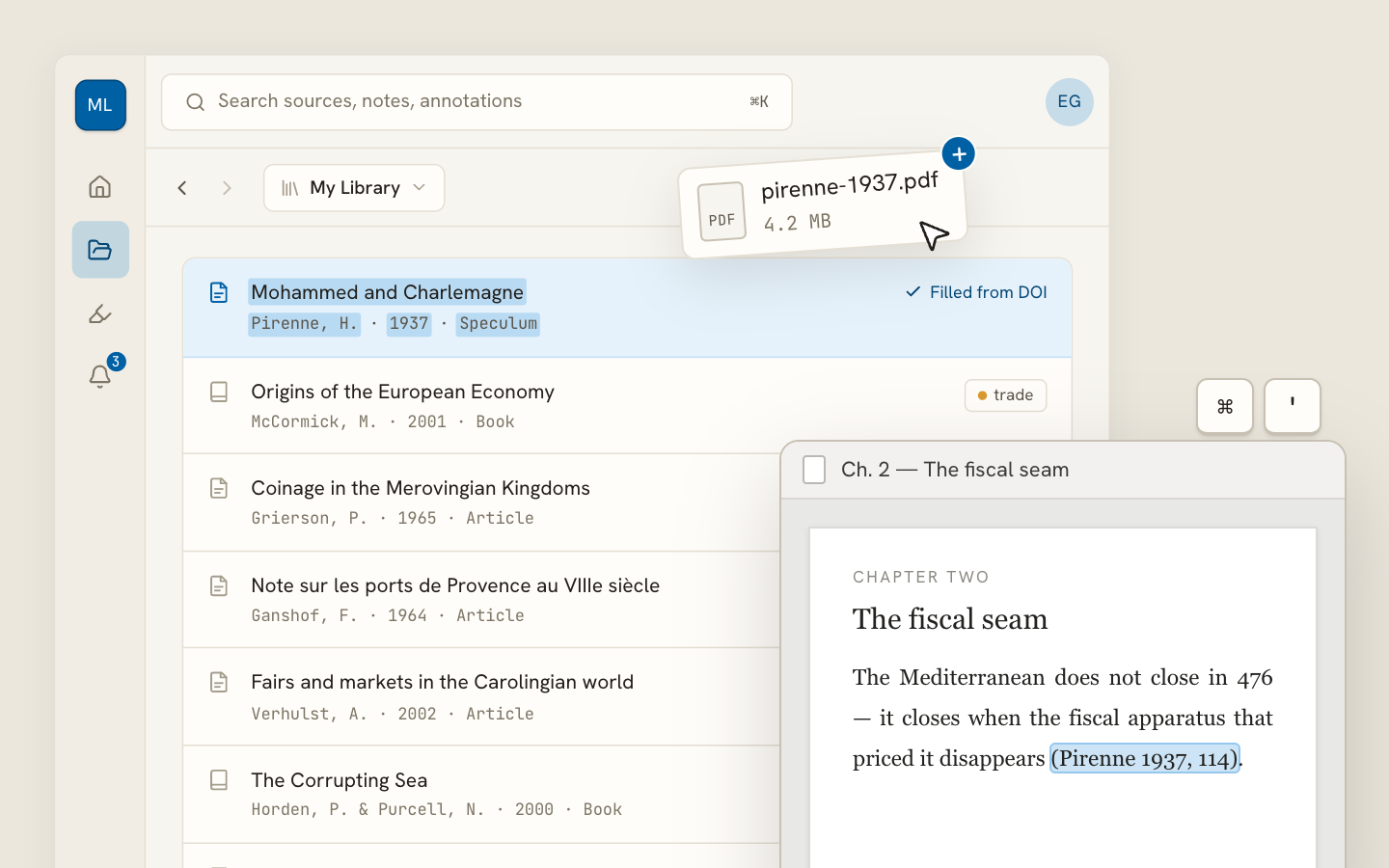
Archivero library view with a source list and an open PDF

Your weekly research workflow, in one email

One tested workflow, three links, no filler — every Tuesday.

Unsubscribe in one click. We never share your address.

Guides/How to Write a Thesis

Thesis Introduction

How to write a thesis introduction — including background context, the research problem, objectives, research questions, and the thesis statement.

8 min readThesis writing

Key Takeaways

  • The thesis introduction frames the research — it provides context, defines the problem, and states the research questions.
  • It follows a funnel structure: broad field → narrowed topic → specific research problem → research questions → thesis statement.
  • A complete introduction includes background, problem statement, research objectives, research questions or hypotheses, thesis statement, scope and limitations, and a chapter overview.
  • The problem statement is the most important element — it tells the reader what gap or issue your research addresses.
  • The thesis statement appears near the end of the introduction and declares your central argument or the position your findings support.
  • The introduction is not an abstract — it provides context and justification, while the abstract summarizes the entire thesis including results and conclusions.
  • Most thesis introductions run 5–15 pages (1,500–5,000 words), depending on the discipline and overall thesis length.
  • Write the introduction last or revise it last — once you know your results, you can frame the problem more precisely.

On this page

1 of 15
Key TakeawaysPurpose of the IntroductionWhat to IncludeBackground and ContextProblem StatementResearch ObjectivesResearch Questions or HypothesesThesis StatementScope and LimitationsChapter OverviewHow Long Should It Be?Introduction vs. AbstractExample StructureCommon MistakesNext Steps
All Thesis writing guides →

The introduction is the first chapter of a thesis or dissertation, and it serves a single purpose: to frame the research so the reader understands what you studied, why it matters, and how you approached it. A strong introduction moves from broad context to a specific research question, ending with a clear thesis statement and a roadmap of the chapters that follow.

Purpose of the Introduction

The introduction answers three questions for the reader:

  1. What is the topic? — the broad subject area and narrowed focus
  2. Why does it matter? — why this research is needed, what gap it fills
  3. What did you set out to do? — your research questions and objectives

Everything in the introduction should build toward the thesis statement. Background context isn't there for decoration — it's there to show the reader why your research question is worth asking and why previous work hasn't fully answered it.

The introduction also sets the tone for the thesis. It establishes your academic voice, demonstrates your command of the field, and gives the reader confidence that the research was approached rigorously.

What to Include

A thesis introduction typically contains seven components, presented in this order.

Background and Context

Start by establishing the broader landscape your research sits within. This isn't a full literature review — it's a brief orientation that gives the reader enough context to understand the problem.

For example, if your thesis investigates the effects of remote learning on student engagement, you might open with the rapid shift to online education during the COVID-19 pandemic, the scale of the change, and the questions it raised about educational effectiveness.

Keep the background focused: every piece of context you include should connect to the research problem you're about to introduce. If a fact or trend doesn't lead toward your specific question, it doesn't belong in the introduction.

Problem Statement

The problem statement is the core of the introduction. It identifies the specific gap, conflict, or unanswered question that your research addresses.

A strong problem statement does three things:

  1. Identifies what is unknown or unresolved — "While studies have examined X, few have investigated Y."
  2. Explains why it matters — "Without understanding Y, practitioners cannot…"
  3. Points toward your research — "This study addresses this gap by…"

Despite extensive research on online learning platforms, few studies have examined how asynchronous course design specifically affects student engagement in first-generation college students — a population that faces distinct barriers to academic persistence.

The problem statement is what justifies the entire thesis. If you can't articulate the problem clearly, the rest of the thesis lacks a foundation.

Research Objectives

Research objectives state what your study aimed to achieve. They are typically phrased as infinitive statements:

  • To investigate the relationship between X and Y
  • To evaluate the effectiveness of Z in context W
  • To identify the factors that influence Q

Keep objectives concrete and measurable. Avoid vague goals like "to explore" or "to understand" unless they're paired with specific outcomes.

Research Questions or Hypotheses

Research questions are the specific questions your thesis answers. They should flow directly from the problem statement and be answerable through your chosen methodology.

Quantitative studies often use hypotheses:

H1: Students in asynchronous online courses report lower engagement scores than students in synchronous courses.

Qualitative studies typically use open-ended research questions:

How do first-generation college students describe their engagement with asynchronous course materials?

Most theses have 2–4 research questions. More than that usually signals that the scope is too broad.

For a detailed guide on crafting research questions, see Research Question.

Thesis Statement

The thesis statement declares the central argument or main finding of your research. In empirical theses, it often reflects what the results ultimately showed — which is why many writers revise the introduction after completing their analysis.

This study demonstrates that asynchronous course design significantly reduces perceived engagement among first-generation college students, primarily due to the absence of real-time peer interaction and instructor feedback.

The thesis statement typically appears near the end of the introduction, after the research questions. It's the sentence that the rest of the thesis supports.

For a comprehensive overview of thesis statements, see What Is a Thesis Statement?.

Scope and Limitations

Briefly state what your study covers and what it intentionally excludes. This manages reader expectations and demonstrates academic honesty.

This study focuses on undergraduate students at public universities in the southeastern United States during the 2022–2023 academic year. It does not address graduate-level courses, private institutions, or synchronous hybrid models.

Scope is about boundaries. Limitations are about constraints — what might affect the validity of your findings. Some writers save detailed limitations for the Methodology or Discussion chapter, but a brief mention in the introduction is standard.

Chapter Overview

End the introduction with a short paragraph or list summarizing what each subsequent chapter covers. This gives the reader a roadmap:

Chapter 2 reviews the literature on online learning and student engagement. Chapter 3 describes the mixed-methods research design. Chapter 4 presents the quantitative and qualitative findings. Chapter 5 discusses the results in relation to existing research. Chapter 6 summarizes the conclusions and offers recommendations for course design.

Keep it concise — one or two sentences per chapter. The chapter overview is a navigation aid, not a detailed preview.

How Long Should It Be?

The introduction typically makes up 5–10% of the total thesis length. In practice:

Thesis TypeIntroduction Length
Undergraduate honors thesis3–5 pages (1,000–2,000 words)
Master's thesis5–10 pages (2,000–4,000 words)
Doctoral dissertation8–15 pages (3,000–5,000 words)

These are guidelines, not rules. A complex topic with extensive background may need a longer introduction. A narrowly focused study may need a shorter one. The introduction should be long enough to establish context and justify the research, and no longer.

Introduction vs. Abstract

Students sometimes confuse the introduction and the abstract because both appear early in the thesis and both describe the research. But they serve different purposes.

IntroductionAbstract
LengthIntroductionSeveral pages (a full chapter)Abstract150–300 words
PositionIntroductionChapter 1 of the thesisAbstractFront matter (before Chapter 1)
ContentIntroductionBackground, problem, questions, scopeAbstractSummary of the entire thesis (including results)
Results included?IntroductionNo — the introduction doesn't reveal findingsAbstractYes — the abstract states key findings and conclusions
AudienceIntroductionReaders who will read the full thesisAbstractReaders deciding whether to read the thesis

The introduction sets up the problem. The abstract summarizes the entire project — including the answer. For a full guide on writing an abstract, see Thesis Abstract.

Example Structure

Here's what a thesis introduction might look like in outline form for a study on the impact of social media on body image in college-age women:

Background:Rising social media use among 18–24-year-olds; link between media exposure and body image disturbance documented since the 1990s.

Problem statement:While studies have examined traditional media and body image, fewer have investigated the specific mechanisms by which algorithmic content curation on platforms like Instagram and TikTok influences body dissatisfaction — particularly the role of appearance-comparison features (likes, filters, suggested content).

Research objectives:To identify which platform features are most strongly associated with body dissatisfaction; to examine whether media literacy moderates the relationship.

Research questions:(1) Which social media features are most strongly associated with body dissatisfaction in college-age women? (2) Does media literacy moderate the relationship between social media use and body dissatisfaction?

Thesis statement:This study finds that algorithmic content curation and appearance-comparison features — not overall screen time — are the primary drivers of body dissatisfaction, and that media literacy significantly moderates this relationship.

Scope:Female undergraduate students at three public universities; survey and interview data collected Spring 2025.

Chapter overview:Literature review (Ch. 2), Methodology (Ch. 3), Results (Ch. 4), Discussion (Ch. 5), Conclusion (Ch. 6).

Common Mistakes

  1. Starting too broad. "Since the beginning of time, humans have communicated…" is a clichéd opening that delays the actual topic. Start with the specific field, not the history of civilization.

  2. Burying the problem statement. If the reader has to wade through five pages of background before learning what problem you're addressing, the introduction needs restructuring. The problem statement should appear early — typically on the first or second page.

  3. Including results. The introduction sets up the investigation; it doesn't reveal the findings. Save that for the Results and Discussion chapters (and the abstract).

  4. Treating it as a literature review. The introduction mentions key studies to establish context, but it doesn't critically analyze them in depth — that's the job of Chapter 2.

  5. Writing it first and never revising. Many writers draft the introduction before conducting research, which is fine as a starting point. But the introduction should be revised after the thesis is complete to ensure it accurately frames what the research actually found.

  6. Omitting the chapter overview. The reader should know what's coming. A brief chapter-by-chapter roadmap takes one paragraph and significantly improves the reading experience.

Next Steps

With the introduction framed, move on to the chapters that follow:

  • Literature Review — how to survey existing research and identify the gap your thesis fills
  • Thesis Methodology — how to describe and justify your research design
  • Thesis Structure — an overview of how all chapters fit together
  • Research Question — how to formulate the questions that guide your thesis

Archivero helps you collect and organize the sources you'll reference in your introduction — capture key studies, annotate background reading, and keep the context for your problem statement in one place.

All Thesis writing guides →
← PreviousThesis StructureNext →Literature Review

More on Thesis writing

From crafting a thesis statement to structuring chapters, writing the proposal and preparing for the defence.

View all 19 guides →
8 sections·9 min readThesis writingLiterature Review8 sections·9 min readThesis writingThesis Methodology8 sections·7 min readThesis writingThesis Conclusion8 sections·8 min readThesis writingThesis Abstract

Your sources, PDFs and citations in one library

  • Import a Zotero, Mendeley or EndNote library — or a folder of PDFs
  • Highlight and annotate without leaving the source
  • Cite in any CSL style as you write, with one shared library for your lab
Request early accessSee the product →
Archivero library view with a source list and an open PDF

Your weekly research workflow, in one email

One tested workflow, three links, no filler — every Tuesday.

Unsubscribe in one click. We never share your address.