The methodology chapter of a thesis explains how you conducted your research — your overall design, data collection methods, analysis techniques, and the reasoning behind each choice. It appears as Chapter 3 in most theses, bridging the gap between the literature review (what others have studied) and the results (what you found). A well-written methodology allows another researcher to evaluate the rigor of your work and, in principle, replicate your study.
What Is a Methodology Chapter?
The methodology chapter is a detailed account of the research process. It tells the reader exactly what you did, how you did it, and — critically — why you did it that way. It is the section of the thesis that allows your research to be evaluated for rigor, validity, and reliability.
A methodology chapter typically answers:
- What overall research approach did you use? (qualitative, quantitative, mixed methods)
- How did you collect your data? (surveys, interviews, experiments, archival research)
- Who or what did you study? (participants, texts, datasets, artifacts)
- How did you select your sample or cases?
- How did you analyze the data?
- What ethical safeguards did you put in place?
- What are the limitations of your approach?
The methodology isn't just a procedural checklist — it's an argument. You're arguing that your research design was the most appropriate way to answer your research question, given the constraints of time, resources, and existing knowledge.
Methodology vs. Methods
These terms are often used interchangeably, but they refer to different things.
| Methodology | Methods | |
|---|---|---|
| Definition | The overarching framework and rationale for how you approach research | The specific tools, techniques, and procedures used to collect and analyze data |
| Scope | Philosophical and strategic | Practical and procedural |
| Example | "This study uses a constructivist grounded theory methodology" | "Semi-structured interviews were conducted with 15 participants" |
| Question it answers | Why did you research this way? | What did you do? |
Your methodology chapter should cover both: the broader rationale (methodology) and the specific procedures (methods). Most theses weave them together, but some programs expect them in separate sections.
What to Include
Research Design (Qualitative, Quantitative, Mixed)
Your research design is the overarching plan for answering your research question. It determines the type of data you collect, how you collect it, and how you analyze it.
Quantitative designs test hypotheses using numerical data, statistical analysis, and controlled conditions. Common quantitative designs include:
- Experimental — manipulating variables to test cause-and-effect
- Quasi-experimental — similar to experimental but without full randomization
- Correlational — measuring relationships between variables
- Survey-based — collecting data through structured questionnaires
Qualitative designs explore experiences, meanings, and processes using non-numerical data. Common qualitative designs include:
- Phenomenological — understanding lived experiences
- Grounded theory — building theory from data
- Case study — in-depth investigation of a single case or small number of cases
- Ethnographic — immersive observation within a cultural or social group
- Narrative — analyzing stories and personal accounts
Mixed methods designs combine quantitative and qualitative approaches, either sequentially (one informs the other) or concurrently (both collected simultaneously). A common example: a survey (quantitative) followed by interviews (qualitative) to explore survey results in depth.
State your design explicitly and explain why it fits your research question. If you're studying the prevalence of a phenomenon, quantitative methods are likely appropriate. If you're studying how people experience a phenomenon, qualitative methods may be more suitable.
Data Collection Methods
Describe exactly how you gathered your data. Be specific enough that another researcher could replicate the process.
For surveys and questionnaires:
- What instrument did you use? (existing validated scale, or one you designed?)
- How many questions? What response format? (Likert scale, multiple choice, open-ended)
- How was the survey distributed? (online, in person, by mail)
- What was the response rate?
For interviews:
- How many interviews did you conduct?
- Were they structured, semi-structured, or unstructured?
- How long were they? Where were they conducted?
- Were they recorded? Transcribed verbatim?
- What interview guide or protocol did you use?
For experiments:
- What were the independent and dependent variables?
- What were the experimental and control conditions?
- What procedures did participants follow?
- How were confounding variables controlled?
For archival or document analysis:
- What documents or datasets did you analyze?
- Where did you access them?
- What was the date range or scope of the material?
Data Analysis Methods
Explain how you processed and analyzed the collected data.
Quantitative analysis methods include:
- Descriptive statistics (means, frequencies, standard deviations)
- Inferential statistics (t-tests, ANOVA, chi-square, regression)
- Statistical software used (SPSS, R, Stata, Python)
Qualitative analysis methods include:
- Thematic analysis — identifying patterns and themes across data
- Content analysis — systematically categorizing text or media
- Grounded theory coding — open, axial, and selective coding to develop theory
- Discourse analysis — examining language use and meaning in context
For each method, describe the process step by step. If you used thematic analysis, explain how you generated codes, how you grouped them into themes, and how you ensured consistency (e.g., coding by multiple researchers).
Ethical Considerations
Research involving human participants requires ethical safeguards. At minimum, address:
- Informed consent — how participants were informed about the study and agreed to participate
- Anonymity and confidentiality — how participant identities were protected
- Data storage and security — where data was stored and who had access
- Institutional review board (IRB) approval — whether your study was reviewed and approved by an ethics committee
- Right to withdraw — whether participants could leave the study at any time
If your research did not involve human participants (e.g., archival document analysis), state this explicitly and explain why ethical review was not required.
Limitations
Every methodology has limitations — aspects of the design that might affect the validity, reliability, or generalizability of the findings. Address them honestly.
Common limitations include:
- Sample size — too small to generalize broadly
- Sampling method — convenience sampling may introduce bias
- Self-report data — participants may not report accurately
- Cross-sectional design — captures a snapshot, not change over time
- Researcher bias — particularly in qualitative studies where the researcher is the instrument
Acknowledging limitations doesn't weaken your thesis — it strengthens it. It shows you understand the boundaries of your claims and have designed the best study possible within those constraints.
Qualitative vs. Quantitative Methodology
Choosing between qualitative and quantitative (or mixed) approaches depends on your research question. Here's a practical comparison:
| Quantitative | Qualitative | |
|---|---|---|
| Research question type | How much? How many? What is the relationship? | How? Why? What is the experience? |
| Data type | Numbers, measurements, statistics | Words, images, observations |
| Sample size | Larger (30–1,000+) | Smaller (5–50) |
| Analysis | Statistical tests | Coding, thematic analysis |
| Generalizability | High (if sample is representative) | Low (findings are context-specific) |
| Depth | Broad but shallow | Narrow but deep |
| Output | Statistical significance, correlations, effect sizes | Themes, categories, narratives |
Neither approach is inherently better. The right choice depends on what your research question asks. Some questions demand numbers; others demand stories. Mixed methods combines both when neither alone is sufficient.
How Long Should It Be?
The methodology chapter is typically one of the longer chapters in a thesis because it needs to provide enough detail for replication and evaluation.
| Thesis Type | Methodology Length |
|---|---|
| Undergraduate honors thesis | 5–10 pages |
| Master's thesis | 10–25 pages |
| Doctoral dissertation | 15–40 pages |
Quantitative methodologies tend to be more concise (the procedures can be described precisely). Qualitative methodologies tend to be longer because they require more justification and description of the researcher's positionality and interpretive framework.
Example Methodology Outline
Here's an example outline for a mixed-methods thesis methodology chapter:
3.1 Research DesignThis study uses an explanatory sequential mixed-methods design (Creswell & Creswell, 2018). Quantitative data was collected first via survey, followed by qualitative interviews to explore key survey findings in depth.
3.2 Participants and Sampling250 undergraduate students completed the online survey (convenience sample recruited via university email lists). From the survey respondents, 15 participants were purposively selected for interviews based on maximum variation sampling.
3.3 Data Collection3.3.1 Survey: The survey used the validated Social Media Engagement Scale (Chen et al., 2020) plus demographic questions. It was administered online via Qualtrics over a three-week period in February 2025. 3.3.2 Interviews: Semi-structured interviews lasting 30–45 minutes were conducted via Zoom, recorded, and transcribed verbatim.
3.4 Data Analysis3.4.1 Quantitative: Survey data was analyzed using descriptive statistics and multiple regression in SPSS (version 28). 3.4.2 Qualitative: Interview transcripts were analyzed using reflexive thematic analysis (Braun & Clarke, 2019).
3.5 Ethical ConsiderationsThe study received IRB approval (Protocol #2024-0847). All participants provided informed consent. Interview participants were assigned pseudonyms.
3.6 LimitationsThe convenience sample limits generalizability. Self-reported social media use may not reflect actual behavior. The cross-sectional design cannot establish causation.
Common Mistakes
Describing what you did without explaining why. Every choice — your design, your sampling strategy, your analysis method — needs justification. "I used surveys" is description. "I used surveys because the research question required data from a large sample to detect statistically significant relationships" is methodology.
Being too vague. "Data was collected and analyzed" tells the reader nothing. Specify the instrument, the procedure, the sample, the timeline, and the analytical technique.
Omitting ethical considerations. Even if your IRB process was straightforward, document it. Ethical transparency is expected in any thesis involving human participants.
Confusing methodology with results. The methodology chapter describes the plan and process. It does not present findings — save those for Chapter 4.
Failing to acknowledge limitations. No study is perfect. Pretending yours is undermines credibility. State limitations clearly and explain how you mitigated them where possible.
Using methods that don't match the research question. If your research question asks "how do students experience…" but you only used a survey with closed-ended questions, there's a mismatch. The methodology must be capable of answering the questions you've posed.
Next Steps
With your methodology documented, move on to presenting what you found:
- Thesis Structure — how the methodology chapter fits within the overall thesis
- Literature Review — the chapter that precedes methodology and identifies the gap you're addressing
- Thesis Conclusion — how to summarize findings, discuss implications, and acknowledge limitations
- Research Question — how to formulate the questions that your methodology is designed to answer
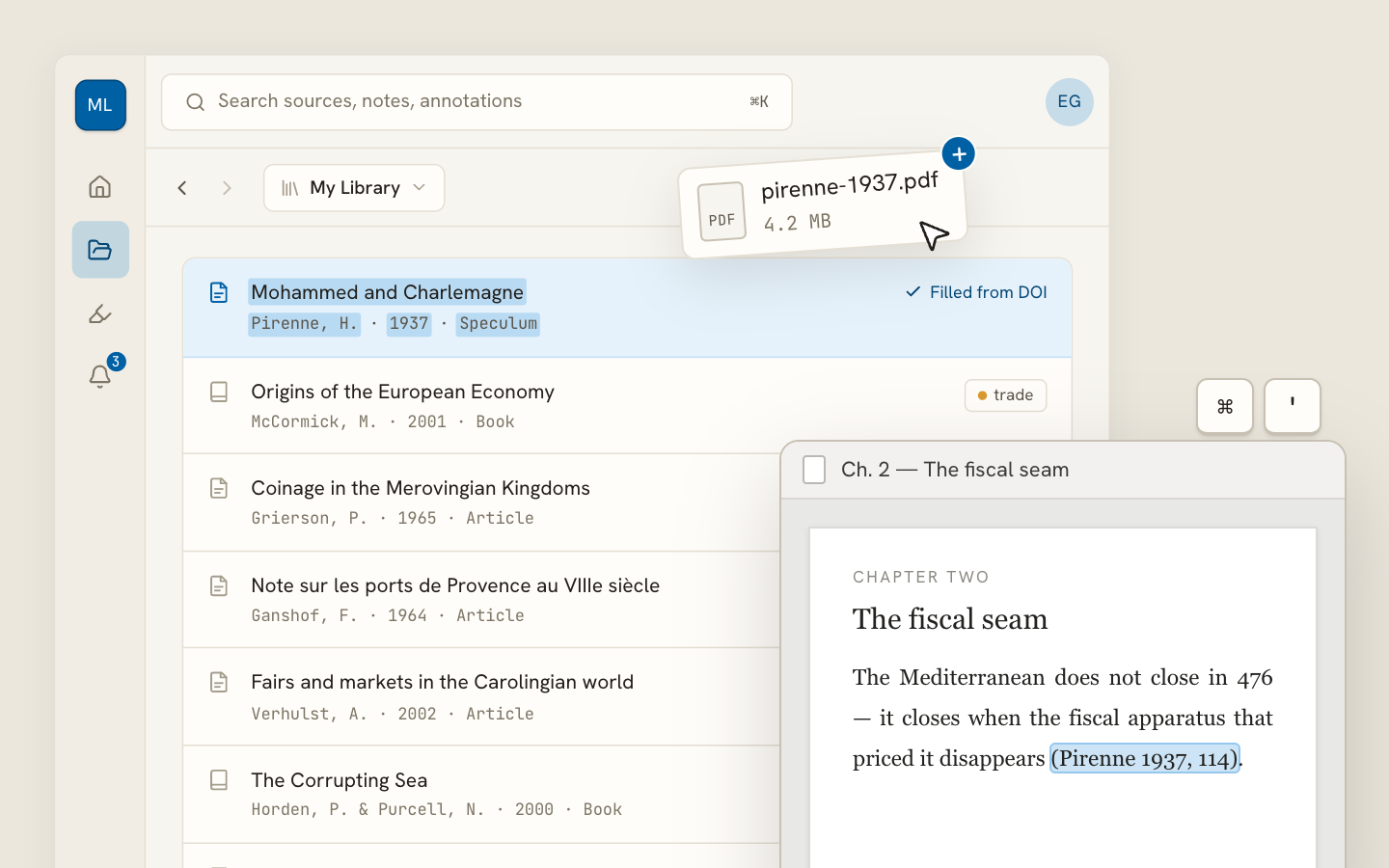
Archivero helps you keep your methodology grounded in the literature — link your design choices back to the sources that inform them, and organize your research process alongside the evidence that justifies it.