The conclusion is the final chapter of a thesis or dissertation, and it ties the entire research project together. It restates the research problem, summarizes the key findings, directly answers the research questions, discusses the broader implications of the work, and identifies directions for future research — all without introducing new data or arguments.
Purpose of the Conclusion
The conclusion serves as the reader's final impression of your thesis. After hundreds of pages of context, analysis, and evidence, the conclusion answers the question: "So what?"
It has three jobs:
- Synthesize — pull together the key findings from across the thesis into a coherent summary
- Answer — directly address the research questions or hypotheses stated in the Introduction
- Contextualize — explain what the findings mean for the field, for practice, or for policy, and point toward what comes next
The conclusion rewards the reader for staying with you through the full thesis. It's where you demonstrate that your research actually contributes something — that the gap you identified in the literature review has been, at least partially, filled.
What to Include
Summary of Key Findings
Begin the conclusion by summarizing the most important results from your study. This is not a chapter-by-chapter recap — it's a distillation of the findings that matter most for answering your research questions.
Keep it concise. The reader has already read the Results and Discussion chapters. The conclusion should highlight the main takeaways, not rehash every data point.
This study found that asynchronous course design was associated with a 23% decrease in self-reported student engagement compared to synchronous formats, with the strongest effects observed among first-generation college students. Interview data revealed that the absence of real-time peer interaction and delayed instructor feedback were the primary drivers of disengagement.
Focus on findings that directly address the research objectives. If a result was interesting but tangential, it may not belong in the conclusion.
Answering the Research Question
Return to the research questions you stated in the Introduction and answer them explicitly. This creates a satisfying structural symmetry — the thesis opens with questions and closes with answers.
Research Question 1:Which social media features are most strongly associated with body dissatisfaction in college-age women?
Answer:Algorithmic content curation and appearance-based filters were the features most strongly associated with body dissatisfaction (β = .42, p < .001), while overall screen time showed no significant independent effect.
If your findings didn't fully answer a question, say so honestly. Partial answers are still contributions.
Implications of the Research
Discuss what your findings mean beyond the immediate study. Implications can be:
- Theoretical — do your findings support, challenge, or extend an existing theory?
- Practical — how could your findings inform practice, design, or decision-making?
- Policy — do your findings suggest changes to institutional, organizational, or governmental policy?
These findings suggest that course designers should prioritize synchronous interaction opportunities in online programs — even brief, low-stakes activities — rather than focusing solely on content delivery quality. For institutions serving high proportions of first-generation students, this design consideration may directly affect retention rates.
Be specific about who the implications are for and what they should do differently based on your research.
Limitations
Briefly acknowledge the limitations of your study. You may have discussed limitations in the Methodology or Discussion chapters, but the conclusion should include a concise summary of the most significant ones.
Common limitations to address:
- Sample — size, diversity, representativeness
- Design — cross-sectional vs. longitudinal, lack of control group
- Measurement — self-report bias, instrument validity
- Scope — geographic, temporal, or contextual constraints
Frame limitations constructively: they're not apologies — they're honest boundaries that inform how the findings should be interpreted.
Recommendations for Future Research
Point toward the research that should come next. This section demonstrates that your thesis is part of an ongoing conversation, not a dead end.
Good future research recommendations are:
- Specific — not "more research is needed" but "a longitudinal study tracking X over Y period would clarify whether…"
- Grounded in your findings — connected to results, limitations, or unexpected patterns from your study
- Feasible — realistic suggestions that other researchers could actually pursue
Future studies should employ longitudinal designs to determine whether the observed relationship between algorithmic curation and body dissatisfaction persists or attenuates over time. Additionally, cross-cultural research is needed to assess whether the platform features identified in this study have similar effects in non-Western contexts.
What Not to Include
The conclusion has clear boundaries. Avoid:
- New data or results — everything in the conclusion should trace back to findings already presented in the Results/Discussion chapters
- New literature — don't cite studies you haven't discussed in the Literature Review
- New arguments — the conclusion synthesizes existing arguments; it doesn't make new ones
- Excessive hedging — while acknowledging limitations is important, don't undermine your entire thesis with "this study might possibly suggest that…"
- Repetitive detail — the conclusion summarizes; it doesn't reproduce the Results chapter word for word
Conclusion vs. Discussion
Students sometimes struggle with the boundary between the Discussion (Chapter 5) and the Conclusion (Chapter 6). Here's the distinction:
| Discussion | Conclusion | |
|---|---|---|
| Focus | Interpreting results in detail | Synthesizing the big picture |
| Level of detail | High — examines each finding | Low — highlights key takeaways |
| Connection to literature | Extensive — compares findings with previous studies | Brief — restates the contribution without re-analyzing |
| New interpretation | Yes — this is where you explain what results mean | No — the interpretation is already established |
| Forward-looking | Sometimes discusses implications | Primarily discusses implications and future directions |
The Discussion says "here's what each finding means." The Conclusion says "here's what the whole thesis means."
How Long Should It Be?
The conclusion is typically one of the shorter chapters. It's concise by design — a synthesis, not a re-analysis.
| Thesis Type | Conclusion Length |
|---|---|
| Undergraduate honors thesis | 2–5 pages |
| Master's thesis | 5–10 pages |
| Doctoral dissertation | 8–15 pages |
If your conclusion is running long, you may be repeating too much from the Discussion or introducing new analysis that belongs in an earlier chapter.
Example Structure
Here's a sample outline for a thesis conclusion:
6.1 Summary of Key FindingsRestates the three main findings: (1) asynchronous formats reduced engagement, (2) first-generation students were disproportionately affected, (3) peer interaction — not content quality — was the primary driver.
6.2 Answering the Research QuestionsReturns to each research question from Chapter 1 and states the answer supported by the findings.
6.3 ImplicationsTheoretical: Extends the Community of Inquiry framework by identifying peer interaction as more critical than instructor presence in online settings. Practical: Online course designers should embed synchronous touchpoints into asynchronous course shells. Policy: Universities with large first-generation student populations should audit their online programs for engagement supports.
6.4 LimitationsConvenience sample from one institution; self-report data; cross-sectional design.
6.5 Recommendations for Future ResearchLongitudinal study tracking engagement across semesters; multi-institution comparison; experimental design testing specific synchronous interventions.
6.6 Closing StatementA final paragraph restating the core contribution and its significance for online education equity.
Common Mistakes
Introducing new results. If a finding appears for the first time in the conclusion, it belongs in the Results chapter. The conclusion only discusses findings that have already been presented and interpreted.
Simply repeating the abstract. The abstract and the conclusion summarize the thesis, but at different levels of detail and for different audiences. The conclusion is more reflective, more detailed, and more forward-looking than the 300-word abstract.
Ignoring the research questions. The introduction asks questions; the conclusion should answer them explicitly. If you don't return to your research questions, the thesis feels incomplete.
Being too vague about implications. "This research has important implications for education" doesn't tell the reader anything. Specify what implications, for whom, and what should change as a result.
Excessive apology for limitations. Limitations should be stated factually, not apologetically. "This study was limited to one institution" is clearer and more professional than "Unfortunately, we were only able to study one institution, which is a major weakness."
Ending without a closing statement. The final paragraph of the thesis should leave the reader with a clear sense of your contribution. Don't let the thesis trail off with a list of future research recommendations — end with a statement that lands.
Next Steps
With the conclusion written, round out the remaining components of your thesis:
- Thesis Abstract — how to write a concise, standalone summary of your entire thesis
- Thesis Structure — how the conclusion fits within the overall thesis framework
- Thesis Introduction — revisit the introduction to ensure it mirrors the conclusion
- Thesis Formatting — formatting guidelines for the final submission
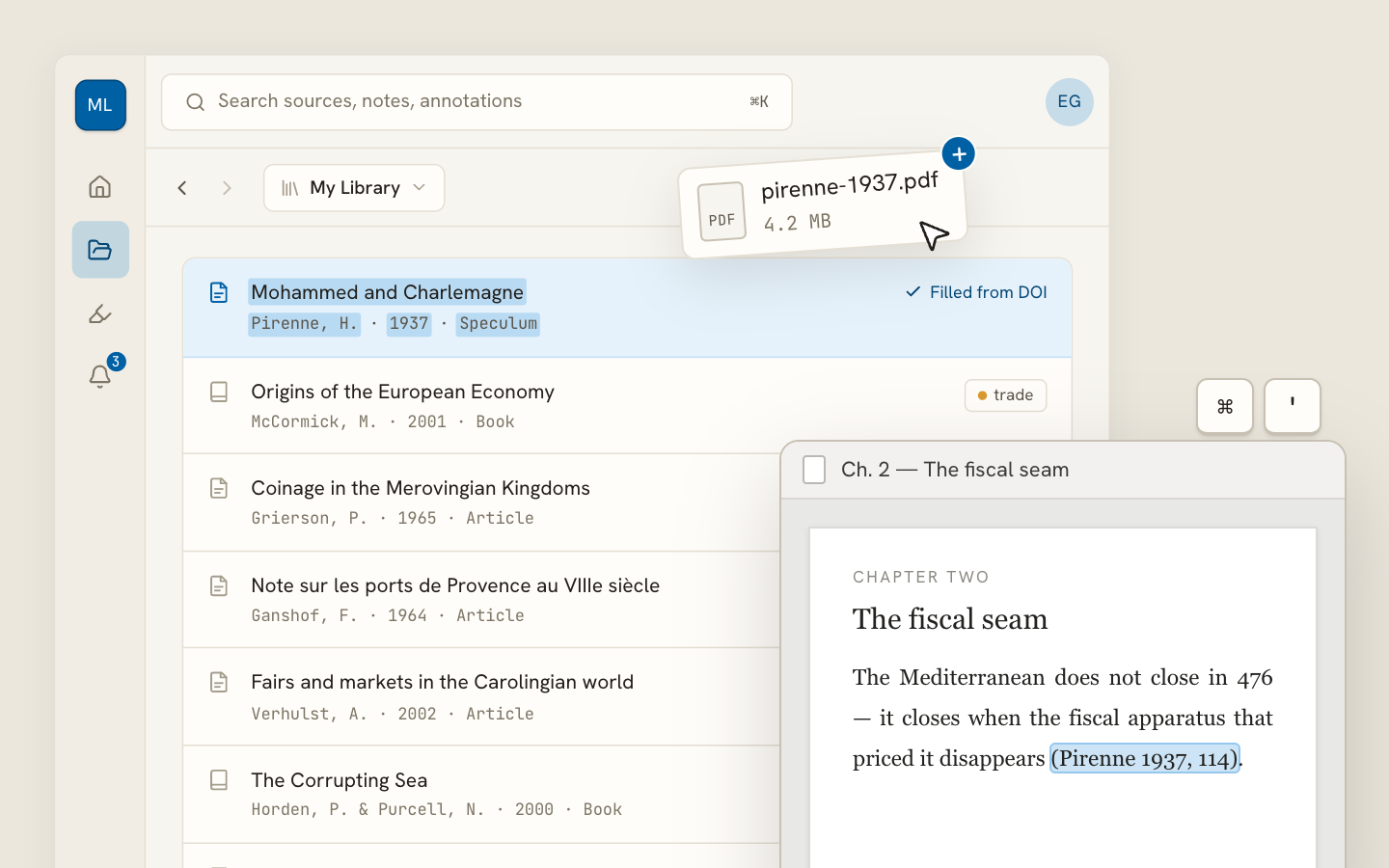
Archivero helps you bring the thesis full circle — revisit the sources and annotations from your research to ensure your conclusion accurately reflects the evidence and arguments built across every chapter.