Archivero is in early access — your sources, PDFs and citations in one library.Request early access →
Archivero/guides/
APAMLAHarvardThesis writing
Subscribe
Archivero/guides/Request early access →

Guides

APA styleMLA styleHarvard referencingThesis writing

Compare

APA 6th vs 7thMLA 8th vs 9thHarvard vs APAThesis vs dissertation

Product

FeaturesEarly access

Resources

DocsCheat sheetsNewsletter

Company

ContactStatus ↗
© 2025–2026 Ernesto F. GonzálezGuidesDocsContactPrivacyTerms
Guides/How to Write a Thesis

Thesis Proposal

How to write a thesis proposal — outlining your research question, methodology, timeline, and literature review to get your thesis approved.

9 min readThesis writing

Key Takeaways

  • A thesis proposal is a plan for your thesis — it describes what you intend to research and how, submitted for committee approval before you begin.
  • A proposal is not a thesis — it proposes research that hasn't been done yet, written in future tense ("this study will examine…").
  • Key components include: title, introduction and problem statement, research questions, preliminary literature review, proposed methodology, timeline, expected contributions, and preliminary bibliography.
  • The literature review in a proposal is preliminary — it establishes the gap but doesn't need the depth of the final thesis literature review.
  • The methodology section must convince the committee that your approach is feasible and appropriate for answering your research question.
  • Include a realistic timeline with milestones — committees want to see that you've planned the work and can complete it within your program's deadlines.
  • A master's thesis proposal is typically 10–25 pages; a doctoral dissertation proposal may reach 20–50 pages.
  • The proposal becomes a living document — your actual thesis may deviate from the proposal as findings emerge, and that's expected.

On this page

1 of 17
Key TakeawaysWhat Is a Thesis Proposal?Thesis Proposal vs. ThesisWhat to IncludeTitle and Working TitleIntroduction and Problem StatementResearch QuestionsLiterature Review (Preliminary)Proposed MethodologyTimeline and MilestonesExpected ContributionsPreliminary BibliographyHow Long Is a Thesis Proposal?Example OutlineTips for Getting ApprovedCommon MistakesNext Steps
All Thesis writing guides →

A thesis proposal is a formal document that outlines your planned research — the question you intend to investigate, the existing scholarship that justifies it, the methodology you'll use, and a timeline for completion. It is submitted to your thesis committee or department for approval before you begin the actual research. A strong proposal demonstrates that your project is feasible, original, and methodologically sound.

What Is a Thesis Proposal?

A thesis proposal is essentially a pitch. You're asking your committee, department, or institution to approve a research project by demonstrating that:

  1. The question is worth asking — there's a genuine gap in the literature
  2. You understand the existing research — the preliminary literature review proves it
  3. Your methodology is sound — the approach can actually answer the question
  4. The project is feasible — you have the resources, access, and time to complete it

The proposal serves a protective function as well. By requiring approval before research begins, the institution ensures that the project meets ethical standards (especially for research involving human subjects), aligns with the program's requirements, and has a realistic chance of completion.

Most programs require the proposal to be defended in an oral presentation — a mini version of the thesis defense — where committee members ask questions, suggest revisions, and ultimately give (or withhold) approval to proceed.

Thesis Proposal vs. Thesis

Thesis ProposalThesis
WhenThesis ProposalBefore research beginsThesisAfter research is complete
TenseThesis ProposalFuture ("this study will examine…")ThesisPast ("this study examined…")
Literature reviewThesis ProposalPreliminary — establishes the gapThesisComprehensive — full survey of the field
MethodologyThesis ProposalProposed — describes what you plan to doThesisDocumented — describes what you actually did
ResultsThesis ProposalNone — research hasn't happened yetThesisFull presentation of findings
LengthThesis Proposal10–50 pagesThesis80–300+ pages

The proposal becomes the foundation of the thesis. In many programs, the proposal's introduction and literature review are revised and expanded into the thesis's first two chapters.

What to Include

Title and Working Title

Your proposal needs a descriptive, specific title. It doesn't need to be final — most theses change their title during the writing process — but it should clearly indicate the topic, the population or context, and the approach.

Vague:"A Study on Social Media" Specific: "The Relationship Between Instagram Use and Body Image Satisfaction Among Female College Students: A Mixed-Methods Study"

A good working title helps you stay focused. If you can't summarize your project in a title, the scope may not be clear enough.

Introduction and Problem Statement

The introduction frames the research by answering three questions:

  1. What is the topic? — Provide the necessary context
  2. What is the problem? — Identify the specific issue your research addresses
  3. Why does it matter? — Explain the significance for theory, practice, or policy

The problem statement is the core of the introduction. It should clearly articulate what is unknown, unresolved, or insufficiently studied — the gap that your research will fill.

Despite a growing body of research on social media and mental health, few studies have examined the specific mechanisms through which platform design features — as opposed to overall screen time — influence body image outcomes among college-age women (Fardouly et al., 2018; Tiggemann & Slater, 2017). This gap is significant because interventions targeting total screen time may be less effective than those targeting specific design elements.

Research Questions

State your research questions clearly and explicitly. These are the questions your study is designed to answer — the same questions you'll return to in your thesis conclusion.

Primary Research Question:How do specific Instagram design features (algorithmic content curation, appearance-based filters, and social comparison metrics) relate to body image satisfaction among female college students aged 18–22?

Sub-Question 1:Which design features are most strongly associated with body dissatisfaction? Sub-Question 2: How do students describe the experience of encountering appearance-focused algorithmic content?

For guidance on formulating research questions, see Research Question.

Literature Review (Preliminary)

The proposal's literature review is a condensed version of the full review you'll write for the thesis. Its purpose is to:

  1. Demonstrate your knowledge of the existing research
  2. Establish the gap that your study addresses
  3. Justify your research question by showing that it hasn't been adequately answered

A proposal literature review typically covers the major themes, key studies, and significant debates — but it doesn't need the exhaustive coverage of the final chapter. You'll expand it significantly as you continue reading during the research process.

In a 20-page proposal, the literature review might be 5–8 pages. In a 40-page doctoral proposal, it might reach 10–15 pages.

For more on writing a literature review, see Literature Review.

Proposed Methodology

The methodology section must convince the committee that your approach is appropriate, rigorous, and feasible. Describe:

  • Research design — qualitative, quantitative, or mixed methods, and why
  • Participants / sample — who or what you'll study, how you'll recruit, and how many
  • Data collection — specific methods (surveys, interviews, experiments, archival data) and instruments
  • Data analysis — analytical techniques and software
  • Ethical considerations — IRB requirements, informed consent, confidentiality

Because the research hasn't happened yet, write in future tense: "This study will employ…" "Participants will be recruited through…" "Data will be analyzed using…"

The committee will evaluate whether your methodology can actually answer your research questions. A mismatch between the questions and the methods is the most common reason proposals are sent back for revision.

For more on research methodology, see Methodology.

Timeline and Milestones

Include a realistic timeline showing when each phase of the research will be completed. Committees want evidence that you've thought through the practical logistics, not just the intellectual framework.

A typical master's thesis timeline might look like:

PhaseTimeframe
Literature review (expanded)Months 1–2
IRB application and approvalMonth 2
Data collectionMonths 3–4
Data analysisMonths 4–5
Writing Results and DiscussionMonths 5–6
Writing Introduction and ConclusionMonth 7
Revision and committee feedbackMonth 8
Final submission and defenseMonth 9

Build in buffer time. Every phase takes longer than you expect — especially data collection and committee feedback cycles.

Expected Contributions

Briefly describe what your research will contribute. This isn't a results section (you don't have results yet) — it's a statement of what the study could add to the field if the research goes as planned.

This study is expected to contribute to the growing literature on social media and body image by identifying the specific platform features most strongly associated with body dissatisfaction — moving beyond the dominant focus on overall screen time. The findings may inform the design of targeted interventions and platform design guidelines.

Preliminary Bibliography

Include a complete list of all sources cited in the proposal. Format according to your program's required citation style (APA, MLA, Chicago, etc.).

The bibliography is "preliminary" because you'll add many more sources as you expand the literature review and refine the methodology during the thesis itself.

How Long Is a Thesis Proposal?

Proposal length varies by degree level, discipline, and institutional requirements.

Degree LevelTypical Length
Undergraduate honors thesis5–10 pages
Master's thesis10–25 pages
Doctoral dissertation20–50 pages

Check your program's specific guidelines. Some departments provide a proposal template or outline; follow it exactly.

Example Outline

Here's a representative outline for a master's thesis proposal:

1. Introduction(3–4 pages) 1.1 Background and Context 1.2 Problem Statement 1.3 Purpose of the Study 1.4 Research Questions 1.5 Significance of the Study 1.6 Definition of Key Terms

2. Literature Review(6–8 pages) 2.1 Social Media and Mental Health: Overview 2.2 Body Image and Social Comparison Theory 2.3 Platform Design Features and User Behavior 2.4 Gaps in the Literature

3. Proposed Methodology(4–6 pages) 3.1 Research Design 3.2 Participants and Sampling 3.3 Data Collection Instruments 3.4 Data Analysis Plan 3.5 Ethical Considerations 3.6 Limitations

4. Timeline(1 page)

5. References(2–3 pages)

Tips for Getting Approved

  1. Align with your advisor's expertise. Proposals that connect to your advisor's research area benefit from their guidance and are more likely to receive enthusiastic support.

  2. Be specific, not ambitious. Committees reject proposals that try to do too much. A focused, achievable study is more compelling than a sweeping investigation that can't be completed in the available time.

  3. Demonstrate feasibility. Show that you have access to participants, data, instruments, and institutional support. Address potential obstacles and explain how you'll handle them.

  4. Anticipate committee questions. Read your proposal as a skeptic would. Where are the weak points? Address them proactively in the text rather than waiting for the committee to raise them.

  5. Follow formatting requirements exactly. Programs often have specific templates, margin requirements, and section expectations. Ignoring them signals carelessness.

  6. Write clearly and concisely. Your proposal is the committee's first extended sample of your writing. Dense, jargon-heavy, or disorganized prose raises concerns about the thesis itself.

Common Mistakes

  1. Writing a thesis instead of a proposal. The proposal describes planned research in future tense. If you're presenting results or writing in past tense, you've gone beyond the proposal stage.

  2. Insufficient literature review. A proposal that cites 5–10 sources suggests shallow engagement with the field. Even a preliminary review should demonstrate substantive reading.

  3. Methodology that doesn't match the questions. If your research question asks "how do participants experience…" but your methodology only includes a closed-ended survey, the committee will flag the mismatch.

  4. No timeline. Omitting a timeline suggests you haven't thought about feasibility. Include realistic milestones even if the dates are approximate.

  5. Overly broad scope. Proposing to study a phenomenon across all contexts, populations, and timeframes is a red flag. Narrow the scope to something achievable.

  6. Ignoring ethical considerations. Any research involving human participants requires ethical review. Failing to address IRB requirements, consent protocols, or data protection suggests unpreparedness.

  7. Treating the proposal as final. The proposal is a plan, not a contract. Your actual thesis will evolve. But the proposal should still be as thoughtful and rigorous as possible — it sets the foundation.

Next Steps

With your proposal approved, begin the full thesis:

  • Research Question — refine the questions your study will answer
  • Literature Review — expand the preliminary review into a comprehensive chapter
  • Methodology — develop the methodology section into the full Chapter 3
  • Thesis Structure — see how the proposal's components map onto the thesis chapters
  • Thesis Introduction — expand and revise the proposal's introduction into Chapter 1

Archivero helps you transition from proposal to thesis by keeping your sources, notes, and reading organized — so the preliminary literature review grows naturally into the full chapter as your research progresses.
All Thesis writing guides →
← PreviousThesis AbstractNext →Thesis Formatting

More on Thesis writing

From crafting a thesis statement to structuring chapters, writing the proposal and preparing for the defence.

View all 19 guides →
8 sections·9 min readThesis writingThesis Formatting7 sections·7 min readThesis writingThesis vs. Dissertation7 sections·10 min readThesis writingThesis Defense6 sections·9 min readThesis writingCommon Thesis Mistakes

Your sources, PDFs and citations in one library

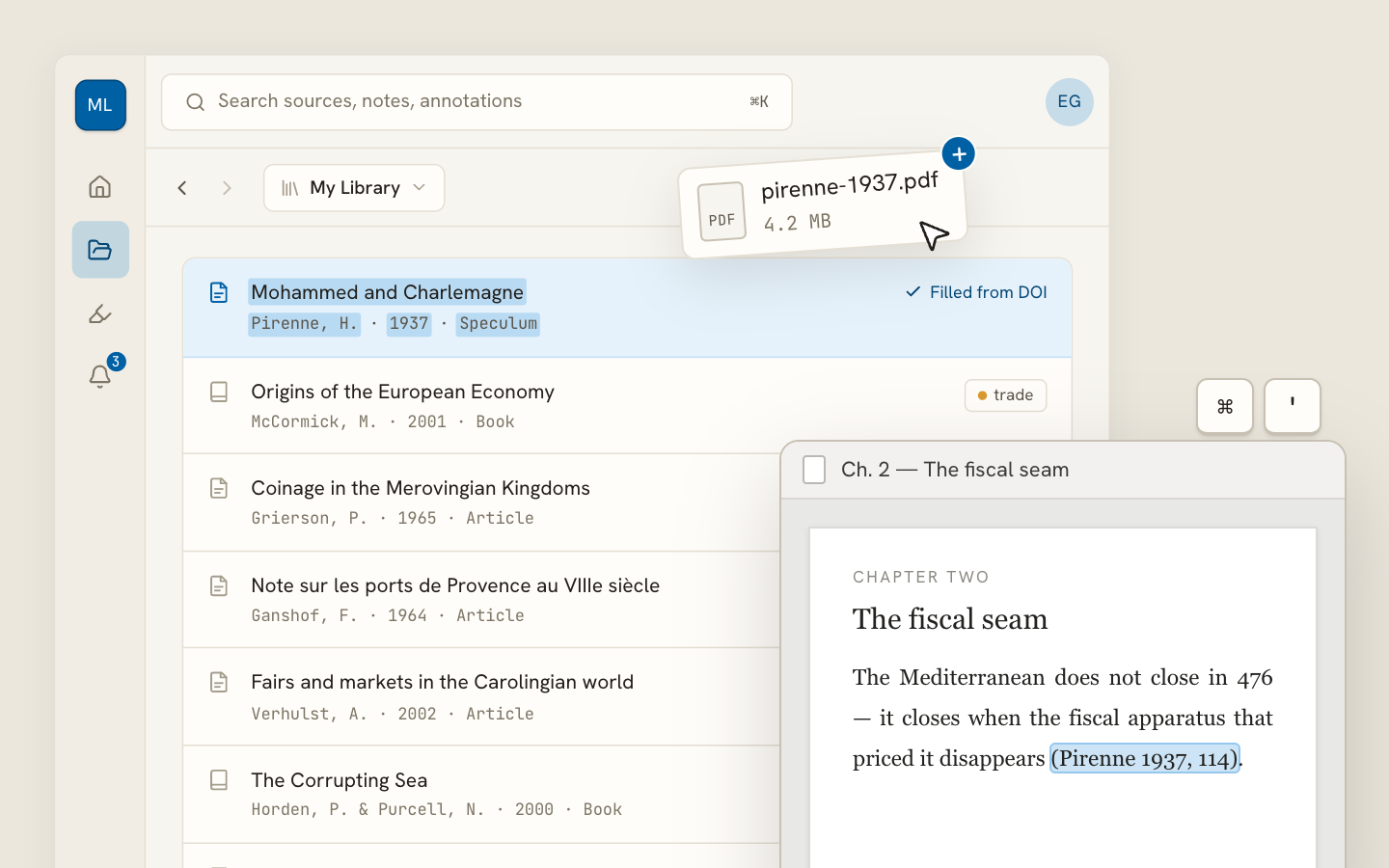
  • Import a Zotero, Mendeley or EndNote library — or a folder of PDFs
  • Highlight and annotate without leaving the source
  • Cite in any CSL style as you write, with one shared library for your lab
Request early accessSee the product →
Archivero library view with a source list and an open PDF

Your weekly research workflow, in one email

One tested workflow, three links, no filler — every Tuesday.

Unsubscribe in one click. We never share your address.

Guides/How to Write a Thesis

Thesis Proposal

How to write a thesis proposal — outlining your research question, methodology, timeline, and literature review to get your thesis approved.

9 min readThesis writing

Key Takeaways

  • A thesis proposal is a plan for your thesis — it describes what you intend to research and how, submitted for committee approval before you begin.
  • A proposal is not a thesis — it proposes research that hasn't been done yet, written in future tense ("this study will examine…").
  • Key components include: title, introduction and problem statement, research questions, preliminary literature review, proposed methodology, timeline, expected contributions, and preliminary bibliography.
  • The literature review in a proposal is preliminary — it establishes the gap but doesn't need the depth of the final thesis literature review.
  • The methodology section must convince the committee that your approach is feasible and appropriate for answering your research question.
  • Include a realistic timeline with milestones — committees want to see that you've planned the work and can complete it within your program's deadlines.
  • A master's thesis proposal is typically 10–25 pages; a doctoral dissertation proposal may reach 20–50 pages.
  • The proposal becomes a living document — your actual thesis may deviate from the proposal as findings emerge, and that's expected.

On this page

1 of 17
Key TakeawaysWhat Is a Thesis Proposal?Thesis Proposal vs. ThesisWhat to IncludeTitle and Working TitleIntroduction and Problem StatementResearch QuestionsLiterature Review (Preliminary)Proposed MethodologyTimeline and MilestonesExpected ContributionsPreliminary BibliographyHow Long Is a Thesis Proposal?Example OutlineTips for Getting ApprovedCommon MistakesNext Steps
All Thesis writing guides →

A thesis proposal is a formal document that outlines your planned research — the question you intend to investigate, the existing scholarship that justifies it, the methodology you'll use, and a timeline for completion. It is submitted to your thesis committee or department for approval before you begin the actual research. A strong proposal demonstrates that your project is feasible, original, and methodologically sound.

What Is a Thesis Proposal?

A thesis proposal is essentially a pitch. You're asking your committee, department, or institution to approve a research project by demonstrating that:

  1. The question is worth asking — there's a genuine gap in the literature
  2. You understand the existing research — the preliminary literature review proves it
  3. Your methodology is sound — the approach can actually answer the question
  4. The project is feasible — you have the resources, access, and time to complete it

The proposal serves a protective function as well. By requiring approval before research begins, the institution ensures that the project meets ethical standards (especially for research involving human subjects), aligns with the program's requirements, and has a realistic chance of completion.

Most programs require the proposal to be defended in an oral presentation — a mini version of the thesis defense — where committee members ask questions, suggest revisions, and ultimately give (or withhold) approval to proceed.

Thesis Proposal vs. Thesis

Thesis ProposalThesis
WhenThesis ProposalBefore research beginsThesisAfter research is complete
TenseThesis ProposalFuture ("this study will examine…")ThesisPast ("this study examined…")
Literature reviewThesis ProposalPreliminary — establishes the gapThesisComprehensive — full survey of the field
MethodologyThesis ProposalProposed — describes what you plan to doThesisDocumented — describes what you actually did
ResultsThesis ProposalNone — research hasn't happened yetThesisFull presentation of findings
LengthThesis Proposal10–50 pagesThesis80–300+ pages

The proposal becomes the foundation of the thesis. In many programs, the proposal's introduction and literature review are revised and expanded into the thesis's first two chapters.

What to Include

Title and Working Title

Your proposal needs a descriptive, specific title. It doesn't need to be final — most theses change their title during the writing process — but it should clearly indicate the topic, the population or context, and the approach.

Vague:"A Study on Social Media" Specific: "The Relationship Between Instagram Use and Body Image Satisfaction Among Female College Students: A Mixed-Methods Study"

A good working title helps you stay focused. If you can't summarize your project in a title, the scope may not be clear enough.

Introduction and Problem Statement

The introduction frames the research by answering three questions:

  1. What is the topic? — Provide the necessary context
  2. What is the problem? — Identify the specific issue your research addresses
  3. Why does it matter? — Explain the significance for theory, practice, or policy

The problem statement is the core of the introduction. It should clearly articulate what is unknown, unresolved, or insufficiently studied — the gap that your research will fill.

Despite a growing body of research on social media and mental health, few studies have examined the specific mechanisms through which platform design features — as opposed to overall screen time — influence body image outcomes among college-age women (Fardouly et al., 2018; Tiggemann & Slater, 2017). This gap is significant because interventions targeting total screen time may be less effective than those targeting specific design elements.

Research Questions

State your research questions clearly and explicitly. These are the questions your study is designed to answer — the same questions you'll return to in your thesis conclusion.

Primary Research Question:How do specific Instagram design features (algorithmic content curation, appearance-based filters, and social comparison metrics) relate to body image satisfaction among female college students aged 18–22?

Sub-Question 1:Which design features are most strongly associated with body dissatisfaction? Sub-Question 2: How do students describe the experience of encountering appearance-focused algorithmic content?

For guidance on formulating research questions, see Research Question.

Literature Review (Preliminary)

The proposal's literature review is a condensed version of the full review you'll write for the thesis. Its purpose is to:

  1. Demonstrate your knowledge of the existing research
  2. Establish the gap that your study addresses
  3. Justify your research question by showing that it hasn't been adequately answered

A proposal literature review typically covers the major themes, key studies, and significant debates — but it doesn't need the exhaustive coverage of the final chapter. You'll expand it significantly as you continue reading during the research process.

In a 20-page proposal, the literature review might be 5–8 pages. In a 40-page doctoral proposal, it might reach 10–15 pages.

For more on writing a literature review, see Literature Review.

Proposed Methodology

The methodology section must convince the committee that your approach is appropriate, rigorous, and feasible. Describe:

  • Research design — qualitative, quantitative, or mixed methods, and why
  • Participants / sample — who or what you'll study, how you'll recruit, and how many
  • Data collection — specific methods (surveys, interviews, experiments, archival data) and instruments
  • Data analysis — analytical techniques and software
  • Ethical considerations — IRB requirements, informed consent, confidentiality

Because the research hasn't happened yet, write in future tense: "This study will employ…" "Participants will be recruited through…" "Data will be analyzed using…"

The committee will evaluate whether your methodology can actually answer your research questions. A mismatch between the questions and the methods is the most common reason proposals are sent back for revision.

For more on research methodology, see Methodology.

Timeline and Milestones

Include a realistic timeline showing when each phase of the research will be completed. Committees want evidence that you've thought through the practical logistics, not just the intellectual framework.

A typical master's thesis timeline might look like:

PhaseTimeframe
Literature review (expanded)Months 1–2
IRB application and approvalMonth 2
Data collectionMonths 3–4
Data analysisMonths 4–5
Writing Results and DiscussionMonths 5–6
Writing Introduction and ConclusionMonth 7
Revision and committee feedbackMonth 8
Final submission and defenseMonth 9

Build in buffer time. Every phase takes longer than you expect — especially data collection and committee feedback cycles.

Expected Contributions

Briefly describe what your research will contribute. This isn't a results section (you don't have results yet) — it's a statement of what the study could add to the field if the research goes as planned.

This study is expected to contribute to the growing literature on social media and body image by identifying the specific platform features most strongly associated with body dissatisfaction — moving beyond the dominant focus on overall screen time. The findings may inform the design of targeted interventions and platform design guidelines.

Preliminary Bibliography

Include a complete list of all sources cited in the proposal. Format according to your program's required citation style (APA, MLA, Chicago, etc.).

The bibliography is "preliminary" because you'll add many more sources as you expand the literature review and refine the methodology during the thesis itself.

How Long Is a Thesis Proposal?

Proposal length varies by degree level, discipline, and institutional requirements.

Degree LevelTypical Length
Undergraduate honors thesis5–10 pages
Master's thesis10–25 pages
Doctoral dissertation20–50 pages

Check your program's specific guidelines. Some departments provide a proposal template or outline; follow it exactly.

Example Outline

Here's a representative outline for a master's thesis proposal:

1. Introduction(3–4 pages) 1.1 Background and Context 1.2 Problem Statement 1.3 Purpose of the Study 1.4 Research Questions 1.5 Significance of the Study 1.6 Definition of Key Terms

2. Literature Review(6–8 pages) 2.1 Social Media and Mental Health: Overview 2.2 Body Image and Social Comparison Theory 2.3 Platform Design Features and User Behavior 2.4 Gaps in the Literature

3. Proposed Methodology(4–6 pages) 3.1 Research Design 3.2 Participants and Sampling 3.3 Data Collection Instruments 3.4 Data Analysis Plan 3.5 Ethical Considerations 3.6 Limitations

4. Timeline(1 page)

5. References(2–3 pages)

Tips for Getting Approved

  1. Align with your advisor's expertise. Proposals that connect to your advisor's research area benefit from their guidance and are more likely to receive enthusiastic support.

  2. Be specific, not ambitious. Committees reject proposals that try to do too much. A focused, achievable study is more compelling than a sweeping investigation that can't be completed in the available time.

  3. Demonstrate feasibility. Show that you have access to participants, data, instruments, and institutional support. Address potential obstacles and explain how you'll handle them.

  4. Anticipate committee questions. Read your proposal as a skeptic would. Where are the weak points? Address them proactively in the text rather than waiting for the committee to raise them.

  5. Follow formatting requirements exactly. Programs often have specific templates, margin requirements, and section expectations. Ignoring them signals carelessness.

  6. Write clearly and concisely. Your proposal is the committee's first extended sample of your writing. Dense, jargon-heavy, or disorganized prose raises concerns about the thesis itself.

Common Mistakes

  1. Writing a thesis instead of a proposal. The proposal describes planned research in future tense. If you're presenting results or writing in past tense, you've gone beyond the proposal stage.

  2. Insufficient literature review. A proposal that cites 5–10 sources suggests shallow engagement with the field. Even a preliminary review should demonstrate substantive reading.

  3. Methodology that doesn't match the questions. If your research question asks "how do participants experience…" but your methodology only includes a closed-ended survey, the committee will flag the mismatch.

  4. No timeline. Omitting a timeline suggests you haven't thought about feasibility. Include realistic milestones even if the dates are approximate.

  5. Overly broad scope. Proposing to study a phenomenon across all contexts, populations, and timeframes is a red flag. Narrow the scope to something achievable.

  6. Ignoring ethical considerations. Any research involving human participants requires ethical review. Failing to address IRB requirements, consent protocols, or data protection suggests unpreparedness.

  7. Treating the proposal as final. The proposal is a plan, not a contract. Your actual thesis will evolve. But the proposal should still be as thoughtful and rigorous as possible — it sets the foundation.

Next Steps

With your proposal approved, begin the full thesis:

  • Research Question — refine the questions your study will answer
  • Literature Review — expand the preliminary review into a comprehensive chapter
  • Methodology — develop the methodology section into the full Chapter 3
  • Thesis Structure — see how the proposal's components map onto the thesis chapters
  • Thesis Introduction — expand and revise the proposal's introduction into Chapter 1

Archivero helps you transition from proposal to thesis by keeping your sources, notes, and reading organized — so the preliminary literature review grows naturally into the full chapter as your research progresses.

All Thesis writing guides →
← PreviousThesis AbstractNext →Thesis Formatting

More on Thesis writing

From crafting a thesis statement to structuring chapters, writing the proposal and preparing for the defence.

View all 19 guides →
8 sections·9 min readThesis writingThesis Formatting7 sections·7 min readThesis writingThesis vs. Dissertation7 sections·10 min readThesis writingThesis Defense6 sections·9 min readThesis writingCommon Thesis Mistakes

Your sources, PDFs and citations in one library

  • Import a Zotero, Mendeley or EndNote library — or a folder of PDFs
  • Highlight and annotate without leaving the source
  • Cite in any CSL style as you write, with one shared library for your lab
Request early accessSee the product →
Archivero library view with a source list and an open PDF

Your weekly research workflow, in one email

One tested workflow, three links, no filler — every Tuesday.

Unsubscribe in one click. We never share your address.