Archivero is in early access — your sources, PDFs and citations in one library.Request early access →
Archivero/guides/
APAMLAHarvardThesis writing
Subscribe
Archivero/guides/Request early access →

Guides

APA styleMLA styleHarvard referencingThesis writing

Compare

APA 6th vs 7thMLA 8th vs 9thHarvard vs APAThesis vs dissertation

Product

FeaturesEarly access

Resources

DocsCheat sheetsNewsletter

Company

ContactStatus ↗
© 2025–2026 Ernesto F. GonzálezGuidesDocsContactPrivacyTerms
Guides/How to Write a Thesis

Thesis Defense

How to prepare for a thesis defense — what to expect, common questions, presentation tips, and how to handle the Q&A with your committee.

10 min readThesis writing

Key Takeaways

  • A thesis defense is a formal oral examination where you present your research and answer committee questions — it is the final hurdle before your thesis is accepted.
  • The defense typically includes a 20–40 minute presentation followed by a 30–90 minute Q&A session with the committee.
  • Committee members test whether you understand your research deeply — they ask about your choices, limitations, and the implications of your findings.
  • Most students pass the defense, often with minor revisions required; outright failure is rare because advisors typically don't allow students to defend until they're ready.
  • Know your thesis inside out — especially the methodology, limitations, and how your findings connect to the literature.
  • Prepare for common questions like "What would you do differently?" and "How does this contribute to the field?"
  • Practice the presentation multiple times with different audiences to build fluency and anticipate questions.
  • The defense is a scholarly conversation, not a hostile interrogation — the committee wants you to succeed.

On this page

1 of 16
Key TakeawaysWhat Is a Thesis Defense?What to ExpectBefore the DefenseDuring the PresentationThe Q&A SessionAfter the DefenseCommon Thesis Defense QuestionsHow to PrepareKnow Your Thesis Inside OutAnticipate QuestionsPractice Your PresentationPrepare Your SlidesPresentation TipsWhat If You Don't Pass?Next Steps
All Thesis writing guides →

A thesis defense (also called a viva voce in the UK) is a formal oral examination in which you present your research to your thesis committee and answer their questions about your methodology, findings, and conclusions. It is the final step before your thesis or dissertation is officially accepted — a demonstration that you understand your own work deeply enough to explain it, justify it, and respond to expert scrutiny.

What Is a Thesis Defense?

A thesis defense is a formal academic event in which you present the key elements of your thesis or dissertation to a committee of experts, then respond to their questions, criticisms, and suggestions. The word "defense" is accurate — you are defending your research decisions, your interpretation of findings, and the validity of your conclusions.

Despite the adversarial connotation, a defense is fundamentally a scholarly conversation. The committee has already read your thesis. They're not encountering your research for the first time. Their questions probe the depth of your understanding, test the robustness of your methodology, and explore the implications you may not have fully addressed in the written document.

The defense serves several purposes:

  1. Verification — confirming that you are the one who did the work and that you understand it fully
  2. Quality assurance — identifying any remaining issues, gaps, or weaknesses before the thesis is finalized
  3. Scholarly development — treating you as a colleague who can engage in rigorous academic discourse
  4. Gate-keeping — certifying that the thesis meets the standards of the institution and the discipline

What to Expect

Before the Defense

The weeks before the defense involve both logistical preparation and intellectual review.

Logistics:

  • Your thesis must be submitted to all committee members with enough lead time — typically 2–4 weeks before the defense date
  • You'll schedule the defense through your department, reserving a room and confirming the committee's availability
  • Some programs require the defense to be publicly announced, with open attendance for faculty and students

Preparation:

  • Re-read your entire thesis — you need to know every chapter, every table, every claim, and the reasoning behind every methodological choice
  • Prepare a presentation (typically slides) that summarizes the key elements
  • Anticipate questions and practice answering them

Don't assume that because you wrote the thesis, you remember every detail. By the time you defend, months may have passed since you wrote certain chapters.

During the Presentation

The presentation is your opportunity to walk the committee through your research in a structured, concise format. You have the floor — this is the one part of the defense where you control the narrative.

Typical structure (20–40 minutes):

  1. Introduction (2–3 minutes) — the research problem, context, and why it matters
  2. Literature Review (3–5 minutes) — the key gap your research addresses (don't summarize every source — highlight the gap)
  3. Research Questions (1–2 minutes) — state them clearly
  4. Methodology (5–8 minutes) — your design, data collection, and analysis approach
  5. Key Findings (5–10 minutes) — the most important results, with key data
  6. Discussion and Implications (3–5 minutes) — what the findings mean
  7. Limitations and Future Research (2–3 minutes) — what you couldn't do and what should come next
  8. Conclusion (1–2 minutes) — the core contribution of your thesis

Keep the presentation focused. The committee has read the full thesis — they don't need a chapter-by-chapter recap. Emphasize the decisions you made, the findings that matter most, and the contribution to the field.

The Q&A Session

After the presentation, the committee asks questions. This is the core of the defense and typically lasts 30–90 minutes depending on the degree level and institution.

Questions may come in rounds (each committee member takes a turn) or in open format (any member can ask at any time). Your advisor or committee chair typically moderates.

The Q&A covers several categories:

  • Clarification questions — "Can you explain what you mean by [term] on page 47?"
  • Methodological questions — "Why did you use semi-structured interviews instead of focus groups?"
  • Interpretation questions — "How do you account for the fact that your findings contradict [established study]?"
  • Limitation questions — "You acknowledge that your sample was convenience-based. How does that affect the generalizability of your conclusions?"
  • Big-picture questions — "What is the most significant contribution of this work to the field?"
  • Hypothetical questions — "If you were starting this study over, what would you do differently?"

It's normal and expected to not know the answer to every question. If a question goes beyond your data or expertise, say so honestly: "That's an important point. My data doesn't address that directly, but based on the literature, I would hypothesize that…" Acknowledging the limits of your study is a sign of scholarly maturity, not weakness.

After the Defense

After the Q&A, the committee typically asks you to leave the room while they deliberate. The deliberation is usually brief — 10–30 minutes. You'll then be invited back and told the outcome.

Possible outcomes:

OutcomeWhat It Means
PassThesis accepted as is — no further changes needed (uncommon)
Pass with minor revisionsThesis accepted, but small corrections required (the most common outcome)
Pass with major revisionsSubstantial revisions required, possibly followed by a re-examination or re-submission to the committee
FailThesis not accepted — the student may need to redo significant portions and re-defend (rare)

Most students pass with minor revisions. Outright failure is uncommon because advisors generally won't let students defend until the thesis is in good shape. If your advisor says you're ready, you almost certainly are.

Common Thesis Defense Questions

These questions come up frequently across disciplines. Prepare a thoughtful response for each.

  1. "Can you summarize your thesis in 2–3 sentences?" — Tests whether you can articulate the core contribution clearly and concisely.

  2. "Why does this research matter?" — Tests your understanding of the significance and real-world implications.

  3. "Why did you choose this methodology?" — Tests whether you can justify your research design and explain why alternatives were less suitable.

  4. "What are the limitations of your study?" — Tests your awareness of what your research can and cannot claim.

  5. "How do your findings relate to [specific study in your literature review]?" — Tests your familiarity with the literature and your ability to position your work within it.

  6. "What surprised you during the research process?" — Tests reflective thinking and engagement with the work.

  7. "If you could do this study again, what would you change?" — Tests your ability to critically evaluate your own work.

  8. "What are the practical implications of your findings?" — Tests whether you can connect academic research to real-world application.

  9. "How could future research build on your findings?" — Tests your understanding of how your work fits into the ongoing scholarly conversation.

  10. "How did you ensure the validity / reliability / trustworthiness of your findings?" — Tests your methodological rigor.

How to Prepare

Know Your Thesis Inside Out

Re-read the entire thesis critically before the defense. Pay special attention to:

  • Your research questions — you must be able to state them from memory
  • Your methodological choices — why you chose each method and what the alternatives were
  • Your key findings — the specific numbers, themes, or patterns that answer your questions
  • Your limitations — what you acknowledged and how you addressed or accounted for them
  • Your literature review — especially the studies you relied on most heavily

You should be able to turn to any page of your thesis and explain what's there and why.

Anticipate Questions

Put yourself in each committee member's shoes. What are their areas of expertise? What aspects of your thesis are they most likely to scrutinize? If a committee member specializes in methodology, expect detailed questions about your research design. If another is a subject-matter expert, expect questions about your theoretical framework.

Read your thesis as a skeptic. Where are the weakest arguments? The thinnest evidence? The most significant limitations? Those are the areas the committee will probe.

Practice Your Presentation

Practice the full presentation at least 3–5 times:

  • Once alone, timing yourself (aim for under your time limit, not over)
  • Once in front of your advisor for feedback
  • Once in front of peers — friends, fellow graduate students, or colleagues who can ask practice questions
  • If possible, once in the actual room where the defense will take place

Practice answering questions, not just delivering the presentation. Have your practice audience ask you tough questions and practice responding under pressure.

Prepare Your Slides

Slides should support your presentation, not replace it. Follow these guidelines:

  • Keep text minimal — bullet points and key phrases, not paragraphs
  • Use visuals for data — charts, graphs, and tables are more effective than text descriptions
  • Limit to 15–25 slides for a 30-minute presentation
  • Include your research questions on a slide — they're the backbone
  • Use a clear, readable font — at least 24pt for body text
  • Avoid animations and transitions — they look unprofessional in an academic context
  • Include a slide for limitations — it signals that you're aware of them before the committee asks
  • End with a "Questions?" slide or a summary slide that stays visible during the Q&A

Presentation Tips

  1. Open with confidence. Your first minute sets the tone. Start with the problem your research addresses and why it matters — not with "Um, so, my thesis is about…"

  2. Speak to the committee, not to your slides. Make eye contact. Know your presentation well enough that you only glance at slides for reference.

  3. Don't read from notes. Brief bullet points on note cards are fine for reference, but reading a prepared script signals a lack of confidence in your own material.

  4. Manage your time. Going over your allotted time cuts into the Q&A and frustrates the committee. Practice until you can consistently finish 2–3 minutes under the limit.

  5. Pause before answering questions. A 3-second pause to collect your thoughts is far better than a rambling, unfocused answer. It's not a speed test.

  6. Be honest about what you don't know. "I'm not sure, but based on my findings I would expect…" is a perfectly acceptable answer. Making up an answer is not.

  7. Treat it as a conversation. The best defenses feel like a discussion between scholars, not an interrogation. Engage with the committee's ideas, ask for clarification on their questions if needed, and show genuine interest in the intellectual exchange.

What If You Don't Pass?

First, understand that not passing is rare. Advisors who believe a student isn't ready will typically delay the defense rather than allow the student to fail publicly.

If the committee requires major revisions, you'll receive written feedback specifying what needs to change. You may have weeks or months to make the revisions, after which the committee reviews the updated thesis. In some cases, a second defense is required; in others, written approval from the committee is sufficient.

If the committee determines that the thesis doesn't meet the standards for the degree — an exceedingly uncommon outcome — the student may need to rewrite significant portions and re-defend. In doctoral programs, this may also involve additional coursework or a change in research direction.

The key point: the defense is not a gotcha moment. It is a structured, guided process, and by the time you reach it, you've already demonstrated your capability through years of coursework, research, and writing.

Next Steps

As you prepare for the defense, revisit the components of your thesis:

  • Thesis Structure — review how all chapters fit together before you present
  • Thesis Conclusion — make sure your conclusion clearly answers the research questions
  • Thesis Abstract — practice distilling your thesis into a concise summary
  • Research Question — be ready to state and defend your research questions
  • Methodology — expect the most questions here
  • Thesis Formatting — finalize formatting before submission

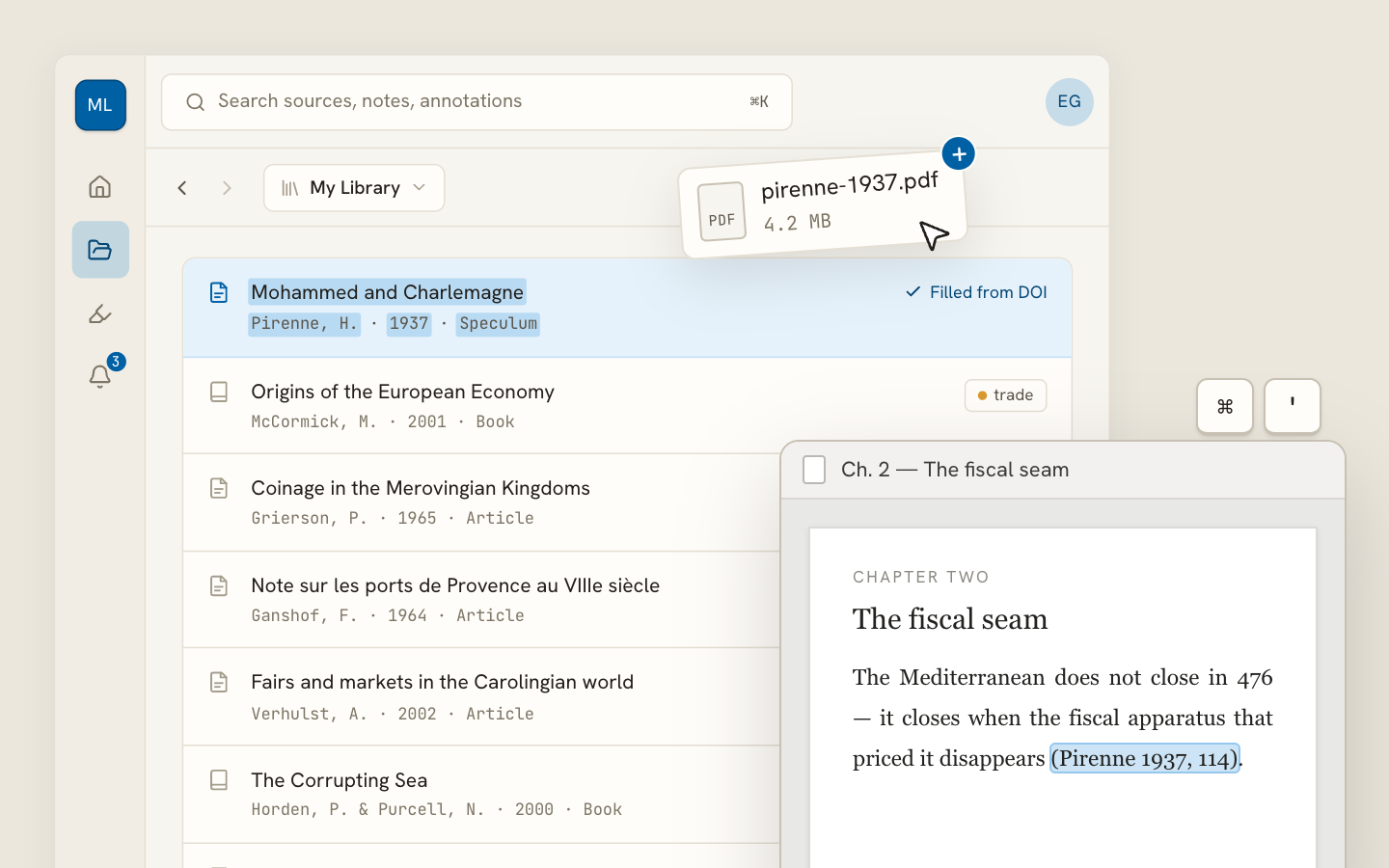
Archivero helps you prepare for the defense by keeping your entire research — sources, annotations, highlights, and notes — organized and searchable, so you can quickly revisit any study, data point, or argument when preparing your presentation and anticipating committee questions.
All Thesis writing guides →
← PreviousThesis vs. DissertationNext →Common Thesis Mistakes

More on Thesis writing

From crafting a thesis statement to structuring chapters, writing the proposal and preparing for the defence.

View all 19 guides →
6 sections·9 min readThesis writingCommon Thesis Mistakes9 sections·7 min readThesis writingWhat Is a Thesis Statement?10 sections·8 min readThesis writingHow to Write a Thesis Statement8 sections·9 min readThesis writingThesis Statement Examples

Your sources, PDFs and citations in one library

  • Import a Zotero, Mendeley or EndNote library — or a folder of PDFs
  • Highlight and annotate without leaving the source
  • Cite in any CSL style as you write, with one shared library for your lab
Request early accessSee the product →
Archivero library view with a source list and an open PDF

Your weekly research workflow, in one email

One tested workflow, three links, no filler — every Tuesday.

Unsubscribe in one click. We never share your address.

Guides/How to Write a Thesis

Thesis Defense

How to prepare for a thesis defense — what to expect, common questions, presentation tips, and how to handle the Q&A with your committee.

10 min readThesis writing

Key Takeaways

  • A thesis defense is a formal oral examination where you present your research and answer committee questions — it is the final hurdle before your thesis is accepted.
  • The defense typically includes a 20–40 minute presentation followed by a 30–90 minute Q&A session with the committee.
  • Committee members test whether you understand your research deeply — they ask about your choices, limitations, and the implications of your findings.
  • Most students pass the defense, often with minor revisions required; outright failure is rare because advisors typically don't allow students to defend until they're ready.
  • Know your thesis inside out — especially the methodology, limitations, and how your findings connect to the literature.
  • Prepare for common questions like "What would you do differently?" and "How does this contribute to the field?"
  • Practice the presentation multiple times with different audiences to build fluency and anticipate questions.
  • The defense is a scholarly conversation, not a hostile interrogation — the committee wants you to succeed.

On this page

1 of 16
Key TakeawaysWhat Is a Thesis Defense?What to ExpectBefore the DefenseDuring the PresentationThe Q&A SessionAfter the DefenseCommon Thesis Defense QuestionsHow to PrepareKnow Your Thesis Inside OutAnticipate QuestionsPractice Your PresentationPrepare Your SlidesPresentation TipsWhat If You Don't Pass?Next Steps
All Thesis writing guides →

A thesis defense (also called a viva voce in the UK) is a formal oral examination in which you present your research to your thesis committee and answer their questions about your methodology, findings, and conclusions. It is the final step before your thesis or dissertation is officially accepted — a demonstration that you understand your own work deeply enough to explain it, justify it, and respond to expert scrutiny.

What Is a Thesis Defense?

A thesis defense is a formal academic event in which you present the key elements of your thesis or dissertation to a committee of experts, then respond to their questions, criticisms, and suggestions. The word "defense" is accurate — you are defending your research decisions, your interpretation of findings, and the validity of your conclusions.

Despite the adversarial connotation, a defense is fundamentally a scholarly conversation. The committee has already read your thesis. They're not encountering your research for the first time. Their questions probe the depth of your understanding, test the robustness of your methodology, and explore the implications you may not have fully addressed in the written document.

The defense serves several purposes:

  1. Verification — confirming that you are the one who did the work and that you understand it fully
  2. Quality assurance — identifying any remaining issues, gaps, or weaknesses before the thesis is finalized
  3. Scholarly development — treating you as a colleague who can engage in rigorous academic discourse
  4. Gate-keeping — certifying that the thesis meets the standards of the institution and the discipline

What to Expect

Before the Defense

The weeks before the defense involve both logistical preparation and intellectual review.

Logistics:

  • Your thesis must be submitted to all committee members with enough lead time — typically 2–4 weeks before the defense date
  • You'll schedule the defense through your department, reserving a room and confirming the committee's availability
  • Some programs require the defense to be publicly announced, with open attendance for faculty and students

Preparation:

  • Re-read your entire thesis — you need to know every chapter, every table, every claim, and the reasoning behind every methodological choice
  • Prepare a presentation (typically slides) that summarizes the key elements
  • Anticipate questions and practice answering them

Don't assume that because you wrote the thesis, you remember every detail. By the time you defend, months may have passed since you wrote certain chapters.

During the Presentation

The presentation is your opportunity to walk the committee through your research in a structured, concise format. You have the floor — this is the one part of the defense where you control the narrative.

Typical structure (20–40 minutes):

  1. Introduction (2–3 minutes) — the research problem, context, and why it matters
  2. Literature Review (3–5 minutes) — the key gap your research addresses (don't summarize every source — highlight the gap)
  3. Research Questions (1–2 minutes) — state them clearly
  4. Methodology (5–8 minutes) — your design, data collection, and analysis approach
  5. Key Findings (5–10 minutes) — the most important results, with key data
  6. Discussion and Implications (3–5 minutes) — what the findings mean
  7. Limitations and Future Research (2–3 minutes) — what you couldn't do and what should come next
  8. Conclusion (1–2 minutes) — the core contribution of your thesis

Keep the presentation focused. The committee has read the full thesis — they don't need a chapter-by-chapter recap. Emphasize the decisions you made, the findings that matter most, and the contribution to the field.

The Q&A Session

After the presentation, the committee asks questions. This is the core of the defense and typically lasts 30–90 minutes depending on the degree level and institution.

Questions may come in rounds (each committee member takes a turn) or in open format (any member can ask at any time). Your advisor or committee chair typically moderates.

The Q&A covers several categories:

  • Clarification questions — "Can you explain what you mean by [term] on page 47?"
  • Methodological questions — "Why did you use semi-structured interviews instead of focus groups?"
  • Interpretation questions — "How do you account for the fact that your findings contradict [established study]?"
  • Limitation questions — "You acknowledge that your sample was convenience-based. How does that affect the generalizability of your conclusions?"
  • Big-picture questions — "What is the most significant contribution of this work to the field?"
  • Hypothetical questions — "If you were starting this study over, what would you do differently?"

It's normal and expected to not know the answer to every question. If a question goes beyond your data or expertise, say so honestly: "That's an important point. My data doesn't address that directly, but based on the literature, I would hypothesize that…" Acknowledging the limits of your study is a sign of scholarly maturity, not weakness.

After the Defense

After the Q&A, the committee typically asks you to leave the room while they deliberate. The deliberation is usually brief — 10–30 minutes. You'll then be invited back and told the outcome.

Possible outcomes:

OutcomeWhat It Means
PassThesis accepted as is — no further changes needed (uncommon)
Pass with minor revisionsThesis accepted, but small corrections required (the most common outcome)
Pass with major revisionsSubstantial revisions required, possibly followed by a re-examination or re-submission to the committee
FailThesis not accepted — the student may need to redo significant portions and re-defend (rare)

Most students pass with minor revisions. Outright failure is uncommon because advisors generally won't let students defend until the thesis is in good shape. If your advisor says you're ready, you almost certainly are.

Common Thesis Defense Questions

These questions come up frequently across disciplines. Prepare a thoughtful response for each.

  1. "Can you summarize your thesis in 2–3 sentences?" — Tests whether you can articulate the core contribution clearly and concisely.

  2. "Why does this research matter?" — Tests your understanding of the significance and real-world implications.

  3. "Why did you choose this methodology?" — Tests whether you can justify your research design and explain why alternatives were less suitable.

  4. "What are the limitations of your study?" — Tests your awareness of what your research can and cannot claim.

  5. "How do your findings relate to [specific study in your literature review]?" — Tests your familiarity with the literature and your ability to position your work within it.

  6. "What surprised you during the research process?" — Tests reflective thinking and engagement with the work.

  7. "If you could do this study again, what would you change?" — Tests your ability to critically evaluate your own work.

  8. "What are the practical implications of your findings?" — Tests whether you can connect academic research to real-world application.

  9. "How could future research build on your findings?" — Tests your understanding of how your work fits into the ongoing scholarly conversation.

  10. "How did you ensure the validity / reliability / trustworthiness of your findings?" — Tests your methodological rigor.

How to Prepare

Know Your Thesis Inside Out

Re-read the entire thesis critically before the defense. Pay special attention to:

  • Your research questions — you must be able to state them from memory
  • Your methodological choices — why you chose each method and what the alternatives were
  • Your key findings — the specific numbers, themes, or patterns that answer your questions
  • Your limitations — what you acknowledged and how you addressed or accounted for them
  • Your literature review — especially the studies you relied on most heavily

You should be able to turn to any page of your thesis and explain what's there and why.

Anticipate Questions

Put yourself in each committee member's shoes. What are their areas of expertise? What aspects of your thesis are they most likely to scrutinize? If a committee member specializes in methodology, expect detailed questions about your research design. If another is a subject-matter expert, expect questions about your theoretical framework.

Read your thesis as a skeptic. Where are the weakest arguments? The thinnest evidence? The most significant limitations? Those are the areas the committee will probe.

Practice Your Presentation

Practice the full presentation at least 3–5 times:

  • Once alone, timing yourself (aim for under your time limit, not over)
  • Once in front of your advisor for feedback
  • Once in front of peers — friends, fellow graduate students, or colleagues who can ask practice questions
  • If possible, once in the actual room where the defense will take place

Practice answering questions, not just delivering the presentation. Have your practice audience ask you tough questions and practice responding under pressure.

Prepare Your Slides

Slides should support your presentation, not replace it. Follow these guidelines:

  • Keep text minimal — bullet points and key phrases, not paragraphs
  • Use visuals for data — charts, graphs, and tables are more effective than text descriptions
  • Limit to 15–25 slides for a 30-minute presentation
  • Include your research questions on a slide — they're the backbone
  • Use a clear, readable font — at least 24pt for body text
  • Avoid animations and transitions — they look unprofessional in an academic context
  • Include a slide for limitations — it signals that you're aware of them before the committee asks
  • End with a "Questions?" slide or a summary slide that stays visible during the Q&A

Presentation Tips

  1. Open with confidence. Your first minute sets the tone. Start with the problem your research addresses and why it matters — not with "Um, so, my thesis is about…"

  2. Speak to the committee, not to your slides. Make eye contact. Know your presentation well enough that you only glance at slides for reference.

  3. Don't read from notes. Brief bullet points on note cards are fine for reference, but reading a prepared script signals a lack of confidence in your own material.

  4. Manage your time. Going over your allotted time cuts into the Q&A and frustrates the committee. Practice until you can consistently finish 2–3 minutes under the limit.

  5. Pause before answering questions. A 3-second pause to collect your thoughts is far better than a rambling, unfocused answer. It's not a speed test.

  6. Be honest about what you don't know. "I'm not sure, but based on my findings I would expect…" is a perfectly acceptable answer. Making up an answer is not.

  7. Treat it as a conversation. The best defenses feel like a discussion between scholars, not an interrogation. Engage with the committee's ideas, ask for clarification on their questions if needed, and show genuine interest in the intellectual exchange.

What If You Don't Pass?

First, understand that not passing is rare. Advisors who believe a student isn't ready will typically delay the defense rather than allow the student to fail publicly.

If the committee requires major revisions, you'll receive written feedback specifying what needs to change. You may have weeks or months to make the revisions, after which the committee reviews the updated thesis. In some cases, a second defense is required; in others, written approval from the committee is sufficient.

If the committee determines that the thesis doesn't meet the standards for the degree — an exceedingly uncommon outcome — the student may need to rewrite significant portions and re-defend. In doctoral programs, this may also involve additional coursework or a change in research direction.

The key point: the defense is not a gotcha moment. It is a structured, guided process, and by the time you reach it, you've already demonstrated your capability through years of coursework, research, and writing.

Next Steps

As you prepare for the defense, revisit the components of your thesis:

  • Thesis Structure — review how all chapters fit together before you present
  • Thesis Conclusion — make sure your conclusion clearly answers the research questions
  • Thesis Abstract — practice distilling your thesis into a concise summary
  • Research Question — be ready to state and defend your research questions
  • Methodology — expect the most questions here
  • Thesis Formatting — finalize formatting before submission

Archivero helps you prepare for the defense by keeping your entire research — sources, annotations, highlights, and notes — organized and searchable, so you can quickly revisit any study, data point, or argument when preparing your presentation and anticipating committee questions.

All Thesis writing guides →
← PreviousThesis vs. DissertationNext →Common Thesis Mistakes

More on Thesis writing

From crafting a thesis statement to structuring chapters, writing the proposal and preparing for the defence.

View all 19 guides →
6 sections·9 min readThesis writingCommon Thesis Mistakes9 sections·7 min readThesis writingWhat Is a Thesis Statement?10 sections·8 min readThesis writingHow to Write a Thesis Statement8 sections·9 min readThesis writingThesis Statement Examples

Your sources, PDFs and citations in one library

  • Import a Zotero, Mendeley or EndNote library — or a folder of PDFs
  • Highlight and annotate without leaving the source
  • Cite in any CSL style as you write, with one shared library for your lab
Request early accessSee the product →
Archivero library view with a source list and an open PDF

Your weekly research workflow, in one email

One tested workflow, three links, no filler — every Tuesday.

Unsubscribe in one click. We never share your address.