A thesis statement starts as a rough idea and becomes a precise claim through a process of questioning, positioning, and refining. The difference between a forgettable thesis and a compelling one usually comes down to specificity — the more precisely you define your argument, the stronger the paper that follows.
Writing a thesis statement doesn't have to feel like staring at a blank page until something brilliant appears. It's a structured process. You start with a topic, ask a question, take a position, and then sharpen that position until it's specific enough to drive an entire paper. Here's how to do it, step by step.
Step 1: Start with a Question
Every strong thesis statement begins as a question. You might not formally write the question down, but the mental shift from "I'm writing about X" to "What do I want to say about X?" is where thesis writing actually starts.
Take your broad topic and convert it into a focused question:
Topic:Social media and teenagers
Question:How does social media use affect the mental health of teenagers?
Topic:Renewable energy
Question:Why have some countries adopted renewable energy faster than others?
Topic:Shakespeare's Hamlet
Question:How does Hamlet's indecision function as the play's central dramatic device?
The question doesn't need to be perfect — it just needs to give you a direction. You'll refine it as you go.
Step 2: Take a Position
A question opens the door. A thesis statement walks through it. Once you have a question, answer it — and make sure your answer is something that could be argued.
Question:How does social media use affect the mental health of teenagers?
Provisional thesis:Social media harms teenagers' mental health.
That's a position. It's not a great thesis yet — it's too vague — but it's a starting point. The key test: could a reasonable person disagree? If yes, you have a position. If no, you might have a statement of fact.
Compare:
Fact (not a thesis):Many teenagers use social media daily.
Position (thesis material):Daily social media use contributes to anxiety and depression among teenagers.
Step 3: Give Reasons or a Preview
A thesis that states a claim without reasons leaves the reader wondering, "Why should I believe this?" Adding your key supporting points transforms a claim into a roadmap.
Claim only:Social media harms teenagers' mental health.
Claim + reasons:Social media harms teenagers' mental health by promoting unrealistic beauty standards, replacing face-to-face interaction, and creating cycles of compulsive checking.
The version with reasons tells the reader exactly what to expect from the body of the paper — three sections, each addressing one mechanism of harm. You don't always need to list three points explicitly, but giving the reader some sense of how you'll support your claim makes the thesis significantly stronger.
Step 4: Refine for Specificity
This is where good thesis statements become great ones. Go through your draft thesis and ask:
- Can I replace any vague word with a precise one? "Social media" is broad — do you mean Instagram, TikTok, all platforms? "Harms" is vague — do you mean increases anxiety, worsens body image, disrupts sleep?
- Can I narrow the scope? "Teenagers" is broad — do you mean 13–15-year-olds? U.S. high school students? Female adolescents?
- Is every word earning its place? Cut filler words and hedging language.
Here's the refinement in action:
Draft 1:Social media is bad for teenagers.
Draft 2:Social media harms teenagers' mental health.
Draft 3:Social media harms teenagers' mental health by promoting unrealistic beauty standards, replacing face-to-face interaction, and creating cycles of compulsive checking.
Draft 4:Instagram and TikTok contribute to anxiety and negative body image among teenage girls by normalizing edited appearances, encouraging social comparison, and rewarding compulsive engagement.
Each draft gets more specific. Draft 4 names the platforms, the population, the effects, and the mechanisms. A reader knows exactly what this paper will argue.
Step 5: Check Against Common Pitfalls
Before you finalize your thesis, run it through this quick checklist:
| Check | Question | If "No"… |
|---|---|---|
| Arguable | Could someone reasonably disagree? | You may have a fact, not a thesis. |
| Specific | Does it name concrete things (people, effects, mechanisms)? | Replace vague terms with precise ones. |
| Focused | Does it make one main claim (not three separate arguments)? | Narrow to a single line of reasoning. |
| Supportable | Can you back it up with evidence from your research? | Adjust the claim to match your sources. |
| Debatable | Is it more than a personal preference or moral truism? | Reframe as an evidence-based argument. |
If your thesis passes all five checks, it's ready to build a paper around.
Thesis Statement Formulas
Formulas aren't a substitute for critical thinking, but they're a reliable way to get started — especially when you're staring at a blank page at midnight. Here are three that work across disciplines.
The Simple Formula (Topic + Claim)
[Topic]is/should/causes [claim] because [reason].
Example:
Remote work improves employee productivity because it eliminates commuting time and reduces workplace distractions.
This works for straightforward argumentative essays where you have one main reason or a general claim to make.
The 3-Point Formula (Claim + 3 Reasons)
[Subject]does/is/should [claim] because of [reason 1], [reason 2], and [reason 3].
Example:
Public universities should eliminate legacy admissions because the practice perpetuates socioeconomic inequality, undermines meritocracy, and disproportionately benefits white applicants.
This is the classic five-paragraph-essay formula, and while it can feel formulaic, it's effective for short papers because it gives the essay an instant structure.
The Although/Because Formula (Counterargument + Position)
Although [counterargument/opposing view], [your position] because [reason].
Example:
Although nuclear energy produces minimal greenhouse gas emissions, it should not be classified as renewable because of the environmental risks of uranium mining and radioactive waste disposal.
This formula is particularly strong because it acknowledges the opposing side, which makes your own argument more credible. It signals to the reader that you've considered multiple perspectives.
Before and After Examples
Seeing a weak thesis transformed into a strong one is often more instructive than reading rules. Here are five real before-and-after revisions:
Before:Technology is changing the world.
After:Generative AI tools like ChatGPT are disrupting higher education by making traditional essay assignments ineffective as a measure of student understanding.
Before:The Great Gatsby is about the American Dream.
After:In The Great Gatsby, Fitzgerald uses Gatsby's self-invention and eventual downfall to argue that the American Dream is a destructive illusion rooted in class immobility.
Before:Exercise is good for you.
After:Regular aerobic exercise reduces the risk of major depressive disorder by increasing serotonin production, improving sleep quality, and providing a sense of accomplishment.
Before:College is too expensive.
After:The rising cost of tuition at U.S. public universities disproportionately burdens first-generation students, who take on more debt, work more hours, and graduate at lower rates than their peers.
Before:In this paper I will discuss climate change.
After:International climate agreements have failed to reduce global emissions because they rely on voluntary compliance, lack enforcement mechanisms, and allow the world's largest polluters to set their own targets.
Adjusting Your Thesis as You Write
Your thesis statement isn't a contract — it's a working claim. As you draft body paragraphs, conduct more research, or discover that your evidence points in a different direction, you should revisit and revise the thesis.
This is normal and expected. In fact, many experienced writers consider their first thesis statement a "working thesis" that will be refined during the drafting process. A few common adjustments:
- Narrowing: You planned to cover three reasons but realized your paper is strongest with two. Remove the weakest one.
- Shifting: Your research convinced you of a different position than you originally planned. Update the thesis to match what you actually argue in the paper.
- Sharpening: After writing the body, you understand your own argument better. Go back and make the thesis more precise.
The final step of writing any paper should be re-reading the thesis statement and making sure it accurately represents what you wrote — not what you planned to write.
Common Mistakes
- Making an announcement instead of an argument. "In this paper, I will examine the effects of social media on teenagers" describes your plan — it doesn't state a claim. Drop the meta-commentary and state what you found.
- Phrasing the thesis as a question. "Is social media harmful to teenagers?" is a research question, not a thesis. Answer it.
- Being so broad that the thesis could apply to anything. "Education is important for society" — what education? What society? Important how? Narrow it.
- Including evidence in the thesis. "According to Smith (2020), social media increases anxiety" belongs in a body paragraph, not the thesis statement.
- Writing two thesis statements. If your sentence has a semicolon separating two independent arguments, you may be trying to do too much. Pick one argument or find a way to unify them.
- Waiting until the end to write it. Some writers draft the thesis last, but even a rough working thesis at the start gives your paper direction. You can always refine it later.
Next Steps
You've got the process. Now see it in action:
- Thesis Statement Examples — 30+ examples organized by essay type and subject area
- Strong vs. Weak Thesis Statements — side-by-side comparisons with a revision checklist
- What Is a Thesis Statement? — the fundamentals of what a thesis statement is and where it goes
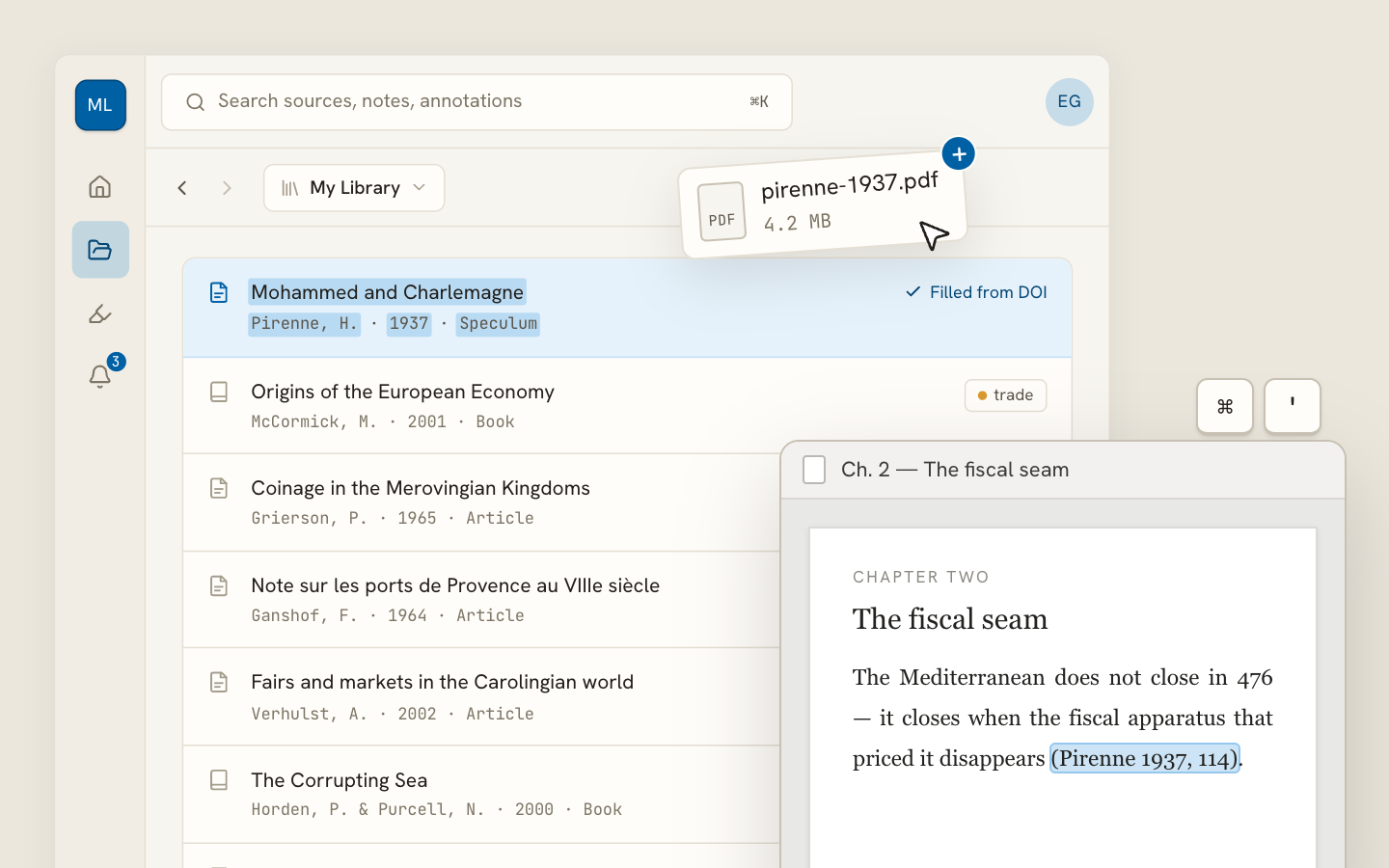
Archivero helps you collect and organize sources while you develop your argument — annotate key passages, build connections between readings, and keep your evidence in one place as your thesis takes shape.