Archivero is in early access — your sources, PDFs and citations in one library.Request early access →
Archivero/guides/
APAMLAHarvardThesis writing
Subscribe
Archivero/guides/Request early access →

Guides

APA styleMLA styleHarvard referencingThesis writing

Compare

APA 6th vs 7thMLA 8th vs 9thHarvard vs APAThesis vs dissertation

Product

FeaturesEarly access

Resources

DocsCheat sheetsNewsletter

Company

ContactStatus ↗
© 2025–2026 Ernesto F. GonzálezGuidesDocsContactPrivacyTerms
Guides/How to Write a Thesis

Argumentative Thesis Statement

How to write an argumentative thesis statement that takes a clear, debatable position — with formulas, examples by subject, and common mistakes to avoid.

8 min readThesis writing

Key Takeaways

  • An argumentative thesis states a debatable claim and gives reasons to support it — it takes a side rather than simply explaining a topic.
  • The most reliable formula is claim + "because" + reasons:
    • Governments should ban single-use plastics because they pollute oceans, harm wildlife, and have cost-effective reusable alternatives.
  • A strong argumentative thesis is specific, arguable, and supportable — a reasonable person could disagree with it.
  • Argumentative differs from analytical (which examines how something works) and expository (which explains a process or concept without taking sides).
  • The best argumentative thesis statements acknowledge complexity — the strongest positions account for counterarguments rather than ignoring them.
  • Common mistakes include stating a fact instead of a claim, being too vague, and choosing a topic that no reasonable person would dispute.
  • Use the Although/Because formula when you want to address a counterargument directly in the thesis itself.

On this page

1 of 18
Key TakeawaysWhat Is an Argumentative Thesis Statement?Argumentative vs. Analytical vs. ExpositoryHow to Write OneStep 1: Pick a Debatable TopicStep 2: Take a Clear SideStep 3: Provide ReasoningFormulas for Argumentative Thesis StatementsThe Simple Formula: Claim + Because + ReasonsThe Although/Because Formula: Counterargument + PositionThe Value/Policy Formula: What Should Be DoneExamples by SubjectSocial Issues & PolicyEducationTechnology & EthicsEnvironmentCommon MistakesNext Steps
All Thesis writing guides →

An argumentative thesis statement takes a clear, debatable position on a topic and provides the reasoning behind it. Unlike analytical or expository thesis statements, which explain or inform, an argumentative thesis asserts a claim that requires evidence and persuasion to defend — making it the foundation of persuasive essays, position papers, and argumentative research papers.

What Is an Argumentative Thesis Statement?

An argumentative thesis statement is a single sentence that declares a position you intend to argue and defend throughout your paper. It does more than announce a topic or describe what exists — it tells the reader what you believe and why.

The word "argumentative" doesn't mean hostile or combative. In academic writing, an argument is a reasoned claim supported by evidence. An argumentative thesis is the sentence that makes that claim explicit.

Universal basic income would reduce poverty more effectively than existing welfare programs because it eliminates bureaucratic overhead, removes benefit cliffs, and gives recipients greater autonomy over how they meet their needs.

That sentence names the position (UBI over welfare), takes a clear side, and previews three supporting reasons. A reader knows immediately what the paper will argue and how it will be structured.

Argumentative vs. Analytical vs. Expository

Thesis statements come in three main types. Understanding the differences helps you match your thesis to your assignment.

TypePurposeExample
ArgumentativePurposeTakes a debatable position and defends itExample"Schools should eliminate homework in grades K–5 because it reduces family time, increases stress, and has no proven academic benefit at that age."
AnalyticalPurposeBreaks a topic into parts and examines how they workExample"In The Great Gatsby, Fitzgerald uses the green light, the Valley of Ashes, and the eyes of Doctor T. J. Eckleburg to expose the emptiness behind the American Dream."
ExpositoryPurposeExplains or informs without taking a sideExample"Photosynthesis converts light energy into chemical energy through two stages: the light-dependent reactions in the thylakoid membrane and the Calvin cycle in the stroma."

The key distinction: an argumentative thesis makes a claim someone could disagree with. An analytical thesis interprets. An expository thesis explains.

If your professor asks for a "persuasive essay," "position paper," or "argumentative essay," you need an argumentative thesis. If the assignment asks you to "analyze," "examine," or "explore," you likely need an analytical one. For more on the other types, see Analytical Thesis Statement and Expository Thesis Statement.

How to Write One

Writing an argumentative thesis is a process of moving from a broad topic to a precise, debatable claim. These steps work whether you're writing a five-paragraph essay or a 20-page research paper.

Step 1: Pick a Debatable Topic

An argumentative thesis needs a topic where reasonable people disagree. If everyone agrees, there's nothing to argue. If the answer is a simple fact, there's nothing to prove.

Not debatable: "Water is essential for human survival." (No one disputes this.)

Debatable: "Municipal governments should fluoridate public water supplies." (People disagree about this.)

The best argumentative topics have at least two legitimate sides. If you can't imagine a thoughtful person taking the opposite position, the topic isn't debatable enough.

Step 2: Take a Clear Side

Once you've chosen a topic, decide what you actually think — and commit to it. A thesis that hedges ("Social media might have some negative effects") is weaker than one that takes a firm position ("Social media platforms should be required to verify users' ages because unrestricted access exposes minors to harmful content").

You don't need to be 100% certain of your position before you start writing. Many writers begin with a working thesis and refine it as they research. But the thesis itself should sound confident, not tentative.

Step 3: Provide Reasoning

A position without reasoning is just an opinion. The strongest argumentative thesis statements include a "because" clause (or equivalent) that previews the evidence or logic behind the claim.

Without reasoning:The voting age should be lowered to 16.

With reasoning:The voting age should be lowered to 16 because 16-year-olds pay taxes, can drive, and are directly affected by education and climate policies they currently have no voice in.

The reasoning tells the reader what the body paragraphs will cover — each reason becomes a section of the paper.

Formulas for Argumentative Thesis Statements

Formulas aren't mandatory, but they're useful starting points — especially when you're staring at a blank page. Once the draft is down, you can revise for style.

The Simple Formula: Claim + Because + Reasons

[Subject] should/should not [action] because [reason 1], [reason 2], and [reason 3].

Example: Public universities should eliminate standardized test requirements for admission because test scores correlate more strongly with family income than with academic ability, disadvantage non-native English speakers, and add unnecessary stress to an already demanding application process.

The Although/Because Formula: Counterargument + Position

Although [counterargument], [your position] because [reasons].

Example: Although proponents argue that nuclear energy is too dangerous for widespread use, it remains the most viable path to carbon-neutral baseload power because modern reactor designs have eliminated the risks that caused historical accidents, and nuclear produces less waste per megawatt-hour than any fossil fuel.

This formula is particularly strong because it shows you've considered the opposition — which makes your argument more credible.

The Value/Policy Formula: What Should Be Done

[Institution/group] should [specific action] in order to [desired outcome] because [supporting logic].

Example: The European Union should mandate standardized charging ports for all consumer electronics in order to reduce e-waste and consumer costs because proprietary connectors create unnecessary landfill volume and force users to purchase redundant accessories.

Examples by Subject

Social Issues & Policy

Decriminalizing all drugs and redirecting enforcement budgets toward treatment programs would reduce incarceration rates, lower overdose deaths, and save taxpayer money — as demonstrated by Portugal's 20-year decriminalization model.

Paid parental leave should be mandated at the federal level for a minimum of 12 weeks because countries with paid leave policies show lower infant mortality, higher workforce retention among women, and stronger early childhood development outcomes.

Education

Public schools should replace letter grades with competency-based assessments because grades incentivize performance over learning, punish students for early mistakes, and fail to communicate what a student actually knows.

Standardized testing should be eliminated from college admissions because it measures test-taking ability rather than academic potential and systematically disadvantages students from under-resourced schools.

Technology & Ethics

Facial recognition technology should be banned from use in public spaces by law enforcement because it disproportionately misidentifies people of color, chills free expression, and enables mass surveillance without meaningful consent or oversight.

Social media platforms should be legally required to disclose their recommendation algorithms because opaque algorithmic curation manipulates user behavior, amplifies misinformation, and undermines informed public discourse.

Environment

Governments should impose a carbon tax on industrial emissions rather than relying on voluntary corporate commitments because market-based incentives produce measurable reductions while voluntary pledges have consistently failed to meet stated targets.

Subsidizing plant-based agriculture over animal agriculture would reduce greenhouse gas emissions, decrease deforestation, and lower healthcare costs associated with diet-related chronic diseases.

Common Mistakes

  1. Stating a fact instead of making a claim. "Climate change is caused by greenhouse gas emissions" is a scientific consensus, not an argument. An argumentative thesis should propose something debatable: "Governments should prioritize carbon capture technology over emissions regulation because…"

  2. Being too vague. "Something should be done about gun violence" tells the reader nothing about your actual position. Specify what should be done, by whom, and why.

  3. Choosing an indefensible position. The strongest arguments acknowledge complexity. If your thesis requires ignoring all evidence on the other side, it's probably too extreme. A claim like "Social media has absolutely no benefits" is hard to defend credibly.

  4. Confusing preference with argument. "Chocolate ice cream is the best flavor" is a preference, not an arguable claim in an academic context. Argumentative thesis statements deal with issues where evidence, logic, and values can be weighed.

  5. Forgetting the reasoning. "The death penalty should be abolished" is a position, but it's not a complete thesis statement without the because. The reasoning is what turns a stance into an argument.

  6. Making an announcement. "In this essay, I will argue that renewable energy is important" describes your plan — it doesn't state your argument. Write the argument itself: "Federal investment in renewable energy infrastructure would create 2 million jobs and reduce carbon emissions by 40% within a decade."

Next Steps

Now that you know how to write an argumentative thesis, explore the other types and see more examples in action:

  • Analytical Thesis Statement — how to write a thesis that examines and interprets rather than argues
  • Expository Thesis Statement — how to write a thesis that explains or informs without taking a side
  • Thesis Statement Examples — 30+ examples across essay types and disciplines
  • Strong vs. Weak Thesis Statements — side-by-side comparisons and a revision checklist

Archivero helps you gather and organize sources while you build your argument — annotate key evidence, track counterarguments, and keep your reasoning connected to the research that supports it.
All Thesis writing guides →
← PreviousStrong vs. Weak Thesis StatementsNext →Analytical Thesis Statement

More on Thesis writing

From crafting a thesis statement to structuring chapters, writing the proposal and preparing for the defence.

View all 19 guides →
7 sections·8 min readThesis writingAnalytical Thesis Statement7 sections·8 min readThesis writingExpository Thesis Statement9 sections·9 min readThesis writingResearch Question12 sections·9 min readThesis writingThesis Structure

Your sources, PDFs and citations in one library

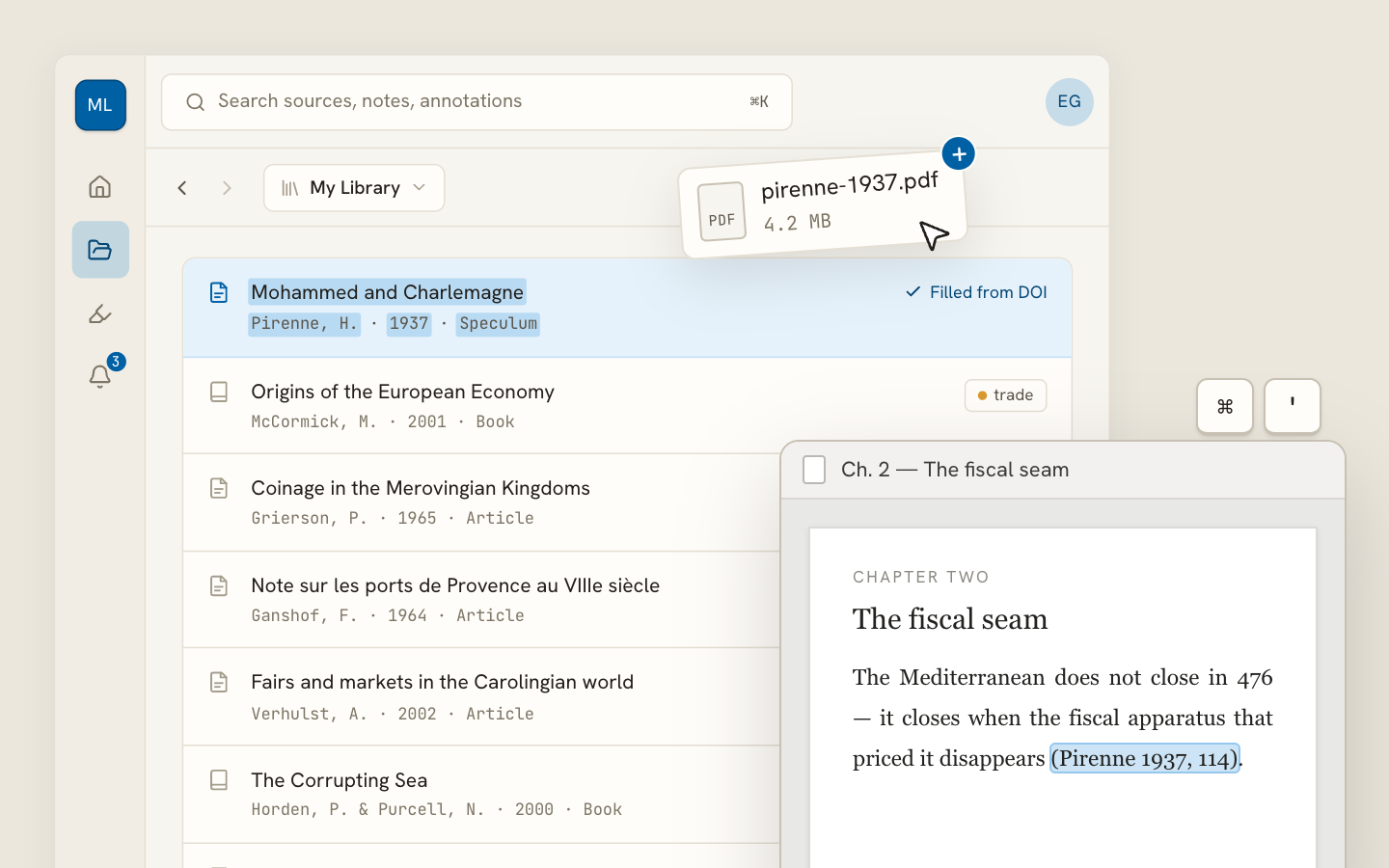
  • Import a Zotero, Mendeley or EndNote library — or a folder of PDFs
  • Highlight and annotate without leaving the source
  • Cite in any CSL style as you write, with one shared library for your lab
Request early accessSee the product →
Archivero library view with a source list and an open PDF

Your weekly research workflow, in one email

One tested workflow, three links, no filler — every Tuesday.

Unsubscribe in one click. We never share your address.

Guides/How to Write a Thesis

Argumentative Thesis Statement

How to write an argumentative thesis statement that takes a clear, debatable position — with formulas, examples by subject, and common mistakes to avoid.

8 min readThesis writing

Key Takeaways

  • An argumentative thesis states a debatable claim and gives reasons to support it — it takes a side rather than simply explaining a topic.
  • The most reliable formula is claim + "because" + reasons:
    • Governments should ban single-use plastics because they pollute oceans, harm wildlife, and have cost-effective reusable alternatives.
  • A strong argumentative thesis is specific, arguable, and supportable — a reasonable person could disagree with it.
  • Argumentative differs from analytical (which examines how something works) and expository (which explains a process or concept without taking sides).
  • The best argumentative thesis statements acknowledge complexity — the strongest positions account for counterarguments rather than ignoring them.
  • Common mistakes include stating a fact instead of a claim, being too vague, and choosing a topic that no reasonable person would dispute.
  • Use the Although/Because formula when you want to address a counterargument directly in the thesis itself.

On this page

1 of 18
Key TakeawaysWhat Is an Argumentative Thesis Statement?Argumentative vs. Analytical vs. ExpositoryHow to Write OneStep 1: Pick a Debatable TopicStep 2: Take a Clear SideStep 3: Provide ReasoningFormulas for Argumentative Thesis StatementsThe Simple Formula: Claim + Because + ReasonsThe Although/Because Formula: Counterargument + PositionThe Value/Policy Formula: What Should Be DoneExamples by SubjectSocial Issues & PolicyEducationTechnology & EthicsEnvironmentCommon MistakesNext Steps
All Thesis writing guides →

An argumentative thesis statement takes a clear, debatable position on a topic and provides the reasoning behind it. Unlike analytical or expository thesis statements, which explain or inform, an argumentative thesis asserts a claim that requires evidence and persuasion to defend — making it the foundation of persuasive essays, position papers, and argumentative research papers.

What Is an Argumentative Thesis Statement?

An argumentative thesis statement is a single sentence that declares a position you intend to argue and defend throughout your paper. It does more than announce a topic or describe what exists — it tells the reader what you believe and why.

The word "argumentative" doesn't mean hostile or combative. In academic writing, an argument is a reasoned claim supported by evidence. An argumentative thesis is the sentence that makes that claim explicit.

Universal basic income would reduce poverty more effectively than existing welfare programs because it eliminates bureaucratic overhead, removes benefit cliffs, and gives recipients greater autonomy over how they meet their needs.

That sentence names the position (UBI over welfare), takes a clear side, and previews three supporting reasons. A reader knows immediately what the paper will argue and how it will be structured.

Argumentative vs. Analytical vs. Expository

Thesis statements come in three main types. Understanding the differences helps you match your thesis to your assignment.

TypePurposeExample
ArgumentativePurposeTakes a debatable position and defends itExample"Schools should eliminate homework in grades K–5 because it reduces family time, increases stress, and has no proven academic benefit at that age."
AnalyticalPurposeBreaks a topic into parts and examines how they workExample"In The Great Gatsby, Fitzgerald uses the green light, the Valley of Ashes, and the eyes of Doctor T. J. Eckleburg to expose the emptiness behind the American Dream."
ExpositoryPurposeExplains or informs without taking a sideExample"Photosynthesis converts light energy into chemical energy through two stages: the light-dependent reactions in the thylakoid membrane and the Calvin cycle in the stroma."

The key distinction: an argumentative thesis makes a claim someone could disagree with. An analytical thesis interprets. An expository thesis explains.

If your professor asks for a "persuasive essay," "position paper," or "argumentative essay," you need an argumentative thesis. If the assignment asks you to "analyze," "examine," or "explore," you likely need an analytical one. For more on the other types, see Analytical Thesis Statement and Expository Thesis Statement.

How to Write One

Writing an argumentative thesis is a process of moving from a broad topic to a precise, debatable claim. These steps work whether you're writing a five-paragraph essay or a 20-page research paper.

Step 1: Pick a Debatable Topic

An argumentative thesis needs a topic where reasonable people disagree. If everyone agrees, there's nothing to argue. If the answer is a simple fact, there's nothing to prove.

Not debatable: "Water is essential for human survival." (No one disputes this.)

Debatable: "Municipal governments should fluoridate public water supplies." (People disagree about this.)

The best argumentative topics have at least two legitimate sides. If you can't imagine a thoughtful person taking the opposite position, the topic isn't debatable enough.

Step 2: Take a Clear Side

Once you've chosen a topic, decide what you actually think — and commit to it. A thesis that hedges ("Social media might have some negative effects") is weaker than one that takes a firm position ("Social media platforms should be required to verify users' ages because unrestricted access exposes minors to harmful content").

You don't need to be 100% certain of your position before you start writing. Many writers begin with a working thesis and refine it as they research. But the thesis itself should sound confident, not tentative.

Step 3: Provide Reasoning

A position without reasoning is just an opinion. The strongest argumentative thesis statements include a "because" clause (or equivalent) that previews the evidence or logic behind the claim.

Without reasoning:The voting age should be lowered to 16.

With reasoning:The voting age should be lowered to 16 because 16-year-olds pay taxes, can drive, and are directly affected by education and climate policies they currently have no voice in.

The reasoning tells the reader what the body paragraphs will cover — each reason becomes a section of the paper.

Formulas for Argumentative Thesis Statements

Formulas aren't mandatory, but they're useful starting points — especially when you're staring at a blank page. Once the draft is down, you can revise for style.

The Simple Formula: Claim + Because + Reasons

[Subject] should/should not [action] because [reason 1], [reason 2], and [reason 3].

Example: Public universities should eliminate standardized test requirements for admission because test scores correlate more strongly with family income than with academic ability, disadvantage non-native English speakers, and add unnecessary stress to an already demanding application process.

The Although/Because Formula: Counterargument + Position

Although [counterargument], [your position] because [reasons].

Example: Although proponents argue that nuclear energy is too dangerous for widespread use, it remains the most viable path to carbon-neutral baseload power because modern reactor designs have eliminated the risks that caused historical accidents, and nuclear produces less waste per megawatt-hour than any fossil fuel.

This formula is particularly strong because it shows you've considered the opposition — which makes your argument more credible.

The Value/Policy Formula: What Should Be Done

[Institution/group] should [specific action] in order to [desired outcome] because [supporting logic].

Example: The European Union should mandate standardized charging ports for all consumer electronics in order to reduce e-waste and consumer costs because proprietary connectors create unnecessary landfill volume and force users to purchase redundant accessories.

Examples by Subject

Social Issues & Policy

Decriminalizing all drugs and redirecting enforcement budgets toward treatment programs would reduce incarceration rates, lower overdose deaths, and save taxpayer money — as demonstrated by Portugal's 20-year decriminalization model.

Paid parental leave should be mandated at the federal level for a minimum of 12 weeks because countries with paid leave policies show lower infant mortality, higher workforce retention among women, and stronger early childhood development outcomes.

Education

Public schools should replace letter grades with competency-based assessments because grades incentivize performance over learning, punish students for early mistakes, and fail to communicate what a student actually knows.

Standardized testing should be eliminated from college admissions because it measures test-taking ability rather than academic potential and systematically disadvantages students from under-resourced schools.

Technology & Ethics

Facial recognition technology should be banned from use in public spaces by law enforcement because it disproportionately misidentifies people of color, chills free expression, and enables mass surveillance without meaningful consent or oversight.

Social media platforms should be legally required to disclose their recommendation algorithms because opaque algorithmic curation manipulates user behavior, amplifies misinformation, and undermines informed public discourse.

Environment

Governments should impose a carbon tax on industrial emissions rather than relying on voluntary corporate commitments because market-based incentives produce measurable reductions while voluntary pledges have consistently failed to meet stated targets.

Subsidizing plant-based agriculture over animal agriculture would reduce greenhouse gas emissions, decrease deforestation, and lower healthcare costs associated with diet-related chronic diseases.

Common Mistakes

  1. Stating a fact instead of making a claim. "Climate change is caused by greenhouse gas emissions" is a scientific consensus, not an argument. An argumentative thesis should propose something debatable: "Governments should prioritize carbon capture technology over emissions regulation because…"

  2. Being too vague. "Something should be done about gun violence" tells the reader nothing about your actual position. Specify what should be done, by whom, and why.

  3. Choosing an indefensible position. The strongest arguments acknowledge complexity. If your thesis requires ignoring all evidence on the other side, it's probably too extreme. A claim like "Social media has absolutely no benefits" is hard to defend credibly.

  4. Confusing preference with argument. "Chocolate ice cream is the best flavor" is a preference, not an arguable claim in an academic context. Argumentative thesis statements deal with issues where evidence, logic, and values can be weighed.

  5. Forgetting the reasoning. "The death penalty should be abolished" is a position, but it's not a complete thesis statement without the because. The reasoning is what turns a stance into an argument.

  6. Making an announcement. "In this essay, I will argue that renewable energy is important" describes your plan — it doesn't state your argument. Write the argument itself: "Federal investment in renewable energy infrastructure would create 2 million jobs and reduce carbon emissions by 40% within a decade."

Next Steps

Now that you know how to write an argumentative thesis, explore the other types and see more examples in action:

  • Analytical Thesis Statement — how to write a thesis that examines and interprets rather than argues
  • Expository Thesis Statement — how to write a thesis that explains or informs without taking a side
  • Thesis Statement Examples — 30+ examples across essay types and disciplines
  • Strong vs. Weak Thesis Statements — side-by-side comparisons and a revision checklist

Archivero helps you gather and organize sources while you build your argument — annotate key evidence, track counterarguments, and keep your reasoning connected to the research that supports it.

All Thesis writing guides →
← PreviousStrong vs. Weak Thesis StatementsNext →Analytical Thesis Statement

More on Thesis writing

From crafting a thesis statement to structuring chapters, writing the proposal and preparing for the defence.

View all 19 guides →
7 sections·8 min readThesis writingAnalytical Thesis Statement7 sections·8 min readThesis writingExpository Thesis Statement9 sections·9 min readThesis writingResearch Question12 sections·9 min readThesis writingThesis Structure

Your sources, PDFs and citations in one library

  • Import a Zotero, Mendeley or EndNote library — or a folder of PDFs
  • Highlight and annotate without leaving the source
  • Cite in any CSL style as you write, with one shared library for your lab
Request early accessSee the product →
Archivero library view with a source list and an open PDF

Your weekly research workflow, in one email

One tested workflow, three links, no filler — every Tuesday.

Unsubscribe in one click. We never share your address.