An analytical thesis statement breaks a subject into its component parts and explains how they work together to create a specific effect, meaning, or outcome. Rather than taking a side or persuading the reader, an analytical thesis answers a how or why question — making it the backbone of literary analyses, historical examinations, scientific explanations, and any essay that interprets rather than argues.
What Is an Analytical Thesis Statement?
An analytical thesis statement tells the reader what you've discovered by examining something closely. It identifies specific elements — techniques, causes, patterns, components — and explains what they produce or reveal when considered together.
The key word is examines. You're not trying to convince the reader to agree with your opinion. You're showing them how something works by taking it apart.
In 1984, Orwell uses the motifs of surveillance, language manipulation, and historical revisionism to illustrate how totalitarian regimes maintain power through the control of information.
That sentence doesn't argue that totalitarianism is bad (that would be argumentative) or explain what totalitarianism is (that would be expository). It identifies three literary motifs and states what they collectively reveal about the text's central concern. The paper that follows would analyze each motif in turn.
Analytical vs. Argumentative vs. Expository
The three types of thesis statements serve fundamentally different purposes. Identifying which one your assignment requires is the first step to writing a strong thesis.
| Type | Key Question | Purpose | Signal Words in Assignments |
|---|---|---|---|
| Analytical | How or why does this work? | Examines, interprets, dissects | "analyze," "examine," "explore," "how does" |
| Argumentative | What should we think/do? | Takes a debatable position and defends it | "argue," "defend," "take a position," "to what extent" |
| Expository | What is this? | Explains or informs without interpretation | "explain," "describe," "define," "summarize" |
An analytical thesis goes deeper than an expository thesis (it doesn't just describe — it interprets) but stops short of an argumentative thesis (it doesn't stake out a debatable position). It sits in the middle: informed interpretation based on evidence.
For example, analyzing how a marketing campaign uses color psychology to influence purchasing decisions is analytical. Arguing that the campaign is unethical is argumentative. Explaining what color psychology is would be expository.
For more on the other types, see Argumentative Thesis Statement and Expository Thesis Statement.
How to Write One
Writing an analytical thesis follows a clear progression: choose what to analyze, break it into parts, and state what the examination reveals.
Step 1: Choose What to Analyze
Analytical essays work best when you have a clearly defined subject and a specific angle. "Analyze Hamlet" is too broad. "Analyze how Shakespeare uses soliloquies in Hamlet to externalize Hamlet's internal conflict" gives you a manageable scope.
Good subjects for analysis include:
- A literary text, film, or artwork
- A historical event or trend
- A scientific process or dataset
- A rhetorical strategy in a speech or advertisement
- A social phenomenon or cultural pattern
The subject needs to have parts you can separate and examine. If there's nothing to break down, analysis isn't the right approach.
Step 2: Identify the Key Components
Once you have your subject, ask: What are the specific elements, techniques, causes, or patterns that make this work the way it does?
For a novel, these might be literary devices, character choices, structural decisions, or recurring motifs. For a historical event, they could be political, economic, and social factors. For a scientific process, they might be stages, variables, or mechanisms.
Aim for two to four components. Fewer than two doesn't give you enough to analyze. More than four is difficult to manage in a single paper.
Step 3: State What the Analysis Reveals
This is where most students stop too soon. Identifying the components is necessary but not sufficient — you also need to explain what they add up to. The "so what" is what separates a thesis from a list.
Without the "so what":Shakespeare uses soliloquies, dramatic irony, and the play-within-a-play in Hamlet.
With the "so what":Shakespeare uses soliloquies, dramatic irony, and the play-within-a-play in Hamlet to blur the boundary between performance and reality, suggesting that Hamlet's paralysis stems not from indecision but from an awareness that all action is a form of theater.
The first version lists techniques. The second explains what those techniques collectively reveal — which is the thesis.
Formulas for Analytical Thesis Statements
These formulas provide scaffolding. Once you've drafted your thesis, you can revise the sentence for style — but the underlying structure should remain.
The How/Why Formula
[Author/Subject] uses [element A], [element B], and [element C] to [achieve effect / reveal insight].
Example: Hitchcock uses confined spaces, point-of-view editing, and diegetic sound in Rear Window to transform the audience into complicit voyeurs, implicating them in the same moral transgression as the protagonist.
The By + -ing Formula
By [doing A] and [doing B], [subject] [achieves effect / demonstrates something].
Example: By juxtaposing statistical data with personal narrative, Ta-Nehisi Coates in Between the World and Me transforms systemic racism from an abstract policy problem into an embodied, visceral reality.
The Reveals/Demonstrates Formula
An analysis of [specific aspect] of [subject] reveals that [insight or finding].
Example: An analysis of voter turnout data across U.S. midterm elections from 2002 to 2022 reveals that early voting access has a stronger correlation with turnout than voter ID requirements, suggesting that convenience, not fraud prevention, is the primary driver of participation.
Examples by Subject
Literature & Poetry
Through the recurring imagery of drowning in Mrs Dalloway, Woolf connects Septimus's shell shock and Clarissa's social suffocation, revealing that the novel treats war trauma and domestic confinement as parallel forms of psychic dissolution.
In "The Waste Land," Eliot layers classical allusion, fragmented voices, and abrupt tonal shifts to mirror the cultural disorientation of post-World War I Europe, creating a poem that enacts the collapse it describes.
History
The rapid industrialization of Meiji Japan (1868–1912) succeeded not through wholesale Western imitation but through selective adoption — the government imported European military organization, American agricultural techniques, and British naval engineering while preserving Shinto institutions and the imperial system as sources of national cohesion.
An examination of propaganda posters from both Allied and Axis powers during World War II reveals that despite ideological opposition, both sides relied on the same visual strategies — dehumanization of the enemy, idealization of the soldier, and appeals to maternal sacrifice — suggesting that wartime persuasion follows universal psychological patterns rather than culturally specific ones.
Science & Data
Analysis of CRISPR-Cas9 off-target effects in recent clinical trials demonstrates that while the technology achieves high precision in well-characterized genomes, its reliability drops significantly in regions of high sequence homology, indicating that therapeutic applications require genome-specific off-target profiling before clinical use.
A comparison of infection rate curves across countries that implemented early lockdowns versus those that delayed reveals that timing — not strictness — of intervention was the primary determinant of first-wave mortality outcomes.
Art & Film
Kubrick's use of symmetrical framing, slow tracking shots, and the Steadicam in The Shining transforms the Overlook Hotel from a setting into an active presence, creating the sensation that the building itself is the source of menace rather than merely its container.
Frida Kahlo's self-portraits employ fragmented anatomy, symbolic flora and fauna, and the blurring of interior and exterior space to externalize chronic pain as a visual language, making the invisible visible and resisting the medical gaze that reduced her body to a case study.
Common Mistakes
Slipping into argument. If your thesis takes a side — "Orwell's 1984 proves that government surveillance is always wrong" — it's an argumentative thesis wearing analytical clothing. An analytical thesis says how Orwell depicts surveillance, not whether surveillance is right or wrong.
Listing without connecting. "Shakespeare uses metaphor, irony, and foreshadowing in Macbeth" names three devices but doesn't explain what they collectively achieve. Always complete the sentence: uses them to do what?
Restating the obvious. "In The Great Gatsby, Fitzgerald writes about wealth and the American Dream" is a summary, not an analysis. Your thesis should reveal something that requires close examination to see — not something apparent from reading the back cover.
Analyzing too much at once. If your thesis names five literary devices, three historical periods, and two theoretical frameworks, it's trying to do the work of a dissertation. Narrow to two or three components you can examine thoroughly.
Forgetting the subject. Analytical thesis statements sometimes become so focused on the technique that they lose sight of what's being analyzed. "The use of irony creates tension" doesn't say where or in what. Anchor the analysis to a specific text, event, or dataset.
Confusing analysis with summary. "In Act 3, Hamlet delivers the 'To be or not to be' soliloquy, where he contemplates death" is a plot summary. An analytical thesis would examine how the soliloquy functions within the play's structure and what it reveals about Hamlet's character.
Next Steps
Now that you know how to write an analytical thesis, explore the other types and deepen your approach:
- Argumentative Thesis Statement — how to write a thesis that takes a debatable position and defends it
- Expository Thesis Statement — how to write a thesis that explains or informs without interpretation
- Thesis Statement Examples — 30+ examples across essay types and disciplines
- How to Write a Thesis Statement — the step-by-step process for any type of thesis
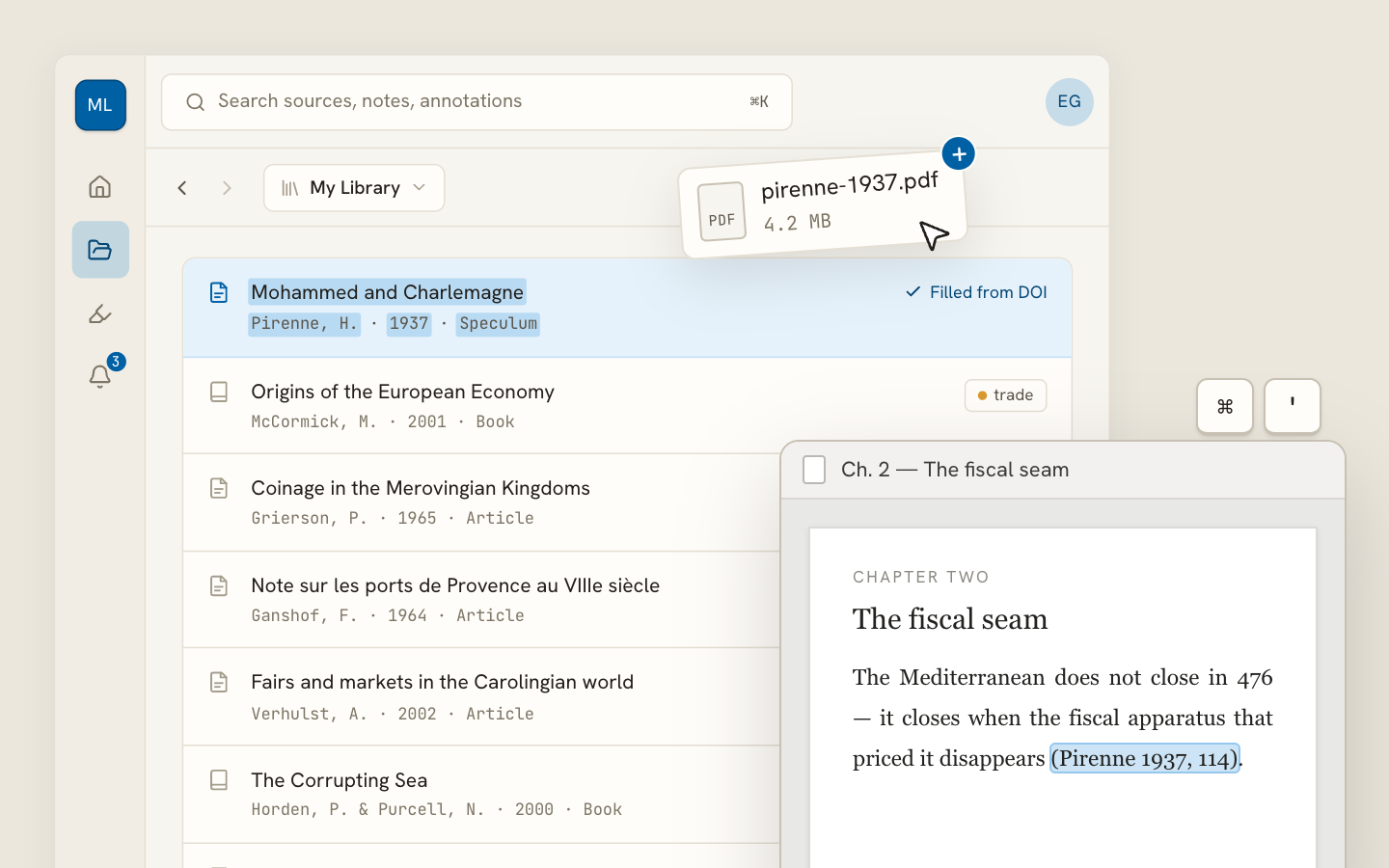
Archivero helps you organize the sources and passages behind your analysis — annotate the evidence, track patterns across texts, and build the connections that turn raw observations into a coherent analytical argument.