An expository thesis statement presents a clear, factual explanation of a topic without arguing for or against it. It tells the reader what the essay will explain — a process, a concept, a cause-and-effect relationship, or a comparison — and previews the key points that will be covered. Expository thesis statements are the foundation of informational writing, from school reports to encyclopedia-style explanations.
What Is an Expository Thesis Statement?
An expository thesis statement announces what the essay will explain and outlines the key aspects of that explanation. The word "expository" comes from "exposition" — the act of setting forth or explaining. An expository essay's job is to make something clear, and the thesis statement is the sentence that tells the reader what that something is.
Unlike an argumentative thesis, an expository thesis doesn't take a side. Unlike an analytical thesis, it doesn't interpret hidden meaning or examine how components create an effect. It lays out information — clearly, objectively, and in a structured way.
The water cycle consists of four main stages — evaporation, condensation, precipitation, and collection — each driven by solar energy and gravity.
That sentence doesn't argue that the water cycle is important or analyze why it works the way it does. It states what the water cycle involves and previews the four stages the essay will explain. The reader knows exactly what's coming.
Expository vs. Argumentative vs. Analytical
Understanding the boundaries between these three types prevents the most common thesis-writing mistake: accidentally writing the wrong kind of thesis for your assignment.
| Type | Purpose | Tone | Example |
|---|---|---|---|
| Expository | Explains or informs | Neutral, objective | "Diabetes is classified into three types — Type 1, Type 2, and gestational — each with distinct causes and treatment approaches." |
| Argumentative | Takes a side and defends it | Persuasive, assertive | "The U.S. healthcare system should adopt universal coverage because the current model leaves 27 million people uninsured and produces worse outcomes per dollar than comparable nations." |
| Analytical | Examines how or why something works | Interpretive, investigative | "An analysis of U.S. healthcare spending reveals that administrative costs, not medical treatment, are the primary driver of higher per-capita expenditure compared to single-payer systems." |
The simplest test: if your thesis contains words like "should," "must," "need to," or "it is wrong/right," it's probably argumentative. If it contains words like "reveals," "demonstrates," or "functions as," it's probably analytical. If it primarily answers "what is" or "how does this work," it's expository.
For more on the other types, see Argumentative Thesis Statement and Analytical Thesis Statement.
How to Write One
Writing an expository thesis follows a straightforward process: identify what you're explaining, state your explanation clearly, and preview the key points.
Step 1: Identify What You're Explaining
Before you can write a thesis, you need to know which type of expository essay you're writing. Each type frames the thesis differently:
- Definition essay: What is this thing, and what are its key characteristics?
- Process essay: How does this work, step by step?
- Cause-and-effect essay: What causes this, or what effects does it produce?
- Compare-and-contrast essay: How are these two things similar and different?
Knowing the essay type gives you the structure of the thesis. A definition essay thesis identifies the term and its key features. A process essay thesis names the process and its stages. The format follows the function.
Step 2: State Your Explanation Clearly
An expository thesis should read as a clear, direct statement that a reader can immediately understand. Avoid hedging ("It could be said that…"), avoid opinion ("Interestingly…"), and avoid vague scope ("There are many aspects of…").
Vague:Sleep is important and works in different ways.
Clear:Sleep occurs in a repeating cycle of four stages — NREM stages 1, 2, and 3 followed by REM sleep — each serving a distinct function in physical recovery and memory consolidation.
The clear version specifies the number of stages, names them, and states what they do. The reader knows exactly what the essay will cover.
Step 3: Preview the Key Points
The most effective expository thesis statements give the reader a roadmap. They don't just name the topic — they outline the main points the essay will address, usually in the order they'll appear.
Without preview:The Great Depression had multiple causes.
With preview:The Great Depression was triggered by the stock market crash of 1929, deepened by bank failures and a contraction in the money supply, and prolonged by protectionist trade policies like the Smoot-Hawley Tariff.
The second version tells the reader to expect three sections, each addressing a different cause. This structure makes the essay easier to write and easier to read.
Formulas for Expository Thesis Statements
These templates provide a starting structure. Adjust the wording for your specific topic — the goal is the underlying pattern, not rigid phrasing.
The Definition Formula
[Term] is/refers to [definition] characterized by [key feature 1], [key feature 2], and [key feature 3].
Example: A blockchain is a decentralized digital ledger characterized by immutable record-keeping, cryptographic security, and distributed consensus across a peer-to-peer network.
The Process Formula
[Process] works through [number] stages/steps: [step 1], [step 2], and [step 3].
Example: Cellular respiration converts glucose into usable energy through three stages: glycolysis in the cytoplasm, the Krebs cycle in the mitochondrial matrix, and oxidative phosphorylation along the inner mitochondrial membrane.
The Cause-and-Effect Formula
[Event/phenomenon] is caused by / results in [cause/effect 1], [cause/effect 2], and [cause/effect 3].
Example: Urban heat islands form because of three primary factors: the replacement of vegetation with heat-absorbing surfaces, waste heat generated by vehicles and buildings, and reduced airflow caused by dense construction patterns.
The Compare-and-Contrast Formula
Although [subject A] and [subject B] both [shared trait], they differ in [difference 1], [difference 2], and [difference 3].
Example: Although classical and operant conditioning both explain how organisms learn through association, they differ in the role of the learner, the type of behavior involved, and the mechanism of reinforcement.
Examples by Essay Type
Definition Essays
Emotional intelligence is the ability to recognize, understand, and manage one's own emotions while also perceiving and influencing the emotions of others — encompassing four core skills: self-awareness, self-regulation, social awareness, and relationship management.
A black hole is a region of spacetime where gravitational pull is so strong that nothing, including light, can escape — formed when massive stars collapse at the end of their life cycle and defined by an event horizon, a singularity, and, in rotating cases, an ergosphere.
Process Essays
Photosynthesis converts light energy into chemical energy through two interdependent stages: the light-dependent reactions, which occur in the thylakoid membrane and produce ATP and NADPH, and the Calvin cycle, which uses those molecules in the stroma to fix carbon dioxide into glucose.
The legislative process in the United States moves a bill through five stages — committee review, floor debate in each chamber, conference committee reconciliation, final chamber votes, and presidential action — with the majority of bills failing before they reach the second stage.
Cause-and-Effect Essays
Antibiotic resistance develops through three primary mechanisms: genetic mutation during bacterial reproduction, horizontal gene transfer between bacterial species, and the selective pressure created by antibiotic overuse in medicine and agriculture.
Chronic sleep deprivation impairs cognitive function by reducing the brain's ability to consolidate memories during REM sleep, disrupting prefrontal cortex activity needed for decision-making, and elevating cortisol levels that interfere with attention and emotional regulation.
Compare-and-Contrast Essays
While mitosis produces two genetically identical daughter cells for growth and repair, meiosis produces four genetically unique gametes for sexual reproduction — differing in the number of divisions, the behavior of homologous chromosomes, and the genetic diversity of the resulting cells.
Capitalism and socialism both aim to organize economic production and distribution, but they diverge fundamentally in ownership structure, the role of government in markets, and the mechanisms used to allocate resources and determine prices.
Common Mistakes
Accidentally arguing. If your thesis says something "should" happen or that something is "better" or "worse," you've crossed into argumentative territory. Expository writing explains what is, not what ought to be.
Being too vague. "There are many causes of climate change" is technically expository, but it's useless as a thesis. Name the specific causes your essay will address.
Listing without a unifying explanation. "This essay will discuss X, Y, and Z" is an announcement, not a thesis. The thesis should state the relationship between the points: X, Y, and Z are the three stages of a process, or the three effects of a cause, or the three characteristics of a concept.
Using opinion-laden language. Words like "unfortunately," "surprisingly," "importantly," or "alarmingly" inject the writer's perspective into what should be a neutral explanation. Let the facts speak.
Making the thesis too narrow or too broad. "The water cycle involves evaporation" is too narrow for a full essay. "Science is complex" is too broad for anything. Match the scope of the thesis to the length of the essay.
Confusing expository with analytical. An expository thesis on the water cycle explains its stages. An analytical thesis on the water cycle might examine how disruptions to one stage cascade through the others. The difference is between describing what happens and interpreting how or why it matters.
Next Steps
Now that you know how to write an expository thesis, explore the other types and see more examples:
- Argumentative Thesis Statement — how to write a thesis that takes a debatable position and defends it
- Analytical Thesis Statement — how to write a thesis that examines and interprets rather than explains
- Thesis Statement Examples — 30+ examples across essay types and disciplines
- What Is a Thesis Statement? — the fundamentals of what a thesis statement is and where it goes
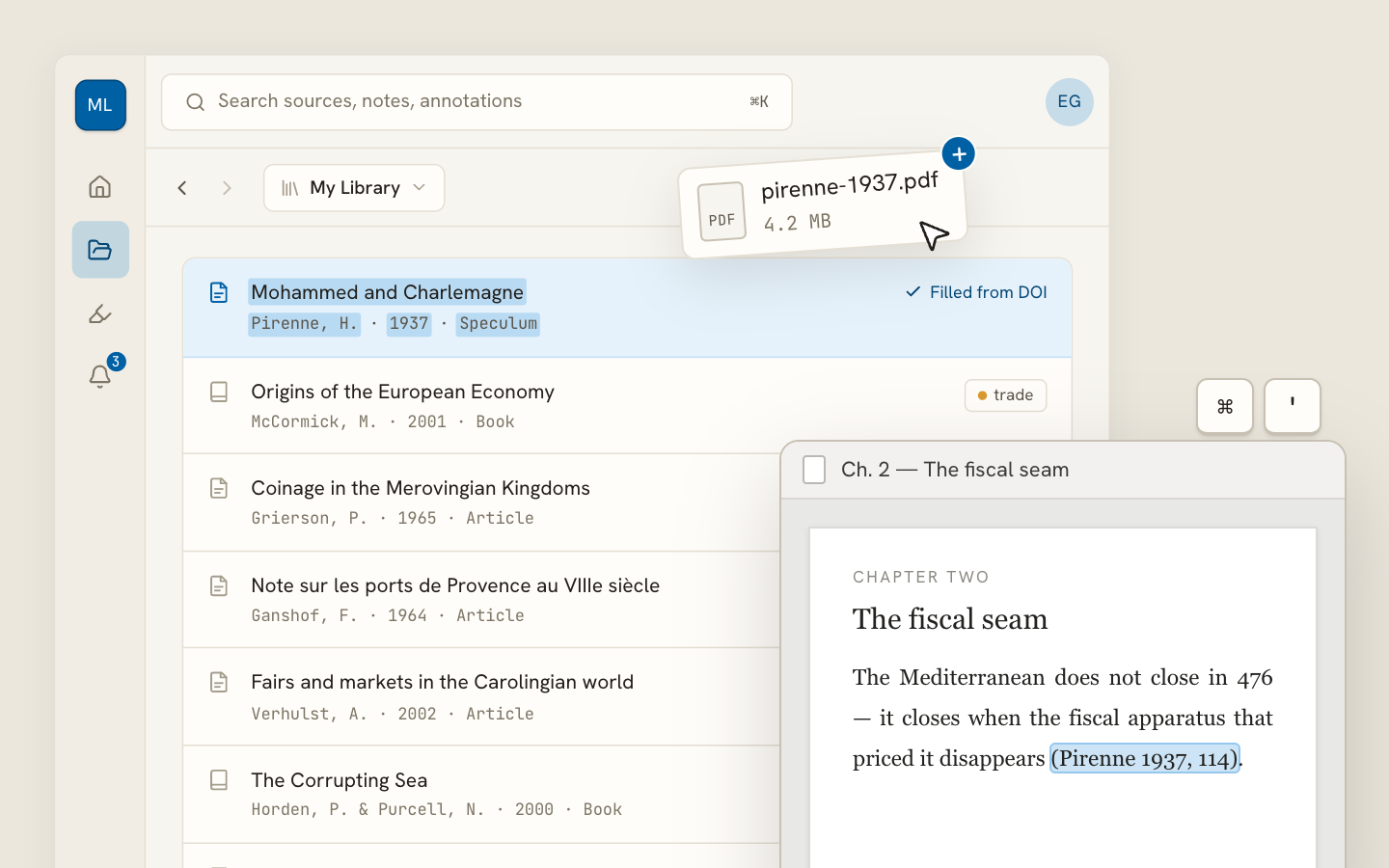
Archivero helps you organize your research and sources when preparing informational writing — collect references, annotate key facts, and keep your evidence structured so your explanations stay clear and well-supported.