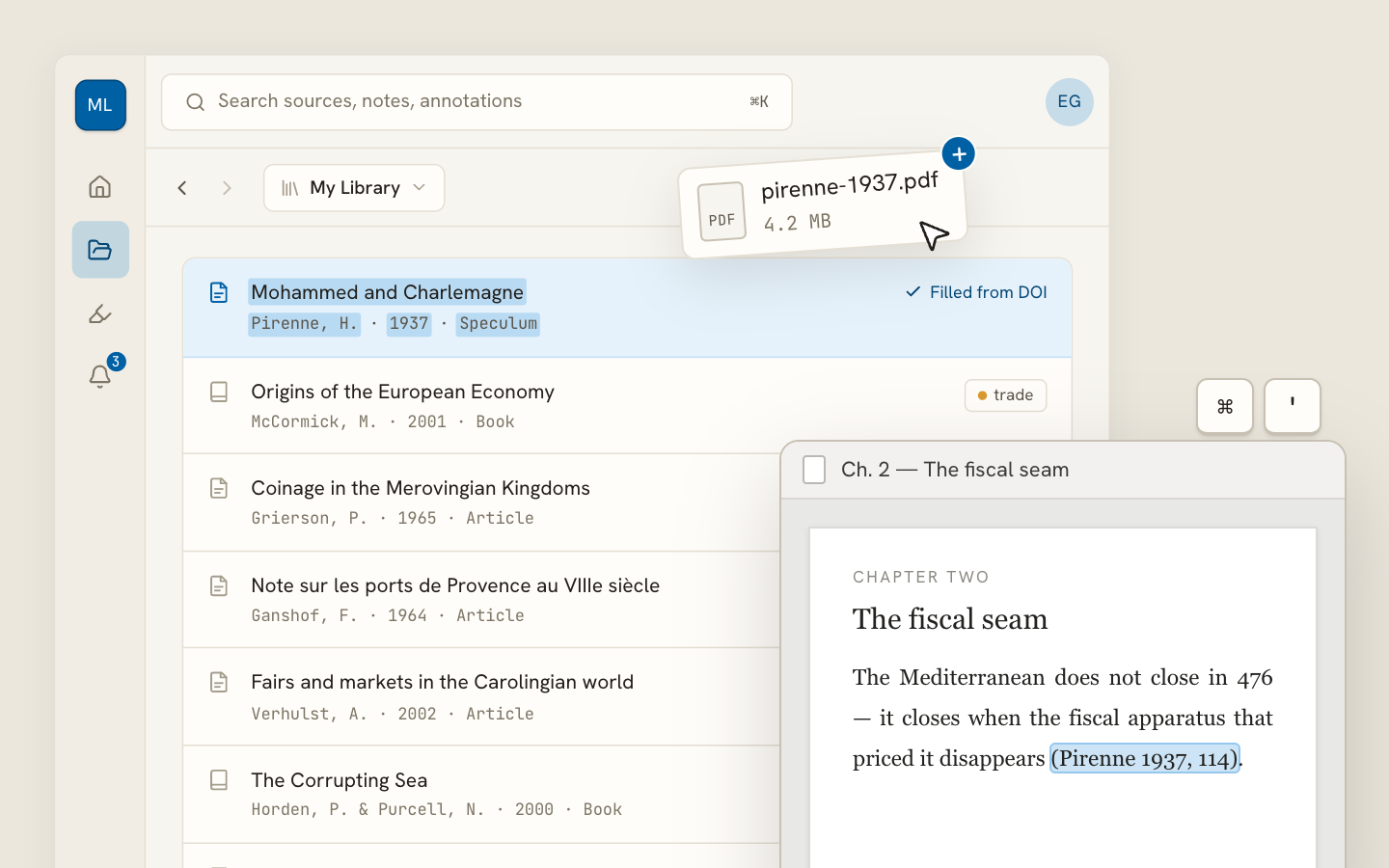
A literature review is a structured survey of existing research on a topic, written to show how previous studies relate to each other and to your own research question. It appears as Chapter 2 in most theses and dissertations, sitting between the Introduction and the Methodology — positioning your study within the broader scholarly conversation and demonstrating the gap your research fills.
What Is a Literature Review?
A literature review is a critical analysis of the published research relevant to your thesis topic. The word "review" is somewhat misleading — it's not a book report or a summary of sources. It's an organized argument that shows:
- What is known — the major findings, theories, and methods in your area
- How studies relate — where researchers agree, disagree, or build on each other's work
- What is not known — the gaps, limitations, or unresolved questions that your thesis addresses
The literature review establishes your credibility as a researcher. It demonstrates that you've read widely, understood the field, and identified a meaningful question that previous research hasn't fully answered.
Think of a literature review as mapping the terrain before you explore. You're showing the reader where others have been, what they've found, and where the unexplored territory lies — with your thesis as the expedition into that territory.
Literature Review vs. Annotated Bibliography
Students often confuse these two formats because both involve summarizing sources. The difference is structural and analytical.
| Literature Review | Annotated Bibliography | |
|---|---|---|
| Structure | Organized by theme, concept, or argument | Organized alphabetically by author |
| Unit of analysis | Themes across multiple sources | Individual sources |
| Purpose | Show relationships between studies and identify gaps | Summarize and evaluate each source independently |
| Synthesis | Required — sources are discussed in relation to each other | Not required — each annotation stands alone |
| Typical use | Chapter in a thesis or dissertation | Preliminary research tool or standalone assignment |
An annotated bibliography describes each source. A literature review uses sources as evidence in a structured argument about the state of knowledge in a field.
Types of Literature Reviews
Narrative / Traditional
A narrative literature review provides a broad overview of the research on a topic. It's the most common type in theses and dissertations. The author selects and discusses relevant studies to build an argument about what's known and what gaps exist. The selection criteria are based on the author's judgment rather than a systematic protocol.
Systematic
A systematic literature review follows a predefined, reproducible protocol for searching, selecting, and analyzing sources. It is common in health sciences and evidence-based fields. Systematic reviews specify exact databases searched, search terms used, inclusion/exclusion criteria, and often include a PRISMA flow diagram showing how many studies were screened and retained.
Thematic
A thematic literature review organizes sources by topic or theme rather than by chronology or methodology. Most thesis literature reviews are thematic — grouping studies by the concepts or variables they examine. For example, a literature review on remote work productivity might have sections on "Communication Tools," "Work-Life Boundaries," and "Management Practices."
How to Write a Literature Review
Step 1: Define Your Scope
Before you start searching, clarify what your literature review will cover and what it won't. Ask yourself:
- What is my research question?
- What key concepts, variables, or theories are central to my topic?
- What time period is relevant? (Last 10 years? Last 50 years?)
- What disciplines or fields should I include?
- What types of studies are relevant (empirical, theoretical, qualitative, quantitative)?
A clear scope prevents the most common literature review problem: reading everything and writing about nothing in particular.
Step 2: Search for Sources
Use academic databases relevant to your discipline:
- Google Scholar — broad, interdisciplinary starting point
- PubMed — health, medicine, life sciences
- PsycINFO — psychology, behavioral sciences
- ERIC — education
- JSTOR — humanities, social sciences
- Scopus / Web of Science — multidisciplinary, citation tracking
Search using a combination of keywords, Boolean operators (AND, OR, NOT), and filters (date range, peer-reviewed, language). Start broad and narrow based on what you find.
Track every search — record the database, search terms, date, and number of results. This is especially important for systematic reviews but good practice for any literature review.
Step 3: Evaluate and Select
Not every source you find belongs in your literature review. Evaluate each source for:
- Relevance — does it directly address your research question or a key concept?
- Quality — is it published in a peer-reviewed journal? Is the methodology sound?
- Currency — is it recent enough to be relevant? (For fast-moving fields, prioritize studies from the last 5–10 years; for foundational work, include seminal older studies.)
- Contribution — does it add something unique, or is it redundant with other sources?
A master's thesis literature review typically draws from 30–60 sources. A doctoral literature review may use 80–200+. Quality matters more than quantity — include sources that meaningfully contribute to your argument.
Step 4: Organize by Theme or Chronology
Once you've selected your sources, group them. The most effective approach for most theses is thematic organization — clustering sources around the key concepts, variables, or debates in your field.
For a thesis on the effects of social media on adolescent mental health, your themes might be:
- Social comparison and self-esteem — studies linking social media use to body image and self-worth
- Cyberbullying and peer victimization — research on online harassment and mental health outcomes
- Sleep disruption — studies connecting screen time and social media use to sleep quality
- Positive effects — research on social support, community building, and identity exploration online
Each theme becomes a section of your literature review. Within each section, discuss multiple sources in conversation with each other.
Chronological organization works when the development of ideas over time is itself part of the argument — for instance, tracing how a theory evolved across decades.
Step 5: Synthesize, Don't Summarize
This is the most important — and most commonly violated — rule of literature review writing. Synthesis means discussing sources in relation to each other. Summary means describing each source independently.
Summary (weak):
Smith (2019) found that social media use was correlated with lower self-esteem in teenagers. Jones (2020) found that Instagram was associated with body dissatisfaction. Lee (2021) found that TikTok use was linked to appearance anxiety.
Synthesis (strong):
Multiple studies have established a link between social media use and diminished self-esteem in adolescents (Smith, 2019; Jones, 2020; Lee, 2021). However, the effect appears to vary by platform: Instagram's image-centric design is more strongly associated with body dissatisfaction (Jones, 2020), while TikTok's short-form video format is linked to appearance anxiety through different mechanisms, particularly algorithmic content curation (Lee, 2021). Smith's (2019) broader survey-based approach did not distinguish between platforms, suggesting that platform-specific research is needed to identify which design features drive the relationship.
The synthesized version does three things at once: it establishes a shared finding, identifies a nuance, and points toward a gap — all in one paragraph.
Step 6: Identify Gaps
The literature review should culminate in a clear statement of what remains unknown, unresolved, or insufficiently studied. This gap is the justification for your thesis.
Gaps can take several forms:
- Missing population: "Most studies have focused on college students; few have examined adolescents under 15."
- Missing variable: "While the relationship between X and Y is well established, the moderating role of Z has not been investigated."
- Methodological gap: "Existing studies rely heavily on cross-sectional surveys; longitudinal designs are needed to establish causation."
- Conflicting findings: "Results are mixed — some studies find X, others find Y — suggesting that additional variables are at play."
The gap statement transitions directly into your methodology chapter: "To address this gap, this study uses…"
Structure and Length
A thesis literature review has its own internal structure, typically:
- Opening paragraph — states the purpose and scope of the review
- Thematic sections — each covering a key concept, debate, or variable (3–6 sections is typical)
- Gap statement / transition — identifies what's missing and previews how your study addresses it
| Thesis Type | Literature Review Length |
|---|---|
| Undergraduate honors thesis | 5–10 pages |
| Master's thesis | 15–30 pages |
| Doctoral dissertation | 30–60 pages |
These ranges are typical but vary by discipline. Humanities literature reviews may be shorter but more analytically dense. STEM literature reviews may be concise and highly structured.
Example Paragraph (Annotated)
Here's an annotated example of a synthesized literature review paragraph:
[Topic sentence — introduces the theme]The relationship between teacher feedback and student motivation has been examined across multiple educational contexts. [Group of supporting studies] Several studies have found that formative, process-oriented feedback — focusing on effort and strategy rather than innate ability — significantly increases student motivation and persistence (Hattie & Timperley, 2007; Dweck, 2015; Black & Wiliam, 2018). [Nuance / contrast] However, the effect is moderated by feedback timing: Mueller and Dweck (2017) demonstrated that delayed feedback on complex tasks led to deeper learning, while Shute (2008) found that immediate feedback was more effective for procedural skills. [Gap] What remains underexplored is whether these findings hold in asynchronous online environments, where the nature and timing of feedback differ fundamentally from face-to-face instruction.
This paragraph follows a clear pattern: theme → consensus → nuance → gap. That pattern — repeated across dozens of paragraphs — is what makes a literature review effective.
Common Mistakes
Summarizing instead of synthesizing. The most common mistake. Each paragraph should discuss multiple sources in conversation, not dedicate one paragraph to one source. If your literature review reads like a series of book reports, it needs restructuring.
Losing sight of the research question. Every section of the literature review should connect to your thesis topic. If a body of research is interesting but tangential, cut it or reduce it to a brief mention.
Relying on secondary sources. Cite the original study, not someone else's summary of it. If Smith (2019) describes a finding from Jones (2015), read Jones (2015) and cite it directly.
Using outdated sources without justification. In most fields, the majority of your sources should be from the last 10 years. Older sources are appropriate for foundational theories or seminal studies — but flag them as such.
Neglecting to state the gap. If your literature review ends without identifying what's missing, the reader has no reason to keep reading. The gap statement is the bridge to your methodology.
Inconsistent citation style. Use the citation format required by your institution (APA, MLA, Chicago, Harvard) consistently throughout. Mixing styles signals carelessness.
Next Steps
With the literature mapped, move on to describing how you investigated the gap:
- Thesis Methodology — how to describe and justify your research design, data collection, and analysis
- Thesis Introduction — how to frame the research problem that the literature review builds toward
- Thesis Structure — how the literature review fits into the overall thesis framework
- Research Question — how to formulate the questions that your literature review supports
For help formatting the citations in your literature review, see our guides on building an APA Reference List or an MLA Works Cited page.
Archivero helps you organize the sources that form your literature review — collect papers, annotate key findings, and group references by theme so synthesis comes naturally when you sit down to write.