Archivero is in early access — your sources, PDFs and citations in one library.Request early access →
Archivero/guides/
APAMLAHarvardThesis writing
Subscribe
Archivero/guides/Request early access →

Guides

APA styleMLA styleHarvard referencingThesis writing

Compare

APA 6th vs 7thMLA 8th vs 9thHarvard vs APAThesis vs dissertation

Product

FeaturesEarly access

Resources

DocsCheat sheetsNewsletter

Company

ContactStatus ↗
© 2025–2026 Ernesto F. GonzálezGuidesDocsContactPrivacyTerms
Guides/How to Write a Thesis

What Is a Thesis Statement?

A thesis statement is a sentence that expresses the main argument or claim of an essay or research paper. Learn what it is, where it goes, and why it matters.

7 min readThesis writing

Key Takeaways

  • A thesis statement is one sentence that states the main argument or claim of your paper.
  • It usually goes at the end of the introduction paragraph.
  • A strong thesis is specific, arguable, and supportable with evidence — it's not a statement of fact or a vague observation.
  • A topic sentence controls a single paragraph; a thesis statement controls the entire paper.
  • A research question asks what you want to investigate; a thesis statement answers it.
  • Thesis statements fall into three main types — argumentative, analytical, and expository — each serving a different purpose.
  • A weak thesis can usually be fixed by narrowing the scope, taking a clear position, and adding specific reasoning.

On this page

1 of 17
Key TakeawaysDefinitionWhere Does a Thesis Statement Go?What Makes a Good Thesis Statement?It Takes a Clear PositionIt Is Specific, Not VagueIt Is ArguableIt Previews the StructureThesis Statement vs. Topic SentenceThesis Statement vs. Research QuestionTypes of Thesis StatementsArgumentativeAnalyticalExpositoryExamplesCommon MistakesNext Steps
All Thesis writing guides →

A thesis statement is a single sentence that expresses the central argument or main claim of an essay, research paper, or thesis. It typically appears at the end of the introduction and serves as a roadmap for the entire piece — telling the reader what position you're taking and, often, how you plan to support it.

Definition

A thesis statement is the core claim that everything else in your paper supports. Think of it as a promise to the reader: this is what I'm going to argue, and here's the angle I'm taking. It isn't a topic, a title, or a question — it's a declarative sentence that takes a position.

For example, the topic "social media and mental health" is not a thesis statement. Neither is the question "Does social media affect mental health?" A thesis statement turns that topic into a specific, debatable claim:

Social media platforms harm adolescent mental health by promoting unrealistic body standards, reducing face-to-face interaction, and encouraging compulsive usage patterns.

That sentence does three things at once: it names the subject, takes a clear position, and previews the supporting points.

Where Does a Thesis Statement Go?

In most academic writing, the thesis statement appears at the end of the introduction — usually as the last sentence of the first paragraph or the introductory section. This placement works because the introduction builds context, and the thesis statement delivers the payoff: here's what this paper is actually about.

In shorter essays (3–5 pages), the thesis typically lands at the end of one introductory paragraph. In longer papers, theses, and dissertations, the thesis statement may appear at the end of a multi-paragraph introduction, sometimes after a brief literature review or background section.

Wherever it appears, the thesis should be easy for the reader to find. If someone has to hunt for your argument, it's either missing or buried.

What Makes a Good Thesis Statement?

Not all thesis statements are created equal. A strong one has four key characteristics.

It Takes a Clear Position

A thesis statement must assert something. It can't simply state a fact that nobody would dispute, and it can't sit on the fence. Compare:

Weak:Climate change is a problem.

Strong:Governments should prioritize renewable energy subsidies over carbon taxes because subsidies drive faster adoption and create more jobs in the energy sector.

The strong version takes a side — subsidies over carbon taxes — and gives reasons.

It Is Specific, Not Vague

Vague thesis statements lead to vague papers. The more precise your claim, the easier it is to support with evidence and the more useful it is for the reader.

Weak:Technology has changed education.

Strong:The shift to asynchronous online learning during the COVID-19 pandemic widened the achievement gap between low-income and high-income students in U.S. public schools.

The strong version specifies the type of technology, the time period, the affected groups, and the geographic context.

It Is Arguable

If no reasonable person could disagree with your thesis, it's probably a statement of fact — not an argument. A good thesis invites counterarguments.

Statement of fact:The United States declared independence in 1776.

Arguable thesis:The American Revolution succeeded primarily because of French military and financial support, not colonial military strategy alone.

It Previews the Structure

The best thesis statements hint at how the paper will be organized. This doesn't mean you need a clunky three-part formula every time, but giving the reader a sense of your reasoning makes the thesis — and the paper — stronger.

Without structure preview: Social media harms teenagers.

With structure preview: Social media harms teenagers by distorting self-image, replacing in-person friendships, and normalizing cyberbullying.

The second version tells the reader to expect three main sections, each addressing one harm.

Thesis Statement vs. Topic Sentence

Students sometimes confuse these two, but they operate at different scales.

Thesis StatementTopic Sentence
ScopeThesis StatementControls the entire paperTopic SentenceControls a single paragraph
LocationThesis StatementEnd of the introductionTopic SentenceBeginning of a body paragraph
PurposeThesis StatementStates the central argumentTopic SentenceStates the paragraph's main point
RelationshipThesis StatementThe "big claim"Topic SentenceSupports the thesis statement

Every topic sentence in your body paragraphs should connect back to the thesis. If a paragraph doesn't support the thesis, it either doesn't belong in the paper or the thesis needs to be revised.

Thesis Statement vs. Research Question

A research question is what you set out to investigate. A thesis statement is the answer you arrive at. In practice, many writers start with a research question during the planning stage and then convert it into a thesis statement once they've done enough reading to take a position.

Research question:How does sleep deprivation affect academic performance in college students?

Thesis statement:Sleep deprivation reduces academic performance in college students by impairing memory consolidation, decreasing attention span, and increasing anxiety before exams.

The research question is open-ended. The thesis statement is a specific, arguable answer. For more on crafting effective research questions, see Research Question.

Types of Thesis Statements

Thesis statements come in three main varieties, each suited to a different kind of essay.

Argumentative

An argumentative thesis takes a debatable position and defends it. It's the most common type in persuasive and argumentative essays.

Universal basic income would reduce poverty more effectively than existing welfare programs because it eliminates bureaucratic overhead, removes benefit cliffs, and provides recipients with greater autonomy.

For a full guide, see Argumentative Thesis Statement.

Analytical

An analytical thesis breaks a topic into components and examines how they work. It doesn't argue for or against something — it explains how or why something functions the way it does.

In 1984, Orwell uses the motifs of surveillance, language manipulation, and historical revisionism to illustrate how totalitarian regimes maintain power through the control of information.

For a full guide, see Analytical Thesis Statement.

Expository

An expository thesis explains or informs without taking a side. It previews the key points the paper will cover on a factual or descriptive topic.

The water cycle consists of four main stages — evaporation, condensation, precipitation, and collection — each driven by solar energy and gravity.

For a full guide, see Expository Thesis Statement.

Examples

Here are thesis statements across different subjects to show the range of what a thesis can look like:

History:The Treaty of Versailles contributed to the rise of fascism in Europe by imposing punitive reparations that destabilized Germany's economy and fueled nationalist resentment.

Literature:Through the unreliable narration of Stevens in The Remains of the Day, Ishiguro explores how emotional repression functions as both a coping mechanism and a source of profound regret.

Education:Project-based learning improves student engagement and retention in STEM subjects more effectively than traditional lecture-based instruction because it connects abstract concepts to real-world applications.

Health:Mandatory nutrition labeling on restaurant menus reduces calorie consumption by an average of 10–15% and should be expanded to all food-service establishments.

Technology:Open-source software development produces more secure and reliable code than proprietary development because of its transparent peer-review process and larger contributor base.

For more examples organized by essay type and subject area, see Thesis Statement Examples.

Common Mistakes

  1. Being too broad. "Pollution is bad" doesn't give the reader anything to hold onto. Narrow it to a specific type of pollution, a specific effect, and a specific population.
  2. Stating a fact instead of an argument. "The Earth revolves around the Sun" is true, but it's not arguable. A thesis needs to be something that requires evidence and reasoning to support.
  3. Phrasing it as a question. A thesis statement is an answer, not a question. If your thesis has a question mark, convert it into a declarative sentence.
  4. Making an announcement. "In this paper, I will discuss…" tells the reader your plan, not your argument. State the argument itself.
  5. Trying to cover too much. If your thesis makes three or four separate claims that each deserve their own paper, pick one and go deep.
  6. Burying it in the middle of a long paragraph. The thesis should be easy to locate — typically the last sentence of the introduction.

For a detailed comparison of strong and weak thesis statements with revision strategies, see Strong vs. Weak Thesis Statements.

Next Steps

Now that you know what a thesis statement is, you're ready to write one:

  • How to Write a Thesis Statement — a step-by-step process for crafting your thesis, with formulas and examples
  • Thesis Statement Examples — 30+ examples across subjects and essay types
  • Strong vs. Weak Thesis Statements — side-by-side comparisons and a revision checklist

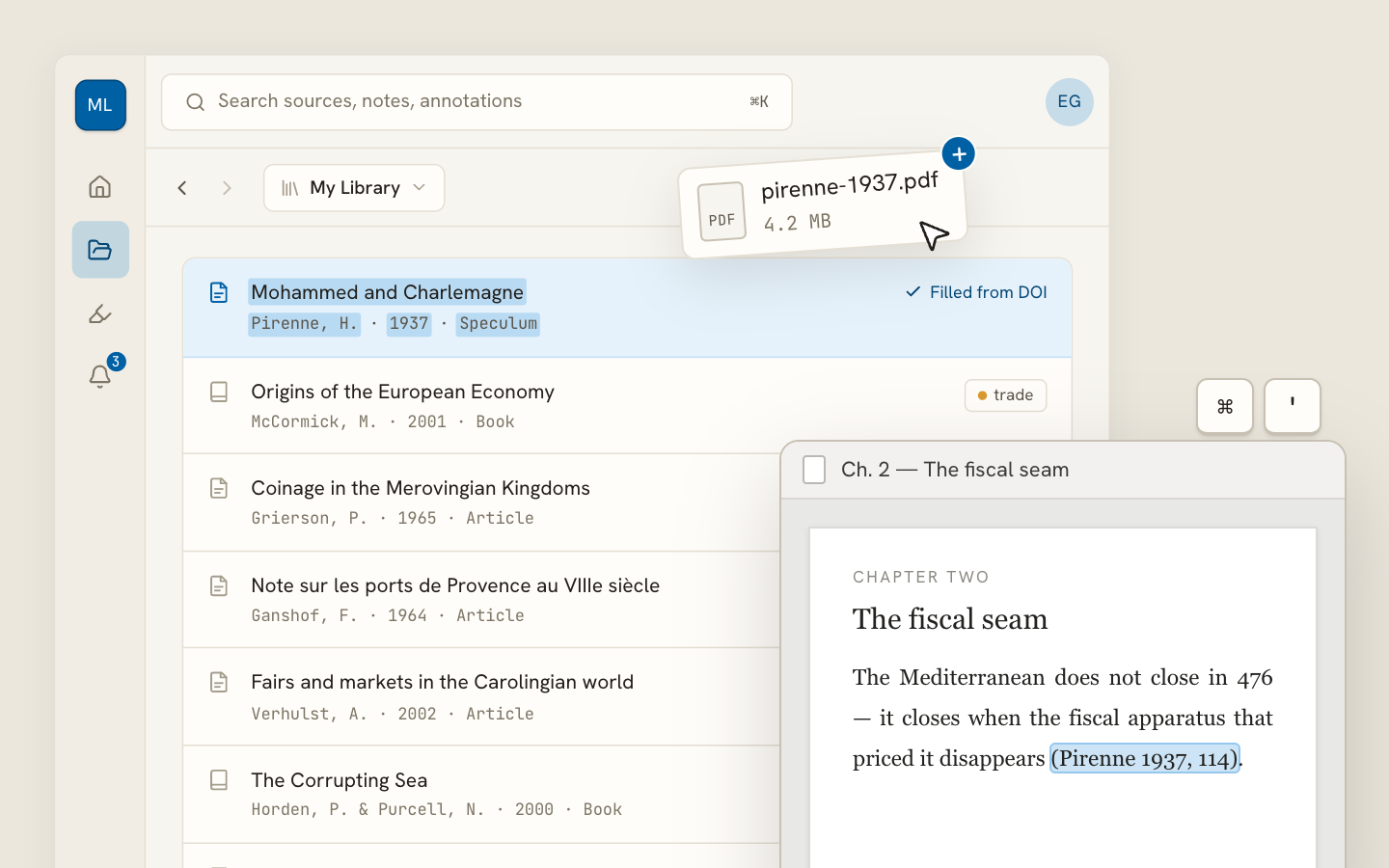
Archivero can help you organize research and sources as you develop your argument — collect your readings, annotate key passages, and keep your evidence connected to the claim you're building.
All Thesis writing guides →
Next →How to Write a Thesis Statement

More on Thesis writing

From crafting a thesis statement to structuring chapters, writing the proposal and preparing for the defence.

View all 19 guides →
10 sections·8 min readThesis writingHow to Write a Thesis Statement8 sections·9 min readThesis writingThesis Statement Examples6 sections·7 min readThesis writingStrong vs. Weak Thesis Statements7 sections·8 min readThesis writingArgumentative Thesis Statement

Your sources, PDFs and citations in one library

  • Import a Zotero, Mendeley or EndNote library — or a folder of PDFs
  • Highlight and annotate without leaving the source
  • Cite in any CSL style as you write, with one shared library for your lab
Request early accessSee the product →
Archivero library view with a source list and an open PDF

Your weekly research workflow, in one email

One tested workflow, three links, no filler — every Tuesday.

Unsubscribe in one click. We never share your address.

Guides/How to Write a Thesis

What Is a Thesis Statement?

A thesis statement is a sentence that expresses the main argument or claim of an essay or research paper. Learn what it is, where it goes, and why it matters.

7 min readThesis writing

Key Takeaways

  • A thesis statement is one sentence that states the main argument or claim of your paper.
  • It usually goes at the end of the introduction paragraph.
  • A strong thesis is specific, arguable, and supportable with evidence — it's not a statement of fact or a vague observation.
  • A topic sentence controls a single paragraph; a thesis statement controls the entire paper.
  • A research question asks what you want to investigate; a thesis statement answers it.
  • Thesis statements fall into three main types — argumentative, analytical, and expository — each serving a different purpose.
  • A weak thesis can usually be fixed by narrowing the scope, taking a clear position, and adding specific reasoning.

On this page

1 of 17
Key TakeawaysDefinitionWhere Does a Thesis Statement Go?What Makes a Good Thesis Statement?It Takes a Clear PositionIt Is Specific, Not VagueIt Is ArguableIt Previews the StructureThesis Statement vs. Topic SentenceThesis Statement vs. Research QuestionTypes of Thesis StatementsArgumentativeAnalyticalExpositoryExamplesCommon MistakesNext Steps
All Thesis writing guides →

A thesis statement is a single sentence that expresses the central argument or main claim of an essay, research paper, or thesis. It typically appears at the end of the introduction and serves as a roadmap for the entire piece — telling the reader what position you're taking and, often, how you plan to support it.

Definition

A thesis statement is the core claim that everything else in your paper supports. Think of it as a promise to the reader: this is what I'm going to argue, and here's the angle I'm taking. It isn't a topic, a title, or a question — it's a declarative sentence that takes a position.

For example, the topic "social media and mental health" is not a thesis statement. Neither is the question "Does social media affect mental health?" A thesis statement turns that topic into a specific, debatable claim:

Social media platforms harm adolescent mental health by promoting unrealistic body standards, reducing face-to-face interaction, and encouraging compulsive usage patterns.

That sentence does three things at once: it names the subject, takes a clear position, and previews the supporting points.

Where Does a Thesis Statement Go?

In most academic writing, the thesis statement appears at the end of the introduction — usually as the last sentence of the first paragraph or the introductory section. This placement works because the introduction builds context, and the thesis statement delivers the payoff: here's what this paper is actually about.

In shorter essays (3–5 pages), the thesis typically lands at the end of one introductory paragraph. In longer papers, theses, and dissertations, the thesis statement may appear at the end of a multi-paragraph introduction, sometimes after a brief literature review or background section.

Wherever it appears, the thesis should be easy for the reader to find. If someone has to hunt for your argument, it's either missing or buried.

What Makes a Good Thesis Statement?

Not all thesis statements are created equal. A strong one has four key characteristics.

It Takes a Clear Position

A thesis statement must assert something. It can't simply state a fact that nobody would dispute, and it can't sit on the fence. Compare:

Weak:Climate change is a problem.

Strong:Governments should prioritize renewable energy subsidies over carbon taxes because subsidies drive faster adoption and create more jobs in the energy sector.

The strong version takes a side — subsidies over carbon taxes — and gives reasons.

It Is Specific, Not Vague

Vague thesis statements lead to vague papers. The more precise your claim, the easier it is to support with evidence and the more useful it is for the reader.

Weak:Technology has changed education.

Strong:The shift to asynchronous online learning during the COVID-19 pandemic widened the achievement gap between low-income and high-income students in U.S. public schools.

The strong version specifies the type of technology, the time period, the affected groups, and the geographic context.

It Is Arguable

If no reasonable person could disagree with your thesis, it's probably a statement of fact — not an argument. A good thesis invites counterarguments.

Statement of fact:The United States declared independence in 1776.

Arguable thesis:The American Revolution succeeded primarily because of French military and financial support, not colonial military strategy alone.

It Previews the Structure

The best thesis statements hint at how the paper will be organized. This doesn't mean you need a clunky three-part formula every time, but giving the reader a sense of your reasoning makes the thesis — and the paper — stronger.

Without structure preview: Social media harms teenagers.

With structure preview: Social media harms teenagers by distorting self-image, replacing in-person friendships, and normalizing cyberbullying.

The second version tells the reader to expect three main sections, each addressing one harm.

Thesis Statement vs. Topic Sentence

Students sometimes confuse these two, but they operate at different scales.

Thesis StatementTopic Sentence
ScopeThesis StatementControls the entire paperTopic SentenceControls a single paragraph
LocationThesis StatementEnd of the introductionTopic SentenceBeginning of a body paragraph
PurposeThesis StatementStates the central argumentTopic SentenceStates the paragraph's main point
RelationshipThesis StatementThe "big claim"Topic SentenceSupports the thesis statement

Every topic sentence in your body paragraphs should connect back to the thesis. If a paragraph doesn't support the thesis, it either doesn't belong in the paper or the thesis needs to be revised.

Thesis Statement vs. Research Question

A research question is what you set out to investigate. A thesis statement is the answer you arrive at. In practice, many writers start with a research question during the planning stage and then convert it into a thesis statement once they've done enough reading to take a position.

Research question:How does sleep deprivation affect academic performance in college students?

Thesis statement:Sleep deprivation reduces academic performance in college students by impairing memory consolidation, decreasing attention span, and increasing anxiety before exams.

The research question is open-ended. The thesis statement is a specific, arguable answer. For more on crafting effective research questions, see Research Question.

Types of Thesis Statements

Thesis statements come in three main varieties, each suited to a different kind of essay.

Argumentative

An argumentative thesis takes a debatable position and defends it. It's the most common type in persuasive and argumentative essays.

Universal basic income would reduce poverty more effectively than existing welfare programs because it eliminates bureaucratic overhead, removes benefit cliffs, and provides recipients with greater autonomy.

For a full guide, see Argumentative Thesis Statement.

Analytical

An analytical thesis breaks a topic into components and examines how they work. It doesn't argue for or against something — it explains how or why something functions the way it does.

In 1984, Orwell uses the motifs of surveillance, language manipulation, and historical revisionism to illustrate how totalitarian regimes maintain power through the control of information.

For a full guide, see Analytical Thesis Statement.

Expository

An expository thesis explains or informs without taking a side. It previews the key points the paper will cover on a factual or descriptive topic.

The water cycle consists of four main stages — evaporation, condensation, precipitation, and collection — each driven by solar energy and gravity.

For a full guide, see Expository Thesis Statement.

Examples

Here are thesis statements across different subjects to show the range of what a thesis can look like:

History:The Treaty of Versailles contributed to the rise of fascism in Europe by imposing punitive reparations that destabilized Germany's economy and fueled nationalist resentment.

Literature:Through the unreliable narration of Stevens in The Remains of the Day, Ishiguro explores how emotional repression functions as both a coping mechanism and a source of profound regret.

Education:Project-based learning improves student engagement and retention in STEM subjects more effectively than traditional lecture-based instruction because it connects abstract concepts to real-world applications.

Health:Mandatory nutrition labeling on restaurant menus reduces calorie consumption by an average of 10–15% and should be expanded to all food-service establishments.

Technology:Open-source software development produces more secure and reliable code than proprietary development because of its transparent peer-review process and larger contributor base.

For more examples organized by essay type and subject area, see Thesis Statement Examples.

Common Mistakes

  1. Being too broad. "Pollution is bad" doesn't give the reader anything to hold onto. Narrow it to a specific type of pollution, a specific effect, and a specific population.
  2. Stating a fact instead of an argument. "The Earth revolves around the Sun" is true, but it's not arguable. A thesis needs to be something that requires evidence and reasoning to support.
  3. Phrasing it as a question. A thesis statement is an answer, not a question. If your thesis has a question mark, convert it into a declarative sentence.
  4. Making an announcement. "In this paper, I will discuss…" tells the reader your plan, not your argument. State the argument itself.
  5. Trying to cover too much. If your thesis makes three or four separate claims that each deserve their own paper, pick one and go deep.
  6. Burying it in the middle of a long paragraph. The thesis should be easy to locate — typically the last sentence of the introduction.

For a detailed comparison of strong and weak thesis statements with revision strategies, see Strong vs. Weak Thesis Statements.

Next Steps

Now that you know what a thesis statement is, you're ready to write one:

  • How to Write a Thesis Statement — a step-by-step process for crafting your thesis, with formulas and examples
  • Thesis Statement Examples — 30+ examples across subjects and essay types
  • Strong vs. Weak Thesis Statements — side-by-side comparisons and a revision checklist

Archivero can help you organize research and sources as you develop your argument — collect your readings, annotate key passages, and keep your evidence connected to the claim you're building.

All Thesis writing guides →
Next →How to Write a Thesis Statement

More on Thesis writing

From crafting a thesis statement to structuring chapters, writing the proposal and preparing for the defence.

View all 19 guides →
10 sections·8 min readThesis writingHow to Write a Thesis Statement8 sections·9 min readThesis writingThesis Statement Examples6 sections·7 min readThesis writingStrong vs. Weak Thesis Statements7 sections·8 min readThesis writingArgumentative Thesis Statement

Your sources, PDFs and citations in one library

  • Import a Zotero, Mendeley or EndNote library — or a folder of PDFs
  • Highlight and annotate without leaving the source
  • Cite in any CSL style as you write, with one shared library for your lab
Request early accessSee the product →
Archivero library view with a source list and an open PDF

Your weekly research workflow, in one email

One tested workflow, three links, no filler — every Tuesday.

Unsubscribe in one click. We never share your address.