Archivero is in early access — your sources, PDFs and citations in one library.Request early access →
Archivero/guides/
APAMLAHarvardThesis writing
Subscribe
Archivero/guides/Request early access →

Guides

APA styleMLA styleHarvard referencingThesis writing

Compare

APA 6th vs 7thMLA 8th vs 9thHarvard vs APAThesis vs dissertation

Product

FeaturesEarly access

Resources

DocsCheat sheetsNewsletter

Company

ContactStatus ↗
© 2025–2026 Ernesto F. GonzálezGuidesDocsContactPrivacyTerms
Guides/How to Write a Thesis

Common Thesis Mistakes

The most common mistakes students make when writing a thesis — from vague thesis statements to poor structure, weak methodology, and formatting errors.

9 min readThesis writing

Key Takeaways

  • The most common thesis statement mistake is being too broad or not arguable — a strong thesis statement takes a specific, debatable position.
  • Structural mistakes include chapters that lack a clear purpose, a disjointed literature review that summarizes instead of synthesizes, and weak transitions between sections.
  • Methodology mistakes often stem from a mismatch between the research question and the chosen methods, or from insufficient justification for design choices.
  • Writing mistakes include summarizing instead of analyzing, inconsistent terminology, and over-quoting sources instead of synthesizing them in your own words.
  • Formatting mistakes — inconsistent headings, wrong page numbers, missing captions — are among the most easily avoidable yet most frequently cited reasons for revision requests.
  • Use the revision checklist at the end of this page to catch common issues before submission.

On this page

1 of 25
Key TakeawaysThesis Statement MistakesToo BroadNot ArguableBuried or MissingStructural MistakesNo Clear Chapter PurposeDisjointed Literature ReviewWeak TransitionsResearch & Methodology MistakesMismatched MethodsInsufficient JustificationIgnoring LimitationsWriting MistakesSummarizing Instead of AnalyzingInconsistent TerminologyOver-Quoting, Under-SynthesizingFormatting MistakesRevision ChecklistThesis Statement & Research QuestionsStructureMethodologyWritingFormattingFinal Checks
All Thesis writing guides →

Writing a thesis is a multi-stage process spanning months or years, and mistakes accumulate at every stage — from the initial thesis statement through the literature review, methodology, writing, and formatting. Most of these mistakes are predictable and preventable. They fall into five categories: thesis statement errors, structural problems, research and methodology weaknesses, writing issues, and formatting inconsistencies.

Thesis Statement Mistakes

The thesis statement is the foundation of the entire paper. A weak thesis statement leads to a weak paper — no amount of good research can compensate for an unclear central argument.

Too Broad

A thesis statement that tries to cover too much ground ends up saying nothing specific.

Too broad:"Social media has changed modern communication."

Revised:"Instagram's algorithmic content curation has contributed to increased body dissatisfaction among college-age women by promoting appearance-based content over other forms of social interaction."

A good thesis statement names a specific topic, a specific population or context, and a specific claim. If your thesis could fill an entire book, it's too broad for a single paper.

For more on narrowing a thesis statement, see Strong vs. Weak Thesis Statements.

Not Arguable

A thesis statement that states a universally accepted fact or an obvious observation isn't arguable — there's nothing to defend.

Not arguable:"Exercise is good for your health."

Revised:"Incorporating 30 minutes of daily moderate exercise reduces the risk of cardiovascular disease more effectively than dietary changes alone, based on a meta-analysis of 15 longitudinal studies."

A strong thesis invites disagreement. If no reasonable person would take the opposing view, the statement isn't doing its job.

Buried or Missing

The thesis statement should appear in the introduction — typically at the end of the introductory paragraph for essays, or as part of the problem statement for thesis documents. A thesis statement that appears on page 5 or is never explicitly stated forces the reader to guess the paper's argument.

If a reader has to ask "What is this paper actually arguing?" after the introduction, the thesis statement is either buried or missing.

For guidance on placement and formulation, see How to Write a Thesis Statement.

Structural Mistakes

A thesis can have strong research and good writing but still fail because the structure doesn't guide the reader logically from question to answer.

No Clear Chapter Purpose

Every chapter in a thesis has a job. If a chapter doesn't have a clear function, it either belongs somewhere else or shouldn't exist at all.

ChapterPurpose
IntroductionFrame the problem, state research questions
Literature ReviewEstablish the gap your research fills
MethodologyExplain how you investigated the question
ResultsPresent what you found
DiscussionInterpret findings and connect to the literature
ConclusionSummarize, answer research questions, discuss implications

A common mistake is combining the Discussion and Results without a clear distinction between what was found (Results) and what it means (Discussion). Another is an Introduction that reads like a miniature literature review — mixing background context with detailed source analysis.

For the standard chapter framework, see Thesis Structure.

Disjointed Literature Review

The literature review is the chapter students struggle with most. The most common mistake: treating it as a series of source summaries instead of a synthesis of the field.

Summary approach (weak):"Smith (2019) found that… Jones (2020) found that… Lee (2021) found that…"

Synthesis approach (strong):"Three studies have linked algorithmic curation to increased body dissatisfaction (Smith, 2019; Jones, 2020; Lee, 2021), though they differ in the mechanisms they propose."

A strong literature review organizes sources by theme, not by author. Each paragraph should discuss multiple sources in relation to each other, building toward the gap that your research addresses.

For a detailed guide, see Literature Review.

Weak Transitions

Chapters, sections, and paragraphs should flow logically into each other. A thesis in which each section feels like a standalone document — with no connection to what came before or what follows — is structurally weak.

Between chapters: End each chapter with a brief paragraph previewing what comes next. Begin each chapter by connecting back to the previous one.

"Chapter 2 identified the gap in the literature regarding platform-specific design features and body image outcomes. Chapter 3 describes the mixed-methods approach used to address this gap."

Between paragraphs: Use transition sentences that link the idea in the previous paragraph to the idea in the next.

Research & Methodology Mistakes

Methodological weaknesses undermine the credibility of the entire thesis. The committee will scrutinize this section more than any other.

Mismatched Methods

The research design must be capable of answering the research question. A mismatch between the two is one of the most common reasons proposals and theses are sent back for revision.

Mismatch:Research question asks "How do students experience online learning?" but the methodology uses only a closed-ended survey.

Better fit:Use semi-structured interviews or a mixed-methods design to capture experiential data.

If your question asks how or why, you likely need qualitative or mixed methods. If it asks how much or to what extent, quantitative methods are probably appropriate.

For more on aligning questions and methods, see Methodology and Research Question.

Insufficient Justification

Every methodological choice needs a reason. "I used surveys" is a description. "I used surveys because the research question required quantifiable data from a large sample to detect statistically significant relationships" is a justification.

The committee will ask why — why this design, why this sample size, why this analytical technique, why not an alternative. If the answer is "because it was easier" or "because my advisor suggested it," the justification is too thin.

Ignoring Limitations

No study is perfect, and pretending yours is undermines credibility. Every thesis should honestly state what the research design cannot capture.

Common limitations to address:

  • Sample size and representativeness
  • Self-report bias
  • Cross-sectional design (no causation claims)
  • Geographic or temporal constraints
  • Instrument validity

Frame limitations as boundaries, not apologies. Stating them clearly shows scholarly maturity and helps future researchers build on your work.

Writing Mistakes

Even with strong research, poor writing can obscure the argument and frustrate the reader.

Summarizing Instead of Analyzing

This is the most pervasive writing problem in academic theses. Students describe what a source says instead of analyzing what it means, how it relates to other sources, or what its limitations are.

Summary:"Smith (2019) conducted a study on social media and found that Instagram use was correlated with body dissatisfaction."

Analysis:"Smith's (2019) finding that Instagram use correlates with body dissatisfaction aligns with social comparison theory (Festinger, 1954), though the cross-sectional design prevents causal claims — a gap that longitudinal study designs could address."

Every time you cite a source, ask: "Am I just reporting what this says, or am I doing something with it?" If you're only reporting, you're summarizing. If you're connecting, comparing, evaluating, or extending, you're analyzing.

Inconsistent Terminology

Using different terms for the same concept confuses the reader and weakens the argument.

Inconsistent:The paper switches between "social media engagement," "online interaction," "digital participation," and "platform usage" — all referring to the same construct.

Consistent:Define "social media engagement" in the introduction and use it throughout. If you need to distinguish sub-concepts, define those explicitly too.

Pick your terms early, define them in the Introduction or a "Definition of Key Terms" section, and use them consistently across all chapters.

Over-Quoting, Under-Synthesizing

A thesis that consists largely of direct quotations from other scholars doesn't demonstrate your understanding — it demonstrates your ability to copy and paste.

Use direct quotes when:

  • The original wording is particularly precise or memorable
  • You're analyzing the language itself (e.g., in a literary or rhetorical analysis)
  • A definition needs to be exact

Paraphrase when:

  • You need to convey the findings or arguments of a source (the vast majority of cases)
  • You're synthesizing multiple sources into a single paragraph
  • You're integrating the source's ideas into your own argument

A typical thesis should contain far more paraphrases than direct quotes. When in doubt, paraphrase and cite.

Formatting Mistakes

Formatting errors are the easiest mistakes to avoid and the most frustrating to receive revision requests for. They're especially common because formatting is usually the last thing students address — and by that point, exhaustion has set in.

The most common formatting mistakes:

  1. Inconsistent heading styles — different chapters use different formatting for the same heading level
  2. Wrong page numbering — Arabic numerals in front matter, numbers on the title page, or page numbers in the wrong position
  3. Manual table of contents — typed by hand instead of auto-generated, leading to page number errors
  4. Missing figure/table captions — every figure and table needs a numbered caption
  5. Incorrect reference formatting — missing hanging indents, inconsistent capitalization, wrong citation style
  6. Inconsistent spacing — switching between single and double spacing without a rule
  7. Not following the university template — using generic formatting instead of the required institutional template

For a detailed formatting guide, see Thesis Formatting.

Revision Checklist

Use this checklist before submitting your thesis — it covers the most common issues committees flag.

Thesis Statement & Research Questions

  • The thesis statement or research questions are clearly stated in the Introduction
  • The thesis statement takes a specific, arguable position (for essay-based theses)
  • Research questions are answered explicitly in the Conclusion

Structure

  • Each chapter has a clear, distinct purpose
  • Chapters connect to each other with transition paragraphs
  • The Literature Review synthesizes sources by theme — not one paragraph per source
  • The Introduction and Conclusion mirror each other (questions → answers)

Methodology

  • The research design matches the research question
  • Every methodological choice is justified (not just described)
  • Limitations are stated honestly
  • Ethical considerations are addressed

Writing

  • Sources are analyzed, not just summarized
  • Terminology is consistent throughout
  • Direct quotes are used sparingly — paraphrasing is the default
  • No new data, arguments, or sources appear in the Conclusion

Formatting

  • Heading styles are consistent across all chapters
  • Page numbers use Roman numerals (front matter) and Arabic numerals (body)
  • Table of contents is auto-generated and matches actual page numbers
  • All figures and tables have numbered captions
  • References follow the required citation style with hanging indents
  • The document follows the university's thesis template

Final Checks

  • Abstract accurately reflects the final thesis (rewritten after all chapters were complete)
  • All committee feedback from the proposal stage has been addressed
  • Spelling and grammar have been checked (not just by spell-check — read aloud)
  • The file is in the required submission format (PDF, specific naming convention, etc.)

Archivero helps you catch mistakes before your committee does — keep your sources, annotations, and thesis chapters organized in one place so you can cross-reference claims, verify citations, and review your entire argument before submission.
All Thesis writing guides →
← PreviousThesis Defense

More on Thesis writing

From crafting a thesis statement to structuring chapters, writing the proposal and preparing for the defence.

View all 19 guides →
9 sections·7 min readThesis writingWhat Is a Thesis Statement?10 sections·8 min readThesis writingHow to Write a Thesis Statement8 sections·9 min readThesis writingThesis Statement Examples6 sections·7 min readThesis writingStrong vs. Weak Thesis Statements

Your sources, PDFs and citations in one library

  • Import a Zotero, Mendeley or EndNote library — or a folder of PDFs
  • Highlight and annotate without leaving the source
  • Cite in any CSL style as you write, with one shared library for your lab
Request early accessSee the product →
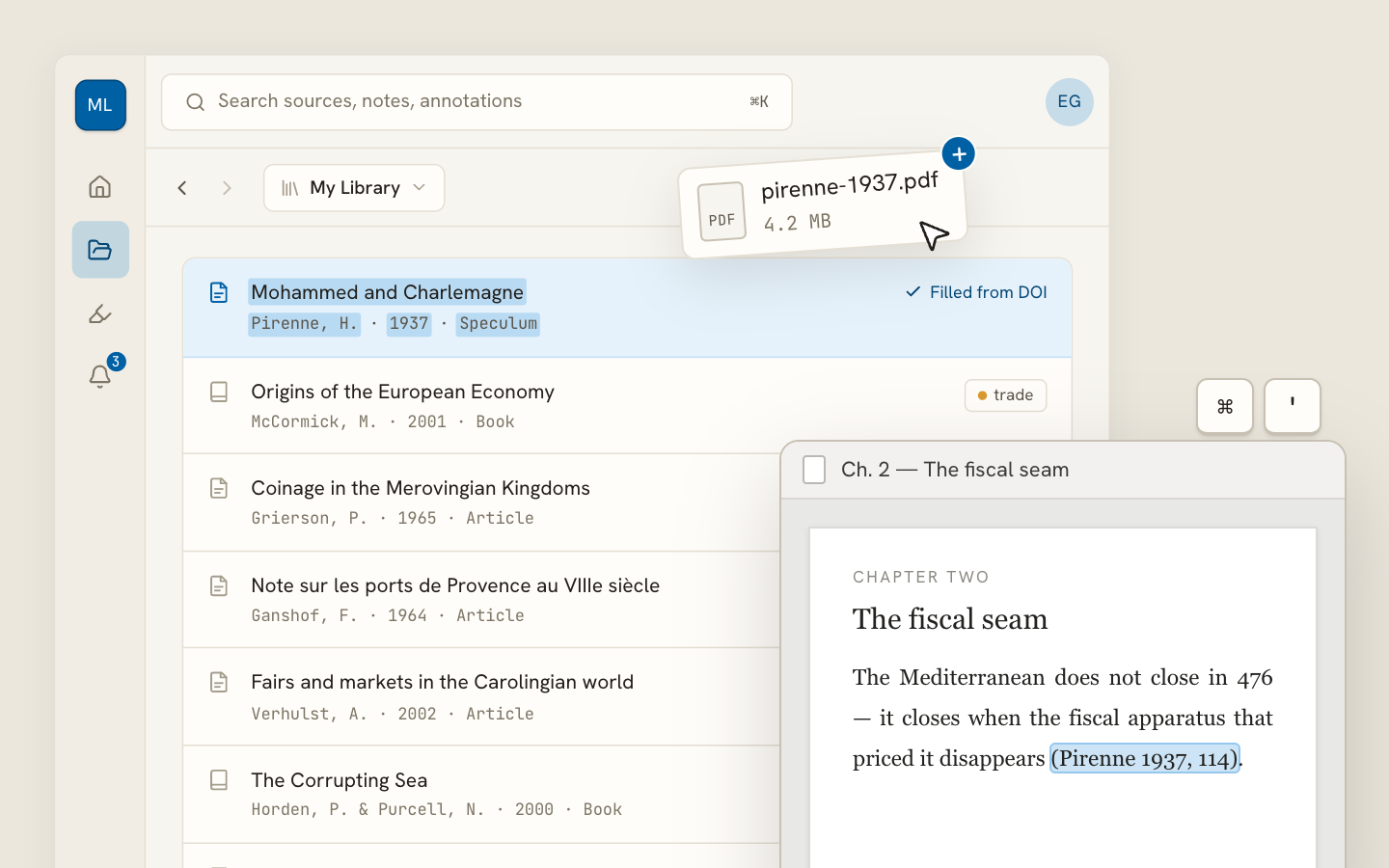
Archivero library view with a source list and an open PDF

Your weekly research workflow, in one email

One tested workflow, three links, no filler — every Tuesday.

Unsubscribe in one click. We never share your address.

Guides/How to Write a Thesis

Common Thesis Mistakes

The most common mistakes students make when writing a thesis — from vague thesis statements to poor structure, weak methodology, and formatting errors.

9 min readThesis writing

Key Takeaways

  • The most common thesis statement mistake is being too broad or not arguable — a strong thesis statement takes a specific, debatable position.
  • Structural mistakes include chapters that lack a clear purpose, a disjointed literature review that summarizes instead of synthesizes, and weak transitions between sections.
  • Methodology mistakes often stem from a mismatch between the research question and the chosen methods, or from insufficient justification for design choices.
  • Writing mistakes include summarizing instead of analyzing, inconsistent terminology, and over-quoting sources instead of synthesizing them in your own words.
  • Formatting mistakes — inconsistent headings, wrong page numbers, missing captions — are among the most easily avoidable yet most frequently cited reasons for revision requests.
  • Use the revision checklist at the end of this page to catch common issues before submission.

On this page

1 of 25
Key TakeawaysThesis Statement MistakesToo BroadNot ArguableBuried or MissingStructural MistakesNo Clear Chapter PurposeDisjointed Literature ReviewWeak TransitionsResearch & Methodology MistakesMismatched MethodsInsufficient JustificationIgnoring LimitationsWriting MistakesSummarizing Instead of AnalyzingInconsistent TerminologyOver-Quoting, Under-SynthesizingFormatting MistakesRevision ChecklistThesis Statement & Research QuestionsStructureMethodologyWritingFormattingFinal Checks
All Thesis writing guides →

Writing a thesis is a multi-stage process spanning months or years, and mistakes accumulate at every stage — from the initial thesis statement through the literature review, methodology, writing, and formatting. Most of these mistakes are predictable and preventable. They fall into five categories: thesis statement errors, structural problems, research and methodology weaknesses, writing issues, and formatting inconsistencies.

Thesis Statement Mistakes

The thesis statement is the foundation of the entire paper. A weak thesis statement leads to a weak paper — no amount of good research can compensate for an unclear central argument.

Too Broad

A thesis statement that tries to cover too much ground ends up saying nothing specific.

Too broad:"Social media has changed modern communication."

Revised:"Instagram's algorithmic content curation has contributed to increased body dissatisfaction among college-age women by promoting appearance-based content over other forms of social interaction."

A good thesis statement names a specific topic, a specific population or context, and a specific claim. If your thesis could fill an entire book, it's too broad for a single paper.

For more on narrowing a thesis statement, see Strong vs. Weak Thesis Statements.

Not Arguable

A thesis statement that states a universally accepted fact or an obvious observation isn't arguable — there's nothing to defend.

Not arguable:"Exercise is good for your health."

Revised:"Incorporating 30 minutes of daily moderate exercise reduces the risk of cardiovascular disease more effectively than dietary changes alone, based on a meta-analysis of 15 longitudinal studies."

A strong thesis invites disagreement. If no reasonable person would take the opposing view, the statement isn't doing its job.

Buried or Missing

The thesis statement should appear in the introduction — typically at the end of the introductory paragraph for essays, or as part of the problem statement for thesis documents. A thesis statement that appears on page 5 or is never explicitly stated forces the reader to guess the paper's argument.

If a reader has to ask "What is this paper actually arguing?" after the introduction, the thesis statement is either buried or missing.

For guidance on placement and formulation, see How to Write a Thesis Statement.

Structural Mistakes

A thesis can have strong research and good writing but still fail because the structure doesn't guide the reader logically from question to answer.

No Clear Chapter Purpose

Every chapter in a thesis has a job. If a chapter doesn't have a clear function, it either belongs somewhere else or shouldn't exist at all.

ChapterPurpose
IntroductionFrame the problem, state research questions
Literature ReviewEstablish the gap your research fills
MethodologyExplain how you investigated the question
ResultsPresent what you found
DiscussionInterpret findings and connect to the literature
ConclusionSummarize, answer research questions, discuss implications

A common mistake is combining the Discussion and Results without a clear distinction between what was found (Results) and what it means (Discussion). Another is an Introduction that reads like a miniature literature review — mixing background context with detailed source analysis.

For the standard chapter framework, see Thesis Structure.

Disjointed Literature Review

The literature review is the chapter students struggle with most. The most common mistake: treating it as a series of source summaries instead of a synthesis of the field.

Summary approach (weak):"Smith (2019) found that… Jones (2020) found that… Lee (2021) found that…"

Synthesis approach (strong):"Three studies have linked algorithmic curation to increased body dissatisfaction (Smith, 2019; Jones, 2020; Lee, 2021), though they differ in the mechanisms they propose."

A strong literature review organizes sources by theme, not by author. Each paragraph should discuss multiple sources in relation to each other, building toward the gap that your research addresses.

For a detailed guide, see Literature Review.

Weak Transitions

Chapters, sections, and paragraphs should flow logically into each other. A thesis in which each section feels like a standalone document — with no connection to what came before or what follows — is structurally weak.

Between chapters: End each chapter with a brief paragraph previewing what comes next. Begin each chapter by connecting back to the previous one.

"Chapter 2 identified the gap in the literature regarding platform-specific design features and body image outcomes. Chapter 3 describes the mixed-methods approach used to address this gap."

Between paragraphs: Use transition sentences that link the idea in the previous paragraph to the idea in the next.

Research & Methodology Mistakes

Methodological weaknesses undermine the credibility of the entire thesis. The committee will scrutinize this section more than any other.

Mismatched Methods

The research design must be capable of answering the research question. A mismatch between the two is one of the most common reasons proposals and theses are sent back for revision.

Mismatch:Research question asks "How do students experience online learning?" but the methodology uses only a closed-ended survey.

Better fit:Use semi-structured interviews or a mixed-methods design to capture experiential data.

If your question asks how or why, you likely need qualitative or mixed methods. If it asks how much or to what extent, quantitative methods are probably appropriate.

For more on aligning questions and methods, see Methodology and Research Question.

Insufficient Justification

Every methodological choice needs a reason. "I used surveys" is a description. "I used surveys because the research question required quantifiable data from a large sample to detect statistically significant relationships" is a justification.

The committee will ask why — why this design, why this sample size, why this analytical technique, why not an alternative. If the answer is "because it was easier" or "because my advisor suggested it," the justification is too thin.

Ignoring Limitations

No study is perfect, and pretending yours is undermines credibility. Every thesis should honestly state what the research design cannot capture.

Common limitations to address:

  • Sample size and representativeness
  • Self-report bias
  • Cross-sectional design (no causation claims)
  • Geographic or temporal constraints
  • Instrument validity

Frame limitations as boundaries, not apologies. Stating them clearly shows scholarly maturity and helps future researchers build on your work.

Writing Mistakes

Even with strong research, poor writing can obscure the argument and frustrate the reader.

Summarizing Instead of Analyzing

This is the most pervasive writing problem in academic theses. Students describe what a source says instead of analyzing what it means, how it relates to other sources, or what its limitations are.

Summary:"Smith (2019) conducted a study on social media and found that Instagram use was correlated with body dissatisfaction."

Analysis:"Smith's (2019) finding that Instagram use correlates with body dissatisfaction aligns with social comparison theory (Festinger, 1954), though the cross-sectional design prevents causal claims — a gap that longitudinal study designs could address."

Every time you cite a source, ask: "Am I just reporting what this says, or am I doing something with it?" If you're only reporting, you're summarizing. If you're connecting, comparing, evaluating, or extending, you're analyzing.

Inconsistent Terminology

Using different terms for the same concept confuses the reader and weakens the argument.

Inconsistent:The paper switches between "social media engagement," "online interaction," "digital participation," and "platform usage" — all referring to the same construct.

Consistent:Define "social media engagement" in the introduction and use it throughout. If you need to distinguish sub-concepts, define those explicitly too.

Pick your terms early, define them in the Introduction or a "Definition of Key Terms" section, and use them consistently across all chapters.

Over-Quoting, Under-Synthesizing

A thesis that consists largely of direct quotations from other scholars doesn't demonstrate your understanding — it demonstrates your ability to copy and paste.

Use direct quotes when:

  • The original wording is particularly precise or memorable
  • You're analyzing the language itself (e.g., in a literary or rhetorical analysis)
  • A definition needs to be exact

Paraphrase when:

  • You need to convey the findings or arguments of a source (the vast majority of cases)
  • You're synthesizing multiple sources into a single paragraph
  • You're integrating the source's ideas into your own argument

A typical thesis should contain far more paraphrases than direct quotes. When in doubt, paraphrase and cite.

Formatting Mistakes

Formatting errors are the easiest mistakes to avoid and the most frustrating to receive revision requests for. They're especially common because formatting is usually the last thing students address — and by that point, exhaustion has set in.

The most common formatting mistakes:

  1. Inconsistent heading styles — different chapters use different formatting for the same heading level
  2. Wrong page numbering — Arabic numerals in front matter, numbers on the title page, or page numbers in the wrong position
  3. Manual table of contents — typed by hand instead of auto-generated, leading to page number errors
  4. Missing figure/table captions — every figure and table needs a numbered caption
  5. Incorrect reference formatting — missing hanging indents, inconsistent capitalization, wrong citation style
  6. Inconsistent spacing — switching between single and double spacing without a rule
  7. Not following the university template — using generic formatting instead of the required institutional template

For a detailed formatting guide, see Thesis Formatting.

Revision Checklist

Use this checklist before submitting your thesis — it covers the most common issues committees flag.

Thesis Statement & Research Questions

  • The thesis statement or research questions are clearly stated in the Introduction
  • The thesis statement takes a specific, arguable position (for essay-based theses)
  • Research questions are answered explicitly in the Conclusion

Structure

  • Each chapter has a clear, distinct purpose
  • Chapters connect to each other with transition paragraphs
  • The Literature Review synthesizes sources by theme — not one paragraph per source
  • The Introduction and Conclusion mirror each other (questions → answers)

Methodology

  • The research design matches the research question
  • Every methodological choice is justified (not just described)
  • Limitations are stated honestly
  • Ethical considerations are addressed

Writing

  • Sources are analyzed, not just summarized
  • Terminology is consistent throughout
  • Direct quotes are used sparingly — paraphrasing is the default
  • No new data, arguments, or sources appear in the Conclusion

Formatting

  • Heading styles are consistent across all chapters
  • Page numbers use Roman numerals (front matter) and Arabic numerals (body)
  • Table of contents is auto-generated and matches actual page numbers
  • All figures and tables have numbered captions
  • References follow the required citation style with hanging indents
  • The document follows the university's thesis template

Final Checks

  • Abstract accurately reflects the final thesis (rewritten after all chapters were complete)
  • All committee feedback from the proposal stage has been addressed
  • Spelling and grammar have been checked (not just by spell-check — read aloud)
  • The file is in the required submission format (PDF, specific naming convention, etc.)

Archivero helps you catch mistakes before your committee does — keep your sources, annotations, and thesis chapters organized in one place so you can cross-reference claims, verify citations, and review your entire argument before submission.

All Thesis writing guides →
← PreviousThesis Defense

More on Thesis writing

From crafting a thesis statement to structuring chapters, writing the proposal and preparing for the defence.

View all 19 guides →
9 sections·7 min readThesis writingWhat Is a Thesis Statement?10 sections·8 min readThesis writingHow to Write a Thesis Statement8 sections·9 min readThesis writingThesis Statement Examples6 sections·7 min readThesis writingStrong vs. Weak Thesis Statements

Your sources, PDFs and citations in one library

  • Import a Zotero, Mendeley or EndNote library — or a folder of PDFs
  • Highlight and annotate without leaving the source
  • Cite in any CSL style as you write, with one shared library for your lab
Request early accessSee the product →
Archivero library view with a source list and an open PDF

Your weekly research workflow, in one email

One tested workflow, three links, no filler — every Tuesday.

Unsubscribe in one click. We never share your address.