Archivero is in early access — your sources, PDFs and citations in one library.Request early access →
Archivero/guides/
APAMLAHarvardThesis writing
Subscribe
Archivero/guides/Request early access →

Guides

APA styleMLA styleHarvard referencingThesis writing

Compare

APA 6th vs 7thMLA 8th vs 9thHarvard vs APAThesis vs dissertation

Product

FeaturesEarly access

Resources

DocsCheat sheetsNewsletter

Company

ContactStatus ↗
© 2025–2026 Ernesto F. GonzálezGuidesDocsContactPrivacyTerms
Guides/Citations/APA Citation Style

How to Cite ChatGPT & AI-Generated Content in APA

APA's guidelines for citing output from ChatGPT, DALL-E, Copilot, and other generative AI tools.

8 min readAPA

On this page

1 of 24
APA's Position on AI-Generated ContentHow to Cite AI-Generated TextReference FormatIn-Text Citation FormatMultiple Uses of the Same ToolHow to Cite AI-Generated ImagesReference FormatIn-Text CitationCaptions for AI-Generated FiguresIncluding the Prompt in an AppendixHow to Format the AppendixWhen AI Is a Tool vs. a SourceAI as a Source (Cite It)AI as a Tool (Disclose, But Citation May Not Be Required)Institutional Policies — Always CheckExample References and In-Text CitationsChatGPTClaudeDALL-EMidjourneyGeminiCopilotCommon MistakesWhat's Next
All APA guides →

Generative AI tools like ChatGPT, Claude, Copilot, and Gemini have become part of the academic workflow — and APA has updated its guidelines to address them. Whether you used AI to brainstorm ideas, generate a first draft, create an image, or summarize a source, you need to know when and how to cite it.

The rules are still evolving, but APA has provided clear guidance for the current moment. Let's break it down.

APA's Position on AI-Generated Content

APA treats AI-generated text the same way it treats any other non-recoverable source: if your reader can't access the exact output you received, you cite it and include enough detail for them to understand what happened.

Here are the foundational principles:

  1. AI is not an author. Large language models don't meet APA's criteria for authorship (they can't approve a manuscript, take responsibility for the work, or be held accountable). The developer of the AI tool — OpenAI, Anthropic, Google, etc. — goes in the author position.
  2. The output isn't retrievable. If someone types the same prompt into ChatGPT, they'll get a different response. This makes AI-generated content a non-recoverable source, similar to a personal communication — except APA has decided it should appear in the reference list (unlike personal communications, which don't).
  3. Transparency is the goal. The citation isn't just about giving credit. It's about letting your reader (and your instructor) know that AI was involved in producing part of your work.

How to Cite AI-Generated Text

Reference Format

The reference entry for AI-generated text follows this structure:

Developer. (Year). Tool Name (Version) [Large language model]. URL

Here are examples for the major tools:

OpenAI. (2025). ChatGPT (Feb 2025 version) [Large language model]. https://chat.openai.com/

Anthropic. (2025). Claude (3.5 Sonnet) [Large language model]. https://claude.ai/

Google. (2025). Gemini (2.0 Ultra) [Large language model]. https://gemini.google.com/

Microsoft. (2025). Copilot (GPT-4 Turbo) [Large language model]. https://copilot.microsoft.com/

Key details:

  • The developer (OpenAI, Anthropic, Google, Microsoft) is the author.
  • Include the version or model number in parentheses after the tool name — include as much specificity as you can. AI models change frequently, so version details help contextualize the output.
  • The description in brackets — [Large language model] — tells the reader what kind of source this is.
  • The URL points to the tool's main page, not to your specific chat session (which isn't publicly accessible).
  • Include the year you generated the content, not the year the model was released.

In-Text Citation Format

In-text citations follow the standard author-date pattern:

Parenthetical:(OpenAI, 2025)

Narrative:OpenAI (2025) generated a summary that…

When describing what the AI produced, be specific about what you asked and how you used the output:

When prompted to summarize the key findings of cognitive load theory, ChatGPT produced a four-paragraph overview that was then revised and fact-checked against primary sources (OpenAI, 2025).

Multiple Uses of the Same Tool

If you used ChatGPT multiple times for different purposes, you only need one reference entry — just make sure each in-text citation is clear about what was generated:

The initial literature search strategy was informed by a ChatGPT-generated list of relevant keywords (OpenAI, 2025). Separately, ChatGPT was used to produce a first draft of the method section, which was substantially revised before inclusion (OpenAI, 2025).

If you used different tools (e.g., both ChatGPT and Claude), create a separate reference entry for each.

How to Cite AI-Generated Images

AI image generators follow the same general pattern, with a bracketed description identifying the type of output.

Reference Format

Developer. (Year). Tool Name (Version) [AI-generated image]. URL

OpenAI. (2025). DALL-E 3 [AI-generated image]. https://openai.com/dall-e-3

Midjourney. (2025). Midjourney (v6.1) [AI-generated image]. https://www.midjourney.com/

In-Text Citation

The figure was generated using DALL-E 3 with the prompt "a neuron firing in watercolor style" (OpenAI, 2025).

Captions for AI-Generated Figures

If you include an AI-generated image as a figure in your paper, use a standard APA figure format and note the source in the caption:

Figure 1

Neural Activity Visualization

Note. Generated by DALL-E 3 (OpenAI, 2025) using the prompt "a neuron firing in watercolor style, scientific illustration, white background."

Including the Prompt in an Appendix

APA recommends providing the full prompt and relevant portions of the output in an appendix or supplemental materials when the AI's contribution is substantial. This is especially important when:

  • AI-generated text was used as a starting point for your writing
  • The AI produced data, analysis, or a summary that you relied on
  • Your instructor requires prompt disclosure

How to Format the Appendix

Appendix

ChatGPT Prompt and Output

On January 15, 2025, the following prompt was entered into ChatGPT (GPT-4, OpenAI):

Prompt: "Summarize the main findings of Walker (2017) regarding the effects of sleep deprivation on memory consolidation. Include specific study results if possible."

Output: "Matthew Walker's 2017 book 'Why We Sleep' discusses several key findings regarding sleep deprivation and memory. First, Walker describes research showing that…" [output continues]

The output was used as a starting point for the literature review section. All claims were verified against the original source, and the text was substantially rewritten.

When AI Is a Tool vs. a Source

Not every use of AI requires a citation. Here's a useful distinction:

AI as a Source (Cite It)

If AI generated content that appears in your paper — text you adapted, data it analyzed, images it created, or summaries you relied on — cite it. Examples:

  • You asked ChatGPT to explain a concept and adapted its response into a paragraph
  • You used AI to generate a summary of a research article
  • An AI tool produced an image you included as a figure
  • You used AI to draft sections of your paper

AI as a Tool (Disclose, But Citation May Not Be Required)

If you used AI the same way you'd use a spell checker, grammar tool, or search engine — as a tool in your process rather than a source of content — a citation may not be necessary, but transparency is still important. Examples:

  • You used Grammarly (which uses AI) to proofread your paper
  • You used an AI-powered search tool to find relevant articles (but read and cited the articles themselves)
  • You used AI to check your grammar or suggest synonyms

Even when a formal citation isn't required, many instructors want you to acknowledge AI use in a note or methods section. When in doubt, disclose.

Use CaseCitation Required?Disclosure Recommended?
AI generated text adapted into your paperCitation Required?YesDisclosure Recommended?Yes
AI summarized a source you relied onCitation Required?YesDisclosure Recommended?Yes
AI created an image in your paperCitation Required?YesDisclosure Recommended?Yes
AI drafted sections you revisedCitation Required?YesDisclosure Recommended?Yes
AI checked your grammar/spellingCitation Required?NoDisclosure Recommended?Depends on instructor
AI helped you find sources (but you read them)Citation Required?NoDisclosure Recommended?Depends on instructor
AI translated text you then usedCitation Required?YesDisclosure Recommended?Yes

Institutional Policies — Always Check

This is important: APA's citation guidelines tell you how to cite AI, not whether you're allowed to use it. Your university, department, or individual instructor may have their own policies about AI use in academic work. These policies range widely:

  • Some instructors encourage AI use with proper citation
  • Some allow it only for brainstorming or outlining, not drafting
  • Some prohibit it entirely
  • Some require a signed AI-use declaration

Always check your assignment guidelines and course syllabus before using AI tools. The APA format for citing AI won't help you if your instructor considers AI use a violation of academic integrity for that particular assignment.

Example References and In-Text Citations

Here's a complete set of examples showing both the reference entry and corresponding in-text citation for each major AI tool:

ChatGPT

Reference:OpenAI. (2025). ChatGPT (Feb 2025 version) [Large language model]. https://chat.openai.com/

Parenthetical:(OpenAI, 2025)

Narrative:OpenAI (2025) generated…

Claude

Reference:Anthropic. (2025). Claude (3.5 Sonnet) [Large language model]. https://claude.ai/

Parenthetical:(Anthropic, 2025)

Narrative:Anthropic (2025) produced…

DALL-E

Reference:OpenAI. (2025). DALL-E 3 [AI-generated image]. https://openai.com/dall-e-3

Parenthetical:(OpenAI, 2025)

Narrative:The image was generated using DALL-E 3 (OpenAI, 2025).

Midjourney

Reference:Midjourney. (2025). Midjourney (v6.1) [AI-generated image]. https://www.midjourney.com/

Parenthetical:(Midjourney, 2025)

Narrative:Midjourney (2025) produced an image that…

Gemini

Reference:Google. (2025). Gemini (2.0 Ultra) [Large language model]. https://gemini.google.com/

Parenthetical:(Google, 2025)

Narrative:Google (2025) generated a response indicating…

Copilot

Reference:Microsoft. (2025). Copilot (GPT-4 Turbo) [Large language model]. https://copilot.microsoft.com/

Parenthetical:(Microsoft, 2025)

Narrative:Microsoft (2025) provided…

Common Mistakes

These are the AI citation errors we see most often:

  1. Listing "ChatGPT" as the author. The author is the developer — OpenAI, not ChatGPT. ChatGPT is the tool name, which goes in the title position.
  2. Omitting the version. AI models change constantly. Including the version (GPT-4, Claude 3.5 Sonnet, etc.) helps readers understand what tool produced the output.
  3. Linking to a specific chat session. Chat URLs are private and not accessible to readers. Link to the tool's main page instead.
  4. Skipping the appendix. If AI contributed substantially to your work, provide the prompt and output. This is how your reader (and instructor) can evaluate what the AI contributed.
  5. Treating AI as an author. AI tools don't qualify as authors under APA's criteria. They can't consent to publication, take responsibility, or be held accountable.
  6. Not checking institutional policy. Citing AI correctly doesn't mean you're allowed to use it. Always verify your instructor's or institution's AI use policy.

What's Next

Now that you know how to cite AI-generated content, explore these related topics:

  • How to Cite a Website in APA Format — the closest traditional source type to AI-generated content
  • APA Reference List — how to format your reference list with AI and traditional sources together
  • Common APA Format Mistakes — the most frequent errors across all APA formatting

As AI tools become a bigger part of academic writing, Archivero helps you stay on top of the citation rules — save your AI-generated sources alongside your traditional references and let Archivero format everything consistently.
All APA guides →
← PreviousHow to Cite a Dissertation or Thesis in APA FormatNext →APA Annotated Bibliography

More on APA style

The standard in psychology, education and the social sciences. The author–date system, reference-list formatting and what the 7th edition changed.

View all 34 guides →
8 sections·9 min readAPAAPA Annotated Bibliography13 sections·8 min readAPAAPA 6th vs. 7th Edition — What Changed6 sections·8 min readAPACommon APA Format Mistakes (and How to Fix Them)8 sections·5 min readAPAHow to Cite a Chart or Graph in APA Format

Your sources, PDFs and citations in one library

  • Import a Zotero, Mendeley or EndNote library — or a folder of PDFs
  • Highlight and annotate without leaving the source
  • Cite in any CSL style as you write, with one shared library for your lab
Request early accessSee the product →
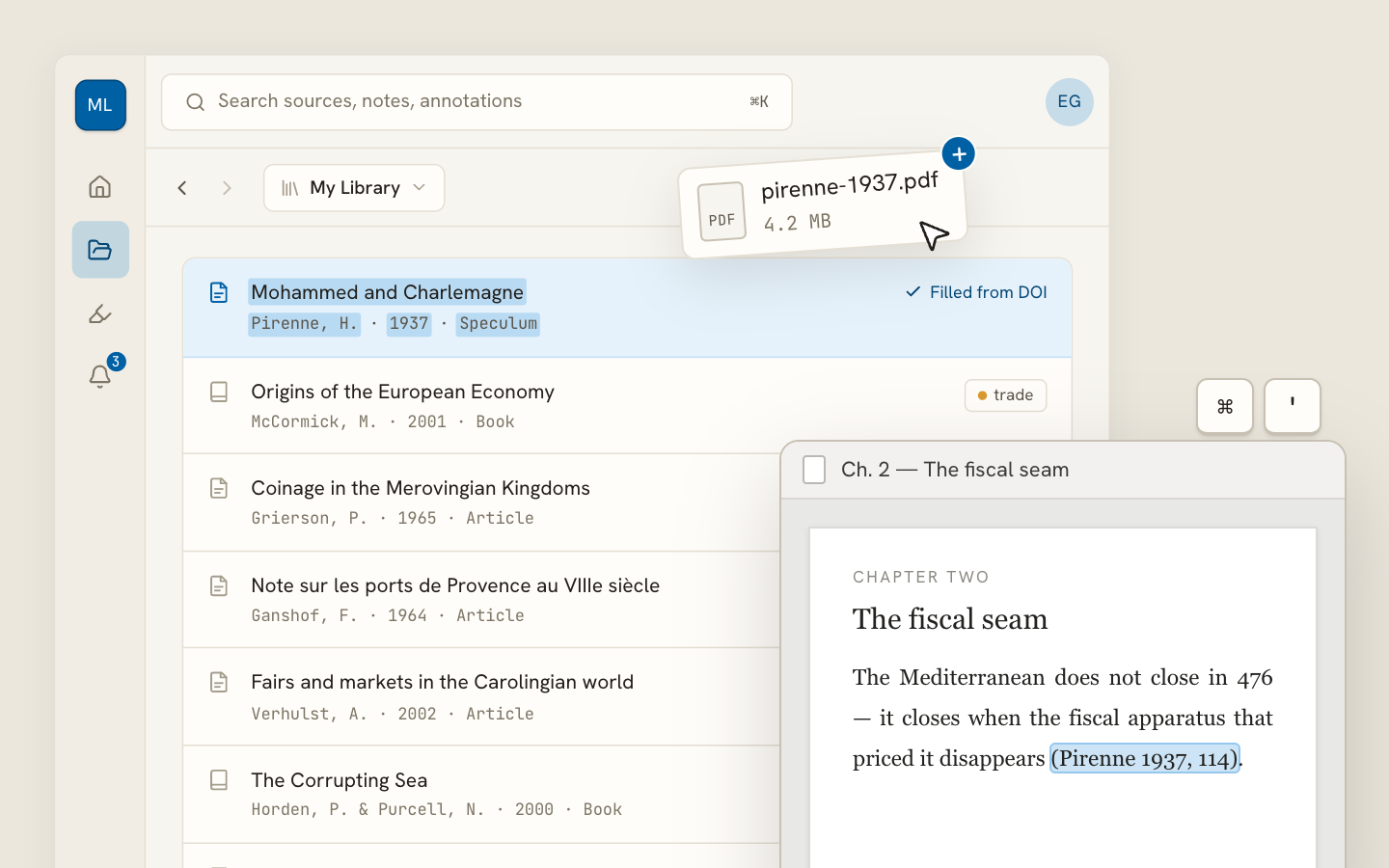
Archivero library view with a source list and an open PDF

Your weekly research workflow, in one email

One tested workflow, three links, no filler — every Tuesday.

Unsubscribe in one click. We never share your address.

Guides/Citations/APA Citation Style

How to Cite ChatGPT & AI-Generated Content in APA

APA's guidelines for citing output from ChatGPT, DALL-E, Copilot, and other generative AI tools.

8 min readAPA

On this page

1 of 24
APA's Position on AI-Generated ContentHow to Cite AI-Generated TextReference FormatIn-Text Citation FormatMultiple Uses of the Same ToolHow to Cite AI-Generated ImagesReference FormatIn-Text CitationCaptions for AI-Generated FiguresIncluding the Prompt in an AppendixHow to Format the AppendixWhen AI Is a Tool vs. a SourceAI as a Source (Cite It)AI as a Tool (Disclose, But Citation May Not Be Required)Institutional Policies — Always CheckExample References and In-Text CitationsChatGPTClaudeDALL-EMidjourneyGeminiCopilotCommon MistakesWhat's Next
All APA guides →

Generative AI tools like ChatGPT, Claude, Copilot, and Gemini have become part of the academic workflow — and APA has updated its guidelines to address them. Whether you used AI to brainstorm ideas, generate a first draft, create an image, or summarize a source, you need to know when and how to cite it.

The rules are still evolving, but APA has provided clear guidance for the current moment. Let's break it down.

APA's Position on AI-Generated Content

APA treats AI-generated text the same way it treats any other non-recoverable source: if your reader can't access the exact output you received, you cite it and include enough detail for them to understand what happened.

Here are the foundational principles:

  1. AI is not an author. Large language models don't meet APA's criteria for authorship (they can't approve a manuscript, take responsibility for the work, or be held accountable). The developer of the AI tool — OpenAI, Anthropic, Google, etc. — goes in the author position.
  2. The output isn't retrievable. If someone types the same prompt into ChatGPT, they'll get a different response. This makes AI-generated content a non-recoverable source, similar to a personal communication — except APA has decided it should appear in the reference list (unlike personal communications, which don't).
  3. Transparency is the goal. The citation isn't just about giving credit. It's about letting your reader (and your instructor) know that AI was involved in producing part of your work.

How to Cite AI-Generated Text

Reference Format

The reference entry for AI-generated text follows this structure:

Developer. (Year). Tool Name (Version) [Large language model]. URL

Here are examples for the major tools:

OpenAI. (2025). ChatGPT (Feb 2025 version) [Large language model]. https://chat.openai.com/

Anthropic. (2025). Claude (3.5 Sonnet) [Large language model]. https://claude.ai/

Google. (2025). Gemini (2.0 Ultra) [Large language model]. https://gemini.google.com/

Microsoft. (2025). Copilot (GPT-4 Turbo) [Large language model]. https://copilot.microsoft.com/

Key details:

  • The developer (OpenAI, Anthropic, Google, Microsoft) is the author.
  • Include the version or model number in parentheses after the tool name — include as much specificity as you can. AI models change frequently, so version details help contextualize the output.
  • The description in brackets — [Large language model] — tells the reader what kind of source this is.
  • The URL points to the tool's main page, not to your specific chat session (which isn't publicly accessible).
  • Include the year you generated the content, not the year the model was released.

In-Text Citation Format

In-text citations follow the standard author-date pattern:

Parenthetical:(OpenAI, 2025)

Narrative:OpenAI (2025) generated a summary that…

When describing what the AI produced, be specific about what you asked and how you used the output:

When prompted to summarize the key findings of cognitive load theory, ChatGPT produced a four-paragraph overview that was then revised and fact-checked against primary sources (OpenAI, 2025).

Multiple Uses of the Same Tool

If you used ChatGPT multiple times for different purposes, you only need one reference entry — just make sure each in-text citation is clear about what was generated:

The initial literature search strategy was informed by a ChatGPT-generated list of relevant keywords (OpenAI, 2025). Separately, ChatGPT was used to produce a first draft of the method section, which was substantially revised before inclusion (OpenAI, 2025).

If you used different tools (e.g., both ChatGPT and Claude), create a separate reference entry for each.

How to Cite AI-Generated Images

AI image generators follow the same general pattern, with a bracketed description identifying the type of output.

Reference Format

Developer. (Year). Tool Name (Version) [AI-generated image]. URL

OpenAI. (2025). DALL-E 3 [AI-generated image]. https://openai.com/dall-e-3

Midjourney. (2025). Midjourney (v6.1) [AI-generated image]. https://www.midjourney.com/

In-Text Citation

The figure was generated using DALL-E 3 with the prompt "a neuron firing in watercolor style" (OpenAI, 2025).

Captions for AI-Generated Figures

If you include an AI-generated image as a figure in your paper, use a standard APA figure format and note the source in the caption:

Figure 1

Neural Activity Visualization

Note. Generated by DALL-E 3 (OpenAI, 2025) using the prompt "a neuron firing in watercolor style, scientific illustration, white background."

Including the Prompt in an Appendix

APA recommends providing the full prompt and relevant portions of the output in an appendix or supplemental materials when the AI's contribution is substantial. This is especially important when:

  • AI-generated text was used as a starting point for your writing
  • The AI produced data, analysis, or a summary that you relied on
  • Your instructor requires prompt disclosure

How to Format the Appendix

Appendix

ChatGPT Prompt and Output

On January 15, 2025, the following prompt was entered into ChatGPT (GPT-4, OpenAI):

Prompt: "Summarize the main findings of Walker (2017) regarding the effects of sleep deprivation on memory consolidation. Include specific study results if possible."

Output: "Matthew Walker's 2017 book 'Why We Sleep' discusses several key findings regarding sleep deprivation and memory. First, Walker describes research showing that…" [output continues]

The output was used as a starting point for the literature review section. All claims were verified against the original source, and the text was substantially rewritten.

When AI Is a Tool vs. a Source

Not every use of AI requires a citation. Here's a useful distinction:

AI as a Source (Cite It)

If AI generated content that appears in your paper — text you adapted, data it analyzed, images it created, or summaries you relied on — cite it. Examples:

  • You asked ChatGPT to explain a concept and adapted its response into a paragraph
  • You used AI to generate a summary of a research article
  • An AI tool produced an image you included as a figure
  • You used AI to draft sections of your paper

AI as a Tool (Disclose, But Citation May Not Be Required)

If you used AI the same way you'd use a spell checker, grammar tool, or search engine — as a tool in your process rather than a source of content — a citation may not be necessary, but transparency is still important. Examples:

  • You used Grammarly (which uses AI) to proofread your paper
  • You used an AI-powered search tool to find relevant articles (but read and cited the articles themselves)
  • You used AI to check your grammar or suggest synonyms

Even when a formal citation isn't required, many instructors want you to acknowledge AI use in a note or methods section. When in doubt, disclose.

Use CaseCitation Required?Disclosure Recommended?
AI generated text adapted into your paperCitation Required?YesDisclosure Recommended?Yes
AI summarized a source you relied onCitation Required?YesDisclosure Recommended?Yes
AI created an image in your paperCitation Required?YesDisclosure Recommended?Yes
AI drafted sections you revisedCitation Required?YesDisclosure Recommended?Yes
AI checked your grammar/spellingCitation Required?NoDisclosure Recommended?Depends on instructor
AI helped you find sources (but you read them)Citation Required?NoDisclosure Recommended?Depends on instructor
AI translated text you then usedCitation Required?YesDisclosure Recommended?Yes

Institutional Policies — Always Check

This is important: APA's citation guidelines tell you how to cite AI, not whether you're allowed to use it. Your university, department, or individual instructor may have their own policies about AI use in academic work. These policies range widely:

  • Some instructors encourage AI use with proper citation
  • Some allow it only for brainstorming or outlining, not drafting
  • Some prohibit it entirely
  • Some require a signed AI-use declaration

Always check your assignment guidelines and course syllabus before using AI tools. The APA format for citing AI won't help you if your instructor considers AI use a violation of academic integrity for that particular assignment.

Example References and In-Text Citations

Here's a complete set of examples showing both the reference entry and corresponding in-text citation for each major AI tool:

ChatGPT

Reference:OpenAI. (2025). ChatGPT (Feb 2025 version) [Large language model]. https://chat.openai.com/

Parenthetical:(OpenAI, 2025)

Narrative:OpenAI (2025) generated…

Claude

Reference:Anthropic. (2025). Claude (3.5 Sonnet) [Large language model]. https://claude.ai/

Parenthetical:(Anthropic, 2025)

Narrative:Anthropic (2025) produced…

DALL-E

Reference:OpenAI. (2025). DALL-E 3 [AI-generated image]. https://openai.com/dall-e-3

Parenthetical:(OpenAI, 2025)

Narrative:The image was generated using DALL-E 3 (OpenAI, 2025).

Midjourney

Reference:Midjourney. (2025). Midjourney (v6.1) [AI-generated image]. https://www.midjourney.com/

Parenthetical:(Midjourney, 2025)

Narrative:Midjourney (2025) produced an image that…

Gemini

Reference:Google. (2025). Gemini (2.0 Ultra) [Large language model]. https://gemini.google.com/

Parenthetical:(Google, 2025)

Narrative:Google (2025) generated a response indicating…

Copilot

Reference:Microsoft. (2025). Copilot (GPT-4 Turbo) [Large language model]. https://copilot.microsoft.com/

Parenthetical:(Microsoft, 2025)

Narrative:Microsoft (2025) provided…

Common Mistakes

These are the AI citation errors we see most often:

  1. Listing "ChatGPT" as the author. The author is the developer — OpenAI, not ChatGPT. ChatGPT is the tool name, which goes in the title position.
  2. Omitting the version. AI models change constantly. Including the version (GPT-4, Claude 3.5 Sonnet, etc.) helps readers understand what tool produced the output.
  3. Linking to a specific chat session. Chat URLs are private and not accessible to readers. Link to the tool's main page instead.
  4. Skipping the appendix. If AI contributed substantially to your work, provide the prompt and output. This is how your reader (and instructor) can evaluate what the AI contributed.
  5. Treating AI as an author. AI tools don't qualify as authors under APA's criteria. They can't consent to publication, take responsibility, or be held accountable.
  6. Not checking institutional policy. Citing AI correctly doesn't mean you're allowed to use it. Always verify your instructor's or institution's AI use policy.

What's Next

Now that you know how to cite AI-generated content, explore these related topics:

  • How to Cite a Website in APA Format — the closest traditional source type to AI-generated content
  • APA Reference List — how to format your reference list with AI and traditional sources together
  • Common APA Format Mistakes — the most frequent errors across all APA formatting

As AI tools become a bigger part of academic writing, Archivero helps you stay on top of the citation rules — save your AI-generated sources alongside your traditional references and let Archivero format everything consistently.

All APA guides →
← PreviousHow to Cite a Dissertation or Thesis in APA FormatNext →APA Annotated Bibliography

More on APA style

The standard in psychology, education and the social sciences. The author–date system, reference-list formatting and what the 7th edition changed.

View all 34 guides →
8 sections·9 min readAPAAPA Annotated Bibliography13 sections·8 min readAPAAPA 6th vs. 7th Edition — What Changed6 sections·8 min readAPACommon APA Format Mistakes (and How to Fix Them)8 sections·5 min readAPAHow to Cite a Chart or Graph in APA Format

Your sources, PDFs and citations in one library

  • Import a Zotero, Mendeley or EndNote library — or a folder of PDFs
  • Highlight and annotate without leaving the source
  • Cite in any CSL style as you write, with one shared library for your lab
Request early accessSee the product →
Archivero library view with a source list and an open PDF

Your weekly research workflow, in one email

One tested workflow, three links, no filler — every Tuesday.

Unsubscribe in one click. We never share your address.