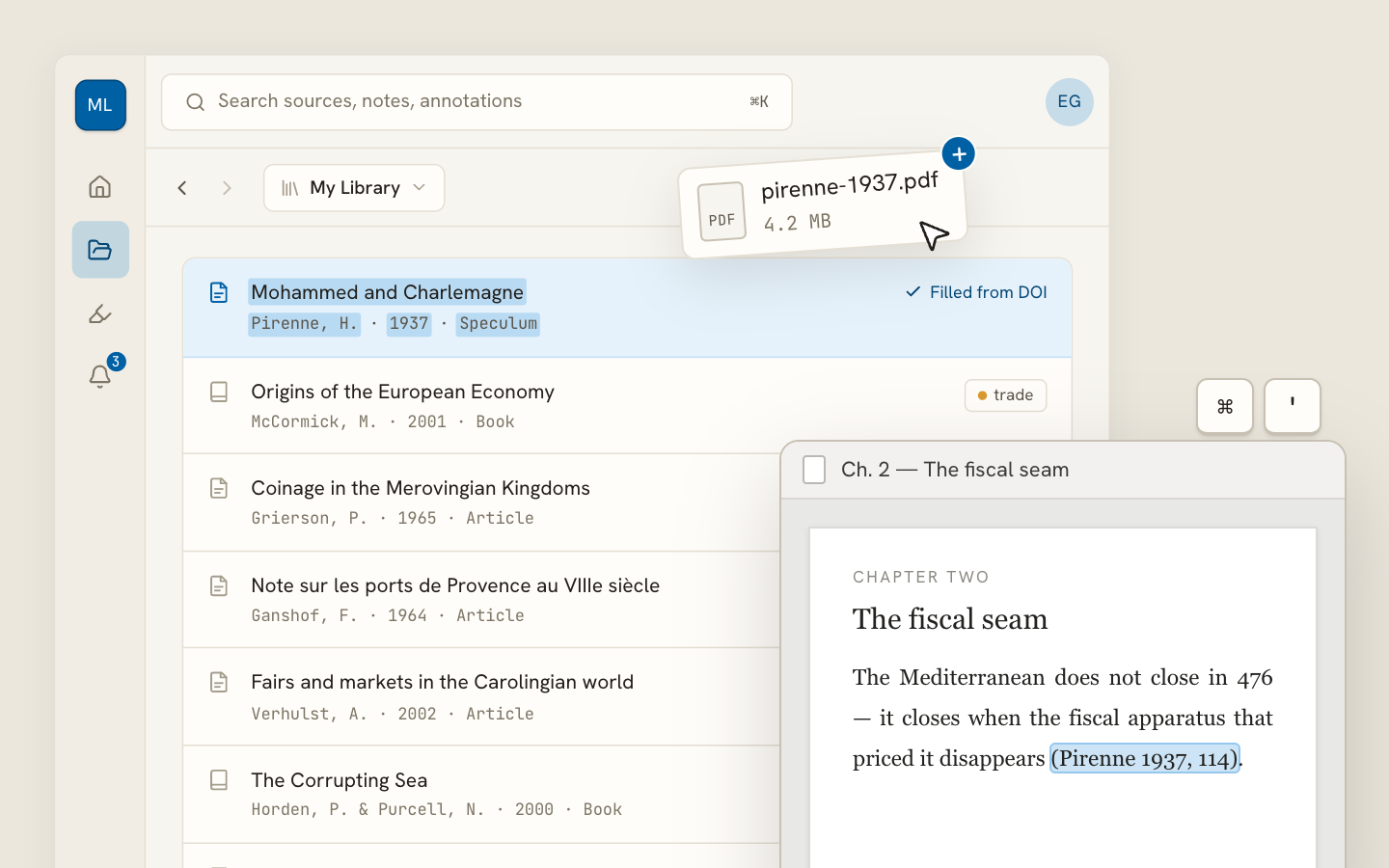
A direct quote reproduces a source's exact words in your own writing. In Harvard referencing, every direct quote must include the author, year, and a page number (or equivalent locator) — either in parentheses or woven into a signal phrase. The formatting changes depending on the length of the quote: short quotations stay inline, while longer passages become indented block quotes.
When to Use a Direct Quote vs. Paraphrasing
Direct quoting is appropriate when:
- The author's exact words are particularly striking, precise, or well-known
- You need to analyse the language itself (e.g., in a literary or discourse analysis)
- Changing the wording would alter the meaning or weaken the claim
- You're quoting a definition or a legal/technical term
For everything else, paraphrase. Academic writing should be predominantly in your own voice. Overusing direct quotes makes your paper read like a patchwork of other people's words — and most markers will penalise this.
A useful rule of thumb: if you're quoting a passage because you don't know how to say it differently, that's a sign you should practise paraphrasing it instead.
For detailed paraphrasing guidance, see How to Paraphrase in Harvard Referencing.
Short Quotations — Under ~40 Words
Short quotes are embedded directly into your sentence, enclosed in single quotation marks. The citation — including the page number — appears in parentheses.
Parenthetical Citation
The author, year, and page number all go inside the parentheses at the end of the sentence:
Sleep has been described as 'the single most effective thing we can do to reset our brain and body health each day' (Walker, 2017, p. 7).
Notice: the full stop comes after the closing parenthesis, not before it.
Narrative Citation
Name the author in the sentence. The year goes in parentheses immediately after the name, and the page number can go at the end:
Walker (2017, p. 7) describes sleep as 'the single most effective thing we can do to reset our brain and body health each day.'
Alternatively, you can place the page number at the end of the quote:
Walker (2017) describes sleep as 'the single most effective thing we can do to reset our brain and body health each day' (p. 7).
Both formats are acceptable — consistency within your paper is what matters.
Punctuation Placement
The full stop always goes after the parenthetical citation, not inside the quotation marks:
✓ …brain and body health each day' (Walker, 2017, p. 7).
✗ …brain and body health each day.' (Walker, 2017, p. 7)
If the original sentence ends with a question mark or exclamation mark, keep it inside the quotation marks and still place the full stop after the citation:
The author asks, 'why do we sleep?' (Walker, 2017, p. 1).
Block Quotations — 40+ Words
When a quote is roughly 40 words or longer, it becomes a block quotation:
- Indent the entire quote from the left margin (typically 1.27 cm / 0.5 inches)
- Do not use quotation marks around the block
- Double-space the quote (same as the rest of your paper)
- Place the citation at the end of the final sentence
Example — Parenthetical Block Quote
Introduce the quote with a signal phrase or sentence ending in a colon:
Diekelmann and Born (2010, p. 115) explain the role of sleep in memory consolidation:
Sleep has been identified as a state that optimises the consolidation of newly acquired information in memory, depending on the specific conditions of learning and the timing of sleep within the consolidation period. Both the encoding of new memories and their subsequent reactivation during sleep appear critical for long-term retention.
No quotation marks around the block. The parenthetical citation was placed in the introductory sentence because the authors were named there.
Alternative — Citation at the End of the Block
If you don't name the authors in the introduction, place the citation in parentheses at the end of the block, after the final full stop:
Sleep has been identified as a state that optimises the consolidation of newly acquired information in memory, depending on the specific conditions of learning and the timing of sleep within the consolidation period. Both the encoding of new memories and their subsequent reactivation during sleep appear critical for long-term retention. (Diekelmann and Born, 2010, p. 115)
Note:Some Harvard guides place the citation after the final full stop of the block (as above). Others place it before the full stop. Check your institution's preference — and be consistent.
Including Page Numbers
Harvard in-text citations for direct quotes must include a locator — something that tells your reader exactly where in the source the quoted words appear.
Standard Page Numbers
Use p. for a single page and pp. for a page range:
(Walker, 2017, p. 108)
(Walker, 2017, pp. 108–110)
Sources Without Page Numbers
Many online and digital sources don't have fixed page numbers. Use whichever locator is available:
| Locator Type | Format | Example |
|---|---|---|
| Paragraph number | para. | (Harris, 2023, para. 4) |
| Section heading | section name | (NHS, 2024, 'Symptoms' section) |
| Chapter number | ch. | (Crawford, 2021, ch. 3) |
| Timestamp (video/audio) | hh:mm:ss or mm:ss | (Brown, 2019, 14:32) |
| Slide number | slide | (Osei, 2025, slide 12) |
If no locator of any kind is available, cite the source without one — but this should be rare for a direct quote.
Adding or Omitting Words
Sometimes you need to modify a quote slightly to make it fit grammatically into your sentence or to clarify meaning. Harvard uses two conventions for this:
Square Brackets — Adding or Changing Words
Use square brackets to insert or modify words within a quote:
The study found that 'the results [of the second trial] confirmed the initial hypothesis' (Patel, 2022, p. 89).
According to the report, '[u]niversity students are disproportionately affected' (Thompson, 2020, p. 14).
The second example shows how to change capitalisation — the original had an uppercase "U," but in your sentence the quote starts mid-sentence.
Ellipsis — Omitting Words
Use an ellipsis (three dots with spaces) to show that you've left out part of the original:
Walker (2017, p. 40) notes that 'sleep deprivation … impairs nearly every cognitive function measured in laboratory settings.'
Rules for ellipses:
- Don't start a quote with an ellipsis — just begin where the relevant text starts
- Don't end a quote with an ellipsis unless the omission is genuinely significant
- Never use an ellipsis to change the meaning of a quote
Single vs. Double Quotation Marks
This is one of the most visible UK/US differences in Harvard formatting:
| Convention | Short Quote Marks | Quote Within a Quote |
|---|---|---|
| UK convention (most Harvard guides) | Single: 'text' | Double inside: 'She said "hello" and left' |
| US convention (some Australian guides) | Double: "text" | Single inside: "She said 'hello' and left" |
Most UK-based Harvard guides use single quotation marks for short quotes, with double marks for a quotation within a quotation:
Thompson (2019, p. 33) writes that 'the concept of "sleep hygiene" has become mainstream.'
If your institution uses double marks as the default, simply reverse the nesting. The key is consistency.
Quoting From a Secondary Source
If you want to quote words that appear in a source you read, but the words were originally written or spoken by someone else, you're dealing with a secondary source. Use "cited in":
Freud described dreams as 'the royal road to the unconscious' (cited in Mitchell, 2020, p. 56).
Only the source you actually read — Mitchell — goes in your reference list. For detailed guidance, see How to Cite a Secondary Source in Harvard.
Common Quoting Mistakes
| Mistake | Why It's Wrong | Correct Approach |
|---|---|---|
| No page number on a direct quote | Reader can't locate the passage | Always include p., pp., para., or another locator |
| Full stop before the citation | Incorrect punctuation placement | Full stop goes after: …text' (Author, Year, p. X). |
| Quotation marks around a block quote | Block quotes shouldn't have them | Indent the block; remove the marks |
| Overusing direct quotes | Your paper should be in your own voice | Paraphrase most passages; quote only when the exact words matter |
| Changing words without brackets | Reader can't tell what the author actually wrote | Use [square brackets] for any changes |
| Removing words without an ellipsis | Conceals omissions | Use … to show where words were removed |
| Mismatched quotation mark style | Inconsistent — some single, some double | Pick one convention and use it throughout |
Summary: Direct Quote Formats at a Glance
| Quote Type | Format |
|---|---|
| Short quote (parenthetical) | …'quoted text' (Author, Year, p. X). |
| Short quote (narrative) | Author (Year, p. X) states that '…quoted text.' |
| Block quote | Indented, no quotation marks, citation at end |
| Quote with added words | '…[added words]…' |
| Quote with omitted words | '…omitted … text…' |
| Quote within a quote | 'outer "inner" outer' (UK convention) |
What's Next?
Now that you know how to format direct quotes, explore these related guides:
- How to Paraphrase in Harvard Referencing — when and how to put sources in your own words
- Harvard In-Text Citations — the complete guide to parenthetical and narrative citations
- Harvard Referencing Example Paper — see direct quotes in context within a fully formatted sample essay