Archivero is in early access — your sources, PDFs and citations in one library.Request early access →
Archivero/guides/
APAMLAHarvardThesis writing
Subscribe
Archivero/guides/Request early access →

Guides

APA styleMLA styleHarvard referencingThesis writing

Compare

APA 6th vs 7thMLA 8th vs 9thHarvard vs APAThesis vs dissertation

Product

FeaturesEarly access

Resources

DocsCheat sheetsNewsletter

Company

ContactStatus ↗
© 2025–2026 Ernesto F. GonzálezGuidesDocsContactPrivacyTerms
Guides/Citations/Harvard Referencing Style

Harvard In-Text Citations

How to format in-text citations in Harvard referencing — author-date rules, page numbers, and special cases with examples.

6 min readHarvard

On this page

1 of 17
The Author-Date System — BasicsParenthetical CitationsNarrative CitationsIncluding Page NumbersWorks With No Page NumbersMultiple Works in One ParentheticalMultiple Works by the Same Author in the Same YearOne AuthorTwo AuthorsThree AuthorsFour or More AuthorsCorporate or Organisational AuthorsNo AuthorNo DateSecondary Sources (Cited In)Common In-Text Citation MistakesWhat's Next?
All Harvard guides →

Every time you use information from a source — whether you're quoting, paraphrasing, or summarising — you need to tell your reader where it came from. In Harvard referencing, you do this with a brief in-text citation placed right in the body of your text. No footnotes, no endnotes, no superscript numbers. Just the author's surname and the year of publication, tucked neatly into your sentence.

This page covers the rules for Harvard in-text citations. Once you learn the basic pattern, every special case is just a variation on the same idea.

The Author-Date System — Basics

Harvard in-text citations follow a simple formula:

(Surname, Year)

That's it. When you paraphrase or refer to an idea from a source, include the author's surname and the year of publication in parentheses:

Sleep deprivation has been linked to impaired memory consolidation and reduced cognitive function (Walker, 2017).

When you quote directly or refer to a specific passage, add the page number:

Sleep deprivation has been linked to "measurable impairments in attention, working memory, and executive function" (Walker, 2017, p. 134).

Parenthetical Citations

A parenthetical citation places all the source information in parentheses at the end of the clause or sentence:

Effective feedback is most useful when it is specific and timely (Hattie, 2012).

The study found a statistically significant correlation between exercise frequency and reported wellbeing (Chen and Patel, 2023, p. 89).

Place the citation before the full stop (period) — the citation is part of the sentence, not a separate element.

When to use parenthetical citations: Use them when you're citing a fact, finding, or idea without focusing on who said it. The emphasis stays on the information rather than the author.

Narrative Citations

A narrative citation integrates the author's name into your sentence. Only the year goes in parentheses:

Hattie (2012) argues that effective feedback must be specific and timely.

According to Chen and Patel (2023, p. 89), there is a statistically significant correlation between exercise frequency and reported wellbeing.

When to use narrative citations: Use them when you're discussing an author's specific argument, theory, or contribution. They put the spotlight on the author and work well for introducing a source you'll discuss at length.

Including Page Numbers

Page numbers are required for direct quotes and recommended (though not always mandatory) for paraphrases of specific passages. The format depends on what you're referencing:

ScenarioFormatExample
Single pageFormatp.Example(Walker, 2017, p. 134)
Page rangeFormatpp.Example(Walker, 2017, pp. 134–138)
Paragraph number (no pages)Formatpara.Example(Harris, 2021, para. 4)

Note the use of a comma before the page reference, and the use of "p." (single page) versus "pp." (page range). Some institutions use a colon instead of a comma — e.g., (Walker, 2017: 134) — so check your university's guide.

Works With No Page Numbers

Many sources — websites, online reports, some e-books — don't have page numbers. In these cases, you have several options to help the reader locate the information:

  • Paragraph number: (Harris, 2021, para. 4)
  • Section heading: (Harris, 2021, 'Methodology' section)
  • Chapter: (Harris, 2021, ch. 3)
  • Timestamp (for videos/audio): (TED, 2019, 04:32)

If none of these locators are available, the author-date citation alone is sufficient:

(Harris, 2021)

You are not required to add a locator for paraphrases from sources without page numbers — but including one is good practice when it helps the reader.

Multiple Works in One Parenthetical

When a point is supported by more than one source, list them in one set of parentheses, separated by semicolons. Order them alphabetically by author surname or chronologically — both approaches are acceptable, but be consistent:

Several studies have demonstrated a positive relationship between mindfulness and stress reduction (Creswell, 2017; Kabat-Zinn, 2013; Williams and Penman, 2011).

Multiple Works by the Same Author in the Same Year

If you cite two or more works by the same author published in the same year, distinguish them by adding lowercase letters after the year — a, b, c, and so on:

In-text citations:

(Thompson, 2020a)

(Thompson, 2020b)

Reference list entries:

Thompson, L. (2020a) 'First article title', Journal Name, 12(3), pp. 45–60.

Thompson, L. (2020b) 'Second article title', Journal Name, 14(1), pp. 11–28.

Assign the letters alphabetically based on the title of each work. The same letters must appear in both the in-text citation and the reference list entry.

One Author

The simplest case — just the surname and year:

(Walker, 2017)

Walker (2017) found that…

Two Authors

List both surnames, connected by "and":

(Chen and Patel, 2023)

Chen and Patel (2023) argue that…

Note:Some Harvard guides use "&" instead of "and" in parenthetical citations: (Chen & Patel, 2023). Check your institution's preference. This guide uses "and" as it is the more common convention in UK Harvard guides.

Three Authors

Many Harvard guides now follow the same approach as APA 7th edition: use et al. from the first citation when there are three or more authors. However, some institutions still require all three names for the first citation. Check your guide.

If your institution uses et al. from the first citation:

(Rahman et al., 2021)

If your institution lists all names on first use:

First citation: (Rahman, Torres and Kim, 2021)

Subsequent citations: (Rahman et al., 2021)

Four or More Authors

Use the first author's surname followed by et al. (not italicised) from the first citation onwards:

(Nguyen et al., 2022)

Nguyen et al. (2022) found that…

"et al." is an abbreviation of the Latin et alii ("and others"). It has a full stop after "al." but not after "et."

For a comprehensive guide to multi-author citations, see Harvard Citation With Multiple Authors.

Corporate or Organisational Authors

When a source is authored by an organisation rather than a named individual, use the organisation's name as the author:

(World Health Organization, 2024)

The World Health Organization (2024) reports that…

If the name is long and you cite it frequently, you can introduce an abbreviation on first use:

First citation: (World Health Organization [WHO], 2024)

Subsequent citations: (WHO, 2024)

No Author

When no author can be identified, use the title of the work (or a shortened version) in place of the author name:

('Data protection in the digital age', 2023)

Use italics if the work is a standalone title (book, report), or single quotation marks if it's part of a larger work (article, web page). For detailed guidance, see How to Cite a Source With No Author in Harvard.

No Date

If no publication date is available, use n.d. (no date):

(Harris, n.d.)

Harris (n.d.) suggests that…

For detailed guidance, see How to Cite a Source With No Date in Harvard.

Secondary Sources (Cited In)

Sometimes you'll read about a study in another author's work but cannot access the original. In this case, cite the original author and note the secondary source you actually read:

Johnson's (1998) research (cited in Williams, 2019) found that…

Early research in the field (Johnson, 1998, cited in Williams, 2019) established that…

Only list the source you actually read (Williams, 2019) in your reference list. For detailed guidance, see How to Cite a Secondary Source in Harvard.

Common In-Text Citation Mistakes

Watch out for these frequent errors:

MistakeWrongRight
Citation after the full stopWrong…cognitive function. (Walker, 2017)Right…cognitive function (Walker, 2017).
Missing comma between author and yearWrong(Walker 2017)Right(Walker, 2017)
Using first name or initialsWrong(Matthew Walker, 2017)Right(Walker, 2017)
Forgetting page numbers for quotesWrong"exact words" (Walker, 2017)Right"exact words" (Walker, 2017, p. 134)
Wrong et al. formatWrong(Nguyen et. al, 2022)Right(Nguyen et al., 2022)
Putting the year outside parenthesesWrong(Walker), 2017Right(Walker, 2017)

What's Next?

Now that you know how to handle in-text citations, learn how to build the reference list that your citations point to:

  • Harvard Reference List — formatting rules, alphabetical ordering, and annotated examples for every common source type
  • Harvard Direct Quotes — detailed rules for short quotes, block quotes, and page number locators
  • Harvard Paraphrasing — how to paraphrase correctly and cite your paraphrases
All Harvard guides →
← PreviousHarvard Format PaperNext →Harvard Reference List

More on Harvard referencing

The dominant system in British, Australian and international universities. In-text citations, reference lists and the local conventions that vary by department.

View all 26 guides →
9 sections·6 min readHarvardHarvard Reference List13 sections·6 min readHarvardHow to Reference a Website in Harvard Style13 sections·6 min readHarvardHow to Reference a Book in Harvard Style12 sections·6 min readHarvardHow to Reference a Journal Article in Harvard Style

Your sources, PDFs and citations in one library

  • Import a Zotero, Mendeley or EndNote library — or a folder of PDFs
  • Highlight and annotate without leaving the source
  • Cite in any CSL style as you write, with one shared library for your lab
Request early accessSee the product →
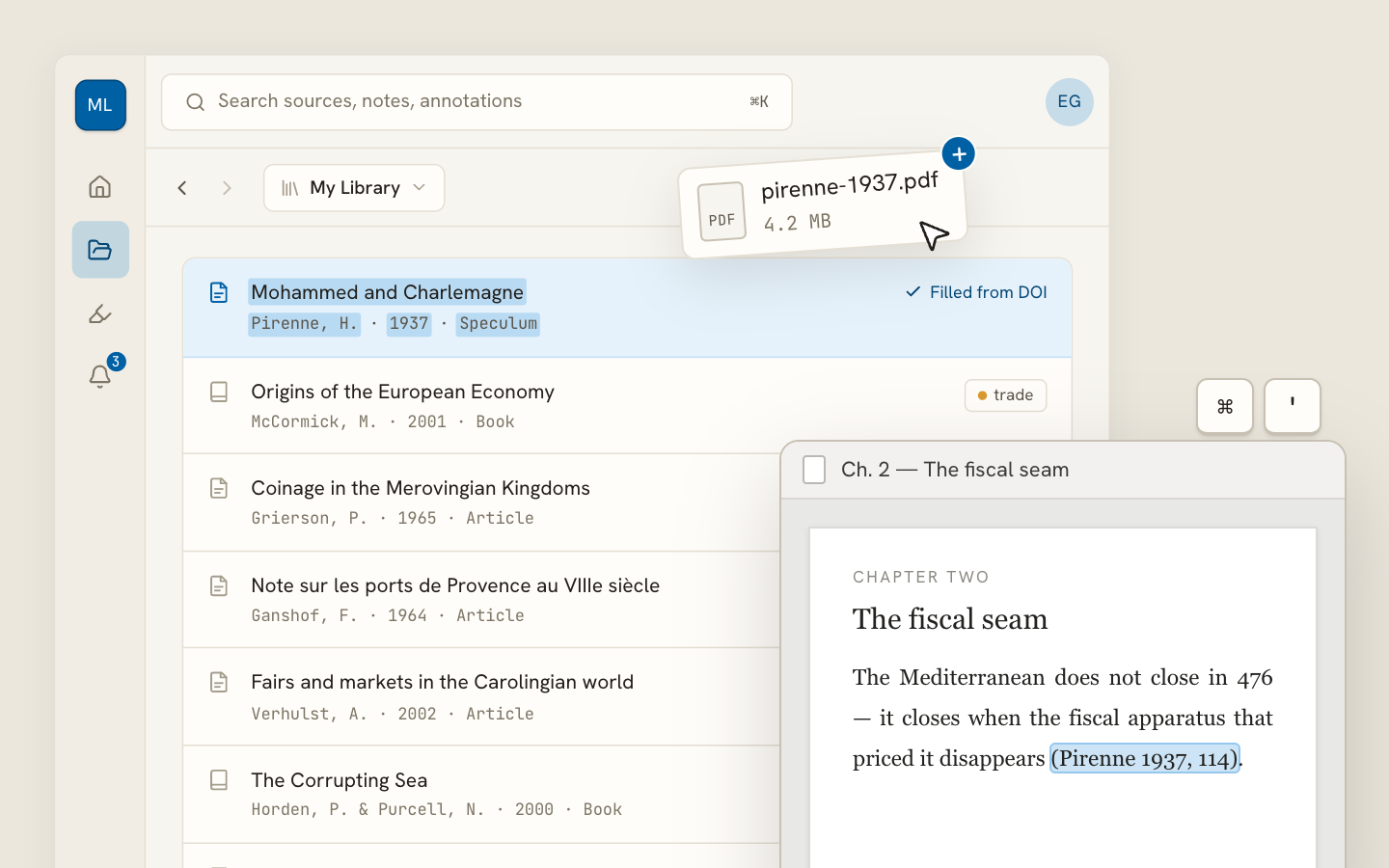
Archivero library view with a source list and an open PDF

Your weekly research workflow, in one email

One tested workflow, three links, no filler — every Tuesday.

Unsubscribe in one click. We never share your address.

Guides/Citations/Harvard Referencing Style

Harvard In-Text Citations

How to format in-text citations in Harvard referencing — author-date rules, page numbers, and special cases with examples.

6 min readHarvard

On this page

1 of 17
The Author-Date System — BasicsParenthetical CitationsNarrative CitationsIncluding Page NumbersWorks With No Page NumbersMultiple Works in One ParentheticalMultiple Works by the Same Author in the Same YearOne AuthorTwo AuthorsThree AuthorsFour or More AuthorsCorporate or Organisational AuthorsNo AuthorNo DateSecondary Sources (Cited In)Common In-Text Citation MistakesWhat's Next?
All Harvard guides →

Every time you use information from a source — whether you're quoting, paraphrasing, or summarising — you need to tell your reader where it came from. In Harvard referencing, you do this with a brief in-text citation placed right in the body of your text. No footnotes, no endnotes, no superscript numbers. Just the author's surname and the year of publication, tucked neatly into your sentence.

This page covers the rules for Harvard in-text citations. Once you learn the basic pattern, every special case is just a variation on the same idea.

The Author-Date System — Basics

Harvard in-text citations follow a simple formula:

(Surname, Year)

That's it. When you paraphrase or refer to an idea from a source, include the author's surname and the year of publication in parentheses:

Sleep deprivation has been linked to impaired memory consolidation and reduced cognitive function (Walker, 2017).

When you quote directly or refer to a specific passage, add the page number:

Sleep deprivation has been linked to "measurable impairments in attention, working memory, and executive function" (Walker, 2017, p. 134).

Parenthetical Citations

A parenthetical citation places all the source information in parentheses at the end of the clause or sentence:

Effective feedback is most useful when it is specific and timely (Hattie, 2012).

The study found a statistically significant correlation between exercise frequency and reported wellbeing (Chen and Patel, 2023, p. 89).

Place the citation before the full stop (period) — the citation is part of the sentence, not a separate element.

When to use parenthetical citations: Use them when you're citing a fact, finding, or idea without focusing on who said it. The emphasis stays on the information rather than the author.

Narrative Citations

A narrative citation integrates the author's name into your sentence. Only the year goes in parentheses:

Hattie (2012) argues that effective feedback must be specific and timely.

According to Chen and Patel (2023, p. 89), there is a statistically significant correlation between exercise frequency and reported wellbeing.

When to use narrative citations: Use them when you're discussing an author's specific argument, theory, or contribution. They put the spotlight on the author and work well for introducing a source you'll discuss at length.

Including Page Numbers

Page numbers are required for direct quotes and recommended (though not always mandatory) for paraphrases of specific passages. The format depends on what you're referencing:

ScenarioFormatExample
Single pageFormatp.Example(Walker, 2017, p. 134)
Page rangeFormatpp.Example(Walker, 2017, pp. 134–138)
Paragraph number (no pages)Formatpara.Example(Harris, 2021, para. 4)

Note the use of a comma before the page reference, and the use of "p." (single page) versus "pp." (page range). Some institutions use a colon instead of a comma — e.g., (Walker, 2017: 134) — so check your university's guide.

Works With No Page Numbers

Many sources — websites, online reports, some e-books — don't have page numbers. In these cases, you have several options to help the reader locate the information:

  • Paragraph number: (Harris, 2021, para. 4)
  • Section heading: (Harris, 2021, 'Methodology' section)
  • Chapter: (Harris, 2021, ch. 3)
  • Timestamp (for videos/audio): (TED, 2019, 04:32)

If none of these locators are available, the author-date citation alone is sufficient:

(Harris, 2021)

You are not required to add a locator for paraphrases from sources without page numbers — but including one is good practice when it helps the reader.

Multiple Works in One Parenthetical

When a point is supported by more than one source, list them in one set of parentheses, separated by semicolons. Order them alphabetically by author surname or chronologically — both approaches are acceptable, but be consistent:

Several studies have demonstrated a positive relationship between mindfulness and stress reduction (Creswell, 2017; Kabat-Zinn, 2013; Williams and Penman, 2011).

Multiple Works by the Same Author in the Same Year

If you cite two or more works by the same author published in the same year, distinguish them by adding lowercase letters after the year — a, b, c, and so on:

In-text citations:

(Thompson, 2020a)

(Thompson, 2020b)

Reference list entries:

Thompson, L. (2020a) 'First article title', Journal Name, 12(3), pp. 45–60.

Thompson, L. (2020b) 'Second article title', Journal Name, 14(1), pp. 11–28.

Assign the letters alphabetically based on the title of each work. The same letters must appear in both the in-text citation and the reference list entry.

One Author

The simplest case — just the surname and year:

(Walker, 2017)

Walker (2017) found that…

Two Authors

List both surnames, connected by "and":

(Chen and Patel, 2023)

Chen and Patel (2023) argue that…

Note:Some Harvard guides use "&" instead of "and" in parenthetical citations: (Chen & Patel, 2023). Check your institution's preference. This guide uses "and" as it is the more common convention in UK Harvard guides.

Three Authors

Many Harvard guides now follow the same approach as APA 7th edition: use et al. from the first citation when there are three or more authors. However, some institutions still require all three names for the first citation. Check your guide.

If your institution uses et al. from the first citation:

(Rahman et al., 2021)

If your institution lists all names on first use:

First citation: (Rahman, Torres and Kim, 2021)

Subsequent citations: (Rahman et al., 2021)

Four or More Authors

Use the first author's surname followed by et al. (not italicised) from the first citation onwards:

(Nguyen et al., 2022)

Nguyen et al. (2022) found that…

"et al." is an abbreviation of the Latin et alii ("and others"). It has a full stop after "al." but not after "et."

For a comprehensive guide to multi-author citations, see Harvard Citation With Multiple Authors.

Corporate or Organisational Authors

When a source is authored by an organisation rather than a named individual, use the organisation's name as the author:

(World Health Organization, 2024)

The World Health Organization (2024) reports that…

If the name is long and you cite it frequently, you can introduce an abbreviation on first use:

First citation: (World Health Organization [WHO], 2024)

Subsequent citations: (WHO, 2024)

No Author

When no author can be identified, use the title of the work (or a shortened version) in place of the author name:

('Data protection in the digital age', 2023)

Use italics if the work is a standalone title (book, report), or single quotation marks if it's part of a larger work (article, web page). For detailed guidance, see How to Cite a Source With No Author in Harvard.

No Date

If no publication date is available, use n.d. (no date):

(Harris, n.d.)

Harris (n.d.) suggests that…

For detailed guidance, see How to Cite a Source With No Date in Harvard.

Secondary Sources (Cited In)

Sometimes you'll read about a study in another author's work but cannot access the original. In this case, cite the original author and note the secondary source you actually read:

Johnson's (1998) research (cited in Williams, 2019) found that…

Early research in the field (Johnson, 1998, cited in Williams, 2019) established that…

Only list the source you actually read (Williams, 2019) in your reference list. For detailed guidance, see How to Cite a Secondary Source in Harvard.

Common In-Text Citation Mistakes

Watch out for these frequent errors:

MistakeWrongRight
Citation after the full stopWrong…cognitive function. (Walker, 2017)Right…cognitive function (Walker, 2017).
Missing comma between author and yearWrong(Walker 2017)Right(Walker, 2017)
Using first name or initialsWrong(Matthew Walker, 2017)Right(Walker, 2017)
Forgetting page numbers for quotesWrong"exact words" (Walker, 2017)Right"exact words" (Walker, 2017, p. 134)
Wrong et al. formatWrong(Nguyen et. al, 2022)Right(Nguyen et al., 2022)
Putting the year outside parenthesesWrong(Walker), 2017Right(Walker, 2017)

What's Next?

Now that you know how to handle in-text citations, learn how to build the reference list that your citations point to:

  • Harvard Reference List — formatting rules, alphabetical ordering, and annotated examples for every common source type
  • Harvard Direct Quotes — detailed rules for short quotes, block quotes, and page number locators
  • Harvard Paraphrasing — how to paraphrase correctly and cite your paraphrases
All Harvard guides →
← PreviousHarvard Format PaperNext →Harvard Reference List

More on Harvard referencing

The dominant system in British, Australian and international universities. In-text citations, reference lists and the local conventions that vary by department.

View all 26 guides →
9 sections·6 min readHarvardHarvard Reference List13 sections·6 min readHarvardHow to Reference a Website in Harvard Style13 sections·6 min readHarvardHow to Reference a Book in Harvard Style12 sections·6 min readHarvardHow to Reference a Journal Article in Harvard Style

Your sources, PDFs and citations in one library

  • Import a Zotero, Mendeley or EndNote library — or a folder of PDFs
  • Highlight and annotate without leaving the source
  • Cite in any CSL style as you write, with one shared library for your lab
Request early accessSee the product →
Archivero library view with a source list and an open PDF

Your weekly research workflow, in one email

One tested workflow, three links, no filler — every Tuesday.

Unsubscribe in one click. We never share your address.