Books are the bedrock of humanities research. Whether you're analyzing a novel for a literature course, referencing a philosophical treatise, or citing a historical account, you'll need to know how to cite books in MLA format. The good news is that books are one of the most straightforward source types to cite — and once you learn the basic pattern, every variation is just a twist on the same formula.
Let's start with the simplest case and work our way through every scenario you're likely to encounter.
The Basic Format
Every book citation follows MLA's core element structure:
Author. Title of Book. Publisher, Year.
Here's what that looks like:
Morrison, Toni. Beloved. Vintage Books, 2004.
What to notice: The author's name is inverted (last name, first name). The book title is italicized and in title case. The publisher name follows, then the year of publication. That's all you need for a standard single-author book.
Book With One Author
The baseline case — one person wrote the book, and you're citing the whole thing.
Works Cited:
Woolf, Virginia. A Room of One's Own. Harcourt, 1929.
In-text citations:
Parenthetical:(Woolf 4)
Signal phrase:Woolf argues that "a woman must have money and a room of her own" (4).
Nothing fancy — just the four core elements. Include the page number in your in-text citation to point the reader to the specific passage.
Book With Multiple Authors
Two Authors
List both authors. Invert only the first author's name. Join them with "and":
Works Cited:
Gilbert, Sandra M., and Susan Gubar. The Madwoman in the Attic: The Woman Writer and the Nineteenth-Century Literary Imagination. Yale UP, 2000.
In-text citations:
Parenthetical:(Gilbert and Gubar 73)
Signal phrase:Gilbert and Gubar argue that nineteenth-century women writers faced a unique "anxiety of authorship" (73).
Note that MLA uses "and" — not an ampersand (&) — in both the Works Cited entry and in-text citations. The second author's name appears in normal order (first name last name).
Three or More Authors
List only the first author followed by "et al." (Latin for "and others"):
Works Cited:
Rabinowitz, Peter J., et al. Authorizing Readers: Resistance and Respect in the Teaching of Literature. Teachers College P, 1998.
In-text citations:
Parenthetical:(Rabinowitz et al. 112)
Signal phrase:Rabinowitz et al. challenge the traditional model of reader response (112).
"et al." is not italicized and has a period after "al." — it's an abbreviation of "alii."
For more on multi-author citations, see MLA Citation With Multiple Authors.
Edited Book (Editor as Author)
When you're citing an edited collection as a whole — not a specific chapter within it — the editor takes the author position. Add "editor" or "editors" after the name:
Works Cited:
Gates, Henry Louis, Jr., editor. The Classic Slave Narratives. Signet Classics, 2012.
In-text citations:
(Gates 15)
For two editors, use "editors":
Gilbert, Sandra M., and Susan Gubar, editors. The Norton Anthology of Literature by Women. 3rd ed., W. W. Norton, 2007.
Chapter or Essay in an Edited Book
This is where MLA's container system comes into play. The chapter is the source, and the book is the container:
Works Cited:
Morrison, Toni. "Rootedness: The Ancestor as Foundation." Black Women Writers (1950–1980), edited by Mari Evans, Anchor Books, 1984, pp. 339–45.
In-text citations:
(Morrison 340)
What to notice:
- The chapter title goes in quotation marks (it's a part of a larger work)
- The book title is italicized (it's the container)
- "edited by" is lowercase and precedes the editor's name in normal order
- Page numbers of the chapter appear at the end (pp. 339–45)
E-Book
If you read the book as an e-book and the format is essentially the same as the print version (just delivered digitally), cite it like a print book — no special notation needed.
If the e-book format matters or differs from print (e.g., it has no page numbers, or you want to note the platform), add a description:
Works Cited:
Kahneman, Daniel. Thinking, Fast and Slow. Kindle ed., Farrar, Straus and Giroux, 2011.
In-text citations:
If the e-book has page numbers, use them:
(Kahneman 47)
If it doesn't (common with Kindle), use the chapter or section:
(Kahneman, ch. 3)
E-Book From a Database
If you accessed the e-book through a library database, the database becomes a second container:
Shelley, Mary. Frankenstein. 1818. Project Gutenberg, https://www.gutenberg.org/ebooks/84.
Audiobook
If you listened to an audiobook, you may want to note the narrator — especially if the narration is a significant part of the experience:
Works Cited:
Obama, Michelle. Becoming. Narrated by Michelle Obama, Random House Audio, 2018.
In-text citation:
(Obama)
Since audiobooks typically don't have page numbers, cite the author's name only — or use a timestamp if you're referencing a specific passage:
(Obama 02:14:33)
Translated Book
When a book has been translated, the translator is listed as an "other contributor":
Works Cited:
García Márquez, Gabriel. One Hundred Years of Solitude. Translated by Gregory Rabassa, Harper Perennial, 2006.
In-text citations:
(García Márquez 104)
If the translation itself is the focus of your analysis, you can place the translator in the author position:
Rabassa, Gregory, translator. One Hundred Years of Solitude. By Gabriel García Márquez, Harper Perennial, 2006.
Book With No Author
When a book has no identifiable author, begin the entry with the title:
Works Cited:
The Epic of Gilgamesh. Translated by Andrew George, Penguin Classics, 2003.
In-text citations:
(Epic of Gilgamesh 12)
Italicize the shortened title in the parenthetical citation, since the full title is italicized in the Works Cited entry. Keep the shortened title as brief as possible while staying unambiguous.
Edition Other Than the First
If you're citing a second or later edition, include the edition after the title:
Works Cited:
Strunk, William, Jr., and E. B. White. The Elements of Style. 4th ed., Longman, 2000.
In-text citations:
(Strunk and White 23)
Abbreviate "edition" as "ed." — and note that "ed." here means edition, not editor. Context makes the difference.
Multivolume Work
Citing the Entire Work
Proust, Marcel. In Search of Lost Time. Translated by C. K. Scott Moncrieff and Terence Kilmartin, 6 vols., Modern Library, 2003.
In-text citation (with volume and page):
(Proust 3: 245)
The number before the colon is the volume; the number after is the page.
Citing a Single Volume
Proust, Marcel. The Guermantes Way. Translated by C. K. Scott Moncrieff and Terence Kilmartin, vol. 3, Modern Library, 2003.
In-text citation:
(Proust 245)
Graphic Novel or Illustrated Work
Graphic novels follow the standard format. If the writer and illustrator are the same person:
Satrapi, Marjane. Persepolis. Pantheon Books, 2003.
If different people wrote and illustrated the work, credit both:
Gaiman, Neil. The Sandman: Preludes & Nocturnes. Illustrated by Sam Kieth and Mike Dringenberg, DC Comics, 2010.
Republished Book
When citing a classic work that has been republished by a modern publisher, include the original publication date for context:
Works Cited:
Shelley, Mary. Frankenstein. 1818. Edited by J. Paul Hunter, 2nd ed., W. W. Norton, 2012.
In-text citations:
(Shelley 42)
The original date appears right after the title, before any editor or publisher information.
Sacred or Religious Texts
Religious texts are cited by their title (italicized), the specific edition or version, and the publisher:
The Bible. New International Version, Zondervan, 2011.
The Quran. Translated by M. A. S. Abdel Haleem, Oxford UP, 2004.
In-text citations use book, chapter, and verse — not page numbers:
(New International Version Bible, Gen. 1.1–3)
After the first citation, abbreviate the version:
(NIV Bible, John 3.16)
Quick-Reference Table
| Scenario | Works Cited Format | In-Text Example |
|---|---|---|
| One author | Last, First. Title. Publisher, Year. | (Last Page) |
| Two authors | Last, First, and First Last. Title. Publisher, Year. | (Last and Last Page) |
| Three+ authors | Last, First, et al. Title. Publisher, Year. | (Last et al. Page) |
| Editor | Last, First, editor. Title. Publisher, Year. | (Last Page) |
| Chapter in edited book | Last, First. "Chapter." Book Title, edited by First Last, Publisher, Year, pp. xx–xx. | (Last Page) |
| E-book | Last, First. Title. Kindle ed., Publisher, Year. | (Last Page) or (Last, ch. X) |
| Audiobook | Last, First. Title. Narrated by First Last, Publisher, Year. | (Last) or (Last Timestamp) |
| Translated book | Last, First. Title. Translated by First Last, Publisher, Year. | (Last Page) |
| No author | Title. Publisher, Year. | (Shortened Title Page) |
| Later edition | Last, First. Title. Xth ed., Publisher, Year. | (Last Page) |
| Republished | Last, First. Title. Orig. Year. Publisher, Current Year. | (Last Page) |
Common Mistakes
These are the errors we see most often with book citations:
- Using sentence case for the title. MLA uses title case in Works Cited entries. Capitalize all principal words. (Sentence case is for APA.)
- Using initials instead of full first names. MLA uses the author's name as it appears on the source — typically the full first name, not just initials (unlike APA).
- Including the city of publication. MLA 9th edition doesn't require the publisher's city. Just use the publisher name.
- Italicizing chapter titles. Only the book title gets italicized. Chapter titles within edited books go in quotation marks.
- Using "&" instead of "and." MLA always uses "and" — never an ampersand, whether in the Works Cited entry or in-text citation.
- Forgetting the editor information for chapters in edited books. The container needs "edited by" followed by the editor's name for the entry to be complete.
- Omitting page numbers in in-text citations. If the source has page numbers, include them — even when paraphrasing.
What's Next
Now that you know how to cite books, you might want to explore:
- How to Cite a Journal Article in MLA Format — the other essential source type for academic research
- MLA Citation With Multiple Authors — deeper coverage of multi-author scenarios
- MLA Works Cited Page — the complete guide to building and formatting your Works Cited page
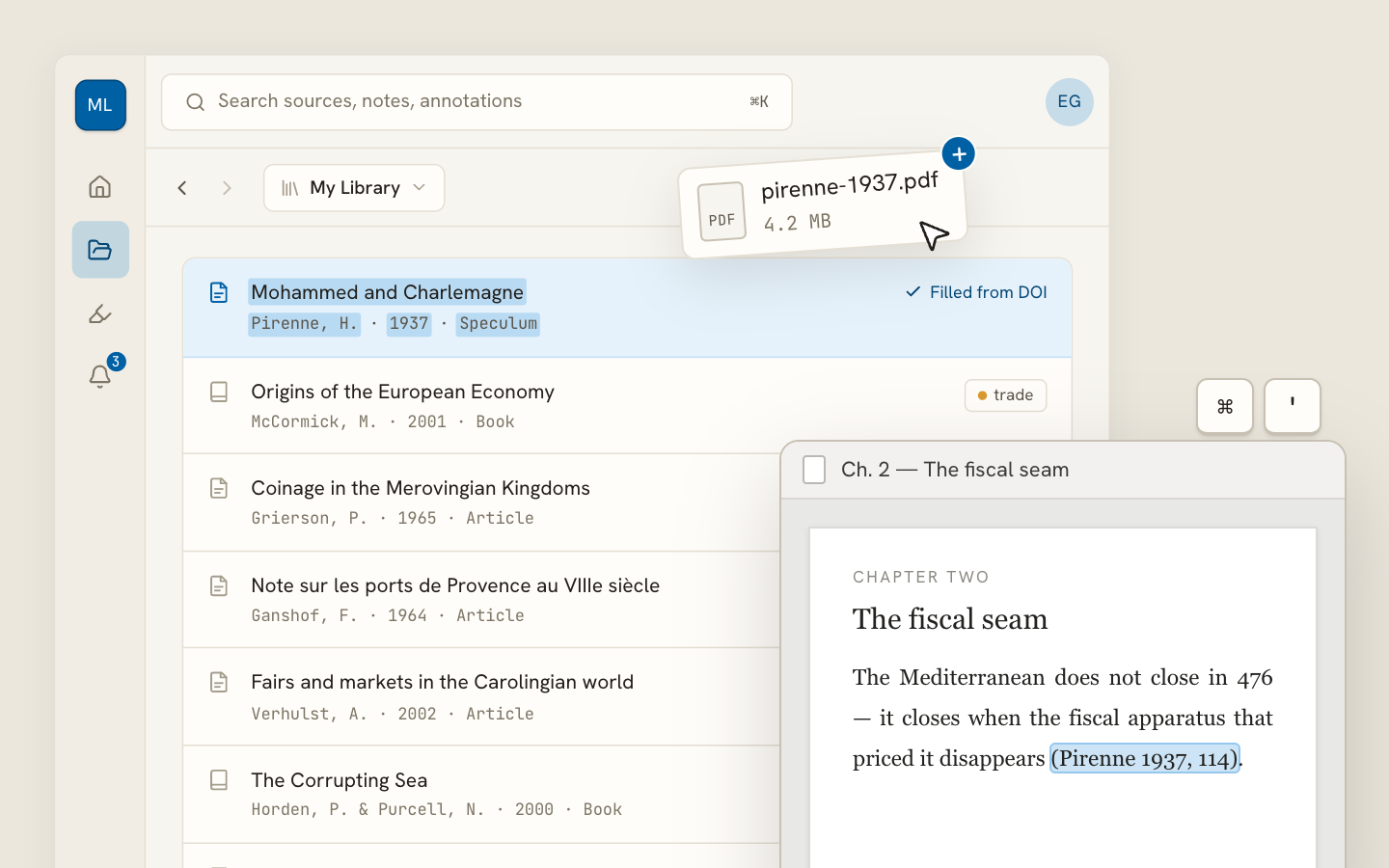
If you're tired of looking up publishers and edition numbers, Archivero can automatically generate MLA Works Cited entries for books — just add the book to your library and the citation is ready to copy.