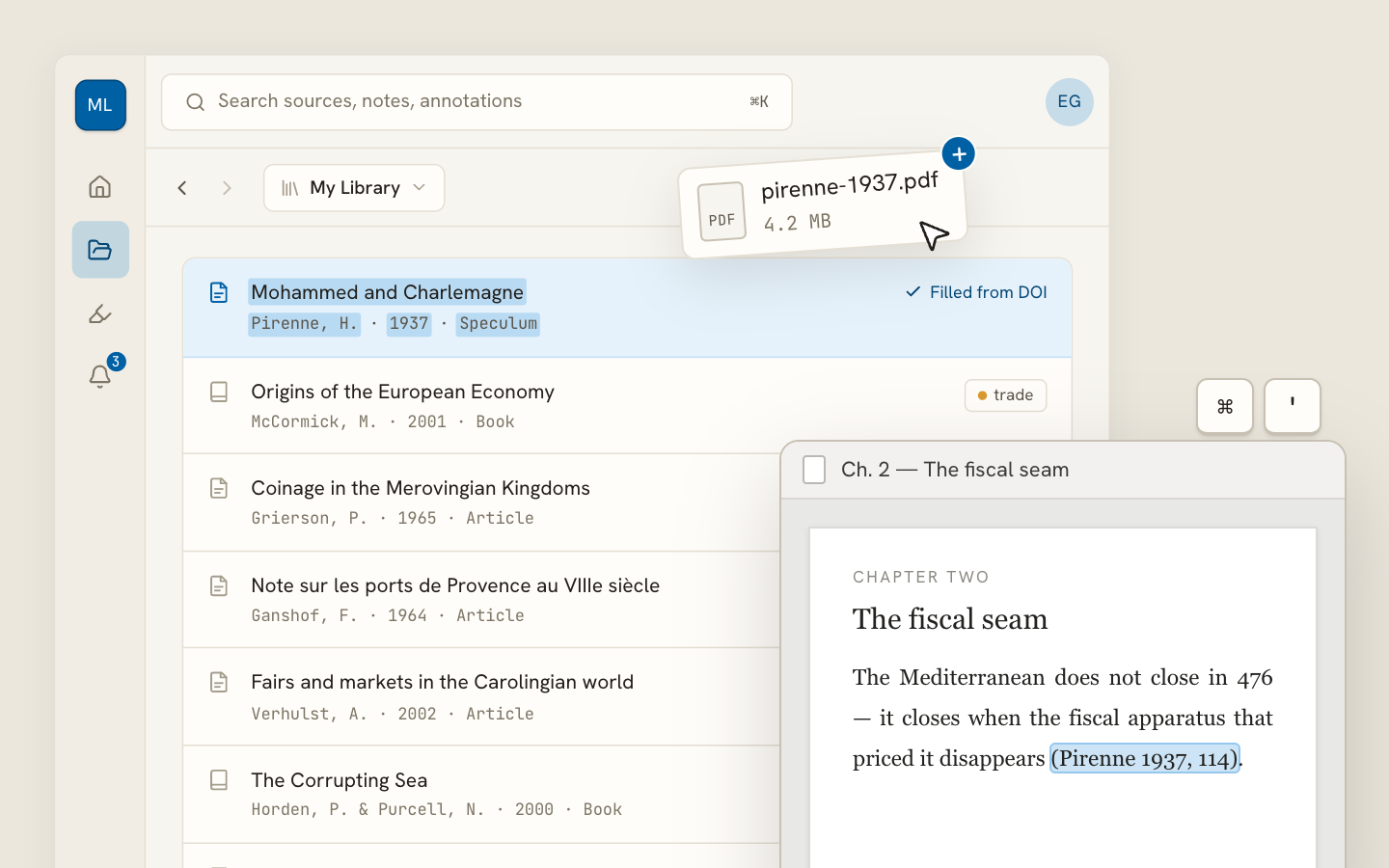
Paraphrasing — restating a source's ideas in your own words — is one of the most important skills in academic writing. In fact, most of your paper should consist of paraphrases and your own analysis, with direct quotations used sparingly for moments when the exact wording matters.
But paraphrasing in MLA comes with its own rules: you still need a citation, you usually need a page number, and the line between a good paraphrase and accidental plagiarism is thinner than most students realize. This guide covers how to paraphrase correctly, how to cite paraphrases, and how to avoid the most common pitfalls.
Paraphrasing vs. Quoting vs. Summarizing
These three techniques serve different purposes. Understanding when to use each one will improve your writing:
| Technique | What it does | When to use it |
|---|---|---|
| Paraphrasing | Restates a specific passage in your own words, roughly the same length as the original | When the idea matters but the exact wording doesn't |
| Quoting | Reproduces the source's exact words | When the phrasing itself is significant — literary analysis, key definitions, striking language |
| Summarizing | Condenses a larger argument or section into a brief overview | When you need to convey the gist of an entire chapter, article, or argument |
All three require a citation. The difference is in how you present the source material.
How to Cite a Paraphrase in MLA
A paraphrase needs an in-text citation just like a direct quotation does. MLA uses the author-page system:
With a Page Number
If the original source has page numbers, include the relevant page in your citation:
Original (Morrison, p. 3):
"124 was spiteful. Full of a baby's venom. The women in the house knew it and so did the children."
Paraphrase with parenthetical citation:
The house at 124 Bluestone Road had a malicious energy that everyone in the family could feel — a hostility connected to the spirit of a dead infant (Morrison 3).
Paraphrase with signal phrase:
Morrison establishes from the first sentence that the house at 124 Bluestone Road carries a malicious, infantile energy that no one in the family can ignore (3).
What to notice:
- The paraphrase uses completely different sentence structure and vocabulary
- The citation includes the author's last name and the page number (no comma between them)
- When a signal phrase names the author, only the page number goes in the parenthetical
Without a Page Number
Many sources — especially websites, online articles, and some e-books — don't have page numbers. In that case, cite the author's name alone:
Parenthetical:Social media has fundamentally changed how political movements organize and communicate with supporters (Tufekci).
Signal phrase:Tufekci argues that social media has fundamentally changed how political movements organize and communicate with supporters.
If the source numbers its paragraphs, you can use "par." or "pars.":
(Tufekci, par. 14)
Don't make up page numbers or use the page numbers of a PDF printout if they don't match the original source.
Multiple Paraphrases From the Same Source
If you paraphrase the same source multiple times in a paragraph, you don't need to cite it after every sentence — but you do need to make the boundaries clear. Place the citation at the end of the relevant passage, and use signal phrases to indicate when you're returning to the source:
Morrison's novel opens with a house that seems to have its own malevolent personality — 124 Bluestone Road is described as actively hostile, saturated with the energy of a dead child. The family members don't question the haunting; they simply live with it, each woman developing her own strategy for coping with the presence (3). Later, when Paul D arrives, his first act is to confront the spirit physically, an assertion of masculine authority that temporarily disrupts the balance the women had established (22).
Each shift to a new idea or page gets its own citation. The reader can tell which ideas come from the source and where your analysis begins.
What Makes a Good Paraphrase
A good paraphrase captures the source's meaning without borrowing its language or sentence structure. Here's what that looks like in practice:
Example: Good Paraphrase
Original (Wong 87):
"Stevens's narration is marked by what might be called emotional unreliability — an inability or unwillingness to acknowledge the depth of his own feelings, even as he recounts the relevant events with meticulous factual precision."
Good paraphrase:
Wong identifies a specific kind of unreliability in Stevens's narration: while the facts he reports are accurate, he consistently avoids confronting the emotions attached to those facts (87).
Why this works:
- The sentence structure is completely different from the original
- Key ideas are preserved (factual accuracy, emotional avoidance) but expressed with new vocabulary
- The paraphrase is roughly the same length as the original passage
- The citation gives credit to Wong
Example: Bad Paraphrase (Patchwriting)
Bad paraphrase:
Stevens's narration is characterized by emotional unreliability — he is unable to acknowledge the depth of his feelings, even though he recounts events with factual precision (Wong 87).
Why this fails:
- The sentence structure is almost identical to the original
- Key phrases are lifted directly: "emotional unreliability," "acknowledge the depth of his feelings," "factual precision"
- Only minor words have been swapped ("marked by" → "characterized by," "meticulous" → removed)
- This is patchwriting — superficial rewording that's too close to the original
How to Avoid Patchwriting
Patchwriting — replacing a word here and there while keeping the original sentence structure — is one of the most common forms of accidental plagiarism. Here's a practical process for avoiding it:
- Read the passage carefully. Make sure you understand the idea — not just the words.
- Close the source. Put it away, minimize the tab, cover the page.
- Write the idea from memory in your own words. If you can't explain it without looking, you don't understand it well enough yet.
- Compare your version to the original. Check for borrowed phrases, similar sentence structures, or identical sequences of ideas.
- Add the citation. Include the author and page number.
If you find that your paraphrase is still too close, try one of these strategies:
- Change the sentence structure. If the original is a complex sentence with a subordinate clause, try two simple sentences — or vice versa.
- Start from a different angle. If the original starts with the main claim, start with the evidence or the context.
- Use different vocabulary. Find genuine synonyms — but don't force obscure words. If the original says "children," don't write "juveniles" just to be different.
- Combine information from multiple sentences. Sometimes the best paraphrase synthesizes ideas from several sentences in the original into a single new sentence.
Signal Phrases for Paraphrases
Signal phrases are especially important for paraphrases because they help the reader distinguish your ideas from the source's ideas. Without a signal phrase, the boundary can be invisible.
Common Signal-Phrase Verbs for Paraphrases
| Verb | Best used when the source… |
|---|---|
| argues | makes a debatable claim |
| suggests | proposes something tentatively |
| notes | states a fact or observation |
| observes | describes something noticed |
| explains | breaks down a process or concept |
| contends | makes a strong or controversial argument |
| acknowledges | concedes a point |
| demonstrates | provides evidence for a claim |
| points out | draws attention to something |
| claims | asserts something (slightly skeptical tone) |
Signal-Phrase Examples
Wong argues that Stevens's narration is not factually unreliable but emotionally avoidant — he reports events accurately while refusing to confront the feelings they provoke (87).
As Tufekci observes, social media has given political movements the ability to scale rapidly, but this speed comes at the cost of organizational depth.
Morrison establishes in the opening paragraph that the house is not merely a setting but a character — a hostile, grieving presence (3).
Notice how the signal phrase names the author, the verb conveys the author's rhetorical stance (argues, observes, establishes), and the paraphrase flows naturally into your own sentence.
When to Paraphrase vs. When to Quote
As a general rule, paraphrase more often than you quote. Your paper should sound like you — with sources supporting, illustrating, and extending your ideas. Reserve direct quotations for moments when:
- The author's exact words are memorable, precise, or technically significant
- You're doing close reading or textual analysis
- The phrasing is so well-crafted that paraphrasing would lose its force
- You need to preserve the original wording for accuracy (definitions, policies, legal language)
Everything else should be paraphrased. A paper that strings together quotations — even well-cited ones — reads as a patchwork of other people's words rather than your own argument.
For more on when and how to use direct quotations, see How to Use Block Quotes in MLA Format.
Common Paraphrasing Mistakes
- Patchwriting. Swapping a few words while keeping the original sentence structure. This is the most common paraphrasing error and can constitute plagiarism even with a citation.
- Forgetting the citation. A paraphrase without a citation is plagiarism — even if the wording is entirely your own. You're still using someone else's idea.
- Dropping page numbers. If the source has page numbers, include them. Citing (Wong) when you paraphrased a specific passage from page 87 is incomplete.
- Blurring boundaries. If a paragraph mixes your ideas with paraphrased material, the reader needs to know where the source's ideas end and yours begin. Use signal phrases and citations to mark the transitions.
- Over-paraphrasing a single source. If you spend an entire paragraph (or several) paraphrasing one source, your paper starts to read like a summary rather than an argument. Balance sources with your own analysis.
- Using overly complex synonyms. Paraphrasing doesn't mean pulling out a thesaurus. Write naturally — the goal is to express the idea accurately, not to sound artificially different from the original.
What's Next
Now that you know how to paraphrase in MLA, explore related topics:
- How to Use Block Quotes in MLA Format — when you decide to quote directly instead
- MLA In-Text Citations — the complete guide to author-page citations
- Common MLA Format Mistakes — a full checklist to catch errors before submitting
If you're using Archivero to manage your research, you can highlight a passage in any source, take a note in your own words, and the citation is already attached — so your paraphrases always have the right page number and author information ready to go.