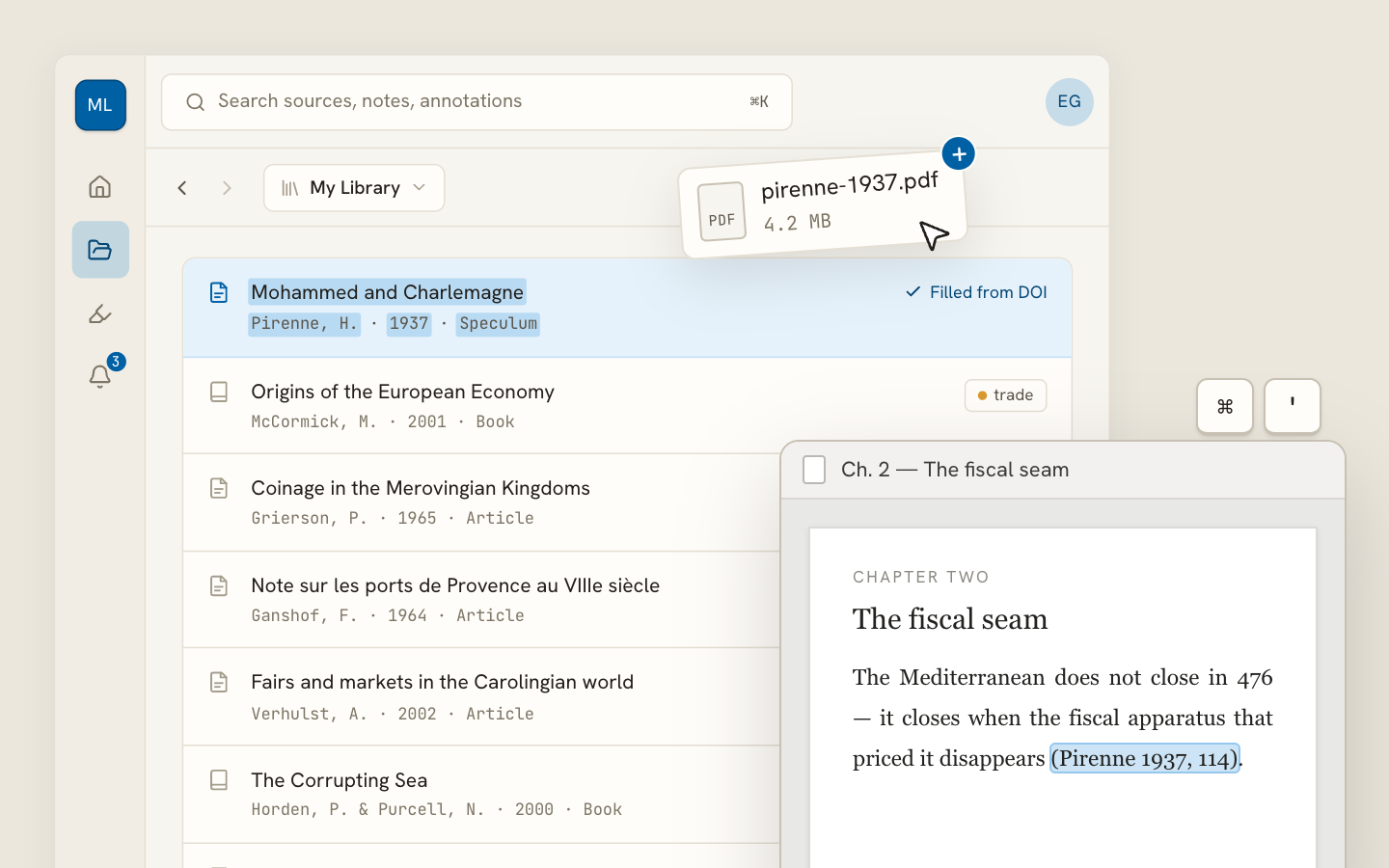
MLA in-text citations follow the author-page system — the author's last name and the page number, with no comma or "p." between them. Citations appear either in parentheses at the end of a sentence or as part of a signal phrase. Each in-text citation corresponds to a full entry on the Works Cited page.
Every time you use someone else's ideas, words, or findings in your paper — whether you're quoting directly, paraphrasing, or summarizing — you need an in-text citation to tell your reader where the information came from. In MLA, that means pointing the reader to the right entry on your Works Cited page and, when possible, to the specific location in the source.
MLA uses the author-page system. At its simplest, you mention the author's last name and the relevant page number. That's it. Everything else on this page is just variations on that one idea.
The Two Ways to Cite
You have two options for placing a citation in your writing. Both are equally acceptable — the choice depends on what reads more naturally in context.
Parenthetical Citations
The author and page number go inside parentheses, usually at the end of the sentence, before the period:
The narrative structure of the novel deliberately mirrors the fragmentation of memory (Morrison 36).
This format keeps the focus on the idea rather than the person. It works well when you're presenting evidence or supporting a point.
Signal-Phrase Citations
Here, the author's name becomes part of your sentence, and only the page number goes in parentheses:
Morrison uses fragmented chronology to mirror how memory actually works (36).
This format works well when you want to emphasize who is making the argument — for example, when comparing multiple scholars' positions or tracing the history of an idea.
Writing tip:Mix both formats throughout your paper. A paragraph packed with nothing but parenthetical citations at the end of every sentence feels clunky and repetitive. Signal-phrase citations add variety and make your prose more engaging.
Author-Page Number System — The Basics
MLA's in-text citation format is built on two pieces of information:
- The author's last name — to point the reader to the right Works Cited entry
- The page number — to point the reader to the exact location in the source
No comma between them. No "p." or "pp." before the number. Just the name and the number:
(García Márquez 104)
If you've already named the author in a signal phrase, only the page number goes in parentheses:
García Márquez describes Macondo as "a city of mirrors" (104).
What Counts as a "Page Number"
In most cases, you'll use the page number printed on the source. But MLA allows other locators when page numbers aren't available:
| Source Type | Locator | Example |
|---|---|---|
| Printed book or article | Page number | (Morrison 36) |
| Numbered paragraphs | par. or pars. | (Smith, par. 12) |
| Sections | sec. | (Johnson, sec. 3) |
| Chapters | ch. | (Lee, ch. 7) |
| Time-stamped media | Timestamp | (Obama 00:14:32) |
| Lines of poetry or verse | Line(s) | (Keats, line 14) |
If the source has no page numbers and no other numbered divisions, simply use the author's name alone:
(Sullivan)
Page Numbers, Paragraph Numbers, and Timestamps
Page Numbers
For sources with page numbers, always include them — even when paraphrasing. Page numbers allow your reader to locate the specific passage you're referencing:
The novel redefines the boundaries of historical fiction (Rushdie 211).
For a range of pages, use an en dash:
(Greenblatt 97–116)
No Page Numbers
Many digital sources — websites, e-books without fixed pages, online articles — don't have page numbers. That's fine. If the source doesn't have page numbers or any other numbered divisions, cite the author's name only:
The report emphasizes the growing gap in digital literacy (Warschauer).
If the source numbers its paragraphs, use "par." after a comma:
(Chen, par. 15)
Timestamps
For videos, podcasts, or other time-based media, use the timestamp in hours:minutes:seconds format:
(Adichie 00:07:22)
How Many Authors?
The number of authors on a source determines how you format the in-text citation.
One Author
Use the author's last name:
(Woolf 87)
Woolf argues that "a woman must have money and a room of her own" (4).
Two Authors
Include both last names, joined by "and":
(Gilbert and Gubar 73)
Gilbert and Gubar describe the anxiety of female authorship (73).
Note: MLA uses "and" (not an ampersand) in both parenthetical and signal-phrase citations. This differs from APA, which uses "&" in parenthetical citations.
Three or More Authors
Use the first author's last name followed by "et al." (Latin for "and others"):
(Rabinowitz et al. 112)
Rabinowitz et al. challenge the traditional reading of the novel (112).
"et al." is not italicized and has a period after "al."
Multiple Works by the Same Author
If your Works Cited page includes more than one work by the same author, the reader won't know which one you mean from the last name alone. Add a shortened version of the title to distinguish them:
(Morrison, Beloved 36)
(Morrison, Song of Solomon 7)
Italicize the shortened title if the full title is italicized (books, films). Use quotation marks if the original title is in quotation marks (articles, poems, short stories):
(Morrison, "Rootedness" 342)
Keep the shortened title as brief as possible while remaining unambiguous — usually the first noun phrase is enough.
Two or More Sources in One Parenthetical
If you need to cite multiple sources to support a single point, list them in one set of parentheses, separated by semicolons:
Several scholars have noted the unreliability of the narrator in this period (Brooks 45; Booth 156; Phelan 87).
Arrange the sources in alphabetical order by author, or in whatever order is most relevant to your argument.
Corporate and Organizational Authors
When the author of a source is an organization rather than a person, use the organization's name in place of the author's last name:
(United Nations 12)
The United Nations reports that global literacy rates have improved steadily (12).
If the name is long, you can abbreviate it in subsequent citations — but introduce the abbreviation first:
First citation: (Modern Language Association [MLA] 45)
Subsequent citations: (MLA 45)
Works With No Author
When a source has no identifiable author, use a shortened version of the title in place of the author's name:
("Endangered Species" 12)
(Oxford English Dictionary)
Use italics or quotation marks as appropriate for the title type. For more detail, see How to Cite a Source With No Author.
Indirect Sources (Qtd. in)
Sometimes you'll find a quote or idea in one source that was originally said or written by someone else. When you can't locate the original source, use "qtd. in" (quoted in):
Faulkner described the past as "never dead" (qtd. in Cowley 141).
On the Works Cited page, list only the source you actually read (Cowley, in this case), not the original speaker. Whenever possible, track down the original source and cite it directly.
Punctuation and Placement
Getting the punctuation right is one of the trickiest parts of MLA in-text citations. Here are the rules:
Short Quotations
For quotations shorter than four lines of prose, place the parenthetical citation after the closing quotation mark and before the period:
Woolf famously argued that "a woman must have money and a room of her own if she is to write fiction" (4).
Block Quotations
For quotations of four or more lines of prose (or three or more lines of verse), set the quote as a block — indented 0.5 inches from the left margin, with no quotation marks. The parenthetical citation goes after the final period:
Woolf opens her argument by laying out its terms directly:
But, you may say, we asked you to speak about women and fiction — what has that got to do with a room of one's own? I will try to explain. (3)
For more on block quote formatting, see How to Use Block Quotes in MLA Format.
Signal-Phrase Citations
When you use a signal phrase, the period always comes after the page-number parenthetical:
Morrison writes that memory "is never in the past" (36).
Common In-Text Citation Mistakes
These are the errors we see most often:
- Adding a comma between author and page number. MLA uses no punctuation between them: (Morrison 36), not (Morrison, 36). The comma is an APA convention.
- Using "p." or "pp." before page numbers. MLA omits these: (Morrison 36), not (Morrison, p. 36). Again, that's APA.
- Placing the period before the parenthetical. The period goes after the closing parenthesis for short quotations: …"fiction" (4). not …"fiction." (4)
- Forgetting page numbers when paraphrasing. If the source has page numbers, include them even when you're paraphrasing — not just when quoting directly.
- Using et al. for two-author works. Only use et al. for three or more authors. Two-author works always list both names.
- Italicizing et al. It's not italicized.
- Citing a source that's not on the Works Cited page. Every in-text citation must point to a corresponding Works Cited entry, and vice versa.
What's Next
Now that you know how to handle in-text citations, explore:
- MLA General Format — make sure your paper's layout is correct
- MLA Works Cited — learn how to build the entries that your in-text citations point to
If you're tired of double-checking author names and page numbers, Archivero can automatically generate properly formatted MLA citations for any source in your library — just save the source and the citation is ready to copy.