Archivero is in early access — your sources, PDFs and citations in one library.Request early access →
Archivero/guides/
APAMLAHarvardThesis writing
Subscribe
Archivero/guides/Request early access →

Guides

APA styleMLA styleHarvard referencingThesis writing

Compare

APA 6th vs 7thMLA 8th vs 9thHarvard vs APAThesis vs dissertation

Product

FeaturesEarly access

Resources

DocsCheat sheetsNewsletter

Company

ContactStatus ↗
© 2025–2026 Ernesto F. GonzálezGuidesDocsContactPrivacyTerms
Guides/Citations/MLA Citation Style

How to Cite an Encyclopedia or Dictionary in MLA Format

MLA 9th edition formats for entries in print and online encyclopedias, dictionaries, and reference works — including Wikipedia.

6 min readMLA

Key Takeaways

  • The entry title goes in quotation marks; the encyclopedia or dictionary title is italicized:
    • "Postcolonialism." Encyclopædia Britannica.
  • If the entry has a named author, list them first. If not, start with the entry title.
  • For print entries, include the edition and volume number if applicable:
    • "Romanticism." The Oxford Encyclopedia of British Literature, edited by David Scott Kastan, vol. 4, Oxford UP, 2006, pp. 384–92.
  • For online entries, include the URL and an access date if the content is regularly updated:
    • "Existentialism." Stanford Encyclopedia of Philosophy, 2023, https://plato.stanford.edu/entries/existentialism/. Accessed 1 Mar. 2026.
  • Wikipedia is cited like any online encyclopedia entry — with the article title, Wikipedia, the date of the last revision, and the URL.
  • Dictionary definitions use the word as the entry title, with the dictionary as the container:
    • "Empathy." Merriam-Webster, 2026, https://www.merriam-webster.com/dictionary/empathy.
  • In-text citations use the author (if known) or a shortened title:
    • (Kastan 386) or ("Postcolonialism")

On this page

1 of 22
Key TakeawaysPrint Encyclopedia Entry — With an AuthorPrint Encyclopedia Entry — Without an AuthorOnline Encyclopedia EntryEncyclopædia BritannicaStanford Encyclopedia of PhilosophyWikipediaFormatHow to Find the Revision DateA Note on Wikipedia in Academic WritingPrint Dictionary EntryStandard DictionarySpecialized DictionaryOnline Dictionary EntryMerriam-WebsterOxford English Dictionary (OED)Specialized Reference WorksLiterary ReferencePhilosophical ReferenceIn-Text Citation Quick ReferenceCommon MistakesWhat's Next
All MLA guides →

Encyclopedia and dictionary entries are reference works — concise, authoritative summaries on a specific topic or term. MLA cites them like any other short work inside a larger container: the entry title goes in quotation marks and the reference work title is italicized. The format shifts slightly depending on whether the entry has a named author and whether you accessed it in print or online.

Reference works are common sources in introductory paragraphs, literature reviews, and definitional arguments. Students cite them frequently but often format them incorrectly — especially Wikipedia, which has its own quirks. This guide covers every scenario you're likely to encounter.

Print Encyclopedia Entry — With an Author

Some encyclopedia entries are signed by a contributor. When an author's name appears at the end of the entry, list them as the author:

Works Cited:

Kastan, David Scott. "Romanticism." The Oxford Encyclopedia of British Literature, edited by David Scott Kastan, vol. 4, Oxford UP, 2006, pp. 384–92.

In-text citation:

(Kastan 386)

What to notice:

  • The entry title ("Romanticism") is in quotation marks
  • The encyclopedia title is italicized
  • The editor, volume, publisher, year, and page range are included
  • When the author and editor are the same person, list them in both positions

Print Encyclopedia Entry — Without an Author

If no author is identified, begin with the entry title:

Works Cited:

"Rhetoric." The New Princeton Encyclopedia of Poetry and Poetics, edited by Alex Preminger and T. V. F. Brogan, 3rd ed., Princeton UP, 1993, pp. 1044–58.

In-text citation:

("Rhetoric" 1046)

Online Encyclopedia Entry

Online encyclopedias follow the same pattern but add the URL. If the content is regularly updated (as with most online reference works), include an access date.

Encyclopædia Britannica

Works Cited:

"Postcolonialism." Encyclopædia Britannica, 15 Aug. 2024, https://www.britannica.com/topic/postcolonialism. Accessed 1 Mar. 2026.

In-text citation:

("Postcolonialism")

Stanford Encyclopedia of Philosophy

Works Cited:

Crowell, Steven. "Existentialism." Stanford Encyclopedia of Philosophy, edited by Edward N. Zalta, 2023, https://plato.stanford.edu/entries/existentialism/. Accessed 1 Mar. 2026.

In-text citation:

(Crowell)

When to include an access date: MLA 9th edition recommends including an access date when the source content may change over time. Online encyclopedias are frequently updated, so adding "Accessed [date]" is good practice.

Wikipedia

Wikipedia is an online encyclopedia and follows the standard format for online reference works. MLA does not prohibit citing Wikipedia, but many instructors do — always check your assignment guidelines.

Format

Works Cited:

"Narrative." Wikipedia, Wikimedia Foundation, 28 Feb. 2026, https://en.wikipedia.org/wiki/Narrative. Accessed 1 Mar. 2026.

In-text citation:

("Narrative")

What to notice:

  • The article title is in quotation marks
  • Wikipedia is italicized as the container
  • Wikimedia Foundation is the publisher
  • The date is the last revision date of the article (visible in the article's history)
  • An access date is included because Wikipedia content changes frequently

How to Find the Revision Date

  1. Go to the Wikipedia article
  2. Click the "View history" tab at the top
  3. The most recent date at the top of the list is the article's last revision date

A Note on Wikipedia in Academic Writing

While MLA provides a format for Wikipedia, it's best used as a starting point rather than a primary source in academic papers. Wikipedia is useful for:

  • Getting an overview of a topic before diving into scholarly sources
  • Finding citations in the reference section that point to published research
  • Defining basic terms in informal or introductory contexts

For a formal paper, prefer peer-reviewed sources. If you must cite Wikipedia, be transparent about it.

Print Dictionary Entry

Dictionary citations use the defined word as the entry title:

Standard Dictionary

Works Cited:

"Empathy." The American Heritage Dictionary of the English Language, 5th ed., Houghton Mifflin Harcourt, 2011.

In-text citation:

("Empathy")

You don't need page numbers for alphabetically arranged reference works — the reader can find the entry by looking up the word.

Specialized Dictionary

Works Cited:

"Free Indirect Discourse." A Dictionary of Narratology, by Gerald Prince, 2nd ed., U of Nebraska P, 2003.

In-text citation:

(Prince)

When the dictionary has a named author, use them as the author.

Online Dictionary Entry

Merriam-Webster

Works Cited:

"Empathy." Merriam-Webster, 2026, https://www.merriam-webster.com/dictionary/empathy. Accessed 1 Mar. 2026.

In-text citation:

("Empathy")

Oxford English Dictionary (OED)

Works Cited:

"Sublime, adj." Oxford English Dictionary, Oxford UP, 2024, https://www.oed.com/dictionary/sublime_adj. Accessed 1 Mar. 2026.

In-text citation:

("Sublime")

What to notice:

  • For the OED, include the part of speech abbreviation ("adj.," "n.," "v.") if the word has multiple entries
  • The OED is a subscription database, so access may be through your library

Specialized Reference Works

Subject-specific encyclopedias follow the same format:

Literary Reference

Works Cited:

Abrams, M. H. "Irony." A Glossary of Literary Terms, 12th ed., Cengage Learning, 2024, pp. 184–89.

In-text citation:

(Abrams 185)

Philosophical Reference

Works Cited:

Audi, Robert, editor. "Epistemology." The Cambridge Dictionary of Philosophy, 3rd ed., Cambridge UP, 2015, pp. 325–31.

In-text citation:

("Epistemology" 326)

In-Text Citation Quick Reference

Source TypeWorks Cited Starts WithIn-Text Citation
Encyclopedia (with author)Works Cited Starts WithKastan, David Scott.In-Text Citation(Kastan 386)
Encyclopedia (no author)Works Cited Starts With"Rhetoric."In-Text Citation("Rhetoric" 1046)
Online encyclopediaWorks Cited Starts With"Postcolonialism."In-Text Citation("Postcolonialism")
Stanford EncyclopediaWorks Cited Starts WithCrowell, Steven.In-Text Citation(Crowell)
WikipediaWorks Cited Starts With"Narrative."In-Text Citation("Narrative")
Print dictionaryWorks Cited Starts With"Empathy."In-Text Citation("Empathy")
Online dictionaryWorks Cited Starts With"Empathy."In-Text Citation("Empathy")
OEDWorks Cited Starts With"Sublime, adj."In-Text Citation("Sublime")
Specialized referenceWorks Cited Starts WithAbrams, M. H.In-Text Citation(Abrams 185)

Common Mistakes

  1. Omitting the access date for online reference works. Since encyclopedias and dictionaries are regularly updated, include an access date so readers know which version you consulted.
  2. Italicizing the entry title. The entry title goes in quotation marks — only the encyclopedia or dictionary title gets italics.
  3. Forgetting the publisher for Wikipedia. Wikipedia's publisher is Wikimedia Foundation — include it in the citation.
  4. Using the wrong date for Wikipedia. Use the article's last revision date from the View History tab, not the date you accessed it (that goes in "Accessed [date]").
  5. Including page numbers for alphabetically arranged works. If the reference work is arranged alphabetically (like a standard dictionary), page numbers are unnecessary — the reader can find the entry by the word.
  6. Citing a dictionary definition without context. If you're using a definition to support an argument, explain why that particular definition matters — don't just drop it in.

What's Next

Now that you know how to cite encyclopedias and dictionaries, explore related guides:

  • How to Cite a Source With No Author in MLA — many reference entries lack named authors
  • How to Cite a Website in MLA Format — for web-based reference sources
  • MLA Works Cited Page — the complete guide to building Works Cited entries

Archivero can simplify reference work citations — save a dictionary or encyclopedia page to your library, and the Works Cited entry is generated automatically with the entry title, source, and access information.
All MLA guides →
← PreviousHow to Cite an Interview in MLA FormatNext →How to Cite a Dissertation or Thesis in MLA Format

More on MLA style

The standard in literature, the humanities and cultural studies. The author–page system, Works Cited entries and the 9th edition's container model.

View all 27 guides →
10 sections·5 min readMLAHow to Cite a Dissertation or Thesis in MLA Format9 sections·8 min readMLAMLA Format Paper12 sections·8 min readMLAMLA In-Text Citations9 sections·9 min readMLAMLA Works Cited Page

Your sources, PDFs and citations in one library

  • Import a Zotero, Mendeley or EndNote library — or a folder of PDFs
  • Highlight and annotate without leaving the source
  • Cite in any CSL style as you write, with one shared library for your lab
Request early accessSee the product →
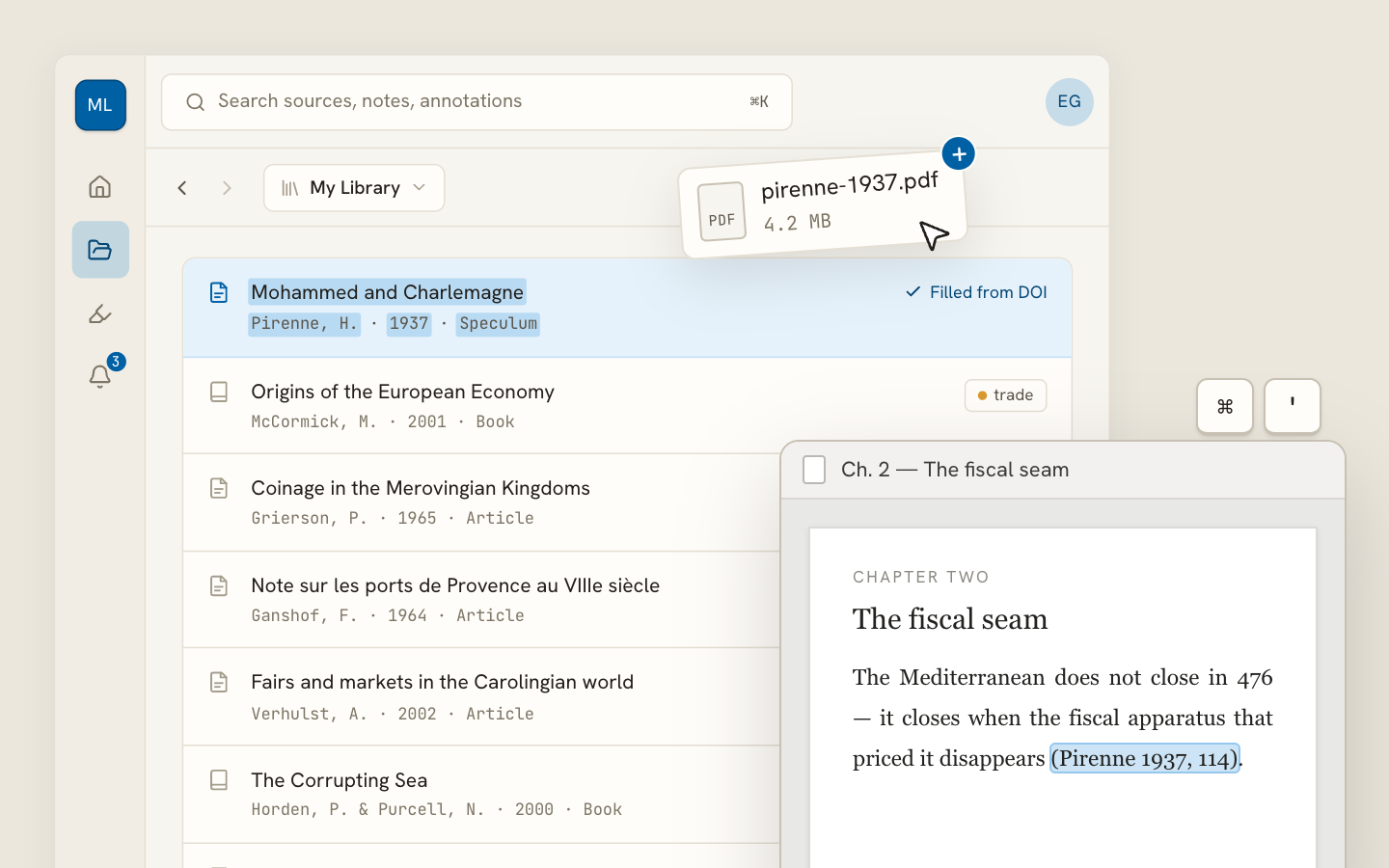
Archivero library view with a source list and an open PDF

Your weekly research workflow, in one email

One tested workflow, three links, no filler — every Tuesday.

Unsubscribe in one click. We never share your address.

Guides/Citations/MLA Citation Style

How to Cite an Encyclopedia or Dictionary in MLA Format

MLA 9th edition formats for entries in print and online encyclopedias, dictionaries, and reference works — including Wikipedia.

6 min readMLA

Key Takeaways

  • The entry title goes in quotation marks; the encyclopedia or dictionary title is italicized:
    • "Postcolonialism." Encyclopædia Britannica.
  • If the entry has a named author, list them first. If not, start with the entry title.
  • For print entries, include the edition and volume number if applicable:
    • "Romanticism." The Oxford Encyclopedia of British Literature, edited by David Scott Kastan, vol. 4, Oxford UP, 2006, pp. 384–92.
  • For online entries, include the URL and an access date if the content is regularly updated:
    • "Existentialism." Stanford Encyclopedia of Philosophy, 2023, https://plato.stanford.edu/entries/existentialism/. Accessed 1 Mar. 2026.
  • Wikipedia is cited like any online encyclopedia entry — with the article title, Wikipedia, the date of the last revision, and the URL.
  • Dictionary definitions use the word as the entry title, with the dictionary as the container:
    • "Empathy." Merriam-Webster, 2026, https://www.merriam-webster.com/dictionary/empathy.
  • In-text citations use the author (if known) or a shortened title:
    • (Kastan 386) or ("Postcolonialism")

On this page

1 of 22
Key TakeawaysPrint Encyclopedia Entry — With an AuthorPrint Encyclopedia Entry — Without an AuthorOnline Encyclopedia EntryEncyclopædia BritannicaStanford Encyclopedia of PhilosophyWikipediaFormatHow to Find the Revision DateA Note on Wikipedia in Academic WritingPrint Dictionary EntryStandard DictionarySpecialized DictionaryOnline Dictionary EntryMerriam-WebsterOxford English Dictionary (OED)Specialized Reference WorksLiterary ReferencePhilosophical ReferenceIn-Text Citation Quick ReferenceCommon MistakesWhat's Next
All MLA guides →

Encyclopedia and dictionary entries are reference works — concise, authoritative summaries on a specific topic or term. MLA cites them like any other short work inside a larger container: the entry title goes in quotation marks and the reference work title is italicized. The format shifts slightly depending on whether the entry has a named author and whether you accessed it in print or online.

Reference works are common sources in introductory paragraphs, literature reviews, and definitional arguments. Students cite them frequently but often format them incorrectly — especially Wikipedia, which has its own quirks. This guide covers every scenario you're likely to encounter.

Print Encyclopedia Entry — With an Author

Some encyclopedia entries are signed by a contributor. When an author's name appears at the end of the entry, list them as the author:

Works Cited:

Kastan, David Scott. "Romanticism." The Oxford Encyclopedia of British Literature, edited by David Scott Kastan, vol. 4, Oxford UP, 2006, pp. 384–92.

In-text citation:

(Kastan 386)

What to notice:

  • The entry title ("Romanticism") is in quotation marks
  • The encyclopedia title is italicized
  • The editor, volume, publisher, year, and page range are included
  • When the author and editor are the same person, list them in both positions

Print Encyclopedia Entry — Without an Author

If no author is identified, begin with the entry title:

Works Cited:

"Rhetoric." The New Princeton Encyclopedia of Poetry and Poetics, edited by Alex Preminger and T. V. F. Brogan, 3rd ed., Princeton UP, 1993, pp. 1044–58.

In-text citation:

("Rhetoric" 1046)

Online Encyclopedia Entry

Online encyclopedias follow the same pattern but add the URL. If the content is regularly updated (as with most online reference works), include an access date.

Encyclopædia Britannica

Works Cited:

"Postcolonialism." Encyclopædia Britannica, 15 Aug. 2024, https://www.britannica.com/topic/postcolonialism. Accessed 1 Mar. 2026.

In-text citation:

("Postcolonialism")

Stanford Encyclopedia of Philosophy

Works Cited:

Crowell, Steven. "Existentialism." Stanford Encyclopedia of Philosophy, edited by Edward N. Zalta, 2023, https://plato.stanford.edu/entries/existentialism/. Accessed 1 Mar. 2026.

In-text citation:

(Crowell)

When to include an access date: MLA 9th edition recommends including an access date when the source content may change over time. Online encyclopedias are frequently updated, so adding "Accessed [date]" is good practice.

Wikipedia

Wikipedia is an online encyclopedia and follows the standard format for online reference works. MLA does not prohibit citing Wikipedia, but many instructors do — always check your assignment guidelines.

Format

Works Cited:

"Narrative." Wikipedia, Wikimedia Foundation, 28 Feb. 2026, https://en.wikipedia.org/wiki/Narrative. Accessed 1 Mar. 2026.

In-text citation:

("Narrative")

What to notice:

  • The article title is in quotation marks
  • Wikipedia is italicized as the container
  • Wikimedia Foundation is the publisher
  • The date is the last revision date of the article (visible in the article's history)
  • An access date is included because Wikipedia content changes frequently

How to Find the Revision Date

  1. Go to the Wikipedia article
  2. Click the "View history" tab at the top
  3. The most recent date at the top of the list is the article's last revision date

A Note on Wikipedia in Academic Writing

While MLA provides a format for Wikipedia, it's best used as a starting point rather than a primary source in academic papers. Wikipedia is useful for:

  • Getting an overview of a topic before diving into scholarly sources
  • Finding citations in the reference section that point to published research
  • Defining basic terms in informal or introductory contexts

For a formal paper, prefer peer-reviewed sources. If you must cite Wikipedia, be transparent about it.

Print Dictionary Entry

Dictionary citations use the defined word as the entry title:

Standard Dictionary

Works Cited:

"Empathy." The American Heritage Dictionary of the English Language, 5th ed., Houghton Mifflin Harcourt, 2011.

In-text citation:

("Empathy")

You don't need page numbers for alphabetically arranged reference works — the reader can find the entry by looking up the word.

Specialized Dictionary

Works Cited:

"Free Indirect Discourse." A Dictionary of Narratology, by Gerald Prince, 2nd ed., U of Nebraska P, 2003.

In-text citation:

(Prince)

When the dictionary has a named author, use them as the author.

Online Dictionary Entry

Merriam-Webster

Works Cited:

"Empathy." Merriam-Webster, 2026, https://www.merriam-webster.com/dictionary/empathy. Accessed 1 Mar. 2026.

In-text citation:

("Empathy")

Oxford English Dictionary (OED)

Works Cited:

"Sublime, adj." Oxford English Dictionary, Oxford UP, 2024, https://www.oed.com/dictionary/sublime_adj. Accessed 1 Mar. 2026.

In-text citation:

("Sublime")

What to notice:

  • For the OED, include the part of speech abbreviation ("adj.," "n.," "v.") if the word has multiple entries
  • The OED is a subscription database, so access may be through your library

Specialized Reference Works

Subject-specific encyclopedias follow the same format:

Literary Reference

Works Cited:

Abrams, M. H. "Irony." A Glossary of Literary Terms, 12th ed., Cengage Learning, 2024, pp. 184–89.

In-text citation:

(Abrams 185)

Philosophical Reference

Works Cited:

Audi, Robert, editor. "Epistemology." The Cambridge Dictionary of Philosophy, 3rd ed., Cambridge UP, 2015, pp. 325–31.

In-text citation:

("Epistemology" 326)

In-Text Citation Quick Reference

Source TypeWorks Cited Starts WithIn-Text Citation
Encyclopedia (with author)Works Cited Starts WithKastan, David Scott.In-Text Citation(Kastan 386)
Encyclopedia (no author)Works Cited Starts With"Rhetoric."In-Text Citation("Rhetoric" 1046)
Online encyclopediaWorks Cited Starts With"Postcolonialism."In-Text Citation("Postcolonialism")
Stanford EncyclopediaWorks Cited Starts WithCrowell, Steven.In-Text Citation(Crowell)
WikipediaWorks Cited Starts With"Narrative."In-Text Citation("Narrative")
Print dictionaryWorks Cited Starts With"Empathy."In-Text Citation("Empathy")
Online dictionaryWorks Cited Starts With"Empathy."In-Text Citation("Empathy")
OEDWorks Cited Starts With"Sublime, adj."In-Text Citation("Sublime")
Specialized referenceWorks Cited Starts WithAbrams, M. H.In-Text Citation(Abrams 185)

Common Mistakes

  1. Omitting the access date for online reference works. Since encyclopedias and dictionaries are regularly updated, include an access date so readers know which version you consulted.
  2. Italicizing the entry title. The entry title goes in quotation marks — only the encyclopedia or dictionary title gets italics.
  3. Forgetting the publisher for Wikipedia. Wikipedia's publisher is Wikimedia Foundation — include it in the citation.
  4. Using the wrong date for Wikipedia. Use the article's last revision date from the View History tab, not the date you accessed it (that goes in "Accessed [date]").
  5. Including page numbers for alphabetically arranged works. If the reference work is arranged alphabetically (like a standard dictionary), page numbers are unnecessary — the reader can find the entry by the word.
  6. Citing a dictionary definition without context. If you're using a definition to support an argument, explain why that particular definition matters — don't just drop it in.

What's Next

Now that you know how to cite encyclopedias and dictionaries, explore related guides:

  • How to Cite a Source With No Author in MLA — many reference entries lack named authors
  • How to Cite a Website in MLA Format — for web-based reference sources
  • MLA Works Cited Page — the complete guide to building Works Cited entries

Archivero can simplify reference work citations — save a dictionary or encyclopedia page to your library, and the Works Cited entry is generated automatically with the entry title, source, and access information.

All MLA guides →
← PreviousHow to Cite an Interview in MLA FormatNext →How to Cite a Dissertation or Thesis in MLA Format

More on MLA style

The standard in literature, the humanities and cultural studies. The author–page system, Works Cited entries and the 9th edition's container model.

View all 27 guides →
10 sections·5 min readMLAHow to Cite a Dissertation or Thesis in MLA Format9 sections·8 min readMLAMLA Format Paper12 sections·8 min readMLAMLA In-Text Citations9 sections·9 min readMLAMLA Works Cited Page

Your sources, PDFs and citations in one library

  • Import a Zotero, Mendeley or EndNote library — or a folder of PDFs
  • Highlight and annotate without leaving the source
  • Cite in any CSL style as you write, with one shared library for your lab
Request early accessSee the product →
Archivero library view with a source list and an open PDF

Your weekly research workflow, in one email

One tested workflow, three links, no filler — every Tuesday.

Unsubscribe in one click. We never share your address.