Archivero is in early access — your sources, PDFs and citations in one library.Request early access →
Archivero/guides/
APAMLAHarvardThesis writing
Subscribe
Archivero/guides/Request early access →

Guides

APA styleMLA styleHarvard referencingThesis writing

Compare

APA 6th vs 7thMLA 8th vs 9thHarvard vs APAThesis vs dissertation

Product

FeaturesEarly access

Resources

DocsCheat sheetsNewsletter

Company

ContactStatus ↗
© 2025–2026 Ernesto F. GonzálezGuidesDocsContactPrivacyTerms
Guides/Citations/MLA Citation Style

How to Cite an Interview in MLA Format

MLA 9th edition formats for published interviews, broadcast interviews, and personal interviews you conducted yourself.

5 min readMLA

Key Takeaways

  • The interviewee is the author of an interview — the person answering the questions, not the interviewer.
  • Published interviews (in a book, magazine, or website) use the container system — the interview title in quotation marks, the publication in italics:
    • Morrison, Toni. "The Art of Fiction No. 134." The Paris Review, no. 128, 1993.
  • Broadcast interviews (TV, radio, podcast) list the interviewee as author, followed by "Interview by" and the interviewer's name:
    • Obama, Barack. Interview by David Letterman. My Next Guest Needs No Introduction. Netflix, 12 Jan. 2018.
  • Personal interviews you conducted use a simplified format — interviewee name, type of interview, and date:
    • Nakamura, Kenji. Personal interview. 3 Mar. 2026.
  • Personal interviews appear on the Works Cited page but may also be labeled as "Telephone interview," "Email interview," or "Zoom interview."
  • In-text citations use the interviewee's last name:
    • (Morrison) or (Nakamura)

On this page

1 of 19
Key TakeawaysPublished Interview — In a Book or MagazineInterview in a Magazine or JournalInterview in a BookInterview on a WebsiteBroadcast Interview — TV, Radio, PodcastTelevision InterviewRadio InterviewPodcast InterviewPersonal InterviewBasic FormatIn-Person InterviewTelephone InterviewEmail InterviewVideo Call Interview (Zoom, Teams, etc.)Who Is the "Author" of an Interview?In-Text Citation Quick ReferenceCommon MistakesWhat's Next
All MLA guides →

Interviews are primary sources — they capture someone's words, perspectives, and experiences directly. MLA 9th edition handles three types of interviews: published (in print or online), broadcast (TV, radio, podcast), and personal (interviews you conducted yourself). The citation format changes depending on how the interview was published and who the "author" is.

Whether you're citing a literary interview from The Paris Review, a political interview from a podcast, or a conversation you conducted yourself for a research project, MLA provides a consistent format. The key decision is always: how was the interview published — or was it not published at all?

Published Interview — In a Book or Magazine

When an interview appears in a print publication, the interviewee is the author and the interview title is the work. The publication is the container.

Interview in a Magazine or Journal

Works Cited:

Morrison, Toni. "The Art of Fiction No. 134." Interview by Elissa Schappell. The Paris Review, no. 128, 1993, pp. 82–125.

In-text citation:

(Morrison 94)

What to notice:

  • Morrison (the interviewee) is the author
  • The interview title is in quotation marks
  • "Interview by Elissa Schappell" credits the interviewer but doesn't make them the author
  • The Paris Review is the container

Interview in a Book

If the interview appears as a chapter in a collected volume:

Works Cited:

Baldwin, James. "Notes for a Hypothetical Novel." Interview by Studs Terkel. James Baldwin: The Last Interview and Other Conversations, Melville House, 2014, pp. 3–22.

In-text citation:

(Baldwin 10)

Interview on a Website

Works Cited:

Adichie, Chimamanda Ngozi. "Chimamanda Ngozi Adichie on Her New Novel and the Importance of Nuance." Interview by Kira Goldenberg. Literary Hub, 14 Mar. 2025, https://lithub.com/adichie-interview-2025.

In-text citation:

(Adichie)

Broadcast Interview — TV, Radio, Podcast

For interviews that aired on television, radio, or in a podcast episode, the interviewee remains the author and the show is the container.

Television Interview

Works Cited:

Obama, Barack. Interview by David Letterman. My Next Guest Needs No Introduction with David Letterman, season 1, episode 1, Netflix, 12 Jan. 2018.

In-text citation:

(Obama)

Radio Interview

Works Cited:

Coates, Ta-Nehisi. Interview by Terry Gross. "Ta-Nehisi Coates on the Water Dancer." Fresh Air, NPR, 24 Sept. 2019.

In-text citation:

(Coates)

What to notice:

  • The segment title ("Ta-Nehisi Coates on the Water Dancer") goes in quotation marks
  • The show name (Fresh Air) is italicized as the container
  • The network (NPR) is the publisher

Podcast Interview

Works Cited:

Gay, Roxane. Interview by Brené Brown. "Roxane Gay on Living in Your Body." Unlocking Us, Spotify, 11 Nov. 2024, https://open.spotify.com/episode/abc123.

In-text citation:

(Gay)

If the podcast has a season and episode number, include them:

Gay, Roxane. Interview by Brené Brown. "Roxane Gay on Living in Your Body." Unlocking Us, season 3, episode 14, Spotify, 11 Nov. 2024.

Personal Interview

A personal interview is one you conducted yourself — in person, by phone, by email, or over video chat. Since it's not published, the citation format is simpler.

Basic Format

Interviewee Last, First. Personal interview. Day Month Year.

In-Person Interview

Works Cited:

Nakamura, Kenji. Personal interview. 3 Mar. 2026.

In-text citation:

(Nakamura)

Telephone Interview

Works Cited:

Okonkwo, Adaeze. Telephone interview. 18 Feb. 2026.

In-text citation:

(Okonkwo)

Email Interview

Works Cited:

Torres, Lucia. Email interview. 22 Jan. 2026.

In-text citation:

(Torres)

Video Call Interview (Zoom, Teams, etc.)

Works Cited:

Kim, Jihye. Zoom interview. 5 Mar. 2026.

In-text citation:

(Kim)

Who Is the "Author" of an Interview?

The interviewee is always the author — the person whose ideas and words are the subject of the interview. The interviewer receives credit (with "Interview by"), but they are not the author.

There is one exception: if your paper's focus is on the interviewer's technique rather than the content of the interviewee's answers, you might list the interviewer as the author and the interviewee after "Interview with":

Works Cited:

Gross, Terry. "Ta-Nehisi Coates on the Water Dancer." Interview with Ta-Nehisi Coates. Fresh Air, NPR, 24 Sept. 2019.

In-text citation:

(Gross)

This is unusual — most of the time, the interviewee is the author. Use this approach only when your analysis genuinely centers on the interviewer.

In-Text Citation Quick Reference

Interview TypeWorks Cited AuthorIn-Text Citation
Magazine/journalWorks Cited AuthorMorrison, Toni.In-Text Citation(Morrison 94)
Book (collected)Works Cited AuthorBaldwin, James.In-Text Citation(Baldwin 10)
WebsiteWorks Cited AuthorAdichie, Chimamanda Ngozi.In-Text Citation(Adichie)
TelevisionWorks Cited AuthorObama, Barack.In-Text Citation(Obama)
RadioWorks Cited AuthorCoates, Ta-Nehisi.In-Text Citation(Coates)
PodcastWorks Cited AuthorGay, Roxane.In-Text Citation(Gay)
Personal (in-person)Works Cited AuthorNakamura, Kenji.In-Text Citation(Nakamura)
TelephoneWorks Cited AuthorOkonkwo, Adaeze.In-Text Citation(Okonkwo)
EmailWorks Cited AuthorTorres, Lucia.In-Text Citation(Torres)

Common Mistakes

  1. Listing the interviewer as the author. Unless your paper focuses on the interviewer's technique, the interviewee is the author.
  2. Omitting "Interview by" for published interviews. This credit helps the reader understand the source. Include it after the title.
  3. Treating personal interviews like published sources. Personal interviews have no publisher, no container, and no URL — just the interviewee's name, the interview type, and the date.
  4. Forgetting to include personal interviews on the Works Cited page. Even though they're unpublished, personal interviews do appear on the Works Cited page in MLA.
  5. Not specifying the interview type. For personal interviews, distinguish between "Personal interview," "Telephone interview," "Email interview," and "Zoom interview" — this tells the reader how the conversation took place.

What's Next

Now that you know how to cite interviews, explore related guides:

  • How to Cite a Video in MLA Format — for broadcast interviews accessed as video content
  • MLA Works Cited Page — the complete guide to building Works Cited entries

Archivero can help you manage interview sources — save an interview page or podcast episode to your library, and the Works Cited entry is generated automatically with the interviewee, title, and publication details.
All MLA guides →
← PreviousHow to Cite Government & Legal Sources in MLA FormatNext →How to Cite an Encyclopedia or Dictionary in MLA Format

More on MLA style

The standard in literature, the humanities and cultural studies. The author–page system, Works Cited entries and the 9th edition's container model.

View all 27 guides →
10 sections·6 min readMLAHow to Cite an Encyclopedia or Dictionary in MLA Format10 sections·5 min readMLAHow to Cite a Dissertation or Thesis in MLA Format9 sections·8 min readMLAMLA Format Paper12 sections·8 min readMLAMLA In-Text Citations

Your sources, PDFs and citations in one library

  • Import a Zotero, Mendeley or EndNote library — or a folder of PDFs
  • Highlight and annotate without leaving the source
  • Cite in any CSL style as you write, with one shared library for your lab
Request early accessSee the product →
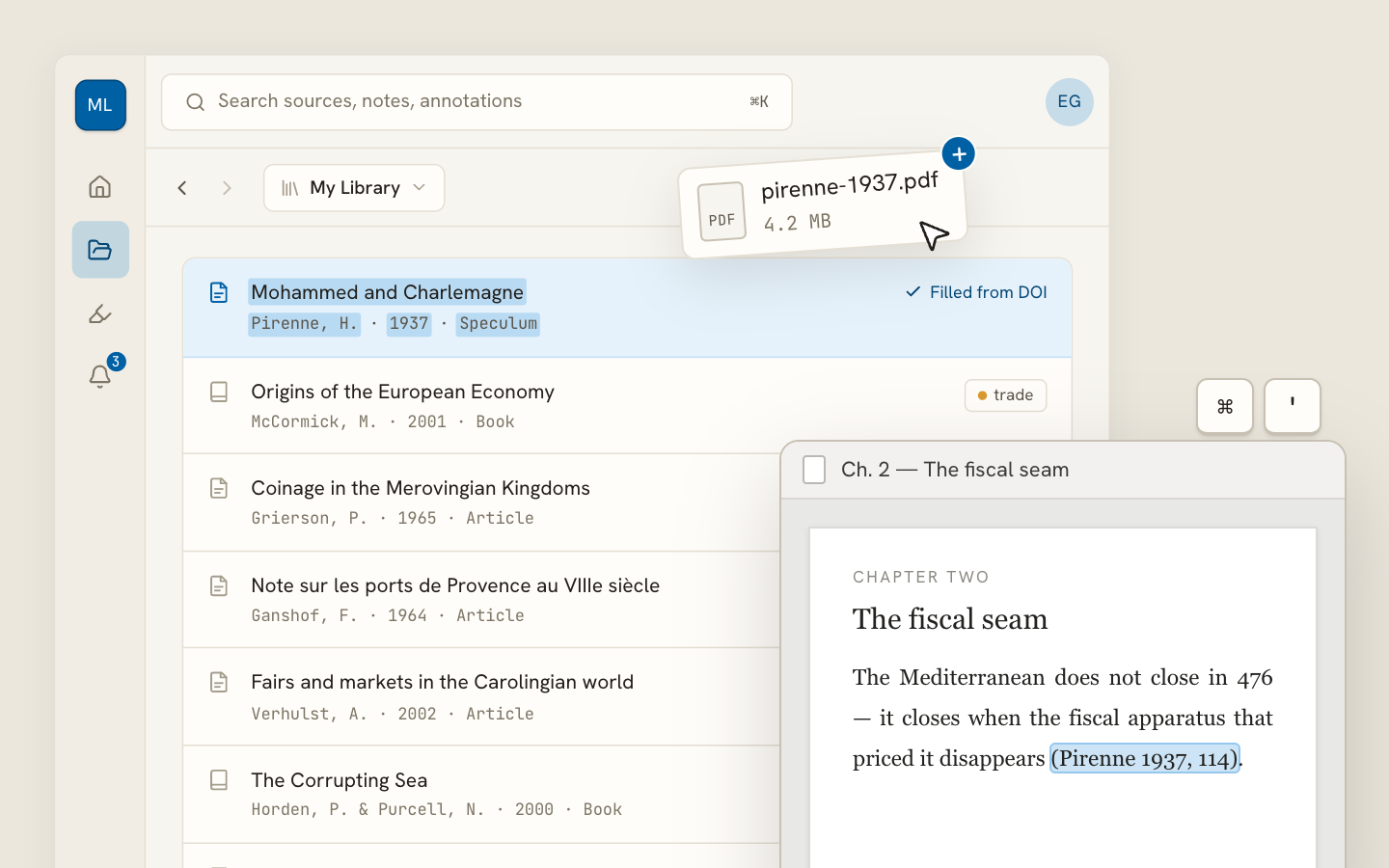
Archivero library view with a source list and an open PDF

Your weekly research workflow, in one email

One tested workflow, three links, no filler — every Tuesday.

Unsubscribe in one click. We never share your address.

Guides/Citations/MLA Citation Style

How to Cite an Interview in MLA Format

MLA 9th edition formats for published interviews, broadcast interviews, and personal interviews you conducted yourself.

5 min readMLA

Key Takeaways

  • The interviewee is the author of an interview — the person answering the questions, not the interviewer.
  • Published interviews (in a book, magazine, or website) use the container system — the interview title in quotation marks, the publication in italics:
    • Morrison, Toni. "The Art of Fiction No. 134." The Paris Review, no. 128, 1993.
  • Broadcast interviews (TV, radio, podcast) list the interviewee as author, followed by "Interview by" and the interviewer's name:
    • Obama, Barack. Interview by David Letterman. My Next Guest Needs No Introduction. Netflix, 12 Jan. 2018.
  • Personal interviews you conducted use a simplified format — interviewee name, type of interview, and date:
    • Nakamura, Kenji. Personal interview. 3 Mar. 2026.
  • Personal interviews appear on the Works Cited page but may also be labeled as "Telephone interview," "Email interview," or "Zoom interview."
  • In-text citations use the interviewee's last name:
    • (Morrison) or (Nakamura)

On this page

1 of 19
Key TakeawaysPublished Interview — In a Book or MagazineInterview in a Magazine or JournalInterview in a BookInterview on a WebsiteBroadcast Interview — TV, Radio, PodcastTelevision InterviewRadio InterviewPodcast InterviewPersonal InterviewBasic FormatIn-Person InterviewTelephone InterviewEmail InterviewVideo Call Interview (Zoom, Teams, etc.)Who Is the "Author" of an Interview?In-Text Citation Quick ReferenceCommon MistakesWhat's Next
All MLA guides →

Interviews are primary sources — they capture someone's words, perspectives, and experiences directly. MLA 9th edition handles three types of interviews: published (in print or online), broadcast (TV, radio, podcast), and personal (interviews you conducted yourself). The citation format changes depending on how the interview was published and who the "author" is.

Whether you're citing a literary interview from The Paris Review, a political interview from a podcast, or a conversation you conducted yourself for a research project, MLA provides a consistent format. The key decision is always: how was the interview published — or was it not published at all?

Published Interview — In a Book or Magazine

When an interview appears in a print publication, the interviewee is the author and the interview title is the work. The publication is the container.

Interview in a Magazine or Journal

Works Cited:

Morrison, Toni. "The Art of Fiction No. 134." Interview by Elissa Schappell. The Paris Review, no. 128, 1993, pp. 82–125.

In-text citation:

(Morrison 94)

What to notice:

  • Morrison (the interviewee) is the author
  • The interview title is in quotation marks
  • "Interview by Elissa Schappell" credits the interviewer but doesn't make them the author
  • The Paris Review is the container

Interview in a Book

If the interview appears as a chapter in a collected volume:

Works Cited:

Baldwin, James. "Notes for a Hypothetical Novel." Interview by Studs Terkel. James Baldwin: The Last Interview and Other Conversations, Melville House, 2014, pp. 3–22.

In-text citation:

(Baldwin 10)

Interview on a Website

Works Cited:

Adichie, Chimamanda Ngozi. "Chimamanda Ngozi Adichie on Her New Novel and the Importance of Nuance." Interview by Kira Goldenberg. Literary Hub, 14 Mar. 2025, https://lithub.com/adichie-interview-2025.

In-text citation:

(Adichie)

Broadcast Interview — TV, Radio, Podcast

For interviews that aired on television, radio, or in a podcast episode, the interviewee remains the author and the show is the container.

Television Interview

Works Cited:

Obama, Barack. Interview by David Letterman. My Next Guest Needs No Introduction with David Letterman, season 1, episode 1, Netflix, 12 Jan. 2018.

In-text citation:

(Obama)

Radio Interview

Works Cited:

Coates, Ta-Nehisi. Interview by Terry Gross. "Ta-Nehisi Coates on the Water Dancer." Fresh Air, NPR, 24 Sept. 2019.

In-text citation:

(Coates)

What to notice:

  • The segment title ("Ta-Nehisi Coates on the Water Dancer") goes in quotation marks
  • The show name (Fresh Air) is italicized as the container
  • The network (NPR) is the publisher

Podcast Interview

Works Cited:

Gay, Roxane. Interview by Brené Brown. "Roxane Gay on Living in Your Body." Unlocking Us, Spotify, 11 Nov. 2024, https://open.spotify.com/episode/abc123.

In-text citation:

(Gay)

If the podcast has a season and episode number, include them:

Gay, Roxane. Interview by Brené Brown. "Roxane Gay on Living in Your Body." Unlocking Us, season 3, episode 14, Spotify, 11 Nov. 2024.

Personal Interview

A personal interview is one you conducted yourself — in person, by phone, by email, or over video chat. Since it's not published, the citation format is simpler.

Basic Format

Interviewee Last, First. Personal interview. Day Month Year.

In-Person Interview

Works Cited:

Nakamura, Kenji. Personal interview. 3 Mar. 2026.

In-text citation:

(Nakamura)

Telephone Interview

Works Cited:

Okonkwo, Adaeze. Telephone interview. 18 Feb. 2026.

In-text citation:

(Okonkwo)

Email Interview

Works Cited:

Torres, Lucia. Email interview. 22 Jan. 2026.

In-text citation:

(Torres)

Video Call Interview (Zoom, Teams, etc.)

Works Cited:

Kim, Jihye. Zoom interview. 5 Mar. 2026.

In-text citation:

(Kim)

Who Is the "Author" of an Interview?

The interviewee is always the author — the person whose ideas and words are the subject of the interview. The interviewer receives credit (with "Interview by"), but they are not the author.

There is one exception: if your paper's focus is on the interviewer's technique rather than the content of the interviewee's answers, you might list the interviewer as the author and the interviewee after "Interview with":

Works Cited:

Gross, Terry. "Ta-Nehisi Coates on the Water Dancer." Interview with Ta-Nehisi Coates. Fresh Air, NPR, 24 Sept. 2019.

In-text citation:

(Gross)

This is unusual — most of the time, the interviewee is the author. Use this approach only when your analysis genuinely centers on the interviewer.

In-Text Citation Quick Reference

Interview TypeWorks Cited AuthorIn-Text Citation
Magazine/journalWorks Cited AuthorMorrison, Toni.In-Text Citation(Morrison 94)
Book (collected)Works Cited AuthorBaldwin, James.In-Text Citation(Baldwin 10)
WebsiteWorks Cited AuthorAdichie, Chimamanda Ngozi.In-Text Citation(Adichie)
TelevisionWorks Cited AuthorObama, Barack.In-Text Citation(Obama)
RadioWorks Cited AuthorCoates, Ta-Nehisi.In-Text Citation(Coates)
PodcastWorks Cited AuthorGay, Roxane.In-Text Citation(Gay)
Personal (in-person)Works Cited AuthorNakamura, Kenji.In-Text Citation(Nakamura)
TelephoneWorks Cited AuthorOkonkwo, Adaeze.In-Text Citation(Okonkwo)
EmailWorks Cited AuthorTorres, Lucia.In-Text Citation(Torres)

Common Mistakes

  1. Listing the interviewer as the author. Unless your paper focuses on the interviewer's technique, the interviewee is the author.
  2. Omitting "Interview by" for published interviews. This credit helps the reader understand the source. Include it after the title.
  3. Treating personal interviews like published sources. Personal interviews have no publisher, no container, and no URL — just the interviewee's name, the interview type, and the date.
  4. Forgetting to include personal interviews on the Works Cited page. Even though they're unpublished, personal interviews do appear on the Works Cited page in MLA.
  5. Not specifying the interview type. For personal interviews, distinguish between "Personal interview," "Telephone interview," "Email interview," and "Zoom interview" — this tells the reader how the conversation took place.

What's Next

Now that you know how to cite interviews, explore related guides:

  • How to Cite a Video in MLA Format — for broadcast interviews accessed as video content
  • MLA Works Cited Page — the complete guide to building Works Cited entries

Archivero can help you manage interview sources — save an interview page or podcast episode to your library, and the Works Cited entry is generated automatically with the interviewee, title, and publication details.

All MLA guides →
← PreviousHow to Cite Government & Legal Sources in MLA FormatNext →How to Cite an Encyclopedia or Dictionary in MLA Format

More on MLA style

The standard in literature, the humanities and cultural studies. The author–page system, Works Cited entries and the 9th edition's container model.

View all 27 guides →
10 sections·6 min readMLAHow to Cite an Encyclopedia or Dictionary in MLA Format10 sections·5 min readMLAHow to Cite a Dissertation or Thesis in MLA Format9 sections·8 min readMLAMLA Format Paper12 sections·8 min readMLAMLA In-Text Citations

Your sources, PDFs and citations in one library

  • Import a Zotero, Mendeley or EndNote library — or a folder of PDFs
  • Highlight and annotate without leaving the source
  • Cite in any CSL style as you write, with one shared library for your lab
Request early accessSee the product →
Archivero library view with a source list and an open PDF

Your weekly research workflow, in one email

One tested workflow, three links, no filler — every Tuesday.

Unsubscribe in one click. We never share your address.