Archivero is in early access — your sources, PDFs and citations in one library.Request early access →
Archivero/guides/
APAMLAHarvardThesis writing
Subscribe
Archivero/guides/Request early access →

Guides

APA styleMLA styleHarvard referencingThesis writing

Compare

APA 6th vs 7thMLA 8th vs 9thHarvard vs APAThesis vs dissertation

Product

FeaturesEarly access

Resources

DocsCheat sheetsNewsletter

Company

ContactStatus ↗
© 2025–2026 Ernesto F. GonzálezGuidesDocsContactPrivacyTerms
Guides/Citations/MLA Citation Style

MLA Annotated Bibliography

How to write and format an annotated bibliography in MLA 9th edition, with examples for summary, evaluative, and reflective annotations.

9 min readMLA

On this page

1 of 15
What Is an Annotated Bibliography?Annotated Bibliography vs. Works Cited vs. Literature ReviewFormatting RulesPage SetupEntry FormatAlphabetical OrderTypes of AnnotationsSummary AnnotationsEvaluative AnnotationsReflective AnnotationsCombination AnnotationsHow Long Should Each Annotation Be?Full-Page ExampleCommon MistakesWhat's Next
All MLA guides →

An annotated bibliography is one of the most commonly assigned research tasks in humanities courses — and one of the most misunderstood. Students often confuse it with a regular Works Cited page (it's not), a literature review (also not), or assume it's just a list of summaries (closer, but not quite). This guide explains what an annotated bibliography actually is, how to format one in MLA 9th edition, and how to write annotations that do real intellectual work.

What Is an Annotated Bibliography?

An annotated bibliography is a list of sources — formatted as standard MLA Works Cited entries — where each entry is followed by a short paragraph (the "annotation") that describes, evaluates, or reflects on the source.

Think of it as a Works Cited page with commentary. The Works Cited entry tells your reader what the source is. The annotation tells your reader why it matters — what it says, how reliable it is, and how it connects to your research.

Annotated Bibliography vs. Works Cited vs. Literature Review

These three things are related but distinct:

Annotated BibliographyWorks CitedLiterature Review
FormatAnnotated BibliographyWorks Cited entry + annotation paragraphWorks CitedWorks Cited entry onlyLiterature ReviewContinuous prose (essay format)
PurposeAnnotated BibliographyDescribe and evaluate individual sourcesWorks CitedList sources cited in your paperLiterature ReviewSynthesize sources into a narrative about the state of research
OrganizationAnnotated BibliographyAlphabetical by authorWorks CitedAlphabetical by authorLiterature ReviewOrganized thematically or chronologically
When assignedAnnotated BibliographyAs a standalone assignment or research preparationWorks CitedAt the end of a research paperLiterature ReviewAs part of a thesis, dissertation, or research proposal
Typical lengthAnnotated Bibliography100–200 words per annotationWorks CitedN/A (just the citation)Literature ReviewSeveral pages of connected prose

An annotated bibliography is usually assigned as a preliminary step in a larger research project. It forces you to find, read, and evaluate your sources before you start writing — which is exactly the point.

Formatting Rules

The formatting follows standard MLA Works Cited conventions, with the addition of the annotation paragraph:

Page Setup

  1. Title: Center the heading "Annotated Bibliography" at the top of the page — same font and size as the rest of your paper. Don't make it bold, underlined, or larger.
  2. Running header: Continue your last name and page number in the upper-right corner.
  3. Margins and spacing: 1-inch margins, double-spaced throughout — within entries, within annotations, and between entries.
  4. Font: Same legible 12 pt font used in the rest of your paper.

Entry Format

Each entry has two parts:

  1. The Works Cited entry — formatted exactly as it would appear on a Works Cited page, with a hanging indent (first line flush left, subsequent lines indented 0.5 inches).
  2. The annotation — starts on a new line after the Works Cited entry, indented 0.5 inches from the left margin (the entire annotation is indented, like a block). Double-spaced, same font.

Gilbert, Sandra M., and Susan Gubar. *The Madwoman in the Attic: The Woman Writer and the

        Nineteenth-Century Literary Imagination*. Yale UP, 2000.

        Gilbert and Gubar argue that nineteenth-century women writers were constrained by a patriarchal literary tradition that offered them only two models: the "angel" and the "monster." Through close readings of Jane Austen, Charlotte Brontë, Emily Dickinson, and others, the authors show how women writers subverted these archetypes by embedding rebellious figures — often madwomen — in their fiction. The book is foundational for feminist literary criticism and remains one of the most frequently cited works in the field. It is directly relevant to my research on how contemporary women novelists continue to engage with the tropes Gilbert and Gubar identified.

Alphabetical Order

Entries are alphabetized the same way as a Works Cited page — by the first element of each entry (usually the author's last name). If there's no author, alphabetize by the first significant word of the title.

Types of Annotations

Your instructor may specify which type of annotation they want. If they don't, ask. The three most common types are:

Summary Annotations

A summary annotation describes the source's content — its main argument, methodology, and findings. It answers the question: What does this source say?

Wong, Cynthia F. Kazuo Ishiguro. 2nd ed., Northcote House, 2005.

        Wong provides a comprehensive critical introduction to the novels of Kazuo Ishiguro, covering A Pale View of Hills through Never Let Me Go. Each chapter focuses on a single novel, analyzing its narrative technique, thematic concerns, and critical reception. Wong pays particular attention to Ishiguro's use of unreliable narration and the tension between memory and self-deception that runs through his work. The book is part of the Writers and Their Work series and is intended for students and general readers approaching Ishiguro for the first time.

Evaluative Annotations

An evaluative annotation goes beyond summary to assess the source's strengths, weaknesses, reliability, and usefulness. It answers: How good is this source, and for what?

Morrison, Toni. Playing in the Dark: Whiteness and the Literary Imagination. Vintage Books, 1993.

        In this slim but influential collection of essays, Morrison examines how the presence of African Americans shaped the literary imagination of white American writers — from Poe to Hemingway. Her argument that a white literary identity was constructed against a racialized "other" has been widely accepted in American literary studies, though some critics have noted that her readings of individual texts are more suggestive than systematic. The book's strength lies in its theoretical framework rather than its textual analyses. For my research, Morrison's concept of "Africanism" as a literary device provides a useful lens for reading contemporary novels that engage with racial identity.

Reflective Annotations

A reflective annotation focuses on how the source connects to your own research. It answers: How will I use this source?

Ishiguro, Kazuo. The Remains of the Day. Faber and Faber, 1989.

        Ishiguro's novel will serve as one of three primary texts in my analysis of the unreliable narrator in contemporary fiction. Stevens's narration is particularly useful for my argument because his unreliability is not deceptive — he genuinely believes his own account. This type of self-deceptive narration differs from the deliberately misleading narrators in earlier fiction (such as in Agatha Christie or Vladimir Nabokov) and raises questions about whether the reader's role is to "catch" the narrator or to empathize with him. I plan to use the novel's closing scene — in which Stevens briefly acknowledges what he has lost — as evidence that Ishiguro treats unreliability as a form of emotional survival rather than a puzzle to be solved.

Combination Annotations

Many instructors want a combination — a brief summary followed by an evaluation and/or reflection. When in doubt, this is usually the safest approach:

García Márquez, Gabriel. One Hundred Years of Solitude. Translated by Gregory Rabassa,

        Harper Perennial, 2006.

        García Márquez chronicles the rise and fall of the Buendía family across seven generations in the fictional town of Macondo. The novel blends historical realism with magical elements — a technique that became the defining feature of Latin American literary boom fiction. Rabassa's English translation is widely regarded as one of the finest literary translations of the twentieth century, preserving both the rhythmic quality and the deadpan tone of the original Spanish. For my research on narrative unreliability, the novel's circular time structure — in which events repeat across generations — offers a model of unreliability that operates at the level of form rather than voice. The narrator presents impossible events with the same authority as historical ones, forcing the reader to question what "reliability" means in a fictional framework.

How Long Should Each Annotation Be?

Unless your instructor specifies a word count, aim for 100–200 words per annotation. That's roughly one substantial paragraph — enough to say something meaningful without writing a mini-essay.

Annotation TypeTypical LengthFocus
SummaryTypical Length100–150 wordsFocusWhat the source says
EvaluativeTypical Length100–200 wordsFocusHow reliable/useful the source is
ReflectiveTypical Length100–150 wordsFocusHow you'll use the source
CombinationTypical Length150–200 wordsFocusSummary + evaluation + relevance

Some assignments ask for longer annotations (250–300 words) — especially when the goal is to demonstrate close reading. Follow your assignment guidelines.

Full-Page Example

Here's a complete annotated bibliography with four entries, using combination annotations:

Annotated Bibliography

García Márquez, Gabriel. One Hundred Years of Solitude. Translated by Gregory Rabassa,

        Harper Perennial, 2006.

        García Márquez chronicles the Buendía family across seven generations in the fictional town of Macondo, blending historical realism with magical elements. The novel's circular structure — in which events and names repeat across generations — creates a narrative in which time itself becomes unreliable. For my research, this offers a model of unreliability that operates at the level of form rather than individual narration.

Gilbert, Sandra M., and Susan Gubar. *The Madwoman in the Attic: The Woman Writer and the

        Nineteenth-Century Literary Imagination*. Yale UP, 2000.

        Gilbert and Gubar argue that nineteenth-century women writers subverted patriarchal literary models by embedding rebellious "madwomen" figures in their fiction. The book is foundational for feminist literary criticism and provides a theoretical framework for understanding how narrative voice can be used as a tool of resistance. I will draw on their concept of the "anxiety of authorship" to analyze how contemporary women novelists use unreliable narration differently from their male counterparts.

Ishiguro, Kazuo. The Remains of the Day. Faber and Faber, 1989.

        Ishiguro's novel follows Stevens, a butler who narrates his decades of service while gradually revealing what he cannot say directly — that he sacrificed his personal life in service to a morally compromised employer. Stevens's self-deceptive narration is central to my argument that contemporary unreliable narrators are not puzzles to be solved but exercises in empathy. The novel's closing scene, where Stevens briefly acknowledges what he has lost, will serve as a key example.

Wong, Cynthia F. Kazuo Ishiguro. 2nd ed., Northcote House, 2005.

        Wong offers a comprehensive critical introduction to Ishiguro's novels, with sustained attention to his use of unreliable narration. Her reading of The Remains of the Day aligns with my own interpretation — that Stevens's reliability about facts makes his emotional unreliability more devastating. The book is useful as secondary criticism supporting my analysis of Ishiguro, though its scope is limited to close reading and does not engage with broader theories of narratology.

Common Mistakes

  1. Calling it "Works Cited." If your assignment asks for an annotated bibliography, the title should be "Annotated Bibliography" — not "Works Cited."
  2. Writing only summaries when evaluation is expected. If your instructor wants evaluative annotations, a pure summary won't earn full marks. Include your assessment of the source's strengths, limitations, and relevance.
  3. Making the annotation too long. An annotation is a paragraph, not an essay. If you're writing more than 200 words per entry (unless instructed otherwise), you're probably including too much detail.
  4. Forgetting the hanging indent on the Works Cited entry. The entry itself uses the standard hanging indent — first line flush left, subsequent lines indented 0.5 inches. The annotation is then indented as a block.
  5. Not alphabetizing. Entries should be in alphabetical order by the first element, just like a standard Works Cited page.
  6. Including sources you haven't read. An annotated bibliography requires you to engage with each source. If you can't write a meaningful annotation, you haven't read the source closely enough.
  7. Writing in first person when the instructor prefers third. Some assignments want "The author argues…" rather than "I will use this source to…" Check the assignment requirements.

What's Next

Now that you know how to write an annotated bibliography, explore:

  • MLA Works Cited Page — the formatting foundation that annotated bibliographies build on
  • MLA Citation Style — the complete overview of MLA 9th edition
  • How to Cite a Book in MLA Format — the most common source type in humanities annotated bibliographies

If you're building an annotated bibliography for a research project, Archivero can generate the Works Cited entries automatically for every source in your library — so you can focus on writing the annotations themselves.
All MLA guides →
← PreviousHow to Cite ChatGPT & AI-Generated Content in MLANext →Common MLA Format Mistakes (and How to Fix Them)

More on MLA style

The standard in literature, the humanities and cultural studies. The author–page system, Works Cited entries and the 9th edition's container model.

View all 27 guides →
7 sections·10 min readMLACommon MLA Format Mistakes (and How to Fix Them)8 sections·8 min readMLAHow to Paraphrase in MLA9 sections·6 min readMLAHow to Cite a Source With No Author in MLA12 sections·8 min readMLAMLA 8th vs. 9th Edition — What Changed

Your sources, PDFs and citations in one library

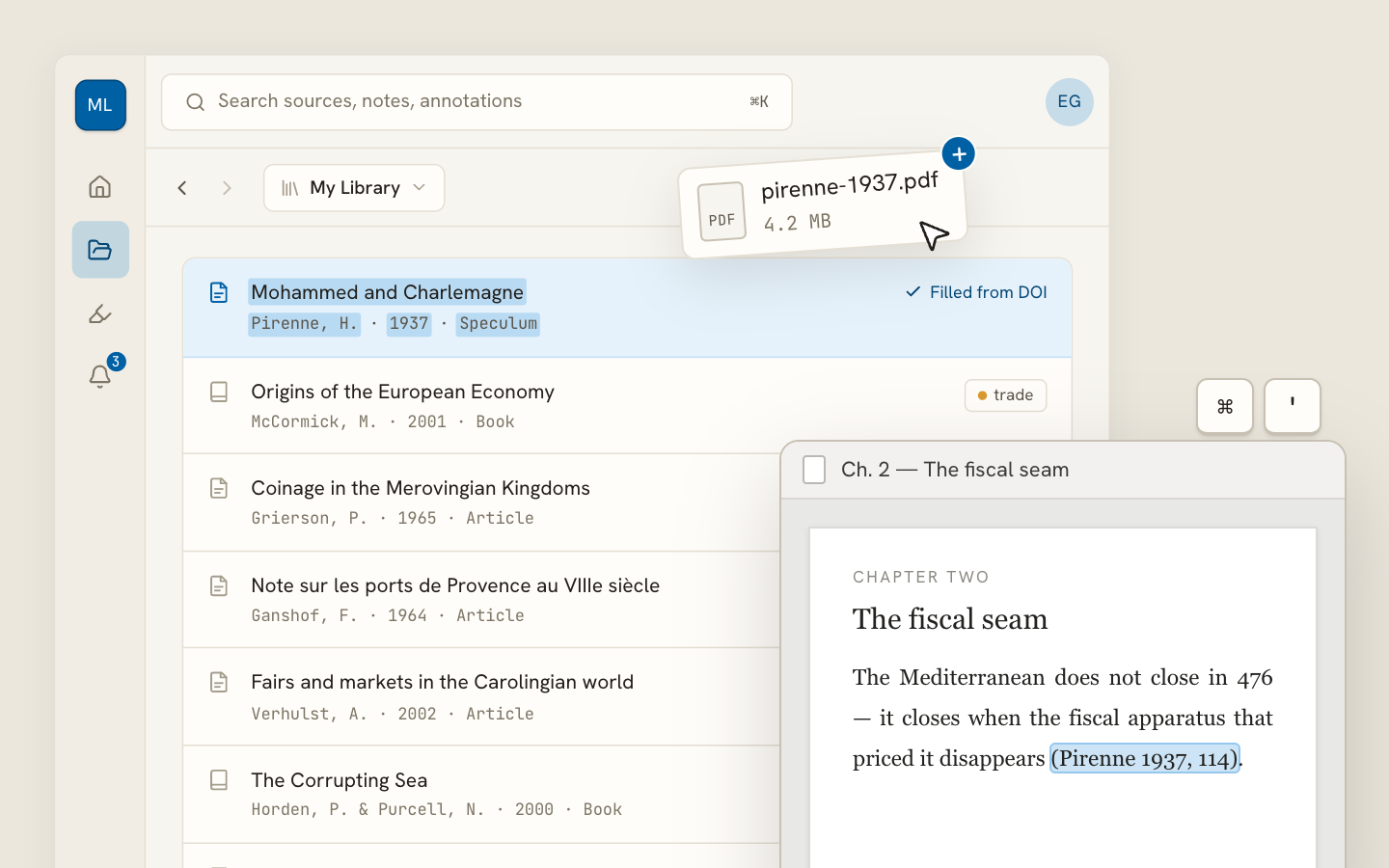
  • Import a Zotero, Mendeley or EndNote library — or a folder of PDFs
  • Highlight and annotate without leaving the source
  • Cite in any CSL style as you write, with one shared library for your lab
Request early accessSee the product →
Archivero library view with a source list and an open PDF

Your weekly research workflow, in one email

One tested workflow, three links, no filler — every Tuesday.

Unsubscribe in one click. We never share your address.

Guides/Citations/MLA Citation Style

MLA Annotated Bibliography

How to write and format an annotated bibliography in MLA 9th edition, with examples for summary, evaluative, and reflective annotations.

9 min readMLA

On this page

1 of 15
What Is an Annotated Bibliography?Annotated Bibliography vs. Works Cited vs. Literature ReviewFormatting RulesPage SetupEntry FormatAlphabetical OrderTypes of AnnotationsSummary AnnotationsEvaluative AnnotationsReflective AnnotationsCombination AnnotationsHow Long Should Each Annotation Be?Full-Page ExampleCommon MistakesWhat's Next
All MLA guides →

An annotated bibliography is one of the most commonly assigned research tasks in humanities courses — and one of the most misunderstood. Students often confuse it with a regular Works Cited page (it's not), a literature review (also not), or assume it's just a list of summaries (closer, but not quite). This guide explains what an annotated bibliography actually is, how to format one in MLA 9th edition, and how to write annotations that do real intellectual work.

What Is an Annotated Bibliography?

An annotated bibliography is a list of sources — formatted as standard MLA Works Cited entries — where each entry is followed by a short paragraph (the "annotation") that describes, evaluates, or reflects on the source.

Think of it as a Works Cited page with commentary. The Works Cited entry tells your reader what the source is. The annotation tells your reader why it matters — what it says, how reliable it is, and how it connects to your research.

Annotated Bibliography vs. Works Cited vs. Literature Review

These three things are related but distinct:

Annotated BibliographyWorks CitedLiterature Review
FormatAnnotated BibliographyWorks Cited entry + annotation paragraphWorks CitedWorks Cited entry onlyLiterature ReviewContinuous prose (essay format)
PurposeAnnotated BibliographyDescribe and evaluate individual sourcesWorks CitedList sources cited in your paperLiterature ReviewSynthesize sources into a narrative about the state of research
OrganizationAnnotated BibliographyAlphabetical by authorWorks CitedAlphabetical by authorLiterature ReviewOrganized thematically or chronologically
When assignedAnnotated BibliographyAs a standalone assignment or research preparationWorks CitedAt the end of a research paperLiterature ReviewAs part of a thesis, dissertation, or research proposal
Typical lengthAnnotated Bibliography100–200 words per annotationWorks CitedN/A (just the citation)Literature ReviewSeveral pages of connected prose

An annotated bibliography is usually assigned as a preliminary step in a larger research project. It forces you to find, read, and evaluate your sources before you start writing — which is exactly the point.

Formatting Rules

The formatting follows standard MLA Works Cited conventions, with the addition of the annotation paragraph:

Page Setup

  1. Title: Center the heading "Annotated Bibliography" at the top of the page — same font and size as the rest of your paper. Don't make it bold, underlined, or larger.
  2. Running header: Continue your last name and page number in the upper-right corner.
  3. Margins and spacing: 1-inch margins, double-spaced throughout — within entries, within annotations, and between entries.
  4. Font: Same legible 12 pt font used in the rest of your paper.

Entry Format

Each entry has two parts:

  1. The Works Cited entry — formatted exactly as it would appear on a Works Cited page, with a hanging indent (first line flush left, subsequent lines indented 0.5 inches).
  2. The annotation — starts on a new line after the Works Cited entry, indented 0.5 inches from the left margin (the entire annotation is indented, like a block). Double-spaced, same font.

Gilbert, Sandra M., and Susan Gubar. *The Madwoman in the Attic: The Woman Writer and the

        Nineteenth-Century Literary Imagination*. Yale UP, 2000.

        Gilbert and Gubar argue that nineteenth-century women writers were constrained by a patriarchal literary tradition that offered them only two models: the "angel" and the "monster." Through close readings of Jane Austen, Charlotte Brontë, Emily Dickinson, and others, the authors show how women writers subverted these archetypes by embedding rebellious figures — often madwomen — in their fiction. The book is foundational for feminist literary criticism and remains one of the most frequently cited works in the field. It is directly relevant to my research on how contemporary women novelists continue to engage with the tropes Gilbert and Gubar identified.

Alphabetical Order

Entries are alphabetized the same way as a Works Cited page — by the first element of each entry (usually the author's last name). If there's no author, alphabetize by the first significant word of the title.

Types of Annotations

Your instructor may specify which type of annotation they want. If they don't, ask. The three most common types are:

Summary Annotations

A summary annotation describes the source's content — its main argument, methodology, and findings. It answers the question: What does this source say?

Wong, Cynthia F. Kazuo Ishiguro. 2nd ed., Northcote House, 2005.

        Wong provides a comprehensive critical introduction to the novels of Kazuo Ishiguro, covering A Pale View of Hills through Never Let Me Go. Each chapter focuses on a single novel, analyzing its narrative technique, thematic concerns, and critical reception. Wong pays particular attention to Ishiguro's use of unreliable narration and the tension between memory and self-deception that runs through his work. The book is part of the Writers and Their Work series and is intended for students and general readers approaching Ishiguro for the first time.

Evaluative Annotations

An evaluative annotation goes beyond summary to assess the source's strengths, weaknesses, reliability, and usefulness. It answers: How good is this source, and for what?

Morrison, Toni. Playing in the Dark: Whiteness and the Literary Imagination. Vintage Books, 1993.

        In this slim but influential collection of essays, Morrison examines how the presence of African Americans shaped the literary imagination of white American writers — from Poe to Hemingway. Her argument that a white literary identity was constructed against a racialized "other" has been widely accepted in American literary studies, though some critics have noted that her readings of individual texts are more suggestive than systematic. The book's strength lies in its theoretical framework rather than its textual analyses. For my research, Morrison's concept of "Africanism" as a literary device provides a useful lens for reading contemporary novels that engage with racial identity.

Reflective Annotations

A reflective annotation focuses on how the source connects to your own research. It answers: How will I use this source?

Ishiguro, Kazuo. The Remains of the Day. Faber and Faber, 1989.

        Ishiguro's novel will serve as one of three primary texts in my analysis of the unreliable narrator in contemporary fiction. Stevens's narration is particularly useful for my argument because his unreliability is not deceptive — he genuinely believes his own account. This type of self-deceptive narration differs from the deliberately misleading narrators in earlier fiction (such as in Agatha Christie or Vladimir Nabokov) and raises questions about whether the reader's role is to "catch" the narrator or to empathize with him. I plan to use the novel's closing scene — in which Stevens briefly acknowledges what he has lost — as evidence that Ishiguro treats unreliability as a form of emotional survival rather than a puzzle to be solved.

Combination Annotations

Many instructors want a combination — a brief summary followed by an evaluation and/or reflection. When in doubt, this is usually the safest approach:

García Márquez, Gabriel. One Hundred Years of Solitude. Translated by Gregory Rabassa,

        Harper Perennial, 2006.

        García Márquez chronicles the rise and fall of the Buendía family across seven generations in the fictional town of Macondo. The novel blends historical realism with magical elements — a technique that became the defining feature of Latin American literary boom fiction. Rabassa's English translation is widely regarded as one of the finest literary translations of the twentieth century, preserving both the rhythmic quality and the deadpan tone of the original Spanish. For my research on narrative unreliability, the novel's circular time structure — in which events repeat across generations — offers a model of unreliability that operates at the level of form rather than voice. The narrator presents impossible events with the same authority as historical ones, forcing the reader to question what "reliability" means in a fictional framework.

How Long Should Each Annotation Be?

Unless your instructor specifies a word count, aim for 100–200 words per annotation. That's roughly one substantial paragraph — enough to say something meaningful without writing a mini-essay.

Annotation TypeTypical LengthFocus
SummaryTypical Length100–150 wordsFocusWhat the source says
EvaluativeTypical Length100–200 wordsFocusHow reliable/useful the source is
ReflectiveTypical Length100–150 wordsFocusHow you'll use the source
CombinationTypical Length150–200 wordsFocusSummary + evaluation + relevance

Some assignments ask for longer annotations (250–300 words) — especially when the goal is to demonstrate close reading. Follow your assignment guidelines.

Full-Page Example

Here's a complete annotated bibliography with four entries, using combination annotations:

Annotated Bibliography

García Márquez, Gabriel. One Hundred Years of Solitude. Translated by Gregory Rabassa,

        Harper Perennial, 2006.

        García Márquez chronicles the Buendía family across seven generations in the fictional town of Macondo, blending historical realism with magical elements. The novel's circular structure — in which events and names repeat across generations — creates a narrative in which time itself becomes unreliable. For my research, this offers a model of unreliability that operates at the level of form rather than individual narration.

Gilbert, Sandra M., and Susan Gubar. *The Madwoman in the Attic: The Woman Writer and the

        Nineteenth-Century Literary Imagination*. Yale UP, 2000.

        Gilbert and Gubar argue that nineteenth-century women writers subverted patriarchal literary models by embedding rebellious "madwomen" figures in their fiction. The book is foundational for feminist literary criticism and provides a theoretical framework for understanding how narrative voice can be used as a tool of resistance. I will draw on their concept of the "anxiety of authorship" to analyze how contemporary women novelists use unreliable narration differently from their male counterparts.

Ishiguro, Kazuo. The Remains of the Day. Faber and Faber, 1989.

        Ishiguro's novel follows Stevens, a butler who narrates his decades of service while gradually revealing what he cannot say directly — that he sacrificed his personal life in service to a morally compromised employer. Stevens's self-deceptive narration is central to my argument that contemporary unreliable narrators are not puzzles to be solved but exercises in empathy. The novel's closing scene, where Stevens briefly acknowledges what he has lost, will serve as a key example.

Wong, Cynthia F. Kazuo Ishiguro. 2nd ed., Northcote House, 2005.

        Wong offers a comprehensive critical introduction to Ishiguro's novels, with sustained attention to his use of unreliable narration. Her reading of The Remains of the Day aligns with my own interpretation — that Stevens's reliability about facts makes his emotional unreliability more devastating. The book is useful as secondary criticism supporting my analysis of Ishiguro, though its scope is limited to close reading and does not engage with broader theories of narratology.

Common Mistakes

  1. Calling it "Works Cited." If your assignment asks for an annotated bibliography, the title should be "Annotated Bibliography" — not "Works Cited."
  2. Writing only summaries when evaluation is expected. If your instructor wants evaluative annotations, a pure summary won't earn full marks. Include your assessment of the source's strengths, limitations, and relevance.
  3. Making the annotation too long. An annotation is a paragraph, not an essay. If you're writing more than 200 words per entry (unless instructed otherwise), you're probably including too much detail.
  4. Forgetting the hanging indent on the Works Cited entry. The entry itself uses the standard hanging indent — first line flush left, subsequent lines indented 0.5 inches. The annotation is then indented as a block.
  5. Not alphabetizing. Entries should be in alphabetical order by the first element, just like a standard Works Cited page.
  6. Including sources you haven't read. An annotated bibliography requires you to engage with each source. If you can't write a meaningful annotation, you haven't read the source closely enough.
  7. Writing in first person when the instructor prefers third. Some assignments want "The author argues…" rather than "I will use this source to…" Check the assignment requirements.

What's Next

Now that you know how to write an annotated bibliography, explore:

  • MLA Works Cited Page — the formatting foundation that annotated bibliographies build on
  • MLA Citation Style — the complete overview of MLA 9th edition
  • How to Cite a Book in MLA Format — the most common source type in humanities annotated bibliographies

If you're building an annotated bibliography for a research project, Archivero can generate the Works Cited entries automatically for every source in your library — so you can focus on writing the annotations themselves.

All MLA guides →
← PreviousHow to Cite ChatGPT & AI-Generated Content in MLANext →Common MLA Format Mistakes (and How to Fix Them)

More on MLA style

The standard in literature, the humanities and cultural studies. The author–page system, Works Cited entries and the 9th edition's container model.

View all 27 guides →
7 sections·10 min readMLACommon MLA Format Mistakes (and How to Fix Them)8 sections·8 min readMLAHow to Paraphrase in MLA9 sections·6 min readMLAHow to Cite a Source With No Author in MLA12 sections·8 min readMLAMLA 8th vs. 9th Edition — What Changed

Your sources, PDFs and citations in one library

  • Import a Zotero, Mendeley or EndNote library — or a folder of PDFs
  • Highlight and annotate without leaving the source
  • Cite in any CSL style as you write, with one shared library for your lab
Request early accessSee the product →
Archivero library view with a source list and an open PDF

Your weekly research workflow, in one email

One tested workflow, three links, no filler — every Tuesday.

Unsubscribe in one click. We never share your address.