Archivero is in early access — your sources, PDFs and citations in one library.Request early access →
Archivero/guides/
APAMLAHarvardThesis writing
Subscribe
Archivero/guides/Request early access →

Guides

APA styleMLA styleHarvard referencingThesis writing

Compare

APA 6th vs 7thMLA 8th vs 9thHarvard vs APAThesis vs dissertation

Product

FeaturesEarly access

Resources

DocsCheat sheetsNewsletter

Company

ContactStatus ↗
© 2025–2026 Ernesto F. GonzálezGuidesDocsContactPrivacyTerms
Guides/Citations/MLA Citation Style

How to Cite ChatGPT & AI-Generated Content in MLA

MLA's guidance for citing output from ChatGPT, DALL-E, Copilot, and other generative AI tools — including the prompt-as-title approach.

8 min readMLA

On this page

1 of 19
MLA's Position on AI-Generated ContentThe General FormatCiting AI-Generated TextChatGPTClaudeMicrosoft CopilotGoogle GeminiCiting AI-Generated ImagesDALL-EMidjourneyAdobe FireflyHandling Long or Complex PromptsExample With an Appendix ReferenceWhen You Used AI but Didn't Quote ItIn-Text Citation FormatTransparency and Academic IntegrityExample Works Cited Entries — All TogetherCommon MistakesWhat's Next
All MLA guides →

Generative AI is now part of the research and writing landscape, and MLA has responded with clear guidance on how to cite it. Whether you used ChatGPT to brainstorm ideas, asked Claude to summarize a source, or generated an image with DALL-E, you need to tell your reader exactly what you did — what tool you used, what you asked it, and when.

This page covers MLA's approach to citing AI-generated text and images, with concrete examples you can adapt to your own work.

MLA's Position on AI-Generated Content

MLA treats AI-generated content as a new kind of source — not authored by a person, but produced by a tool in response to a specific prompt. The key principles:

  1. Transparency is non-negotiable. If you used AI in your writing process, cite it. Your reader needs to know what was generated by a machine and what was written by you.
  2. The prompt is the "title." Since AI output is generated in response to your input, MLA uses your prompt (or a description of it) as the title of the work.
  3. AI is not an "author." The AI tool is treated as the container — similar to how a website is the container for a web page. The developer (OpenAI, Anthropic, Google, etc.) is the publisher.
  4. Always check with your instructor. Many instructors and institutions have specific policies on AI use that go beyond citation format. Following MLA's citation rules doesn't automatically mean your instructor permits AI-assisted work.

Important:Citing AI output correctly is a matter of academic integrity, not just formatting. Submitting AI-generated text as your own work without disclosure — even if you "cite" the tool in your Works Cited — may violate your institution's academic honesty policy. When in doubt, ask your instructor before submitting.

The General Format

MLA's format for AI-generated content follows the container system:

"Prompt or description of prompt." AI Tool Name, version (if known), Developer, Date of generation, URL (if available).

Let's break this down element by element:

ElementWhat to includeExample
TitleWhat to includeYour prompt, in quotation marks. If the prompt is long, use a shortened or descriptive version.Example"Describe the symbolism of water in Beloved by Toni Morrison"
ContainerWhat to includeThe name of the AI tool, italicizedExampleChatGPT
VersionWhat to includeThe model version, if knownExampleGPT-4o
PublisherWhat to includeThe company that developed the toolExampleOpenAI
DateWhat to includeThe date you generated the outputExample15 Feb. 2026
URLWhat to includeA link to the conversation, if the tool provides shareable linksExamplehttps://chat.openai.com/share/abc123

Citing AI-Generated Text

ChatGPT

Works Cited:

"Describe the symbolism of water in Beloved by Toni Morrison." ChatGPT, GPT-4o, OpenAI, 15 Feb. 2026, https://chat.openai.com/share/abc123.

In-text citation:

Parenthetical:The tool suggested that water in Beloved represents both "the Middle Passage and the possibility of baptismal renewal" ("Describe the symbolism").

Signal phrase:When prompted to describe the symbolism of water in Beloved, ChatGPT noted that water represents "the Middle Passage and the possibility of baptismal renewal" ("Describe the symbolism").

What to notice:

  • The prompt is the "title" — cited in shortened form in the in-text citation, just like a shortened article title
  • ChatGPT is italicized as the container
  • The model version follows the container name
  • The date is when you generated the output, not a publication date

Claude

"Summarize the key arguments in Sandra Gilbert and Susan Gubar's The Madwoman in the Attic." Claude, Claude 3.5 Sonnet, Anthropic, 20 Jan. 2026.

Microsoft Copilot

"What are the main differences between MLA 8th and 9th edition citation formats?" Microsoft Copilot, GPT-4, Microsoft, 10 Mar. 2026.

Google Gemini

"Explain the concept of the unreliable narrator in literary criticism." Gemini, Gemini 1.5 Pro, Google, 5 Feb. 2026.

Citing AI-Generated Images

When you use an AI tool to generate an image (DALL-E, Midjourney, Stable Diffusion), the citation follows the same logic — but the prompt describes a visual output rather than text.

DALL-E

Works Cited:

"A watercolor painting of a Victorian library with floor-to-ceiling bookshelves and a reading lamp." DALL-E, version 3, OpenAI, 18 Feb. 2026.

In-text citation — caption format:

Fig. 1. AI-generated image of a Victorian library; generated using DALL-E, version 3, OpenAI, 18 Feb. 2026.

Midjourney

"An impressionist oil painting of a student writing at a desk surrounded by open books, warm golden light." Midjourney, version 6, Midjourney, 22 Feb. 2026.

Adobe Firefly

"A photograph-style image of an annotated bibliography page with highlighted text." Adobe Firefly, version 3, Adobe, 1 Mar. 2026.

For more on placing images in your paper, see MLA Images, Tables & Figures.

Handling Long or Complex Prompts

Sometimes a prompt is too long to use as a title — you might have provided a multi-paragraph instruction, a conversation with multiple follow-up prompts, or a prompt with code or data. In these cases, MLA advises:

  1. Shorten the prompt to a representative phrase and use that as the title
  2. Include the full prompt in an appendix at the end of your paper, and reference it in your text

Example With an Appendix Reference

Works Cited:

"Analyze the narrative structure of Beloved." ChatGPT, GPT-4o, OpenAI, 15 Feb. 2026. See Appendix A for the full prompt and output.

In the appendix, reproduce the entire prompt-and-response exchange, labeled clearly:

Appendix A: ChatGPT Prompt and Output

Prompt:"I'm writing a literary analysis essay about Toni Morrison's Beloved. Can you analyze the narrative structure of the novel, focusing on how Morrison uses nonlinear chronology, multiple perspectives, and the interplay between memory and present action? Please include specific examples from the text."

Output:[Full response reproduced here]

This approach gives your reader full transparency while keeping the Works Cited entry manageable.

When You Used AI but Didn't Quote It

What if you used ChatGPT to brainstorm ideas, outline your paper, or check your grammar — but didn't directly quote or paraphrase any of the output? MLA's guidance is less prescriptive here, but best practice is:

  • If the AI output meaningfully shaped your argument — even if you rewrote it entirely — disclose the use. You might include a note in your paper's introduction or a statement at the end.
  • If the AI was used like a spell-checker or thesaurus — as a mechanical aid rather than a source of ideas — citation may not be necessary. But when in doubt, disclose.
  • Always follow your instructor's policy. Many instructors require disclosure of any AI use, regardless of whether the output was cited directly.

A useful test:If someone else used the same AI tool with the same prompt and got the same (or similar) output, and that output influenced your paper, cite it. If the AI's role was purely mechanical (like fixing a typo), citation is likely unnecessary.

In-Text Citation Format

In-text citations for AI-generated content follow the standard MLA pattern — use the first element of the Works Cited entry (the shortened prompt title) since there is no author:

Citation TypeFormatExample
ParentheticalFormat("Shortened Prompt Title")Example("Describe the symbolism")
Signal phraseFormatAccording to ChatGPT, … ("Shortened Prompt Title")ExampleAccording to ChatGPT, water in the novel symbolizes … ("Describe the symbolism").

Since the "author" is effectively the prompt (a title), place it in quotation marks in the parenthetical citation — just as you would for any source cited by title. For more on citing sources with no traditional author, see How to Cite a Source With No Author in MLA.

Transparency and Academic Integrity

Beyond formatting, here are the principles that should guide your use of AI in academic work:

  1. Disclose early. If your paper relies on AI-generated content, mention it in the introduction or methodology section — don't wait for the Works Cited page to reveal it.
  2. Verify AI output. AI tools hallucinate — they generate plausible-sounding information that may be factually wrong. If an AI tool suggests a source, find it yourself and verify it exists before citing it.
  3. Don't use AI to bypass learning. If the assignment is designed to develop your critical thinking or research skills, using AI to generate your argument defeats the purpose — even if you cite it properly.
  4. Check institutional policies. Your university, department, or instructor may have policies that restrict or prohibit AI use in assignments. These policies override MLA's citation guidance.
  5. Document your process. Save your prompts and the AI's responses. If your instructor questions your use of AI, you'll be able to show exactly what you asked and what you received.

Example Works Cited Entries — All Together

Here's what a Works Cited page might look like when it includes AI-generated sources alongside traditional ones:

"Analyze the narrative structure of Beloved." ChatGPT, GPT-4o, OpenAI, 15 Feb. 2026, https://chat.openai.com/share/abc123.

"A watercolor painting of a Victorian library with floor-to-ceiling bookshelves." DALL-E, version 3, OpenAI, 18 Feb. 2026.

Morrison, Toni. Beloved. Vintage Books, 2004.

"Summarize the key arguments in The Madwoman in the Attic." Claude, Claude 3.5 Sonnet, Anthropic, 20 Jan. 2026.

Wong, Cynthia F. Kazuo Ishiguro. 2nd ed., Northcote House, 2005.

AI entries are alphabetized by their title (the prompt), just like any other source without a traditional author. They sit alongside books, articles, and websites in the same alphabetical list.

Common Mistakes

  1. Listing the AI tool as the author. ChatGPT is not the author — it's the container. The entry begins with the prompt as the title.
  2. Omitting the version. If you know the model version (GPT-4o, Claude 3.5 Sonnet), include it. It helps your reader understand what tool produced the output.
  3. Using a generic title. "ChatGPT response" is too vague. Use your actual prompt (or a shortened version of it) as the title.
  4. Forgetting the date. AI output is ephemeral — the same prompt might produce different results on different days. The date you generated the output is essential.
  5. Not verifying AI claims. If the AI says Toni Morrison published Beloved in 1987, verify that independently. AI tools are not reliable factual sources — they're text generators.
  6. Assuming citation equals permission. Citing AI correctly doesn't mean your instructor allows AI use. Always check institutional and course-specific policies.

What's Next

Now that you know how to cite AI-generated content, explore related guides:

  • MLA Works Cited Page — how to format the complete Works Cited page
  • How to Cite a Website in MLA Format — for web-based sources alongside AI citations
  • How to Cite a Source With No Author in MLA — the broader rules for sources without traditional authors

If you're using AI as a research tool alongside traditional sources, Archivero helps you keep everything organized — your library stores all your sources in one place, and MLA citations are generated automatically.
All MLA guides →
← PreviousMLA Citation With Multiple AuthorsNext →MLA Annotated Bibliography

More on MLA style

The standard in literature, the humanities and cultural studies. The author–page system, Works Cited entries and the 9th edition's container model.

View all 27 guides →
8 sections·9 min readMLAMLA Annotated Bibliography7 sections·10 min readMLACommon MLA Format Mistakes (and How to Fix Them)8 sections·8 min readMLAHow to Paraphrase in MLA9 sections·6 min readMLAHow to Cite a Source With No Author in MLA

Your sources, PDFs and citations in one library

  • Import a Zotero, Mendeley or EndNote library — or a folder of PDFs
  • Highlight and annotate without leaving the source
  • Cite in any CSL style as you write, with one shared library for your lab
Request early accessSee the product →
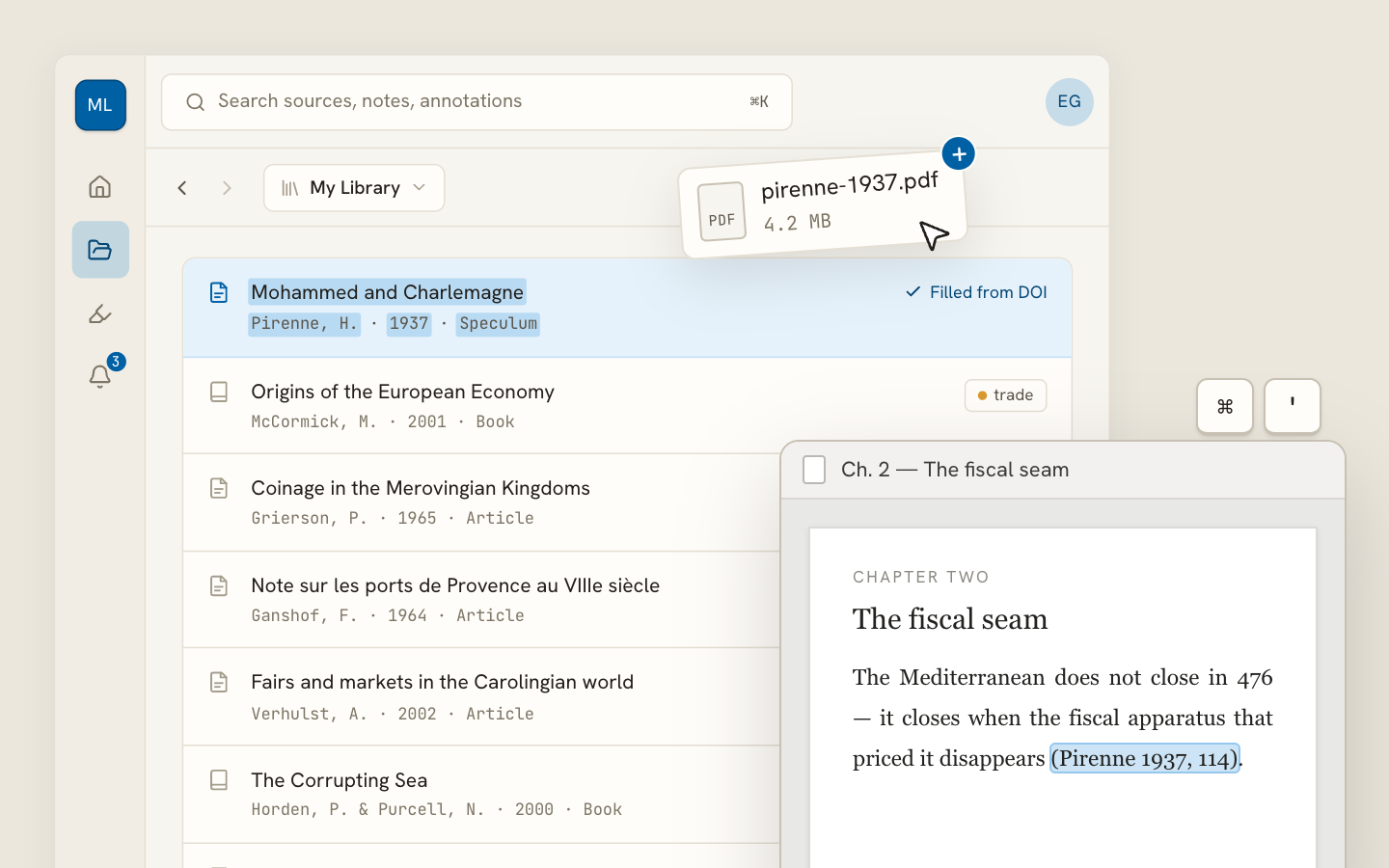
Archivero library view with a source list and an open PDF

Your weekly research workflow, in one email

One tested workflow, three links, no filler — every Tuesday.

Unsubscribe in one click. We never share your address.

Guides/Citations/MLA Citation Style

How to Cite ChatGPT & AI-Generated Content in MLA

MLA's guidance for citing output from ChatGPT, DALL-E, Copilot, and other generative AI tools — including the prompt-as-title approach.

8 min readMLA

On this page

1 of 19
MLA's Position on AI-Generated ContentThe General FormatCiting AI-Generated TextChatGPTClaudeMicrosoft CopilotGoogle GeminiCiting AI-Generated ImagesDALL-EMidjourneyAdobe FireflyHandling Long or Complex PromptsExample With an Appendix ReferenceWhen You Used AI but Didn't Quote ItIn-Text Citation FormatTransparency and Academic IntegrityExample Works Cited Entries — All TogetherCommon MistakesWhat's Next
All MLA guides →

Generative AI is now part of the research and writing landscape, and MLA has responded with clear guidance on how to cite it. Whether you used ChatGPT to brainstorm ideas, asked Claude to summarize a source, or generated an image with DALL-E, you need to tell your reader exactly what you did — what tool you used, what you asked it, and when.

This page covers MLA's approach to citing AI-generated text and images, with concrete examples you can adapt to your own work.

MLA's Position on AI-Generated Content

MLA treats AI-generated content as a new kind of source — not authored by a person, but produced by a tool in response to a specific prompt. The key principles:

  1. Transparency is non-negotiable. If you used AI in your writing process, cite it. Your reader needs to know what was generated by a machine and what was written by you.
  2. The prompt is the "title." Since AI output is generated in response to your input, MLA uses your prompt (or a description of it) as the title of the work.
  3. AI is not an "author." The AI tool is treated as the container — similar to how a website is the container for a web page. The developer (OpenAI, Anthropic, Google, etc.) is the publisher.
  4. Always check with your instructor. Many instructors and institutions have specific policies on AI use that go beyond citation format. Following MLA's citation rules doesn't automatically mean your instructor permits AI-assisted work.

Important:Citing AI output correctly is a matter of academic integrity, not just formatting. Submitting AI-generated text as your own work without disclosure — even if you "cite" the tool in your Works Cited — may violate your institution's academic honesty policy. When in doubt, ask your instructor before submitting.

The General Format

MLA's format for AI-generated content follows the container system:

"Prompt or description of prompt." AI Tool Name, version (if known), Developer, Date of generation, URL (if available).

Let's break this down element by element:

ElementWhat to includeExample
TitleWhat to includeYour prompt, in quotation marks. If the prompt is long, use a shortened or descriptive version.Example"Describe the symbolism of water in Beloved by Toni Morrison"
ContainerWhat to includeThe name of the AI tool, italicizedExampleChatGPT
VersionWhat to includeThe model version, if knownExampleGPT-4o
PublisherWhat to includeThe company that developed the toolExampleOpenAI
DateWhat to includeThe date you generated the outputExample15 Feb. 2026
URLWhat to includeA link to the conversation, if the tool provides shareable linksExamplehttps://chat.openai.com/share/abc123

Citing AI-Generated Text

ChatGPT

Works Cited:

"Describe the symbolism of water in Beloved by Toni Morrison." ChatGPT, GPT-4o, OpenAI, 15 Feb. 2026, https://chat.openai.com/share/abc123.

In-text citation:

Parenthetical:The tool suggested that water in Beloved represents both "the Middle Passage and the possibility of baptismal renewal" ("Describe the symbolism").

Signal phrase:When prompted to describe the symbolism of water in Beloved, ChatGPT noted that water represents "the Middle Passage and the possibility of baptismal renewal" ("Describe the symbolism").

What to notice:

  • The prompt is the "title" — cited in shortened form in the in-text citation, just like a shortened article title
  • ChatGPT is italicized as the container
  • The model version follows the container name
  • The date is when you generated the output, not a publication date

Claude

"Summarize the key arguments in Sandra Gilbert and Susan Gubar's The Madwoman in the Attic." Claude, Claude 3.5 Sonnet, Anthropic, 20 Jan. 2026.

Microsoft Copilot

"What are the main differences between MLA 8th and 9th edition citation formats?" Microsoft Copilot, GPT-4, Microsoft, 10 Mar. 2026.

Google Gemini

"Explain the concept of the unreliable narrator in literary criticism." Gemini, Gemini 1.5 Pro, Google, 5 Feb. 2026.

Citing AI-Generated Images

When you use an AI tool to generate an image (DALL-E, Midjourney, Stable Diffusion), the citation follows the same logic — but the prompt describes a visual output rather than text.

DALL-E

Works Cited:

"A watercolor painting of a Victorian library with floor-to-ceiling bookshelves and a reading lamp." DALL-E, version 3, OpenAI, 18 Feb. 2026.

In-text citation — caption format:

Fig. 1. AI-generated image of a Victorian library; generated using DALL-E, version 3, OpenAI, 18 Feb. 2026.

Midjourney

"An impressionist oil painting of a student writing at a desk surrounded by open books, warm golden light." Midjourney, version 6, Midjourney, 22 Feb. 2026.

Adobe Firefly

"A photograph-style image of an annotated bibliography page with highlighted text." Adobe Firefly, version 3, Adobe, 1 Mar. 2026.

For more on placing images in your paper, see MLA Images, Tables & Figures.

Handling Long or Complex Prompts

Sometimes a prompt is too long to use as a title — you might have provided a multi-paragraph instruction, a conversation with multiple follow-up prompts, or a prompt with code or data. In these cases, MLA advises:

  1. Shorten the prompt to a representative phrase and use that as the title
  2. Include the full prompt in an appendix at the end of your paper, and reference it in your text

Example With an Appendix Reference

Works Cited:

"Analyze the narrative structure of Beloved." ChatGPT, GPT-4o, OpenAI, 15 Feb. 2026. See Appendix A for the full prompt and output.

In the appendix, reproduce the entire prompt-and-response exchange, labeled clearly:

Appendix A: ChatGPT Prompt and Output

Prompt:"I'm writing a literary analysis essay about Toni Morrison's Beloved. Can you analyze the narrative structure of the novel, focusing on how Morrison uses nonlinear chronology, multiple perspectives, and the interplay between memory and present action? Please include specific examples from the text."

Output:[Full response reproduced here]

This approach gives your reader full transparency while keeping the Works Cited entry manageable.

When You Used AI but Didn't Quote It

What if you used ChatGPT to brainstorm ideas, outline your paper, or check your grammar — but didn't directly quote or paraphrase any of the output? MLA's guidance is less prescriptive here, but best practice is:

  • If the AI output meaningfully shaped your argument — even if you rewrote it entirely — disclose the use. You might include a note in your paper's introduction or a statement at the end.
  • If the AI was used like a spell-checker or thesaurus — as a mechanical aid rather than a source of ideas — citation may not be necessary. But when in doubt, disclose.
  • Always follow your instructor's policy. Many instructors require disclosure of any AI use, regardless of whether the output was cited directly.

A useful test:If someone else used the same AI tool with the same prompt and got the same (or similar) output, and that output influenced your paper, cite it. If the AI's role was purely mechanical (like fixing a typo), citation is likely unnecessary.

In-Text Citation Format

In-text citations for AI-generated content follow the standard MLA pattern — use the first element of the Works Cited entry (the shortened prompt title) since there is no author:

Citation TypeFormatExample
ParentheticalFormat("Shortened Prompt Title")Example("Describe the symbolism")
Signal phraseFormatAccording to ChatGPT, … ("Shortened Prompt Title")ExampleAccording to ChatGPT, water in the novel symbolizes … ("Describe the symbolism").

Since the "author" is effectively the prompt (a title), place it in quotation marks in the parenthetical citation — just as you would for any source cited by title. For more on citing sources with no traditional author, see How to Cite a Source With No Author in MLA.

Transparency and Academic Integrity

Beyond formatting, here are the principles that should guide your use of AI in academic work:

  1. Disclose early. If your paper relies on AI-generated content, mention it in the introduction or methodology section — don't wait for the Works Cited page to reveal it.
  2. Verify AI output. AI tools hallucinate — they generate plausible-sounding information that may be factually wrong. If an AI tool suggests a source, find it yourself and verify it exists before citing it.
  3. Don't use AI to bypass learning. If the assignment is designed to develop your critical thinking or research skills, using AI to generate your argument defeats the purpose — even if you cite it properly.
  4. Check institutional policies. Your university, department, or instructor may have policies that restrict or prohibit AI use in assignments. These policies override MLA's citation guidance.
  5. Document your process. Save your prompts and the AI's responses. If your instructor questions your use of AI, you'll be able to show exactly what you asked and what you received.

Example Works Cited Entries — All Together

Here's what a Works Cited page might look like when it includes AI-generated sources alongside traditional ones:

"Analyze the narrative structure of Beloved." ChatGPT, GPT-4o, OpenAI, 15 Feb. 2026, https://chat.openai.com/share/abc123.

"A watercolor painting of a Victorian library with floor-to-ceiling bookshelves." DALL-E, version 3, OpenAI, 18 Feb. 2026.

Morrison, Toni. Beloved. Vintage Books, 2004.

"Summarize the key arguments in The Madwoman in the Attic." Claude, Claude 3.5 Sonnet, Anthropic, 20 Jan. 2026.

Wong, Cynthia F. Kazuo Ishiguro. 2nd ed., Northcote House, 2005.

AI entries are alphabetized by their title (the prompt), just like any other source without a traditional author. They sit alongside books, articles, and websites in the same alphabetical list.

Common Mistakes

  1. Listing the AI tool as the author. ChatGPT is not the author — it's the container. The entry begins with the prompt as the title.
  2. Omitting the version. If you know the model version (GPT-4o, Claude 3.5 Sonnet), include it. It helps your reader understand what tool produced the output.
  3. Using a generic title. "ChatGPT response" is too vague. Use your actual prompt (or a shortened version of it) as the title.
  4. Forgetting the date. AI output is ephemeral — the same prompt might produce different results on different days. The date you generated the output is essential.
  5. Not verifying AI claims. If the AI says Toni Morrison published Beloved in 1987, verify that independently. AI tools are not reliable factual sources — they're text generators.
  6. Assuming citation equals permission. Citing AI correctly doesn't mean your instructor allows AI use. Always check institutional and course-specific policies.

What's Next

Now that you know how to cite AI-generated content, explore related guides:

  • MLA Works Cited Page — how to format the complete Works Cited page
  • How to Cite a Website in MLA Format — for web-based sources alongside AI citations
  • How to Cite a Source With No Author in MLA — the broader rules for sources without traditional authors

If you're using AI as a research tool alongside traditional sources, Archivero helps you keep everything organized — your library stores all your sources in one place, and MLA citations are generated automatically.

All MLA guides →
← PreviousMLA Citation With Multiple AuthorsNext →MLA Annotated Bibliography

More on MLA style

The standard in literature, the humanities and cultural studies. The author–page system, Works Cited entries and the 9th edition's container model.

View all 27 guides →
8 sections·9 min readMLAMLA Annotated Bibliography7 sections·10 min readMLACommon MLA Format Mistakes (and How to Fix Them)8 sections·8 min readMLAHow to Paraphrase in MLA9 sections·6 min readMLAHow to Cite a Source With No Author in MLA

Your sources, PDFs and citations in one library

  • Import a Zotero, Mendeley or EndNote library — or a folder of PDFs
  • Highlight and annotate without leaving the source
  • Cite in any CSL style as you write, with one shared library for your lab
Request early accessSee the product →
Archivero library view with a source list and an open PDF

Your weekly research workflow, in one email

One tested workflow, three links, no filler — every Tuesday.

Unsubscribe in one click. We never share your address.