An indirect source is a passage you found quoted or cited in someone else's work — not in the original. MLA marks these with the abbreviation "qtd. in" (quoted in) to signal that you're relying on a secondhand account. The Works Cited entry lists only the source you actually read, not the original.
Indirect citation is common in the humanities. A biography quotes from a letter. A textbook paraphrases a speech. A literary critic reproduces a passage from an interview. In all these cases, you read the secondary source — but the ideas belong to the original speaker or writer. MLA needs you to be transparent about that chain.
What Is an Indirect Source?
An indirect source arises when:
- A biography quotes from the subject's letters, diaries, or interviews
- A textbook excerpts or paraphrases a primary source
- A critical essay reproduces a passage from another critic's work
- A news article quotes a spokesperson or expert
- A review cites data or findings from the original study
In each case, you didn't read the original — you read someone else's reproduction of it.
When Is Indirect Citation Acceptable?
MLA considers indirect citation a last resort. Always try to find the original source first. Indirect citation is acceptable when:
- The original source is out of print, untranslated, or otherwise inaccessible
- The original is in a restricted archive you can't access
- The passage comes from a personal communication (letter, interview, conversation) that only exists in the secondary source
- You've made a good-faith effort to locate the original and could not find it
If the original is readily available — a published book, a journal article in a database, a speech transcript online — go to the original. Citing it directly is always more credible than citing it secondhand.
In-Text Citation Format — "qtd. in"
When you must cite indirectly, use the abbreviation "qtd. in" before the author of the source you actually read:
Parenthetical Citation
Baldwin described writing as "a political act, whether the writer knows it or not" (qtd. in Cowley 141).
What to notice:
- "qtd. in" is lowercase and not italicized
- Cowley is the author of the source you read
- 141 is the page number in Cowley's book where Baldwin's words appear
- The period goes after the closing parenthesis
Signal-Phrase Citation
According to Baldwin, as quoted in Cowley, writing is always "a political act, whether the writer knows it or not" (141).
In the signal phrase, you can name both the original speaker (Baldwin) and the secondary source author (Cowley) to give the reader full context.
Paraphrasing an Indirect Source
"qtd. in" applies to paraphrases too, not just direct quotations:
Baldwin believed that all writing carries inherent political significance, regardless of the writer's intent (qtd. in Cowley 141).
What Goes on the Works Cited Page
Only the source you actually read appears on the Works Cited page. The original author does not get a separate entry.
Example
You read Cowley's book, which quotes Baldwin:
Works Cited:
Cowley, Malcolm. The Literary Situation. Viking Press, 1954.
You do not add a separate entry for Baldwin's original statement (since you didn't read its original publication).
Why?
The Works Cited page is a list of sources you consulted. If you didn't read Baldwin's original essay or interview, you cannot list it as if you did. The "qtd. in" citation in your text tells the reader where to look — page 141 of Cowley — so they can trace the chain themselves.
Examples by Source Type
Textbook Quoting an Interview
Toni Morrison once remarked that she writes "the kind of books I want to read" (qtd. in Henderson 235).
Works Cited:
Henderson, Mae G. Toni Morrison: A Critical Companion. Oxford UP, 2019.
Biography Quoting a Letter
In a 1945 letter, Woolf confessed that revising Mrs Dalloway felt like "tunnelling — one tunnel connects with another" (qtd. in Lee 372).
Works Cited:
Lee, Hermione. Virginia Woolf. Vintage Books, 1999.
News Article Quoting a Spokesperson
The university's provost stated that "academic freedom remains the cornerstone of our mission" (qtd. in Ramírez).
Works Cited:
Ramírez, Alejandra. "Faculty Senate Debates New Policy." The Campus Herald, 10 Mar. 2025, https://campusherald.edu/faculty-senate-debates-policy.
Critical Essay Citing Another Critic
Derrida's concept of différance has been described by later critics as "the keystone of poststructuralist thought" (qtd. in Eagleton 128).
Works Cited:
Eagleton, Terry. Literary Theory: An Introduction. 3rd ed., U of Minnesota P, 2008.
How to Track Down the Original Source
Before resorting to "qtd. in," try these strategies:
- Check the secondary source's bibliography. The author you're reading likely cited the original — look up that citation and search for it.
- Search library databases. JSTOR, Project MUSE, EBSCOhost, and Google Scholar are good starting points for articles, interviews, and books.
- Search for the exact quotation. Paste the quoted text into Google Scholar or a database search — you may find the original publication.
- Check archive.org or HathiTrust. Out-of-print books are often digitized in these collections.
- Ask a librarian. Reference librarians specialize in tracking down hard-to-find sources.
If you locate the original, cite it directly and skip the "qtd. in." Your citation will be stronger and more credible.
Common Mistakes
- Listing the original author on the Works Cited page. If you didn't read the original source, don't include it. Only the source you actually read appears on the Works Cited page.
- Omitting "qtd. in." Without this abbreviation, the citation implies you read the original — which is misleading if you didn't.
- Using "qtd. in" when you could cite the original directly. If the original is accessible, go to the source. "qtd. in" should be a last resort.
- Putting "qtd. in" after the author's name. The abbreviation goes before the secondary source author: (qtd. in Cowley 141), not (Cowley, qtd. in 141).
- Citing the original author in the parenthetical. The parenthetical identifies where the reader can find the material — that's the secondary source, not the original.
What's Next
Now that you understand indirect citations, explore related guides:
- MLA In-Text Citations — the full author-page citation system
- MLA Works Cited Page — how to build entries for every source type
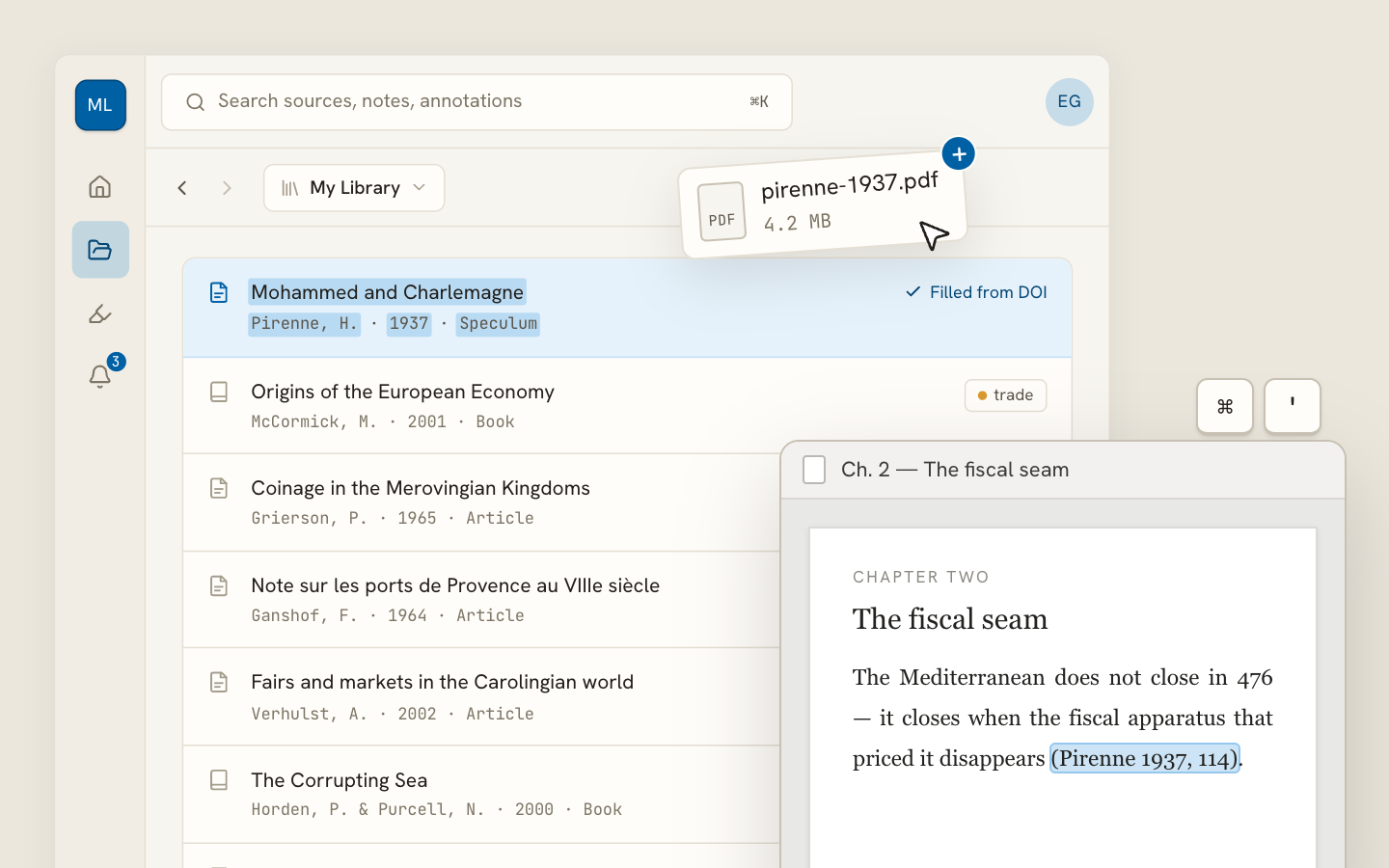
Archivero helps you track down sources and manage your citations — save a source to your library, and the Works Cited entry is generated automatically with all the elements in the right order.