Archivero is in early access — your sources, PDFs and citations in one library.Request early access →
Archivero/guides/
APAMLAHarvardThesis writing
Subscribe
Archivero/guides/Request early access →

Guides

APA styleMLA styleHarvard referencingThesis writing

Compare

APA 6th vs 7thMLA 8th vs 9thHarvard vs APAThesis vs dissertation

Product

FeaturesEarly access

Resources

DocsCheat sheetsNewsletter

Company

ContactStatus ↗
© 2025–2026 Ernesto F. GonzálezGuidesDocsContactPrivacyTerms
Guides/Citations/MLA Citation Style

How to Cite a Poem or Song in MLA Format

MLA 9th edition formats for quoting and citing poems, song lyrics, and spoken-word pieces — including line numbers and slash notation.

7 min readMLA

Key Takeaways

  • Quote up to 3 lines of poetry inline using slash notation with spaces around each slash:
    • "My heart aches, and a drowsy numbness pains / My sense, as though of hemlock I had drunk" (lines 1–2).
  • Quote 4 or more lines of poetry as a block quotation — indented 0.5 inches, with line breaks preserved.
  • Use line numbers instead of page numbers in in-text citations:
    • (lines 1–2) for the first citation; (3–4) after that
  • Write "lines" in the first citation, then use numbers only in subsequent citations to avoid ambiguity with page numbers.
  • A poem from an anthology uses the container system — the poem title in quotation marks, the anthology title in italics.
  • Song lyrics follow the same quoting rules, but always check copyright before reproducing lyrics in published work.
  • The Works Cited entry format depends on where you found the poem — a book, anthology, website, or streaming platform.

On this page

1 of 21
Key TakeawaysQuoting Up to 3 Lines of Poetry — Slash NotationTwo LinesThree LinesQuoting 4 or More Lines — Block QuotationUsing Line Numbers Instead of Page NumbersFirst ReferenceSubsequent ReferencesWhen the Work Has No Line NumbersAct, Scene, and LineCiting a Poem from a Book by a Single AuthorCiting a Poem from an AnthologyCiting a Poem Found OnlineSong LyricsWorks Cited Entry for a SongSong Accessed on a Streaming PlatformCopyright CautionQuoting Drama (Verse Plays)In-Text Citation Quick ReferenceCommon MistakesWhat's Next
All MLA guides →

Poetry and song lyrics are primary texts in literary analysis, and MLA has specific rules for quoting them. Short excerpts (up to three lines of verse) use slash notation inline with your text, while longer passages get their own block quotation format. Instead of page numbers, you cite line numbers — a convention unique to verse.

Whether you're analyzing a Shakespearean sonnet, a contemporary spoken-word piece, or a song from a concept album, the citation and formatting principles are the same. The key differences from prose citation are the slash notation for short excerpts and the use of line numbers.

Quoting Up to 3 Lines of Poetry — Slash Notation

When you quote three or fewer lines of verse, embed them in your text. Use a forward slash ( / ) with a space on each side to indicate where line breaks fall in the original:

Keats opens "Ode to a Nightingale" with a declaration of physical distress: "My heart aches, and a drowsy numbness pains / My sense, as though of hemlock I had drunk" (lines 1–2).

Format rules:

  • Enclose the quotation in double quotation marks
  • Use / (space-slash-space) to mark line breaks
  • Preserve the original capitalization at the beginning of each new line
  • The parenthetical citation follows the closing quotation mark, before the period
  • Write "lines" in the first citation from that poem; after that, use just numbers: (5–6)

Two Lines

Eliot's speaker measures life in domestic triviality: "I have measured out my life with coffee spoons; / I know the voices dying with a dying fall" (lines 51–52).

Three Lines

Dickinson compresses the whole arc of hope into three lines: "Hope is the thing with feathers / That perches in the soul, / And sings the tune without the words" (lines 1–3).

If a quotation crosses a stanza break, use a double slash ( // ) to indicate it:

"And miles to go before I sleep, // And miles to go before I sleep" (lines 15–16).

Quoting 4 or More Lines — Block Quotation

If you're quoting four or more lines of verse, set the passage apart as a block quotation:

  1. Introduce the quotation with a sentence that provides context
  2. Indent the entire quotation 0.5 inches from the left margin
  3. Preserve the original line breaks — reproduce the poem's formatting
  4. Do not use quotation marks (the indentation signals it's a quotation)
  5. Place the parenthetical citation after the final punctuation mark

Keats captures the speaker's sensory overload in the opening stanza:

    My heart aches, and a drowsy numbness pains

    My sense, as though of hemlock I had drunk,

    Or emptied some dull opiate to the drains

    One minute past, and Lethe-wards had sunk. (lines 1–4)

What to notice:

  • No quotation marks
  • Each line of verse starts on its own line, preserving the original layout
  • The parenthetical appears after the period on the last line
  • If the poem uses unusual spacing or indentation, try to reproduce it

Using Line Numbers Instead of Page Numbers

Poetry citations use line numbers, not page numbers. This is one of the key differences between citing verse and citing prose.

First Reference

The first time you cite lines from a poem, use the word "lines" to make clear that the numbers refer to lines, not pages:

(lines 1–4)

Subsequent References

After establishing that you're citing line numbers, use just the numbers:

(12–14)

When the Work Has No Line Numbers

If the poem doesn't have printed line numbers (common in short poems and web publications), count the lines yourself starting from the first line of the poem.

Act, Scene, and Line

For verse plays (Shakespeare, Marlowe, Sophocles), cite by act, scene, and line separated by periods:

(3.1.56–58)

This tells the reader: Act 3, Scene 1, lines 56–58.

Citing a Poem from a Book by a Single Author

If the poem comes from a collection by the poet:

Works Cited:

Oliver, Mary. "The Summer Day." House of Light. Beacon Press, 1990, p. 60.

In-text citation:

(Oliver, lines 1–2) — first reference

(Oliver 3–4) — subsequent references

If you're citing the entire collection, not an individual poem:

Oliver, Mary. House of Light. Beacon Press, 1990.

Citing a Poem from an Anthology

Anthologies use the container system. The poem is the work; the anthology is the container:

Works Cited:

Brooks, Gwendolyn. "We Real Cool." The Norton Anthology of Poetry, edited by Margaret Ferguson et al., 6th ed., W. W. Norton, 2018, p. 1590.

In-text citation:

(Brooks, lines 1–4)

What to notice:

  • The poem title is in quotation marks (it's a short work inside a larger container)
  • The anthology title is in italics (it's the container)
  • Include the editor(s), edition, publisher, year, and page number

Citing a Poem Found Online

If you accessed the poem on a website rather than in a book:

Works Cited:

Angelou, Maya. "Still I Rise." Poetry Foundation, https://www.poetryfoundation.org/poems/46446/still-i-rise.

In-text citation:

(Angelou, lines 1–3)

If the website provides a date of publication or posting, include it:

Hughes, Langston. "Harlem." Academy of American Poets, 1951, https://poets.org/poem/harlem.

Song Lyrics

Song lyrics follow the same quoting rules as poetry: slash notation for up to three lines, block quotation for four or more, and line numbers if you're analyzing specific lines.

Works Cited Entry for a Song

Treat the songwriter as the author. The song title goes in quotation marks; the album title is the container in italics:

Works Cited:

Mitchell, Joni. "A Case of You." Blue, Reprise Records, 1971.

In-text citation:

(Mitchell)

Song Accessed on a Streaming Platform

If you listened to the song on Spotify, Apple Music, or another streaming service, include the platform as a second container:

Works Cited:

Lamar, Kendrick. "Alright." To Pimp a Butterfly, Top Dawg Entertainment, 2015. Spotify, https://open.spotify.com/track/3iVcZ5G6tvkXZkZKlMpIUs.

In-text citation:

(Lamar)

Copyright Caution

Song lyrics are copyrighted, and reproducing them at length can raise legal issues — especially in published writing. For a classroom paper, quoting a few lines for analysis typically falls under fair use. But if you're publishing your work (online, in a journal, or in a book), you may need permission from the rights holder. When in doubt, paraphrase the lyrics and cite the recording instead of quoting verbatim.

Quoting Drama (Verse Plays)

Verse plays — Shakespeare, Marlowe, Molière in verse translation — have their own Works Cited formats, in-text citation rules, and block-quotation conventions. For the complete guide to citing published plays, verse drama, prose plays, and live performances, see How to Cite a Play in MLA Format.

In-Text Citation Quick Reference

Source TypeWorks Cited Starts WithIn-Text Citation
Poem (single-author collection)Works Cited Starts WithOliver, Mary. "The Summer Day."In-Text Citation(Oliver, lines 1–2)
Poem (anthology)Works Cited Starts WithBrooks, Gwendolyn. "We Real Cool."In-Text Citation(Brooks, lines 1–4)
Poem (website)Works Cited Starts WithAngelou, Maya. "Still I Rise."In-Text Citation(Angelou, lines 1–3)
Song (album)Works Cited Starts WithMitchell, Joni. "A Case of You."In-Text Citation(Mitchell)
Song (streaming)Works Cited Starts WithLamar, Kendrick. "Alright."In-Text Citation(Lamar)
Verse playWorks Cited Starts WithShakespeare, William. Hamlet.In-Text Citation(3.1.56–59) — see plays guide

Common Mistakes

  1. Using page numbers instead of line numbers. For poetry, always cite line numbers — not page numbers. Write "lines" in your first citation so the reader knows.
  2. Forgetting the word "lines" in the first citation. Without it, the reader might think the numbers refer to pages. Write (lines 1–3) the first time; then (5–7) after that.
  3. Omitting spaces around the slash. The slash in inline poetry quotations has a space on each side: "word / word" — not "word/word."
  4. Using slash notation for 4+ lines. If you're quoting four or more lines, switch to a block quotation. Slash notation becomes unreadable with long passages.
  5. Adding quotation marks to a block quotation. Block quotations don't use quotation marks — the indentation signals that it's a quotation.
  6. Citing the anthology editor as the poem's author. The poet is the author. The editor is credited in the container information.

What's Next

Now that you know how to cite poetry and song lyrics, explore related guides:

  • How to Cite a Play in MLA Format — citing published plays, verse drama, and live performances
  • How to Use Block Quotes in MLA Format — the complete guide to short and long quotations
  • MLA In-Text Citations — the full author-page citation system
  • How to Cite a Book in MLA Format — for citing poetry collections and anthologies

Archivero can help you manage your poetry sources — save a poem page or anthology to your library, and the Works Cited entry is generated automatically with the correct container formatting.
All MLA guides →
← PreviousMLA Title Page & First Page FormatNext →How to Cite a Play in MLA Format

More on MLA style

The standard in literature, the humanities and cultural studies. The author–page system, Works Cited entries and the 9th edition's container model.

View all 27 guides →
10 sections·10 min readMLAHow to Cite a Play in MLA Format8 sections·6 min readMLAHow to Cite an Indirect Source in MLA11 sections·7 min readMLAHow to Cite Government & Legal Sources in MLA Format7 sections·5 min readMLAHow to Cite an Interview in MLA Format

Your sources, PDFs and citations in one library

  • Import a Zotero, Mendeley or EndNote library — or a folder of PDFs
  • Highlight and annotate without leaving the source
  • Cite in any CSL style as you write, with one shared library for your lab
Request early accessSee the product →
Archivero library view with a source list and an open PDF

Your weekly research workflow, in one email

One tested workflow, three links, no filler — every Tuesday.

Unsubscribe in one click. We never share your address.

Guides/Citations/MLA Citation Style

How to Cite a Poem or Song in MLA Format

MLA 9th edition formats for quoting and citing poems, song lyrics, and spoken-word pieces — including line numbers and slash notation.

7 min readMLA

Key Takeaways

  • Quote up to 3 lines of poetry inline using slash notation with spaces around each slash:
    • "My heart aches, and a drowsy numbness pains / My sense, as though of hemlock I had drunk" (lines 1–2).
  • Quote 4 or more lines of poetry as a block quotation — indented 0.5 inches, with line breaks preserved.
  • Use line numbers instead of page numbers in in-text citations:
    • (lines 1–2) for the first citation; (3–4) after that
  • Write "lines" in the first citation, then use numbers only in subsequent citations to avoid ambiguity with page numbers.
  • A poem from an anthology uses the container system — the poem title in quotation marks, the anthology title in italics.
  • Song lyrics follow the same quoting rules, but always check copyright before reproducing lyrics in published work.
  • The Works Cited entry format depends on where you found the poem — a book, anthology, website, or streaming platform.

On this page

1 of 21
Key TakeawaysQuoting Up to 3 Lines of Poetry — Slash NotationTwo LinesThree LinesQuoting 4 or More Lines — Block QuotationUsing Line Numbers Instead of Page NumbersFirst ReferenceSubsequent ReferencesWhen the Work Has No Line NumbersAct, Scene, and LineCiting a Poem from a Book by a Single AuthorCiting a Poem from an AnthologyCiting a Poem Found OnlineSong LyricsWorks Cited Entry for a SongSong Accessed on a Streaming PlatformCopyright CautionQuoting Drama (Verse Plays)In-Text Citation Quick ReferenceCommon MistakesWhat's Next
All MLA guides →

Poetry and song lyrics are primary texts in literary analysis, and MLA has specific rules for quoting them. Short excerpts (up to three lines of verse) use slash notation inline with your text, while longer passages get their own block quotation format. Instead of page numbers, you cite line numbers — a convention unique to verse.

Whether you're analyzing a Shakespearean sonnet, a contemporary spoken-word piece, or a song from a concept album, the citation and formatting principles are the same. The key differences from prose citation are the slash notation for short excerpts and the use of line numbers.

Quoting Up to 3 Lines of Poetry — Slash Notation

When you quote three or fewer lines of verse, embed them in your text. Use a forward slash ( / ) with a space on each side to indicate where line breaks fall in the original:

Keats opens "Ode to a Nightingale" with a declaration of physical distress: "My heart aches, and a drowsy numbness pains / My sense, as though of hemlock I had drunk" (lines 1–2).

Format rules:

  • Enclose the quotation in double quotation marks
  • Use / (space-slash-space) to mark line breaks
  • Preserve the original capitalization at the beginning of each new line
  • The parenthetical citation follows the closing quotation mark, before the period
  • Write "lines" in the first citation from that poem; after that, use just numbers: (5–6)

Two Lines

Eliot's speaker measures life in domestic triviality: "I have measured out my life with coffee spoons; / I know the voices dying with a dying fall" (lines 51–52).

Three Lines

Dickinson compresses the whole arc of hope into three lines: "Hope is the thing with feathers / That perches in the soul, / And sings the tune without the words" (lines 1–3).

If a quotation crosses a stanza break, use a double slash ( // ) to indicate it:

"And miles to go before I sleep, // And miles to go before I sleep" (lines 15–16).

Quoting 4 or More Lines — Block Quotation

If you're quoting four or more lines of verse, set the passage apart as a block quotation:

  1. Introduce the quotation with a sentence that provides context
  2. Indent the entire quotation 0.5 inches from the left margin
  3. Preserve the original line breaks — reproduce the poem's formatting
  4. Do not use quotation marks (the indentation signals it's a quotation)
  5. Place the parenthetical citation after the final punctuation mark

Keats captures the speaker's sensory overload in the opening stanza:

    My heart aches, and a drowsy numbness pains

    My sense, as though of hemlock I had drunk,

    Or emptied some dull opiate to the drains

    One minute past, and Lethe-wards had sunk. (lines 1–4)

What to notice:

  • No quotation marks
  • Each line of verse starts on its own line, preserving the original layout
  • The parenthetical appears after the period on the last line
  • If the poem uses unusual spacing or indentation, try to reproduce it

Using Line Numbers Instead of Page Numbers

Poetry citations use line numbers, not page numbers. This is one of the key differences between citing verse and citing prose.

First Reference

The first time you cite lines from a poem, use the word "lines" to make clear that the numbers refer to lines, not pages:

(lines 1–4)

Subsequent References

After establishing that you're citing line numbers, use just the numbers:

(12–14)

When the Work Has No Line Numbers

If the poem doesn't have printed line numbers (common in short poems and web publications), count the lines yourself starting from the first line of the poem.

Act, Scene, and Line

For verse plays (Shakespeare, Marlowe, Sophocles), cite by act, scene, and line separated by periods:

(3.1.56–58)

This tells the reader: Act 3, Scene 1, lines 56–58.

Citing a Poem from a Book by a Single Author

If the poem comes from a collection by the poet:

Works Cited:

Oliver, Mary. "The Summer Day." House of Light. Beacon Press, 1990, p. 60.

In-text citation:

(Oliver, lines 1–2) — first reference

(Oliver 3–4) — subsequent references

If you're citing the entire collection, not an individual poem:

Oliver, Mary. House of Light. Beacon Press, 1990.

Citing a Poem from an Anthology

Anthologies use the container system. The poem is the work; the anthology is the container:

Works Cited:

Brooks, Gwendolyn. "We Real Cool." The Norton Anthology of Poetry, edited by Margaret Ferguson et al., 6th ed., W. W. Norton, 2018, p. 1590.

In-text citation:

(Brooks, lines 1–4)

What to notice:

  • The poem title is in quotation marks (it's a short work inside a larger container)
  • The anthology title is in italics (it's the container)
  • Include the editor(s), edition, publisher, year, and page number

Citing a Poem Found Online

If you accessed the poem on a website rather than in a book:

Works Cited:

Angelou, Maya. "Still I Rise." Poetry Foundation, https://www.poetryfoundation.org/poems/46446/still-i-rise.

In-text citation:

(Angelou, lines 1–3)

If the website provides a date of publication or posting, include it:

Hughes, Langston. "Harlem." Academy of American Poets, 1951, https://poets.org/poem/harlem.

Song Lyrics

Song lyrics follow the same quoting rules as poetry: slash notation for up to three lines, block quotation for four or more, and line numbers if you're analyzing specific lines.

Works Cited Entry for a Song

Treat the songwriter as the author. The song title goes in quotation marks; the album title is the container in italics:

Works Cited:

Mitchell, Joni. "A Case of You." Blue, Reprise Records, 1971.

In-text citation:

(Mitchell)

Song Accessed on a Streaming Platform

If you listened to the song on Spotify, Apple Music, or another streaming service, include the platform as a second container:

Works Cited:

Lamar, Kendrick. "Alright." To Pimp a Butterfly, Top Dawg Entertainment, 2015. Spotify, https://open.spotify.com/track/3iVcZ5G6tvkXZkZKlMpIUs.

In-text citation:

(Lamar)

Copyright Caution

Song lyrics are copyrighted, and reproducing them at length can raise legal issues — especially in published writing. For a classroom paper, quoting a few lines for analysis typically falls under fair use. But if you're publishing your work (online, in a journal, or in a book), you may need permission from the rights holder. When in doubt, paraphrase the lyrics and cite the recording instead of quoting verbatim.

Quoting Drama (Verse Plays)

Verse plays — Shakespeare, Marlowe, Molière in verse translation — have their own Works Cited formats, in-text citation rules, and block-quotation conventions. For the complete guide to citing published plays, verse drama, prose plays, and live performances, see How to Cite a Play in MLA Format.

In-Text Citation Quick Reference

Source TypeWorks Cited Starts WithIn-Text Citation
Poem (single-author collection)Works Cited Starts WithOliver, Mary. "The Summer Day."In-Text Citation(Oliver, lines 1–2)
Poem (anthology)Works Cited Starts WithBrooks, Gwendolyn. "We Real Cool."In-Text Citation(Brooks, lines 1–4)
Poem (website)Works Cited Starts WithAngelou, Maya. "Still I Rise."In-Text Citation(Angelou, lines 1–3)
Song (album)Works Cited Starts WithMitchell, Joni. "A Case of You."In-Text Citation(Mitchell)
Song (streaming)Works Cited Starts WithLamar, Kendrick. "Alright."In-Text Citation(Lamar)
Verse playWorks Cited Starts WithShakespeare, William. Hamlet.In-Text Citation(3.1.56–59) — see plays guide

Common Mistakes

  1. Using page numbers instead of line numbers. For poetry, always cite line numbers — not page numbers. Write "lines" in your first citation so the reader knows.
  2. Forgetting the word "lines" in the first citation. Without it, the reader might think the numbers refer to pages. Write (lines 1–3) the first time; then (5–7) after that.
  3. Omitting spaces around the slash. The slash in inline poetry quotations has a space on each side: "word / word" — not "word/word."
  4. Using slash notation for 4+ lines. If you're quoting four or more lines, switch to a block quotation. Slash notation becomes unreadable with long passages.
  5. Adding quotation marks to a block quotation. Block quotations don't use quotation marks — the indentation signals that it's a quotation.
  6. Citing the anthology editor as the poem's author. The poet is the author. The editor is credited in the container information.

What's Next

Now that you know how to cite poetry and song lyrics, explore related guides:

  • How to Cite a Play in MLA Format — citing published plays, verse drama, and live performances
  • How to Use Block Quotes in MLA Format — the complete guide to short and long quotations
  • MLA In-Text Citations — the full author-page citation system
  • How to Cite a Book in MLA Format — for citing poetry collections and anthologies

Archivero can help you manage your poetry sources — save a poem page or anthology to your library, and the Works Cited entry is generated automatically with the correct container formatting.

All MLA guides →
← PreviousMLA Title Page & First Page FormatNext →How to Cite a Play in MLA Format

More on MLA style

The standard in literature, the humanities and cultural studies. The author–page system, Works Cited entries and the 9th edition's container model.

View all 27 guides →
10 sections·10 min readMLAHow to Cite a Play in MLA Format8 sections·6 min readMLAHow to Cite an Indirect Source in MLA11 sections·7 min readMLAHow to Cite Government & Legal Sources in MLA Format7 sections·5 min readMLAHow to Cite an Interview in MLA Format

Your sources, PDFs and citations in one library

  • Import a Zotero, Mendeley or EndNote library — or a folder of PDFs
  • Highlight and annotate without leaving the source
  • Cite in any CSL style as you write, with one shared library for your lab
Request early accessSee the product →
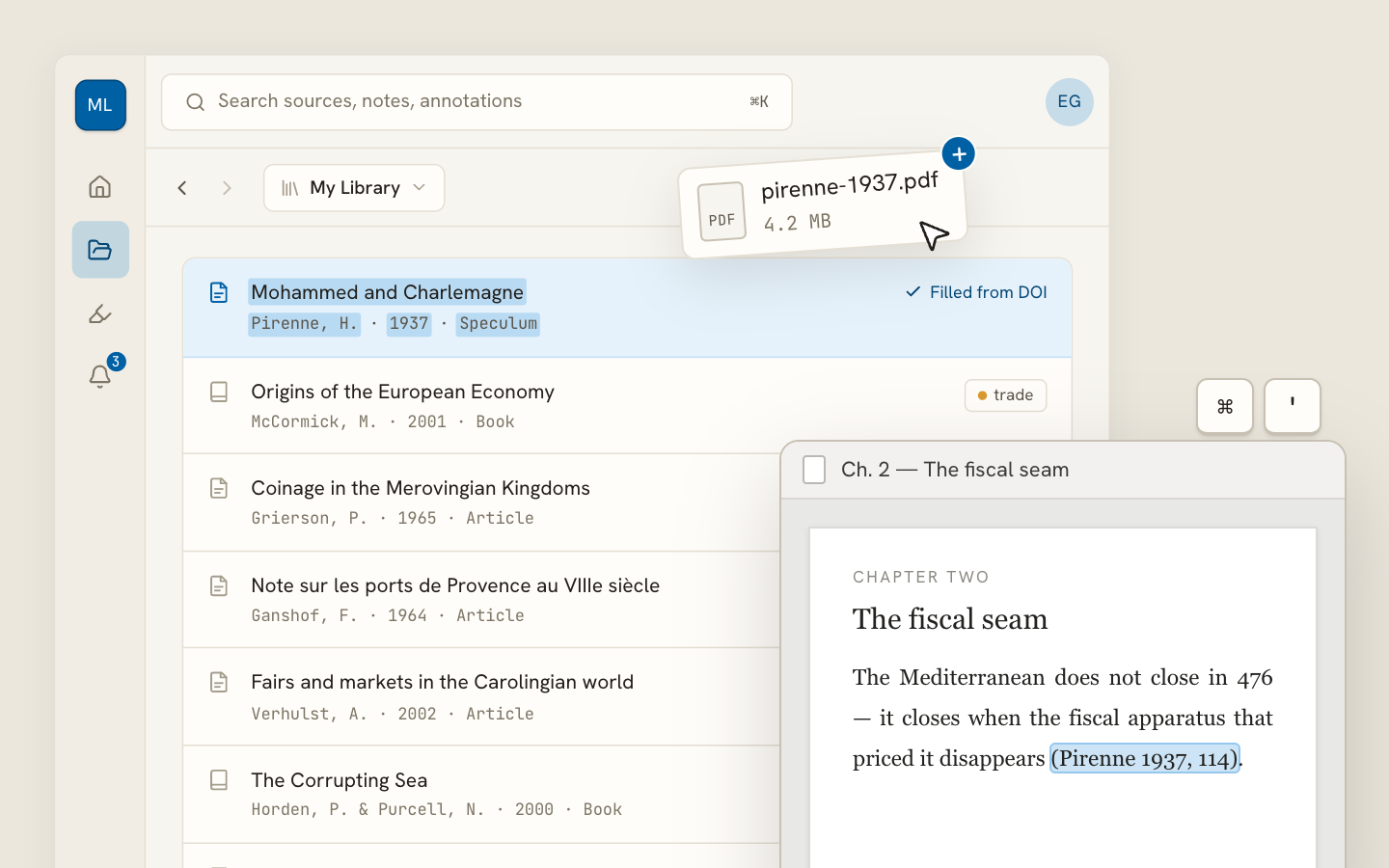
Archivero library view with a source list and an open PDF

Your weekly research workflow, in one email

One tested workflow, three links, no filler — every Tuesday.

Unsubscribe in one click. We never share your address.