Archivero is in early access — your sources, PDFs and citations in one library.Request early access →
Archivero/guides/
APAMLAHarvardThesis writing
Subscribe
Archivero/guides/Request early access →

Guides

APA styleMLA styleHarvard referencingThesis writing

Compare

APA 6th vs 7thMLA 8th vs 9thHarvard vs APAThesis vs dissertation

Product

FeaturesEarly access

Resources

DocsCheat sheetsNewsletter

Company

ContactStatus ↗
© 2025–2026 Ernesto F. GonzálezGuidesDocsContactPrivacyTerms
Guides/Citations/MLA Citation Style

MLA Date Format: How to Write Dates in MLA

MLA writes dates day month year: 15 Oct. 2026 in a Works Cited entry, 15 October 2026 in your heading. Month abbreviations, seasons, ranges and no-date rules.

15 Nov 2026·9 min readMLA

Key Takeaways

  • The default form is day month year, with no comma: 15 October 2026.
  • In a Works Cited entry, abbreviate months whose names run longer than four letters: 15 Oct. 2026. May, June, and July stay whole.
  • In prose you may use either day-month-year or month-day-year, but pick one and keep it: "4 September 2018" or "September 4, 2018."
  • Seasons are lowercase in a Works Cited entry: spring 2008, not Spring 2008.
  • When a source has no date, omit the date element. MLA has no "n.d."

On this page

1 of 19
Key TakeawaysThe Three Places a Date AppearsDay Month Year: the Default FormMonth Abbreviations in a Works Cited EntryThe Date in a Works Cited EntrySeasonsDate RangesThe Date in Your Paper's HeadingDates in Your ProseWhen a Source Has No DateAccess DatesDate Mistakes to AvoidFrequently Asked QuestionsHow do I cite dates in MLA style?Does MLA require a date in the in-text citation?Does MLA have to include the date accessed?Does an MLA citation need the year?Do I put the due date or today's date on my paper?What's Next
More on MLA ↓4 of 28

The MLA date format is day month year: 15 October 2026, with no comma. Which form you write depends on where the date sits: in a Works Cited entry the month is abbreviated when its name runs longer than four letters (15 Oct. 2026), and in your paper's heading and in your prose it is spelled out in full. In prose MLA also allows the month-day-year style (October 15, 2026) as long as you use one style consistently.

Where the date appearsFormExample
The heading on your first pageFormDay month year, month spelled outExample15 October 2026
Your proseFormDay month year, or month-day-year with commasExample15 October 2026, or October 15, 2026
A Works Cited entryFormDay month year, month abbreviatedExample15 Oct. 2026

Between the three it is only the month's form that changes. The order stays day, month, year, with one exception: in your own sentences MLA also allows month-day-year, which is the single choice it leaves you.

The Three Places a Date Appears

A date reaches your paper by three different routes, and students usually arrive at this question from just one of them:

  1. The heading. The fourth line of the block in the upper-left corner of page 1, under your name, your instructor, and the course.
  2. Your own sentences. Any date you write about: when a law passed, when a novel appeared, when an exhibit ran.
  3. A Works Cited entry. The publication date of a source, which is the eighth of MLA's nine core elements.

The rest of this guide takes them one at a time, starting with the form all three share. If you only needed one of the three, the table above has already answered you.

Day Month Year: the Default Form

A date in MLA format has three parts in one order: the day as a numeral, the month as a word, the year in full. 15 October 2026. Three details make the difference between a correct date and a corrected one:

  • No commas. In the day-month-year style, nothing separates the parts: "School started on 4 September 2018." The MLA states the rule in its answer on commas with dates.
  • No leading zero on the day. A source that prints "October 04, 2017" becomes 4 October 2017 in MLA style — the MLA says so directly.
  • No numeric dates. MLA uses no 4/15/26 or 2026-04-15 form anywhere in a paper or a Works Cited entry. The month is always a word.

Month Abbreviations in a Works Cited Entry

In a Works Cited entry, abbreviate every month whose name runs longer than four letters, and put a period after the abbreviation. That leaves three months whole: May, June, and July.

MonthIn a Works Cited entry
JanuaryJan.
FebruaryFeb.
MarchMar.
AprilApr.
MayMay
JuneJune
JulyJuly
AugustAug.
SeptemberSept.
OctoberOct.
NovemberNov.
DecemberDec.

September is the one that catches people: it abbreviates to Sept., four letters plus the period, not "Sep." And the abbreviation keeps its period even when a comma follows it — "15 Sept. 2026, pp. 40–52" has both.

The Date in a Works Cited Entry

The publication date follows the publisher and precedes the location (the page numbers, the URL, the DOI). How much of the date you give is decided by the source, not by you: give what it gives.

A book gives a year:

Morrison, Toni. Beloved. Vintage Books, 2004.

A journal issue often gives a season or a month with the year:

Belton, John. "Painting by the Numbers: The Digital Intermediate." Film Quarterly, vol. 61, no. 3, spring 2008, pp. 58–65.

A web page usually gives a full date, which is where the abbreviation rule shows up:

"How Are Commas Used in Date Ranges?" MLA Style Center, Modern Language Association of America, 17 July 2020, https://style.mla.org/commas-in-date-ranges/.

When a source carries more than one date — published 2019, updated last month — cite the one most relevant to your use of it, which for a page that has been revised is usually the last-updated date. For where the date sits among the other eight elements, see the MLA Works Cited page.

Seasons

Seasons are lowercase in a Works Cited entry: spring 2008, not Spring 2008. The ninth edition made this explicit, and the reason is consistency — MLA styles seasons lowercase in ordinary prose too, so it does the same in the publication-date element.

A season that spans two of them takes an en dash and no repetition: spring–summer 2019. If a journal prints "Winter 2019–20," keep its year range: winter 2019–20.

Date Ranges

In prose, a range follows whichever style you have chosen, and the month-day-year style needs a second comma:

  • Day-month-year: The exhibit ran from 2 June 1995 to 4 April 1996 in New York.
  • Month-day-year: The exhibit ran from June 2, 1995, to April 4, 1996, in New York.

The comma before the year "has to be balanced by one after if there is no other punctuation after the year," as the MLA puts it in its answer on commas in date ranges, quoting section 1.5 of the handbook.

In a Works Cited entry, a range of days or months is joined by an en dash rather than the word "to": 12–14 Jan. 2014, or Jan.–Feb. 2014 for a double issue.

The Date in Your Paper's Heading

The fourth line of the heading on page 1 is the date, written day month year: 15 October 2026. MLA's own guidance is looser than most teachers': in its instructions for formatting a paper the months "may be spelled out or abbreviated," and asked directly, the MLA refers students to their instructor. Spelling it out is the safer default, since nothing is ambiguous about October.

Which date? MLA sets no rule. Follow your instructor's instruction; absent one, the MLA suggests the date you finished writing. For the four lines themselves, see MLA Heading Format.

Dates in Your Prose

Prose is the one place MLA gives you a choice. Section 1.5 of the handbook asks you to "be consistent in your use of either the day-month-year style (12 January 2014) or the month-day-year style (January 12, 2014)." Choose at the start of the paper and do not switch.

The comma rules follow from the choice:

StyleExample
Day-month-yearSchool started on 4 September 2018.
Month-day-yearSchool started on September 4, 2018.
Month-day-year, mid-sentenceWe lived in Hawaii from May 3, 1965, to July 30, 1975.

Months are spelled out in prose — the abbreviations belong to the Works Cited list alone. Decades and centuries are written out: the 1990s with no apostrophe, and the twentieth century in words, hyphenated only when it modifies a noun (twentieth-century poetry).

When a Source Has No Date

Omit the date element. That is the whole rule: if the source you are citing does not give a publication date, leave it out and close up the entry around the gap.

MLA has no "n.d." The abbreviation belongs to APA, where every citation needs a year and a missing one has to be marked; MLA's entry simply ends up one element shorter. Two things you can do instead:

  • If the page shows a copyright date and nothing else, the MLA says to use the copyright date as the entry's date.
  • If there is no date of any kind, add an access date at the end, as below.

Okafor, Nnamdi. "Reading the Weather." Field Almanac, https://www.fieldalmanac.org/reading-the-weather. Accessed 12 Nov. 2026.

The no-author and no-date web cases together are covered on the citing websites guide.

Access Dates

MLA 9th edition does not require an access date. Add one in two situations: the content is likely to change (a wiki, a live dashboard), or the source carries no publication date at all. Some instructors ask for them anyway, which is a third.

The form is Accessed 12 Nov. 2026. — capital A, the month abbreviated as in any Works Cited date, and a period at the end. It goes last, after the URL:

"Magical Realism." Wikipedia, Wikimedia Foundation, 10 Feb. 2026, https://en.wikipedia.org/wiki/Magical_realism. Accessed 18 Feb. 2026.

Date Mistakes to Avoid

WrongRightWhy
04 October 2017Right4 October 2017WhyNo leading zero on the day.
Spring 2008Rightspring 2008WhySeasons are lowercase in the ninth edition.
Jones, Ada. "Tide Tables." Harbor Notes, n.d.RightJones, Ada. "Tide Tables." Harbor Notes.WhyMLA omits a missing date. "n.d." is APA.
Accessed 20 Aug 2016RightAccessed 20 Aug. 2016.WhyThe abbreviation takes a period, and so does the element.
15, October 2026Right15 October 2026WhyThe day-month-year style takes no comma.
15 October 2026, pp. 58–65Right15 Oct. 2026, pp. 58–65WhyIn a Works Cited entry, longer months abbreviate.
Sep. 2026RightSept. 2026WhyMLA's abbreviation for September is four letters.

Frequently Asked Questions

How do I cite dates in MLA style?

Give the date the source gives, in day-month-year order, with the month abbreviated if its name runs longer than four letters: 15 Oct. 2026. A book with only a year keeps the year (2004); a journal issue with a season keeps the season (spring 2008). The date sits after the publisher and before the page numbers or the URL.

Does MLA require a date in the in-text citation?

No. An MLA in-text citation is author and page number — (Morrison 212) — and carries no date at all. That is one of the clearest differences from APA, which puts the year in every citation. See MLA in-text citations for the cases where the parenthesis changes shape.

Does MLA have to include the date accessed?

No. The ninth edition treats the access date as optional and most entries do not need one. Include it when the content can change under you, when the source has no publication date, or when your instructor asks for it, and write it as "Accessed 12 Nov. 2026."

Does an MLA citation need the year?

It needs whatever date the source publishes, and for most sources that is at least a year. If a source gives no date anywhere — not in a byline, not in the metadata, not in a copyright line — the entry simply has no date element, and you may add an access date in its place.

Do I put the due date or today's date on my paper?

MLA does not say, so your instructor's instruction decides it. When there is no instruction, the MLA suggests the date you finished writing the paper. Whichever you use, write it day month year with the month spelled out: 15 October 2026.

What's Next

Dates are one element of a larger system, and these three guides from the MLA style guide cover the rest of it:

  • MLA Works Cited Page — the nine core elements, the container system, and where the date sits among them
  • MLA Heading Format: Example, Rules and Title Page — the four lines on page 1, the centered title, and the title-page question
  • Common MLA Format Mistakes (and How to Fix Them) — the errors instructors flag most often, dates among them

Every entry in a Works Cited list carries a date in one of these forms, which is a lot of small decisions for one list. Archivero keeps your sources in one library and exports the list in MLA, with the months abbreviated for you.

All MLA guides →
← PreviousMLA Works Cited PageNext →How to Cite a Website in MLA Format

MLA Handbook, 9th edition (2021), section 1.5 on date styles in prose; MLA Style Center, Formatting a Research Paper, and the Ask the MLA answers on commas with dates, commas in date ranges, lowercase seasons in works-cited entries, zeros in dates, web sources with no publication date, and dates in student paper headers
More on MLA

28 guides, in the order the section reads them. This is 4 of 28.

MLA overview →
  1. 1General Format
  2. 2In-Text Citations
  3. 3Works Cited
  4. 4DatesYou are here
  5. 5Websites
  6. 6Books
  7. 7Journal Articles
  8. 8Sample Paper
  9. 9Block Quotes
  10. 10Multiple Authors
  11. 11AI-Generated Content
  12. 12Annotated Bibliography
  13. 13Common Mistakes
  14. 14Paraphrasing
  15. 15No Author
  16. 168th vs. 9th Edition
  17. 17Videos
  18. 18Social Media
  19. 19Images & Figures
  20. 20Heading & Title Page
  21. 21Header & Page Numbers
  22. 22Poems & Song Lyrics
  23. 23Plays
  24. 24Indirect Sources
  25. 25Government & Legal Sources
  26. 26Interviews
  27. 27Encyclopedias & Dictionaries
  28. 28Dissertations & Theses
MLA overview →

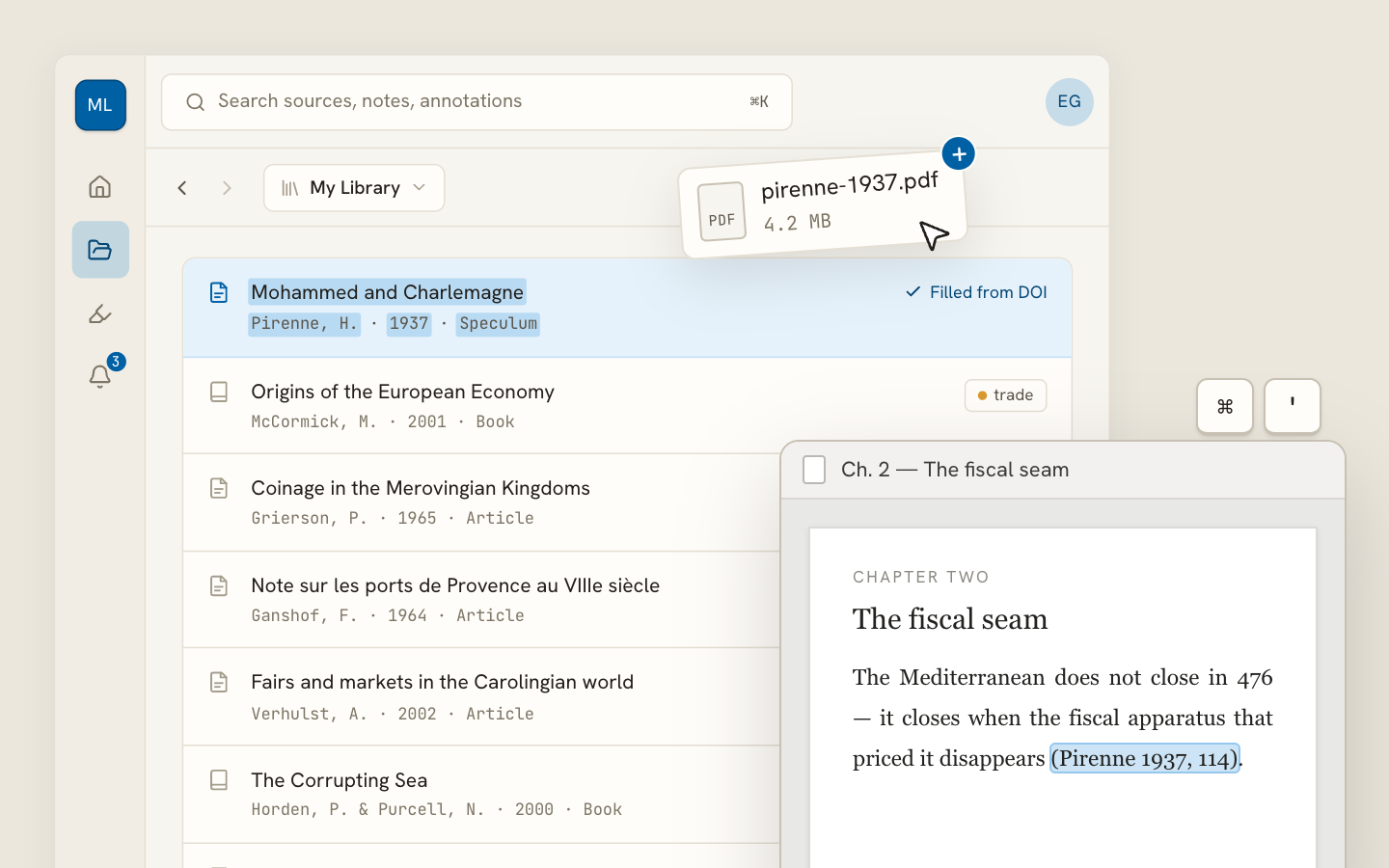
Your sources, PDFs and citations in one library

  • Import a Zotero, Mendeley or EndNote library — or a folder of PDFs
  • Highlight and annotate without leaving the source
  • Cite in any CSL style as you write, with one shared library for your lab
Request early accessSee the product →
Archivero library view with a source list and an open PDF

Your weekly research workflow, in one email

One tested workflow, three links, no filler — every Tuesday.

Unsubscribe in one click. We never share your address.

Guides/Citations/MLA Citation Style

MLA Date Format: How to Write Dates in MLA

MLA writes dates day month year: 15 Oct. 2026 in a Works Cited entry, 15 October 2026 in your heading. Month abbreviations, seasons, ranges and no-date rules.

15 Nov 2026·9 min readMLA

Key Takeaways

  • The default form is day month year, with no comma: 15 October 2026.
  • In a Works Cited entry, abbreviate months whose names run longer than four letters: 15 Oct. 2026. May, June, and July stay whole.
  • In prose you may use either day-month-year or month-day-year, but pick one and keep it: "4 September 2018" or "September 4, 2018."
  • Seasons are lowercase in a Works Cited entry: spring 2008, not Spring 2008.
  • When a source has no date, omit the date element. MLA has no "n.d."

On this page

1 of 19
Key TakeawaysThe Three Places a Date AppearsDay Month Year: the Default FormMonth Abbreviations in a Works Cited EntryThe Date in a Works Cited EntrySeasonsDate RangesThe Date in Your Paper's HeadingDates in Your ProseWhen a Source Has No DateAccess DatesDate Mistakes to AvoidFrequently Asked QuestionsHow do I cite dates in MLA style?Does MLA require a date in the in-text citation?Does MLA have to include the date accessed?Does an MLA citation need the year?Do I put the due date or today's date on my paper?What's Next
More on MLA ↓4 of 28

The MLA date format is day month year: 15 October 2026, with no comma. Which form you write depends on where the date sits: in a Works Cited entry the month is abbreviated when its name runs longer than four letters (15 Oct. 2026), and in your paper's heading and in your prose it is spelled out in full. In prose MLA also allows the month-day-year style (October 15, 2026) as long as you use one style consistently.

Where the date appearsFormExample
The heading on your first pageFormDay month year, month spelled outExample15 October 2026
Your proseFormDay month year, or month-day-year with commasExample15 October 2026, or October 15, 2026
A Works Cited entryFormDay month year, month abbreviatedExample15 Oct. 2026

Between the three it is only the month's form that changes. The order stays day, month, year, with one exception: in your own sentences MLA also allows month-day-year, which is the single choice it leaves you.

The Three Places a Date Appears

A date reaches your paper by three different routes, and students usually arrive at this question from just one of them:

  1. The heading. The fourth line of the block in the upper-left corner of page 1, under your name, your instructor, and the course.
  2. Your own sentences. Any date you write about: when a law passed, when a novel appeared, when an exhibit ran.
  3. A Works Cited entry. The publication date of a source, which is the eighth of MLA's nine core elements.

The rest of this guide takes them one at a time, starting with the form all three share. If you only needed one of the three, the table above has already answered you.

Day Month Year: the Default Form

A date in MLA format has three parts in one order: the day as a numeral, the month as a word, the year in full. 15 October 2026. Three details make the difference between a correct date and a corrected one:

  • No commas. In the day-month-year style, nothing separates the parts: "School started on 4 September 2018." The MLA states the rule in its answer on commas with dates.
  • No leading zero on the day. A source that prints "October 04, 2017" becomes 4 October 2017 in MLA style — the MLA says so directly.
  • No numeric dates. MLA uses no 4/15/26 or 2026-04-15 form anywhere in a paper or a Works Cited entry. The month is always a word.

Month Abbreviations in a Works Cited Entry

In a Works Cited entry, abbreviate every month whose name runs longer than four letters, and put a period after the abbreviation. That leaves three months whole: May, June, and July.

MonthIn a Works Cited entry
JanuaryJan.
FebruaryFeb.
MarchMar.
AprilApr.
MayMay
JuneJune
JulyJuly
AugustAug.
SeptemberSept.
OctoberOct.
NovemberNov.
DecemberDec.

September is the one that catches people: it abbreviates to Sept., four letters plus the period, not "Sep." And the abbreviation keeps its period even when a comma follows it — "15 Sept. 2026, pp. 40–52" has both.

The Date in a Works Cited Entry

The publication date follows the publisher and precedes the location (the page numbers, the URL, the DOI). How much of the date you give is decided by the source, not by you: give what it gives.

A book gives a year:

Morrison, Toni. Beloved. Vintage Books, 2004.

A journal issue often gives a season or a month with the year:

Belton, John. "Painting by the Numbers: The Digital Intermediate." Film Quarterly, vol. 61, no. 3, spring 2008, pp. 58–65.

A web page usually gives a full date, which is where the abbreviation rule shows up:

"How Are Commas Used in Date Ranges?" MLA Style Center, Modern Language Association of America, 17 July 2020, https://style.mla.org/commas-in-date-ranges/.

When a source carries more than one date — published 2019, updated last month — cite the one most relevant to your use of it, which for a page that has been revised is usually the last-updated date. For where the date sits among the other eight elements, see the MLA Works Cited page.

Seasons

Seasons are lowercase in a Works Cited entry: spring 2008, not Spring 2008. The ninth edition made this explicit, and the reason is consistency — MLA styles seasons lowercase in ordinary prose too, so it does the same in the publication-date element.

A season that spans two of them takes an en dash and no repetition: spring–summer 2019. If a journal prints "Winter 2019–20," keep its year range: winter 2019–20.

Date Ranges

In prose, a range follows whichever style you have chosen, and the month-day-year style needs a second comma:

  • Day-month-year: The exhibit ran from 2 June 1995 to 4 April 1996 in New York.
  • Month-day-year: The exhibit ran from June 2, 1995, to April 4, 1996, in New York.

The comma before the year "has to be balanced by one after if there is no other punctuation after the year," as the MLA puts it in its answer on commas in date ranges, quoting section 1.5 of the handbook.

In a Works Cited entry, a range of days or months is joined by an en dash rather than the word "to": 12–14 Jan. 2014, or Jan.–Feb. 2014 for a double issue.

The Date in Your Paper's Heading

The fourth line of the heading on page 1 is the date, written day month year: 15 October 2026. MLA's own guidance is looser than most teachers': in its instructions for formatting a paper the months "may be spelled out or abbreviated," and asked directly, the MLA refers students to their instructor. Spelling it out is the safer default, since nothing is ambiguous about October.

Which date? MLA sets no rule. Follow your instructor's instruction; absent one, the MLA suggests the date you finished writing. For the four lines themselves, see MLA Heading Format.

Dates in Your Prose

Prose is the one place MLA gives you a choice. Section 1.5 of the handbook asks you to "be consistent in your use of either the day-month-year style (12 January 2014) or the month-day-year style (January 12, 2014)." Choose at the start of the paper and do not switch.

The comma rules follow from the choice:

StyleExample
Day-month-yearSchool started on 4 September 2018.
Month-day-yearSchool started on September 4, 2018.
Month-day-year, mid-sentenceWe lived in Hawaii from May 3, 1965, to July 30, 1975.

Months are spelled out in prose — the abbreviations belong to the Works Cited list alone. Decades and centuries are written out: the 1990s with no apostrophe, and the twentieth century in words, hyphenated only when it modifies a noun (twentieth-century poetry).

When a Source Has No Date

Omit the date element. That is the whole rule: if the source you are citing does not give a publication date, leave it out and close up the entry around the gap.

MLA has no "n.d." The abbreviation belongs to APA, where every citation needs a year and a missing one has to be marked; MLA's entry simply ends up one element shorter. Two things you can do instead:

  • If the page shows a copyright date and nothing else, the MLA says to use the copyright date as the entry's date.
  • If there is no date of any kind, add an access date at the end, as below.

Okafor, Nnamdi. "Reading the Weather." Field Almanac, https://www.fieldalmanac.org/reading-the-weather. Accessed 12 Nov. 2026.

The no-author and no-date web cases together are covered on the citing websites guide.

Access Dates

MLA 9th edition does not require an access date. Add one in two situations: the content is likely to change (a wiki, a live dashboard), or the source carries no publication date at all. Some instructors ask for them anyway, which is a third.

The form is Accessed 12 Nov. 2026. — capital A, the month abbreviated as in any Works Cited date, and a period at the end. It goes last, after the URL:

"Magical Realism." Wikipedia, Wikimedia Foundation, 10 Feb. 2026, https://en.wikipedia.org/wiki/Magical_realism. Accessed 18 Feb. 2026.

Date Mistakes to Avoid

WrongRightWhy
04 October 2017Right4 October 2017WhyNo leading zero on the day.
Spring 2008Rightspring 2008WhySeasons are lowercase in the ninth edition.
Jones, Ada. "Tide Tables." Harbor Notes, n.d.RightJones, Ada. "Tide Tables." Harbor Notes.WhyMLA omits a missing date. "n.d." is APA.
Accessed 20 Aug 2016RightAccessed 20 Aug. 2016.WhyThe abbreviation takes a period, and so does the element.
15, October 2026Right15 October 2026WhyThe day-month-year style takes no comma.
15 October 2026, pp. 58–65Right15 Oct. 2026, pp. 58–65WhyIn a Works Cited entry, longer months abbreviate.
Sep. 2026RightSept. 2026WhyMLA's abbreviation for September is four letters.

Frequently Asked Questions

How do I cite dates in MLA style?

Give the date the source gives, in day-month-year order, with the month abbreviated if its name runs longer than four letters: 15 Oct. 2026. A book with only a year keeps the year (2004); a journal issue with a season keeps the season (spring 2008). The date sits after the publisher and before the page numbers or the URL.

Does MLA require a date in the in-text citation?

No. An MLA in-text citation is author and page number — (Morrison 212) — and carries no date at all. That is one of the clearest differences from APA, which puts the year in every citation. See MLA in-text citations for the cases where the parenthesis changes shape.

Does MLA have to include the date accessed?

No. The ninth edition treats the access date as optional and most entries do not need one. Include it when the content can change under you, when the source has no publication date, or when your instructor asks for it, and write it as "Accessed 12 Nov. 2026."

Does an MLA citation need the year?

It needs whatever date the source publishes, and for most sources that is at least a year. If a source gives no date anywhere — not in a byline, not in the metadata, not in a copyright line — the entry simply has no date element, and you may add an access date in its place.

Do I put the due date or today's date on my paper?

MLA does not say, so your instructor's instruction decides it. When there is no instruction, the MLA suggests the date you finished writing the paper. Whichever you use, write it day month year with the month spelled out: 15 October 2026.

What's Next

Dates are one element of a larger system, and these three guides from the MLA style guide cover the rest of it:

  • MLA Works Cited Page — the nine core elements, the container system, and where the date sits among them
  • MLA Heading Format: Example, Rules and Title Page — the four lines on page 1, the centered title, and the title-page question
  • Common MLA Format Mistakes (and How to Fix Them) — the errors instructors flag most often, dates among them

Every entry in a Works Cited list carries a date in one of these forms, which is a lot of small decisions for one list. Archivero keeps your sources in one library and exports the list in MLA, with the months abbreviated for you.

All MLA guides →
← PreviousMLA Works Cited PageNext →How to Cite a Website in MLA Format

MLA Handbook, 9th edition (2021), section 1.5 on date styles in prose; MLA Style Center, Formatting a Research Paper, and the Ask the MLA answers on commas with dates, commas in date ranges, lowercase seasons in works-cited entries, zeros in dates, web sources with no publication date, and dates in student paper headers

More on MLA

28 guides, in the order the section reads them. This is 4 of 28.

MLA overview →
  1. 1General Format
  2. 2In-Text Citations
  3. 3Works Cited
  4. 4DatesYou are here
  5. 5Websites
  6. 6Books
  7. 7Journal Articles
  8. 8Sample Paper
  9. 9Block Quotes
  10. 10Multiple Authors
  11. 11AI-Generated Content
  12. 12Annotated Bibliography
  13. 13Common Mistakes
  14. 14Paraphrasing
  15. 15No Author
  16. 168th vs. 9th Edition
  17. 17Videos
  18. 18Social Media
  19. 19Images & Figures
  20. 20Heading & Title Page
  21. 21Header & Page Numbers
  22. 22Poems & Song Lyrics
  23. 23Plays
  24. 24Indirect Sources
  25. 25Government & Legal Sources
  26. 26Interviews
  27. 27Encyclopedias & Dictionaries
  28. 28Dissertations & Theses
MLA overview →

Your sources, PDFs and citations in one library

  • Import a Zotero, Mendeley or EndNote library — or a folder of PDFs
  • Highlight and annotate without leaving the source
  • Cite in any CSL style as you write, with one shared library for your lab
Request early accessSee the product →
Archivero library view with a source list and an open PDF

Your weekly research workflow, in one email

One tested workflow, three links, no filler — every Tuesday.

Unsubscribe in one click. We never share your address.