Archivero is in early access — your sources, PDFs and citations in one library.Request early access →
Archivero/guides/
APAMLAHarvardThesis writing
Subscribe
Archivero/guides/Request early access →

Guides

APA styleMLA styleHarvard referencingThesis writing

Compare

APA 6th vs 7thMLA 8th vs 9thHarvard vs APAThesis vs dissertation

Product

FeaturesEarly access

Resources

DocsCheat sheetsNewsletter

Company

ContactStatus ↗
© 2025–2026 Ernesto F. GonzálezGuidesDocsContactPrivacyTerms
Guides/Citations/APA Citation Style

How to Cite a Book Chapter in APA Format

The APA 7 reference and in-text format for a chapter in an edited book — with three worked examples, and why a chapter of an authored book gets no entry.

15 Nov 2026·13 min readAPA
Get the cheat sheet →

Key Takeaways

  • The format is Chapter Author. (Year). Title of chapter. In E. E. Editor & F. F. Editor (Eds.), Title of book (pp. xx–xx). Publisher. DOI
  • A chapter of a book written by one author or team gets no reference of its own. Reference the whole book and name the chapter in your in-text citation. See How to Cite a Book in APA Format for the whole-book entry.
  • The chapter title is not italicized; the book title is. Both are in sentence case.
  • Editors' names after "In" are not inverted — initials first, then the surname — and it is (Ed.) for one editor, (Eds.) for two or more.
  • The chapter's page range goes in parentheses after the book title, sharing that parenthesis with the edition and volume: (2nd ed., Vol. 2, pp. 67–75).
  • In the text, cite the chapter's author, never the book's editors.
  • Include a DOI when the chapter has one. A chapter read in a library database, or as a downloaded PDF, is cited exactly like print — no database name, no "Retrieved from".

On this page

1 of 24
Key TakeawaysDoes This Chapter Get Its Own Reference?The Format for a Chapter in an Edited BookThree Worked ExamplesA Chapter in a Print Edited BookA Chapter With a DOIA Republished or Reprinted ChapterThe In-Text Citation: Chapter Author, Never the EditorEditors: "(Ed.)", "(Eds.)" and the Name Order After "In"Edition, Volume and Page Numbers Go in One ParenthesisFive Chapters That Need Something ExtraThe Chapter Has No AuthorYou Are Citing Two Chapters From the Same BookThe Chapter Has No Page NumbersThe Chapter Is TranslatedIt Is a Conference Paper or an Article, Not a ChapterQuick-Reference TableCommon MistakesFrequently Asked QuestionsIs a book chapter italicized in APA?Where does the DOI go in a book chapter reference?Do I cite the chapter author or the book's editor?Can a citation generator format a book chapter correctly?What's Next
More on APA ↓17 of 38APA 7th edition cheat sheet →

In APA 7th edition, a chapter in an edited book puts the chapter's author first and the book's editors after the word "In": Chapter Author. (Year). Title of chapter. In Editor First Initial. Last Name (Ed.), Title of book (pp. xx–xx). Publisher. DOI — so, Armstrong, D. (2019). Malory and character. In M. G. Leitch & C. J. Rushton (Eds.), A new companion to Malory (pp. 144–163). D. S. Brewer. In the text it is simply (Armstrong, 2019).

Most of the confusion around chapter citations in APA style comes from one question the format itself doesn't answer: whether this chapter needs its own reference at all. Settle that first, then the rest is assembly.

Does This Chapter Get Its Own Reference?

A chapter in an edited book gets its own reference, because a different person wrote it. A chapter of an authored book does not: you reference the whole book and point to the chapter in your in-text citation.

That is APA's rule, stated in the manual's section 10.3 and on APA Style's own site, which puts it bluntly: do not create references for chapters of authored books. Look at the title page. If the book names editors and each chapter has its own author, you are citing a chapter. If one author or one team wrote the whole thing, you are citing a book.

What you are holdingWhat goes in the reference listWhat goes in the text
A chapter in an edited book (its own author)What goes in the reference listThe chapter, in the format belowWhat goes in the text(Armstrong, 2019)
A chapter of a book with one authorWhat goes in the reference listThe whole book — nothing for the chapterWhat goes in the text(Kahneman, 2011, Chapter 3)
A whole edited book you are citing cover to coverWhat goes in the reference listThe book, editors in the author positionWhat goes in the text(Leitch & Rushton, 2019)
An entry in a dictionary or encyclopediaWhat goes in the reference listThe entry, in the same format as a chapterWhat goes in the text(Zalta, 2020)

The in-text form for an authored book's chapter is worth seeing on its own:

(Kahneman, 2011, Chapter 3)

A chapter number, not a page range, when you mean the whole chapter. Nothing new enters the reference list — the whole-book entry is already there.

The Format for a Chapter in an Edited Book

Chapter Author. (Year). Title of chapter. In Editor First Initial. Last Name (Ed.), Title of book (pp. xx–xx). Publisher. DOI

Seven elements, in this order:

  1. Chapter author — inverted, as in every APA reference: surname, then initials.
  2. Year — the year the edited book was published, in parentheses.
  3. Chapter title — sentence case, not italicized. It is part of a larger work, and in APA only the larger work is italicized.
  4. "In" plus the editors — initials first, then surname, with an ampersand before the last one, then (Ed.) or (Eds.) and a comma.
  5. Book title — italicized, sentence case.
  6. Page range — in parentheses after the book title, with "pp." and an en dash.
  7. Publisher, then the DOI if the chapter has one.

Three Worked Examples

A Chapter in a Print Edited Book

The base case: a print book, named editors, no DOI.

Reference list:

Armstrong, D. (2019). Malory and character. In M. G. Leitch & C. J. Rushton (Eds.), A new companion to Malory (pp. 144–163). D. S. Brewer.

In-text citations:

Parenthetical:(Armstrong, 2019)

Narrative:Armstrong (2019) reads Malory's knights as…

What to notice: "Malory and character" is the chapter and stays in plain text. A new companion to Malory is the book and takes the italics. Leitch and Rushton are the editors, so their initials come first — M. G. Leitch, not Leitch, M. G. — because they follow "In". Nothing about the city of publication: that was a 6th edition requirement and the 7th edition dropped it.

A Chapter With a DOI

Add the DOI at the end, as a full https://doi.org/ link, with no period after it.

Reference list:

Valls-Ferrer, M., & Mora, J. C. (2014). L2 fluency development in formal instruction and study abroad: The role of initial fluency level and language contact. In C. Pérez-Vidal (Ed.), Language acquisition in study abroad and formal instructional contexts (pp. 111–136). John Benjamins. https://doi.org/10.1075/aals.13.07ch5

In-text citations:

Parenthetical:(Valls-Ferrer & Mora, 2014)

Narrative:Valls-Ferrer and Mora (2014) found that…

What to notice: one editor, so (Ed.), singular. The chapter has two authors, so the reference inverts both and joins them with an ampersand. And the reference says nothing about where you found it — this chapter cites the same way whether you read the hardback, the publisher's PDF, or a scan sent by a classmate. A chapter read through a library database never takes the database name, and APA 7 does not want "Retrieved from" either.

A Republished or Reprinted Chapter

Anthologies reprint older work constantly. Reference the version you actually read, then say where it came from in parentheses at the end.

Reference list:

Lippmann, W. (1966). Stereotypes. In B. Berelson & M. Janowitz (Eds.), Reader in public opinion and communication (2nd ed., pp. 67–75). Free Press; Collier-Macmillan. (Reprinted from Public opinion, pp. 59–70, by W. Lippmann, 1922, Harcourt Brace)

In-text citations:

Parenthetical:(Lippmann, 1922/1966, p. 70)

Narrative:Lippmann (1922/1966) described the stereotype as…

What to notice: the in-text citation carries both dates, original first, separated by a slash — which tells your reader that the idea is from 1922 even though your page numbers are from 1966. The reprint note names the original work, its pages, its author or editor, its year and its publisher, in that order, and it is not italicized apart from the original title. The two publishers separated by a semicolon are not a typo: that edition was co-published, and APA lists both.

The In-Text Citation: Chapter Author, Never the Editor

Cite the person who wrote the chapter you are using. The editors assembled the book; they did not write your chapter, and they do not appear in your in-text citation at all.

Parenthetical:(Armstrong, 2019)

Narrative:Armstrong (2019) argues that…

Quoting directly? Add the page the quotation is on, not the chapter's full range:

(Armstrong, 2019, p. 151)

That is the same rule as any other source — see APA Direct Quotes for quotations of 40 words or more, which become block quotes. For a reprinted chapter, use the double date shown above. The rest of the author-date mechanics, including what happens when two sources share an author and a year, is in APA In-Text Citations.

Editors: "(Ed.)", "(Eds.)" and the Name Order After "In"

Two small things go wrong here more than anything else on the page.

The number. It is (Ed.) when one person edited the book and (Eds.) when two or more did. A book with three editors and "(Ed.)" after their names is the single most visible error in a chapter reference.

The order. Names after "In" are not inverted. Compare:

Author position (inverted):Armstrong, D.

After "In" (not inverted):In M. G. Leitch & C. J. Rushton (Eds.),

Use an ampersand before the last editor, a comma between the others, and a comma after the closing parenthesis of (Eds.). With 21 or more editors — rare, but reference works manage it — list the first 19, an ellipsis, then the final one, exactly as you would for authors. APA Citation With Multiple Authors has the full rule and the et al. thresholds that go with it.

Edition, Volume and Page Numbers Go in One Parenthesis

One parenthesis holds all three, in this order, comma-separated: edition, volume, pages.

(2nd ed., Vol. 2, pp. 67–75)

A few details that catch people out:

  • "pp." belongs to book chapters. A chapter's page range takes "pp."; a journal article's does not. If you are putting "pp." in front of a page range in a journal article reference, something has gone wrong.
  • Use an en dash, not a hyphen: pp. 144–163.
  • One page only? "p. 151", singular.
  • No page numbers at all? Leave the whole parenthesis out. Nothing replaces it.

Five Chapters That Need Something Extra

The Chapter Has No Author

If the chapter carries no author of its own, it isn't really a separate work — it is part of the editors' book. Reference the book with the editors in the author position:

Leitch, M. G., & Rushton, C. J. (Eds.). (2019). A new companion to Malory. D. S. Brewer.

Then cite the chapter in the text by name or number if you need to point at it. An untitled or unattributed section is not a chapter for citation purposes. For genuinely anonymous works, see APA Citation With No Author.

You Are Citing Two Chapters From the Same Book

Two chapters, two references. The repeated book title, editors and publisher are correct, not redundant — each reference stands for a different piece of writing.

Armstrong, D. (2019). Malory and character. In M. G. Leitch & C. J. Rushton (Eds.), A new companion to Malory (pp. 144–163). D. S. Brewer.

Radulescu, R. (2019). Malory and the Grail. In M. G. Leitch & C. J. Rushton (Eds.), A new companion to Malory (pp. 164–180). D. S. Brewer.

If the same author wrote two chapters in the same book, the two references share an author and a year, so they take letter suffixes — 2019a and 2019b — ordered alphabetically by chapter title, and your in-text citations use the letters too.

The Chapter Has No Page Numbers

Plenty of e-book and web chapters have none. Omit the page parenthesis and reference the rest as normal:

Dijkerman, C., & Steenbergen, B. (2017). Motor control and action. In R. Kessels, P. Eling, R. Ponds, J. Spikman, & M. van Zandvoort (Eds.), Clinical neuropsychology. Boom.

To quote from it, locate the passage some other way in the text — a heading, a paragraph count, or the chapter:

(Dijkerman & Steenbergen, 2017, para. 4)

One thing APA 7 does not want here: the platform, the device or a format tag. No "[E-book]", no Kindle, no app name. An e-book chapter is cited like a print one.

The Chapter Is Translated

Name the translator after the book title, and give the original publication year at the end:

Benjamin, W. (1968). The work of art in the age of mechanical reproduction. In H. Arendt (Ed.), Illuminations (H. Zohn, Trans., pp. 217–251). Schocken Books. (Original work published 1935)

In the text, both dates again: (Benjamin, 1935/1968).

It Is a Conference Paper or an Article, Not a Chapter

A quick test when you cannot tell what you are holding. Does the container have editors and a publisher? It is a book, and your piece is a chapter. Does it have a volume, an issue and page numbers in a periodical? It is a journal article, whatever the publisher calls it. Proceedings are the awkward middle: a paper published in an edited proceedings volume is cited as a chapter, while one you watched being delivered is cited as a presentation — APA Conference Papers splits the cases.

Quick-Reference Table

ScenarioReference formatIn-text
Chapter in a print edited bookReference formatLast, F. M. (Year). Chapter title. In F. M. Last (Ed.), Book title (pp. xx–xx). Publisher.In-text(Last, Year)
Chapter with a DOIReference formatLast, F. M. (Year). Chapter title. In F. M. Last (Ed.), Book title (pp. xx–xx). Publisher. DOIIn-text(Last, Year)
Chapter with no page numbersReference formatLast, F. M. (Year). Chapter title. In F. M. Last (Ed.), Book title. Publisher.In-text(Last, Year, para. 4)
Republished chapterReference formatLast, F. M. (Year). Chapter title. In F. M. Last (Ed.), Book title (pp. xx–xx). Publisher. (Reprinted from Original title, pp. xx–xx, by F. M. Last, Year, Publisher)In-text(Last, Year/Year, p. xx)
Chapter of an authored bookReference formatLast, F. M. (Year). Book title. Publisher. — no chapter entryIn-text(Last, Year, Chapter 3)
Chapter with no authorReference formatLast, F. M. (Ed.). (Year). Book title. Publisher.In-text(Last, Year)
Two chapters from one bookReference formatTwo full references, lettered if the author and year matchIn-text(Last, Year-a)

Common Mistakes

These are the errors that turn up most often in chapter references:

  1. Italicizing the chapter title. The book title gets the italics; the chapter stays in plain text. It is the most common chapter error there is.
  2. Inverting the editors' names after "In". It is "In M. G. Leitch", not "In Leitch, M. G.". Inverted order is for the author position only.
  3. Writing "(Ed.)" for a book with several editors. One editor, (Ed.); two or more, (Eds.).
  4. Writing a chapter reference for a chapter of an authored book. Reference the whole book instead and name the chapter in the text.
  5. Citing the editor in the text. Your in-text citation names whoever wrote the chapter, not whoever assembled the book.
  6. Adding the database name or "Retrieved from". A chapter read through EBSCO or ProQuest is cited exactly like the print version.
  7. Leaving out the page range. If the chapter has page numbers, they belong in the reference — and a reader looking for an eight-page argument in a 400-page book will notice they are missing.

Frequently Asked Questions

Is a book chapter italicized in APA?

No. The chapter title is set in plain text and the book title is italicized, because APA italicizes the larger work that contains your source. So A new companion to Malory is italicized, and "Malory and character" inside it is not. The same logic puts a journal's name in italics while the article title stays plain.

Where does the DOI go in a book chapter reference?

At the very end, after the publisher, as a full link: https://doi.org/10.1075/aals.13.07ch5. No label, no "DOI:", no period after it. Include it whenever the chapter has one, print or electronic. If the chapter has no DOI, the reference just ends with the publisher — and if you found the chapter in a library database, you add nothing at all.

Do I cite the chapter author or the book's editor?

The chapter author, in both the reference's author position and the in-text citation. The editors appear in the middle of the reference, after the word "In", and nowhere else. You cite the editors in the author position only when you are citing the whole edited book rather than a chapter of it, or when the chapter has no author of its own.

Can a citation generator format a book chapter correctly?

Usually, as long as what you feed it is right. Chapter references break on inputs, not on formatting: the chapter's author entered as the book's author, an empty editor field, or a missing page range. Those three produce a reference that looks perfectly APA and is wrong. Check the author position, the editors and the page range on every generated chapter entry — including the ones Archivero produces from your library.

What's Next

  • How to Cite a Book in APA Format — the whole-book entry, including edited books, e-books and editions
  • APA Reference List — how the entry you just built is formatted on the page and ordered among the others
  • APA In-Text Citations — the author-date system behind every example above

Chapter references are mostly bookkeeping: the editors, the page range and the publisher, copied correctly, every time. Archivero keeps a chapter and its book together in one library, so the editors and page range are entered once and the APA entry comes out of them.

APA 7th edition cheat sheet →All APA guides →
APA 7th edition cheat sheetPDF · 3 pages · 166 KBDownload →
← PreviousHow to Cite a Book in APA FormatNext →How to Cite a Dictionary or Encyclopedia in APA Format

Publication Manual of the American Psychological Association, 7th edition (2020), section 10.3; APA Style, Chapter in an edited book/ebook references; Purdue OWL, Reference List: Books
More on APA

38 guides, in the order the section reads them. This is 17 of 38.

APA overview →
  1. 1General Format
  2. 2Title Page
  3. 3Heading Levels
  4. 4Abstract
  5. 5Running Head
  6. 6Footnotes
  7. 7Example Paper
  8. 8In-Text Citations
  9. 9Direct Quotes
  10. 10Multiple Authors
  11. 11Paraphrasing
  12. 12No Author
  13. 13Secondary Sources
  14. 14Narrative vs. Parenthetical
  15. 15Reference List
  16. 16Books
  17. 17Book ChaptersYou are here
  18. 18Dictionaries & Encyclopedias
  19. 19Journal Articles
  20. 20Websites
  21. 21Videos
  22. 22Social Media
  23. 23Government Reports
  24. 24Conference Papers
  25. 25Dissertations & Theses
  26. 26Personal Communications
  27. 27AI-Generated Content
  28. 28Annotated Bibliography
  29. 296th vs. 7th Edition
  30. 30Common Mistakes
  31. 31How to Cite a Chart or Graph in APA Format
  32. 32How to Cite a Drawing or Illustration in APA Format
  33. 33How to Format Figures in APA
  34. 34How to Cite an Image in APA Format
  35. 35How to Cite a Map in APA Format
  36. 36How to Cite a Painting in APA Format
  37. 37How to Cite a Photograph in APA Format
  38. 38How to Format Tables in APA
APA overview →

Your sources, PDFs and citations in one library

  • Import a Zotero, Mendeley or EndNote library — or a folder of PDFs
  • Highlight and annotate without leaving the source
  • Cite in any CSL style as you write, with one shared library for your lab
Request early accessSee the product →
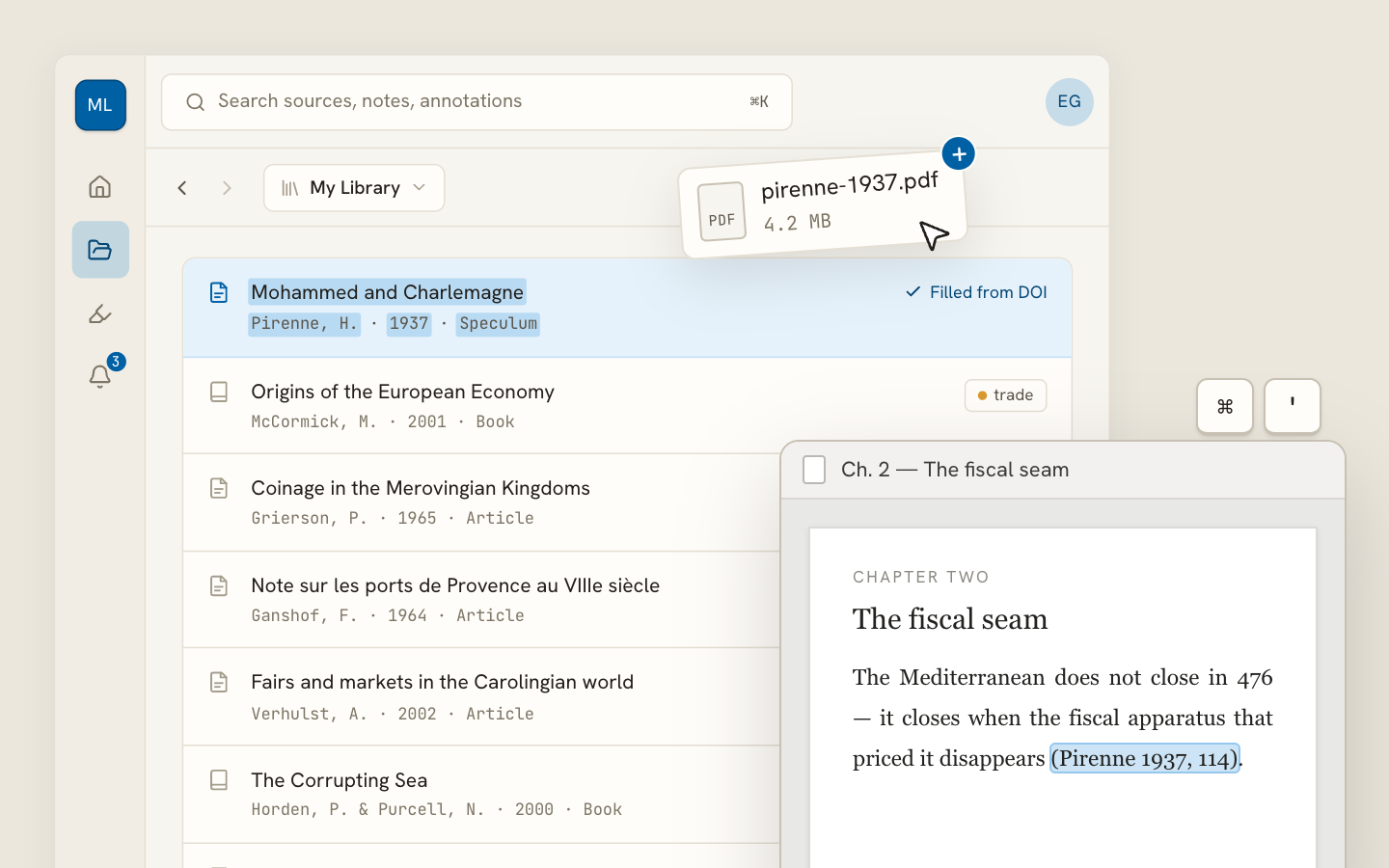
Archivero library view with a source list and an open PDF

Your weekly research workflow, in one email

One tested workflow, three links, no filler — every Tuesday.

Unsubscribe in one click. We never share your address.

Guides/Citations/APA Citation Style

How to Cite a Book Chapter in APA Format

The APA 7 reference and in-text format for a chapter in an edited book — with three worked examples, and why a chapter of an authored book gets no entry.

15 Nov 2026·13 min readAPA
Get the cheat sheet →

Key Takeaways

  • The format is Chapter Author. (Year). Title of chapter. In E. E. Editor & F. F. Editor (Eds.), Title of book (pp. xx–xx). Publisher. DOI
  • A chapter of a book written by one author or team gets no reference of its own. Reference the whole book and name the chapter in your in-text citation. See How to Cite a Book in APA Format for the whole-book entry.
  • The chapter title is not italicized; the book title is. Both are in sentence case.
  • Editors' names after "In" are not inverted — initials first, then the surname — and it is (Ed.) for one editor, (Eds.) for two or more.
  • The chapter's page range goes in parentheses after the book title, sharing that parenthesis with the edition and volume: (2nd ed., Vol. 2, pp. 67–75).
  • In the text, cite the chapter's author, never the book's editors.
  • Include a DOI when the chapter has one. A chapter read in a library database, or as a downloaded PDF, is cited exactly like print — no database name, no "Retrieved from".

On this page

1 of 24
Key TakeawaysDoes This Chapter Get Its Own Reference?The Format for a Chapter in an Edited BookThree Worked ExamplesA Chapter in a Print Edited BookA Chapter With a DOIA Republished or Reprinted ChapterThe In-Text Citation: Chapter Author, Never the EditorEditors: "(Ed.)", "(Eds.)" and the Name Order After "In"Edition, Volume and Page Numbers Go in One ParenthesisFive Chapters That Need Something ExtraThe Chapter Has No AuthorYou Are Citing Two Chapters From the Same BookThe Chapter Has No Page NumbersThe Chapter Is TranslatedIt Is a Conference Paper or an Article, Not a ChapterQuick-Reference TableCommon MistakesFrequently Asked QuestionsIs a book chapter italicized in APA?Where does the DOI go in a book chapter reference?Do I cite the chapter author or the book's editor?Can a citation generator format a book chapter correctly?What's Next
More on APA ↓17 of 38APA 7th edition cheat sheet →

In APA 7th edition, a chapter in an edited book puts the chapter's author first and the book's editors after the word "In": Chapter Author. (Year). Title of chapter. In Editor First Initial. Last Name (Ed.), Title of book (pp. xx–xx). Publisher. DOI — so, Armstrong, D. (2019). Malory and character. In M. G. Leitch & C. J. Rushton (Eds.), A new companion to Malory (pp. 144–163). D. S. Brewer. In the text it is simply (Armstrong, 2019).

Most of the confusion around chapter citations in APA style comes from one question the format itself doesn't answer: whether this chapter needs its own reference at all. Settle that first, then the rest is assembly.

Does This Chapter Get Its Own Reference?

A chapter in an edited book gets its own reference, because a different person wrote it. A chapter of an authored book does not: you reference the whole book and point to the chapter in your in-text citation.

That is APA's rule, stated in the manual's section 10.3 and on APA Style's own site, which puts it bluntly: do not create references for chapters of authored books. Look at the title page. If the book names editors and each chapter has its own author, you are citing a chapter. If one author or one team wrote the whole thing, you are citing a book.

What you are holdingWhat goes in the reference listWhat goes in the text
A chapter in an edited book (its own author)What goes in the reference listThe chapter, in the format belowWhat goes in the text(Armstrong, 2019)
A chapter of a book with one authorWhat goes in the reference listThe whole book — nothing for the chapterWhat goes in the text(Kahneman, 2011, Chapter 3)
A whole edited book you are citing cover to coverWhat goes in the reference listThe book, editors in the author positionWhat goes in the text(Leitch & Rushton, 2019)
An entry in a dictionary or encyclopediaWhat goes in the reference listThe entry, in the same format as a chapterWhat goes in the text(Zalta, 2020)

The in-text form for an authored book's chapter is worth seeing on its own:

(Kahneman, 2011, Chapter 3)

A chapter number, not a page range, when you mean the whole chapter. Nothing new enters the reference list — the whole-book entry is already there.

The Format for a Chapter in an Edited Book

Chapter Author. (Year). Title of chapter. In Editor First Initial. Last Name (Ed.), Title of book (pp. xx–xx). Publisher. DOI

Seven elements, in this order:

  1. Chapter author — inverted, as in every APA reference: surname, then initials.
  2. Year — the year the edited book was published, in parentheses.
  3. Chapter title — sentence case, not italicized. It is part of a larger work, and in APA only the larger work is italicized.
  4. "In" plus the editors — initials first, then surname, with an ampersand before the last one, then (Ed.) or (Eds.) and a comma.
  5. Book title — italicized, sentence case.
  6. Page range — in parentheses after the book title, with "pp." and an en dash.
  7. Publisher, then the DOI if the chapter has one.

Three Worked Examples

A Chapter in a Print Edited Book

The base case: a print book, named editors, no DOI.

Reference list:

Armstrong, D. (2019). Malory and character. In M. G. Leitch & C. J. Rushton (Eds.), A new companion to Malory (pp. 144–163). D. S. Brewer.

In-text citations:

Parenthetical:(Armstrong, 2019)

Narrative:Armstrong (2019) reads Malory's knights as…

What to notice: "Malory and character" is the chapter and stays in plain text. A new companion to Malory is the book and takes the italics. Leitch and Rushton are the editors, so their initials come first — M. G. Leitch, not Leitch, M. G. — because they follow "In". Nothing about the city of publication: that was a 6th edition requirement and the 7th edition dropped it.

A Chapter With a DOI

Add the DOI at the end, as a full https://doi.org/ link, with no period after it.

Reference list:

Valls-Ferrer, M., & Mora, J. C. (2014). L2 fluency development in formal instruction and study abroad: The role of initial fluency level and language contact. In C. Pérez-Vidal (Ed.), Language acquisition in study abroad and formal instructional contexts (pp. 111–136). John Benjamins. https://doi.org/10.1075/aals.13.07ch5

In-text citations:

Parenthetical:(Valls-Ferrer & Mora, 2014)

Narrative:Valls-Ferrer and Mora (2014) found that…

What to notice: one editor, so (Ed.), singular. The chapter has two authors, so the reference inverts both and joins them with an ampersand. And the reference says nothing about where you found it — this chapter cites the same way whether you read the hardback, the publisher's PDF, or a scan sent by a classmate. A chapter read through a library database never takes the database name, and APA 7 does not want "Retrieved from" either.

A Republished or Reprinted Chapter

Anthologies reprint older work constantly. Reference the version you actually read, then say where it came from in parentheses at the end.

Reference list:

Lippmann, W. (1966). Stereotypes. In B. Berelson & M. Janowitz (Eds.), Reader in public opinion and communication (2nd ed., pp. 67–75). Free Press; Collier-Macmillan. (Reprinted from Public opinion, pp. 59–70, by W. Lippmann, 1922, Harcourt Brace)

In-text citations:

Parenthetical:(Lippmann, 1922/1966, p. 70)

Narrative:Lippmann (1922/1966) described the stereotype as…

What to notice: the in-text citation carries both dates, original first, separated by a slash — which tells your reader that the idea is from 1922 even though your page numbers are from 1966. The reprint note names the original work, its pages, its author or editor, its year and its publisher, in that order, and it is not italicized apart from the original title. The two publishers separated by a semicolon are not a typo: that edition was co-published, and APA lists both.

The In-Text Citation: Chapter Author, Never the Editor

Cite the person who wrote the chapter you are using. The editors assembled the book; they did not write your chapter, and they do not appear in your in-text citation at all.

Parenthetical:(Armstrong, 2019)

Narrative:Armstrong (2019) argues that…

Quoting directly? Add the page the quotation is on, not the chapter's full range:

(Armstrong, 2019, p. 151)

That is the same rule as any other source — see APA Direct Quotes for quotations of 40 words or more, which become block quotes. For a reprinted chapter, use the double date shown above. The rest of the author-date mechanics, including what happens when two sources share an author and a year, is in APA In-Text Citations.

Editors: "(Ed.)", "(Eds.)" and the Name Order After "In"

Two small things go wrong here more than anything else on the page.

The number. It is (Ed.) when one person edited the book and (Eds.) when two or more did. A book with three editors and "(Ed.)" after their names is the single most visible error in a chapter reference.

The order. Names after "In" are not inverted. Compare:

Author position (inverted):Armstrong, D.

After "In" (not inverted):In M. G. Leitch & C. J. Rushton (Eds.),

Use an ampersand before the last editor, a comma between the others, and a comma after the closing parenthesis of (Eds.). With 21 or more editors — rare, but reference works manage it — list the first 19, an ellipsis, then the final one, exactly as you would for authors. APA Citation With Multiple Authors has the full rule and the et al. thresholds that go with it.

Edition, Volume and Page Numbers Go in One Parenthesis

One parenthesis holds all three, in this order, comma-separated: edition, volume, pages.

(2nd ed., Vol. 2, pp. 67–75)

A few details that catch people out:

  • "pp." belongs to book chapters. A chapter's page range takes "pp."; a journal article's does not. If you are putting "pp." in front of a page range in a journal article reference, something has gone wrong.
  • Use an en dash, not a hyphen: pp. 144–163.
  • One page only? "p. 151", singular.
  • No page numbers at all? Leave the whole parenthesis out. Nothing replaces it.

Five Chapters That Need Something Extra

The Chapter Has No Author

If the chapter carries no author of its own, it isn't really a separate work — it is part of the editors' book. Reference the book with the editors in the author position:

Leitch, M. G., & Rushton, C. J. (Eds.). (2019). A new companion to Malory. D. S. Brewer.

Then cite the chapter in the text by name or number if you need to point at it. An untitled or unattributed section is not a chapter for citation purposes. For genuinely anonymous works, see APA Citation With No Author.

You Are Citing Two Chapters From the Same Book

Two chapters, two references. The repeated book title, editors and publisher are correct, not redundant — each reference stands for a different piece of writing.

Armstrong, D. (2019). Malory and character. In M. G. Leitch & C. J. Rushton (Eds.), A new companion to Malory (pp. 144–163). D. S. Brewer.

Radulescu, R. (2019). Malory and the Grail. In M. G. Leitch & C. J. Rushton (Eds.), A new companion to Malory (pp. 164–180). D. S. Brewer.

If the same author wrote two chapters in the same book, the two references share an author and a year, so they take letter suffixes — 2019a and 2019b — ordered alphabetically by chapter title, and your in-text citations use the letters too.

The Chapter Has No Page Numbers

Plenty of e-book and web chapters have none. Omit the page parenthesis and reference the rest as normal:

Dijkerman, C., & Steenbergen, B. (2017). Motor control and action. In R. Kessels, P. Eling, R. Ponds, J. Spikman, & M. van Zandvoort (Eds.), Clinical neuropsychology. Boom.

To quote from it, locate the passage some other way in the text — a heading, a paragraph count, or the chapter:

(Dijkerman & Steenbergen, 2017, para. 4)

One thing APA 7 does not want here: the platform, the device or a format tag. No "[E-book]", no Kindle, no app name. An e-book chapter is cited like a print one.

The Chapter Is Translated

Name the translator after the book title, and give the original publication year at the end:

Benjamin, W. (1968). The work of art in the age of mechanical reproduction. In H. Arendt (Ed.), Illuminations (H. Zohn, Trans., pp. 217–251). Schocken Books. (Original work published 1935)

In the text, both dates again: (Benjamin, 1935/1968).

It Is a Conference Paper or an Article, Not a Chapter

A quick test when you cannot tell what you are holding. Does the container have editors and a publisher? It is a book, and your piece is a chapter. Does it have a volume, an issue and page numbers in a periodical? It is a journal article, whatever the publisher calls it. Proceedings are the awkward middle: a paper published in an edited proceedings volume is cited as a chapter, while one you watched being delivered is cited as a presentation — APA Conference Papers splits the cases.

Quick-Reference Table

ScenarioReference formatIn-text
Chapter in a print edited bookReference formatLast, F. M. (Year). Chapter title. In F. M. Last (Ed.), Book title (pp. xx–xx). Publisher.In-text(Last, Year)
Chapter with a DOIReference formatLast, F. M. (Year). Chapter title. In F. M. Last (Ed.), Book title (pp. xx–xx). Publisher. DOIIn-text(Last, Year)
Chapter with no page numbersReference formatLast, F. M. (Year). Chapter title. In F. M. Last (Ed.), Book title. Publisher.In-text(Last, Year, para. 4)
Republished chapterReference formatLast, F. M. (Year). Chapter title. In F. M. Last (Ed.), Book title (pp. xx–xx). Publisher. (Reprinted from Original title, pp. xx–xx, by F. M. Last, Year, Publisher)In-text(Last, Year/Year, p. xx)
Chapter of an authored bookReference formatLast, F. M. (Year). Book title. Publisher. — no chapter entryIn-text(Last, Year, Chapter 3)
Chapter with no authorReference formatLast, F. M. (Ed.). (Year). Book title. Publisher.In-text(Last, Year)
Two chapters from one bookReference formatTwo full references, lettered if the author and year matchIn-text(Last, Year-a)

Common Mistakes

These are the errors that turn up most often in chapter references:

  1. Italicizing the chapter title. The book title gets the italics; the chapter stays in plain text. It is the most common chapter error there is.
  2. Inverting the editors' names after "In". It is "In M. G. Leitch", not "In Leitch, M. G.". Inverted order is for the author position only.
  3. Writing "(Ed.)" for a book with several editors. One editor, (Ed.); two or more, (Eds.).
  4. Writing a chapter reference for a chapter of an authored book. Reference the whole book instead and name the chapter in the text.
  5. Citing the editor in the text. Your in-text citation names whoever wrote the chapter, not whoever assembled the book.
  6. Adding the database name or "Retrieved from". A chapter read through EBSCO or ProQuest is cited exactly like the print version.
  7. Leaving out the page range. If the chapter has page numbers, they belong in the reference — and a reader looking for an eight-page argument in a 400-page book will notice they are missing.

Frequently Asked Questions

Is a book chapter italicized in APA?

No. The chapter title is set in plain text and the book title is italicized, because APA italicizes the larger work that contains your source. So A new companion to Malory is italicized, and "Malory and character" inside it is not. The same logic puts a journal's name in italics while the article title stays plain.

Where does the DOI go in a book chapter reference?

At the very end, after the publisher, as a full link: https://doi.org/10.1075/aals.13.07ch5. No label, no "DOI:", no period after it. Include it whenever the chapter has one, print or electronic. If the chapter has no DOI, the reference just ends with the publisher — and if you found the chapter in a library database, you add nothing at all.

Do I cite the chapter author or the book's editor?

The chapter author, in both the reference's author position and the in-text citation. The editors appear in the middle of the reference, after the word "In", and nowhere else. You cite the editors in the author position only when you are citing the whole edited book rather than a chapter of it, or when the chapter has no author of its own.

Can a citation generator format a book chapter correctly?

Usually, as long as what you feed it is right. Chapter references break on inputs, not on formatting: the chapter's author entered as the book's author, an empty editor field, or a missing page range. Those three produce a reference that looks perfectly APA and is wrong. Check the author position, the editors and the page range on every generated chapter entry — including the ones Archivero produces from your library.

What's Next

  • How to Cite a Book in APA Format — the whole-book entry, including edited books, e-books and editions
  • APA Reference List — how the entry you just built is formatted on the page and ordered among the others
  • APA In-Text Citations — the author-date system behind every example above

Chapter references are mostly bookkeeping: the editors, the page range and the publisher, copied correctly, every time. Archivero keeps a chapter and its book together in one library, so the editors and page range are entered once and the APA entry comes out of them.

APA 7th edition cheat sheet →All APA guides →
APA 7th edition cheat sheetPDF · 3 pages · 166 KBDownload →
← PreviousHow to Cite a Book in APA FormatNext →How to Cite a Dictionary or Encyclopedia in APA Format

Publication Manual of the American Psychological Association, 7th edition (2020), section 10.3; APA Style, Chapter in an edited book/ebook references; Purdue OWL, Reference List: Books

More on APA

38 guides, in the order the section reads them. This is 17 of 38.

APA overview →
  1. 1General Format
  2. 2Title Page
  3. 3Heading Levels
  4. 4Abstract
  5. 5Running Head
  6. 6Footnotes
  7. 7Example Paper
  8. 8In-Text Citations
  9. 9Direct Quotes
  10. 10Multiple Authors
  11. 11Paraphrasing
  12. 12No Author
  13. 13Secondary Sources
  14. 14Narrative vs. Parenthetical
  15. 15Reference List
  16. 16Books
  17. 17Book ChaptersYou are here
  18. 18Dictionaries & Encyclopedias
  19. 19Journal Articles
  20. 20Websites
  21. 21Videos
  22. 22Social Media
  23. 23Government Reports
  24. 24Conference Papers
  25. 25Dissertations & Theses
  26. 26Personal Communications
  27. 27AI-Generated Content
  28. 28Annotated Bibliography
  29. 296th vs. 7th Edition
  30. 30Common Mistakes
  31. 31How to Cite a Chart or Graph in APA Format
  32. 32How to Cite a Drawing or Illustration in APA Format
  33. 33How to Format Figures in APA
  34. 34How to Cite an Image in APA Format
  35. 35How to Cite a Map in APA Format
  36. 36How to Cite a Painting in APA Format
  37. 37How to Cite a Photograph in APA Format
  38. 38How to Format Tables in APA
APA overview →

Your sources, PDFs and citations in one library

  • Import a Zotero, Mendeley or EndNote library — or a folder of PDFs
  • Highlight and annotate without leaving the source
  • Cite in any CSL style as you write, with one shared library for your lab
Request early accessSee the product →
Archivero library view with a source list and an open PDF

Your weekly research workflow, in one email

One tested workflow, three links, no filler — every Tuesday.

Unsubscribe in one click. We never share your address.